 Maksym Kovaliov
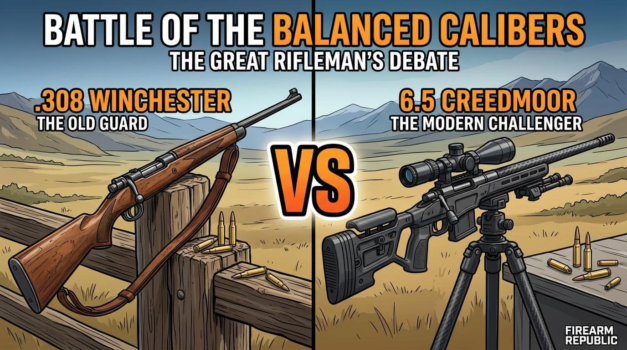
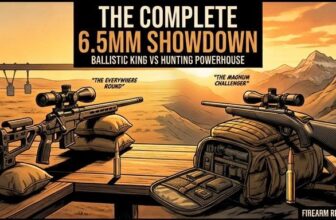
No caliber debate generates more heat with less resolution than 6.5 Creedmoor vs. .308 Winchester. The 6.5 CM camp cites wind drift, trajectory, and recoil. The .308 camp cites terminal performance, availability, and 60 years of proven results. Both sides are right about what their cartridge does well. Both sides overstate their cartridge’s advantages and minimize genuine limitations. This guide cuts through the noise with specific numbers, honest trade-offs, and direct answers by use case – hunting deer, hunting elk, long-range target shooting, and competition. The answer is not the same for every hunter and every scenario, and this guide will tell you exactly which cartridge wins for your specific situation.
The Cartridges: What They Actually Are
6.5 Creedmoor was introduced by Hornady in 2007, developed specifically for long-range target shooting. The design goal was a cartridge that fit in a short-action magazine, stabilized high-BC 6.5mm bullets at practical velocities, and generated manageable recoil for extended competition use. It achieved all three. A standard 6.5 CM load pushes a 140gr bullet at 2,710 fps from a 24″ barrel, generating 2,283 ft-lbs of muzzle energy. The 140gr Berger Hybrid and Hornady ELD-M carry G1 BCs of .617–.697 – the highest of any commonly available hunting and match bullet in this energy class.
.308 Winchester was introduced in 1952 as a commercial version of the military 7.62×51 NATO cartridge. It was designed for reliability in semi-automatic military rifles, and it succeeded – the .308 has served in military sniper rifles, civilian hunting rifles, and target shooting competitions for over 70 years. A standard .308 hunting load pushes a 168gr bullet at 2,650 fps from a 24″ barrel, generating 2,620 ft-lbs of muzzle energy. The Sierra 175gr MatchKing carries a G1 BC of .505; most hunting bullets (.308″) top out around .470–.530 G1 BC.
Both cartridges fit in short-action rifles. Both are widely available. Both have been used to take every species of North American game. The differences that matter are in the numbers.
The Numbers: Head-to-Head Ballistics
Trajectory Comparison (200-yard zero)
| Distance | 6.5 CM 140gr ELD-M | .308 Win 168gr SMK | Difference |
|---|---|---|---|
| 100 yds | +1.8″ | +1.9″ | Negligible |
| 200 yds | 0 (zero) | 0 (zero) | — |
| 300 yds | –7.0″ | –9.5″ | 2.5″ flatter |
| 400 yds | –20.5″ | –28.0″ | 7.5″ flatter |
| 500 yds | –41.5″ | –57.0″ | 15.5″ flatter |
| 600 yds | –71.5″ | –98.0″ | 26.5″ flatter |
| 800 yds | –164″ | –228″ | 64″ flatter |
| 1,000 yds | –330″ | –465″ | 135″ flatter |
Wind Drift Comparison (10 mph full-value crosswind, 200-yard zero)
| Distance | 6.5 CM 140gr ELD-M | .308 Win 168gr SMK | Difference |
|---|---|---|---|
| 300 yds | 3.5″ | 4.6″ | 1.1″ less |
| 400 yds | 6.2″ | 8.2″ | 2.0″ less |
| 500 yds | 9.8″ | 13.1″ | 3.3″ less |
| 600 yds | 14.2″ | 19.2″ | 5.0″ less |
| 800 yds | 25.4″ | 34.8″ | 9.4″ less |
| 1,000 yds | 40.1″ | 55.8″ | 15.7″ less |
Energy Retention Comparison
| Distance | 6.5 CM 140gr ELD-M | .308 Win 168gr SMK | .308 Win 180gr Part. |
|---|---|---|---|
| Muzzle | 2,283 ft-lbs | 2,620 ft-lbs | 2,743 ft-lbs |
| 200 yds | 1,822 ft-lbs | 2,024 ft-lbs | 2,143 ft-lbs |
| 300 yds | 1,618 ft-lbs | 1,757 ft-lbs | 1,862 ft-lbs |
| 400 yds | 1,430 ft-lbs | 1,514 ft-lbs | 1,603 ft-lbs |
| 600 yds | 1,100 ft-lbs | 1,102 ft-lbs | 1,162 ft-lbs |
| 800 yds | 830 ft-lbs | 784 ft-lbs | 828 ft-lbs |
| 1,000 yds | 611 ft-lbs | 541 ft-lbs | 571 ft-lbs |
The energy table reveals something important: the .308 starts with more energy but the 6.5 CM catches and passes it by 600 yards. Past 600 yards, the 6.5 CM retains more energy than the .308 – the high-BC bullet loses velocity more slowly. At 1,000 yards, the 6.5 CM has 13% more retained energy than the .308 168gr load despite starting with 13% less energy at the muzzle.
Recoil Comparison (8-lb rifle)
| Cartridge | Load | Felt Recoil |
|---|---|---|
| 6.5 Creedmoor | 140gr at 2,710 fps | ~12–13 ft-lbs |
| .308 Winchester | 168gr at 2,650 fps | ~16–17 ft-lbs |
| .308 Winchester | 180gr at 2,620 fps | ~17–18 ft-lbs |
The .308 generates approximately 30–40% more recoil than 6.5 CM in comparable rifle weights. That’s the difference between shooting a .243 Winchester and a .308 – noticeable in the field, meaningful over a 50-round practice session.
Hunting Deer: 6.5 CM Wins at Distance, .308 Wins in Brush
Inside 200 yards on deer-sized game, both cartridges are more than adequate. A broadside whitetail hit in the vitals at 100 yards doesn’t register the difference between 1,800 ft-lbs and 2,300 ft-lbs – it goes down either way. The practical differences emerge as distance increases and when shot angle deviates from the broadside ideal.
Where 6.5 CM wins on deer: Past 250 yards in open country, the 6.5 CM’s trajectory and wind advantage make clean shots more likely for two reasons. First, the flatter trajectory means less holdover estimation error at 300–400 yards – a 7.5″ difference in drop at 400 yards is the difference between a clean hit and a gutshot if the hunter misjudges range by 25 yards. Second, the 6.5 CM’s lower recoil enables better follow-through and faster second shots without developing the anticipatory flinch that commonly develops with sustained .308 shooting.
Modern 6.5 CM hunting loads – Hornady Precision Hunter 143gr ELD-X, Federal Terminal Ascent 130gr, Nosler AccuBond 129gr – expand reliably from point-blank to 500+ yards. The ELD-X’s flexible polymer tip initiates expansion at the wide range of impact velocities encountered across hunting distances. For open-country deer hunters who occasionally stretch shots to 300–400 yards, the 6.5 CM is the better caliber.
Where .308 wins on deer: In dense eastern hardwoods where shots average 80–100 yards through cover, the .308’s heavier .30-caliber bullet holds its line through light brush deflection better than the lighter 6.5mm. The larger frontal diameter creates a bigger wound channel at close range. A .308 with a 150gr Winchester Power-Point or Remington Core-Lokt at 75 yards is the classic eastern whitetail combination, and it works. For hunters who primarily take 50–150-yard shots in timber, the .308’s close-range energy advantage over the 6.5 CM is real.
Verdict for deer: 6.5 CM for open country and shots past 200 yards. .308 for dense timber inside 150 yards where brush deflection and close-range energy matter more than trajectory. A hunter who primarily hunts eastern timber and occasionally takes one western deer hunt per year is better served by the .308’s versatility. A hunter who primarily hunts open western terrain is better served by the 6.5 CM’s trajectory and wind performance.
Hunting Elk: .308 Wins at Typical Distances, 6.5 CM Viable with Conditions
Elk hunting is where the caliber debate gets genuinely contentious, and for understandable reasons – the stakes are high, the animals are large and tough, and the shot opportunities are often non-ideal.
The .308’s case on elk: At typical elk hunting distances (100–250 yards in most timber and mountain terrain), the .308’s energy advantage over the 6.5 CM is meaningful. A .308 with 180gr Nosler Partition at 150 yards delivers approximately 2,350 ft-lbs of energy with a .30-caliber bullet driving into a large bone structure. The combination of energy, bullet diameter, and sectional density produces reliable penetration through elk shoulder on quartering shots – the scenario that distinguishes adequate elk cartridges from marginal ones.
The .308’s terminal performance on elk with premium bullets is proven across 60 years of hunting. The Nosler Partition’s dual-core design and the Federal Trophy Bonded Bear Claw’s bonded construction both drive through heavy bone reliably at .308 velocities. There is no question that a .308 is adequate for elk; the only question is whether the 6.5 CM is as well.
The 6.5 CM’s case on elk: The 6.5 CM is adequate for elk inside 300 yards with bonded or monolithic bullets – Federal Terminal Ascent 130gr or Barnes LRX 127gr specifically. Thousands of elk are taken cleanly with 6.5 CM every season. The cartridge’s retained energy at 200 yards (1,822 ft-lbs) is above the 1,500 ft-lbs commonly cited as the elk minimum. The high-BC bullets retain more energy at distance than the .308, meaning at 300+ yards the 6.5 CM is energetically comparable to the .308 at 200 yards.
The qualification: bullet selection is not optional on elk with 6.5 CM. The standard ELD-X hunting bullet is adequate on broadside shots into the vitals at moderate ranges; it’s marginal on quartering shots through heavy shoulder bone at 300 yards. The Terminal Ascent and LRX are built for exactly that scenario. The .308 with a 180gr Partition provides more margin on difficult shots regardless of bullet brand.
Verdict for elk: The .308 provides more margin on difficult shot angles at typical elk hunting distances – this is the honest assessment. The 6.5 CM works on elk and many hunters use it successfully every season; it’s a more conditional recommendation (right bullets, appropriate shots) than the .308, which works on elk with a wider range of bullet options and shot angles. For hunters who want maximum elk confidence, the .308 or a step up to 7mm PRC is the better choice. For hunters whose rifle must cover deer at 400 yards and elk at 250 yards from the same platform, the 6.5 CM makes the compromise. See our full Elk Hunting Caliber Comparison for the detailed breakdown including 7mm PRC.
Long-Range Target Shooting: 6.5 CM Wins Clearly
This is not a close category. The 6.5 Creedmoor dominates long-range target shooting from 500 to 1,000 yards for reasons that are clear in the ballistic tables above.
At 1,000 yards in a 10 mph crosswind, the 6.5 CM drifts 40.1 inches versus 55.8 inches for the .308 – a 15.7-inch difference. On a 24-inch wide steel target at 1,000 yards, that’s the difference between a hit requiring accurate wind reading and a miss that requires perfect wind reading. The 6.5 CM’s flatter trajectory means less elevation dial, which means fewer opportunities for turret error. The lower recoil means faster second shots and better technique development over long sessions.
The 6.5 CM’s dominance in long-range competition is not marketing – it’s reflected in match results. At PRS, NRL, and F-Class competitions, the .308 has been progressively displaced by 6.5 CM and 6mm variants over the last decade as shooters discovered that the ballistic advantages translate to measurable score improvements at 600+ yards. A shooter competing with a .308 at 1,000 yards is at a real disadvantage versus a 6.5 CM shooter of comparable skill.
The one area where the .308 maintains relevance in long-range shooting is F-Class Open division and some military simulation competitions where .308/7.62 NATO is required by the rules. In unrestricted competition, the 6.5 CM is the better cartridge.
See our Long-Range Shooting Guide for the full 500–1,000-yard framework.
Verdict: 6.5 CM wins clearly and without qualification.
PRS and Precision Rifle Competition: 6.5 CM Wins
The 6.5 Creedmoor is the dominant cartridge in Precision Rifle Series competition for the same reasons it dominates long-range target shooting. PRS stages require accurate shots at distances from 100 to 1,000+ yards from time-limited field positions. The combination of lower recoil (faster follow-up shots between multiple targets), flatter trajectory (less holdover management on quick transitions to unknown distances), and better wind performance (fewer misses attributed to wind reading errors) produces consistently better scores than the .308 for comparable shooters.
The 6mm Creedmoor has further displaced the 6.5 CM at the top levels of PRS competition, offering even better BC and lower recoil at the cost of barrel life (1,500–2,000 rounds vs. 2,500–3,500 for 6.5 CM). For entry-level and club-level PRS competition, the 6.5 CM is the right starting cartridge. For hunters who want to do occasional PRS as training, 6.5 CM in a hunting rifle is entirely competitive at club-level matches. See our PRS Competition Guide for the full competition context.
Verdict: 6.5 CM wins.
Ammunition Availability and Cost
This category matters for practical hunters and shooters who buy ammunition rather than reload.
Availability: Both cartridges are widely available at major retailers (Cabela’s, Bass Pro, Sportsman’s Warehouse, Academy) and online. The .308 has a slight edge in rural and regional availability – a small-town hardware store in Wyoming is more likely to have .308 on the shelf than 6.5 CM, though this gap has narrowed significantly since 2019. Both are available at Walmart in most states. For hunters who want the deepest available load selection including budget options, the .308’s larger ammunition market provides more choices.
Cost: Quality hunting ammunition in both calibers runs $2.00–$3.50 per round. Budget hunting loads (Hornady American Whitetail, Winchester Power-Point) are slightly cheaper in .308 ($28–$32/20) than 6.5 CM ($30–$35/20) due to the .308’s larger production volume. Match ammunition costs are comparable: Hornady Match 140gr ELD-M (6.5 CM) and Federal Gold Medal Match 168gr SMK (.308) both run approximately $1.60–$2.00 per round in 20-round boxes.
Reloading: Both cartridges are extremely well-supported for reloaders. Brass availability, bullet selection, and published load data are equally extensive. 6.5 CM brass is available from Hornady, Lapua, Nosler, and Peterson. .308 brass is available from the same manufacturers plus military surplus. The .308’s slightly larger case volume makes it somewhat more tolerant of powder charge variation, which benefits reloaders who are still developing technique.
Verdict: .308 edge on rural availability; essentially tied on cost and reloading support.
Rifle Selection: Effectively a Tie
Both cartridges are available in the same production rifles at the same price points. The Tikka T3x Lite, Bergara B-14 Hunter, Ruger American Gen II, Savage 110 Hunter, Browning X-Bolt, Winchester Model 70, and virtually every other production hunting rifle is available in both 6.5 CM and .308 Winchester. The AR-15 platform supports neither natively; the AR-10 platform supports both. There is no meaningful rifle selection advantage to either cartridge.
The one distinction: the 6.5 CM’s rising market dominance means newer production models often receive 6.5 CM chambering before .308 in their initial release schedule, and some ultralight/premium configurations are 6.5 CM only. The .308’s larger installed base means more used rifles are available in .308 than 6.5 CM. Neither distinction materially affects a buyer choosing between new production rifles.
Verdict: Tie.
Barrel Life: .308 Wins
The .308 Winchester’s slower powder burn and lower operating pressure result in longer barrel life than the 6.5 Creedmoor’s higher-velocity design. A quality .308 barrel in a bolt-action typically lasts 5,000–8,000 rounds before accuracy degradation becomes noticeable. A 6.5 CM barrel typically lasts 2,500–3,500 rounds.
For hunters who fire 50–100 rounds per year (range check plus hunting season), barrel life is irrelevant to either cartridge – neither barrel will wear out in a lifetime of normal hunting use. For precision shooters or competitive shooters who fire 500–1,000+ rounds annually, the .308’s barrel life advantage translates to $300–$500 in barrel replacement savings per shooting cycle. For high-volume PRS competitors who may fire 3,000+ rounds per year, barrel replacement is a real annual cost consideration.
Verdict: .308 Winchester wins for high-volume shooters; irrelevant for hunters.
Complete Comparison Table
| Category | 6.5 Creedmoor | .308 Winchester | Winner |
|---|---|---|---|
| Muzzle energy (140gr/168gr) | 2,283 ft-lbs | 2,620 ft-lbs | .308 Win |
| Energy @ 600 yds | 1,100 ft-lbs | 1,102 ft-lbs | Tie |
| Energy @ 1,000 yds | 611 ft-lbs | 541 ft-lbs | 6.5 CM |
| Wind drift @ 400 yds (10 mph) | 6.2″ | 8.2″ | 6.5 CM |
| Drop @ 400 yds (200-yd zero) | 20.5″ | 28.0″ | 6.5 CM |
| Recoil (8-lb rifle) | 12–13 ft-lbs | 16–17 ft-lbs | 6.5 CM |
| Deer hunting (inside 200 yds) | Excellent | Excellent | Tie |
| Deer hunting (200–400 yds) | Better trajectory | More wind drift | 6.5 CM |
| Elk hunting (100–250 yds) | Adequate | More margin | .308 Win |
| Elk hunting (300+ yds) | Comparable energy | More wind drift | 6.5 CM |
| Long-range target (600–1,000 yds) | Dominant | Competitive | 6.5 CM |
| PRS competition | Dominant | Adequate | 6.5 CM |
| Rural ammo availability | Good | Better | .308 Win |
| Barrel life | 2,500–3,500 rds | 5,000–8,000 rds | .308 Win |
| Bullet selection (hunting) | Excellent | Excellent | Tie |
| Reloading support | Excellent | Excellent | Tie |
Scenario-Based Recommendations
Buy 6.5 Creedmoor if:
You hunt open country where shots regularly extend past 200 yards and wind matters. You’re buying your first precision rifle and want the best platform for learning long-range shooting. You want one cartridge that covers whitetail at 350 yards and elk at 250 yards (with bonded bullets) from the same rifle. You shoot 50+ rounds per year and prefer less recoil for better technique development and more enjoyable practice sessions. You compete in PRS or want to do occasional precision competition. Recoil is a consideration – whether for your own comfort or for youth and recoil-sensitive hunters.
Buy .308 Winchester if:
You hunt dense eastern timber where shots are inside 150 yards and brush deflection is a real concern. You want the single cartridge with the widest availability in the most remote areas. You prioritize elk hunting above all else and want maximum confidence on difficult quartering shots. You shoot moderate volumes (under 200 rounds per year) and barrel life is a practical concern. You already own a quality .308 and shoot it well – don’t buy a 6.5 CM to solve a problem that doesn’t exist. You want the most proven cartridge across the widest range of North American game without any conditions attached.
The honest bottom line:
For most hunters buying a new rifle today, 6.5 Creedmoor is the better choice. The trajectory, wind, and recoil advantages are real at the distances modern hunters shoot, the ammunition selection for hunting is outstanding, and the cartridge handles everything from pronghorn to elk with appropriate bullet selection. The .308’s advantages – close-range energy margin, rural availability, and barrel life – matter for specific hunters in specific situations, but they’re not the primary considerations for the majority of American hunters.
For hunters who already own a .308 and shoot it well: don’t buy a 6.5 CM. The performance difference doesn’t justify the cost and the additional ammunition type to manage. The .308 is an excellent cartridge that kills deer and elk reliably. Use it.
Frequently Asked Questions
Is 6.5 Creedmoor really better than .308 Winchester?
At distance and in wind, yes – the numbers are clear. Past 300 yards, the 6.5 CM’s higher-BC bullets drift less and drop less than .308, and past 600 yards the 6.5 CM retains more energy. Inside 200 yards, the .308 starts with more energy and delivers a larger-diameter, heavier bullet with more close-range margin on large game. “Better” depends on which use case you’re optimizing for. For most modern hunting scenarios (open country, shots to 300+ yards) and for target shooting past 500 yards, the 6.5 CM is the better technical choice. For close-range timber hunting and for maximum elk margin at typical hunting distances, the .308 provides more confidence.
Can I hunt elk with 6.5 Creedmoor?
Yes, with qualifications. Use bonded or monolithic bullets (Federal Terminal Ascent 130gr or Barnes LRX 127gr), keep shots inside 300 yards until you’ve confirmed field accuracy at that distance, and prioritize broadside or slight quartering-away shots where bullet penetration depth requirements are lower. Thousands of elk are taken cleanly with 6.5 CM every season. The .308 provides more margin on difficult quartering shots through heavy bone, but the 6.5 CM is a legitimate elk cartridge, not a marginal one. See our Elk Hunting Caliber Comparison for the full analysis.
Which is better for long-range shooting – 6.5 CM or .308?
6.5 CM, without qualification, for target shooting past 500 yards. The higher-BC bullets drift 15+ inches less in a 10 mph crosswind at 1,000 yards and drop 135 inches less than the .308. In PRS and NRL competition, the 6.5 CM has progressively displaced the .308 as shooters have confirmed that the ballistic advantages translate to real score improvements. The .308 is entirely capable at 600 yards in trained hands; at 800–1,000 yards, it’s fighting physics that the 6.5 CM handles more easily. See our Long-Range Shooting Guide for the full 500–1,000-yard framework.
What’s the recoil difference between 6.5 CM and .308?
Approximately 30–40% more recoil in the .308. In an 8-lb rifle, 6.5 CM generates approximately 12–13 ft-lbs of felt recoil; .308 generates 16–17 ft-lbs. That’s the difference between a .243 Winchester and a .308 in perceived terms – noticeable side by side, meaningful over a 50-round practice session, and a real factor for recoil-sensitive shooters. For most adult hunters, both are manageable. For youth hunters, recoil-sensitive shooters, or anyone who wants to practice extensively without fatigue, the 6.5 CM’s lower recoil has practical value. See our Youth Hunting Rifles Guide for youth-specific context.
Is .308 ammo more available than 6.5 Creedmoor?
In major retailers and online, both cartridges are equally available in a wide variety of loads. The .308 maintains a slight advantage in rural sporting goods stores and small-town hardware shops where shelf space is limited – it’s more likely to have multiple .308 options than 6.5 CM options in very remote areas. This gap has narrowed significantly since 2019 as 6.5 CM adoption has grown. For hunters who stock ammunition before a hunt rather than buying at the destination, this distinction is largely irrelevant.
Should I switch from .308 to 6.5 Creedmoor?
Only if you have a specific use case that the 6.5 CM serves better than your current .308 is serving. If you regularly shoot past 400 yards and wind is a consistent factor, the 6.5 CM’s wind advantage is real and worth switching for. If you compete in PRS or precision target shooting, the 6.5 CM’s dominance in that discipline makes it the right platform. If you’re a deer hunter who takes 80-yard shots in timber and your .308 kills deer cleanly every season, there is no problem to solve. Switching calibers has real costs (new rifle or rebarrel, new ammunition stock, re-learning your zero and DOPE) that are only justified by a genuine performance gap in your actual use case.