 Maksym Kovaliov
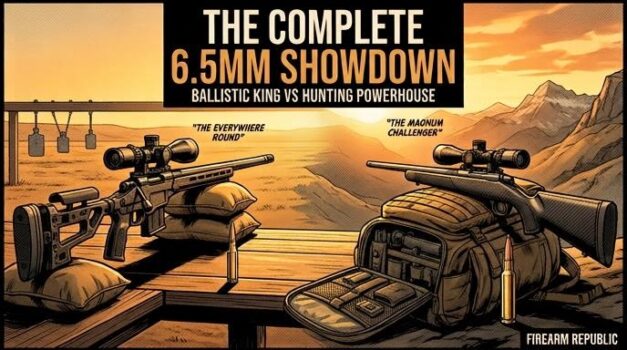


The 6.5 Creedmoor and 6.5 PRC fire the same bullets. Both use 6.5mm (.264″) projectiles, share nearly identical bullet selection, and produce overlapping performance at moderate distances. For a hunter taking 150-yard whitetail shots in eastern hardwoods, the difference between these two cartridges is genuinely academic. But the further out you shoot and the larger the game you pursue, the more the PRC’s performance advantage over the Creedmoor compounds – and the more the Creedmoor’s barrel life, ammunition cost, and rifle selection advantages matter in return. This guide gives you the specific numbers and the specific use cases where each cartridge wins, and tells you directly which one to buy.
What Separates These Two Cartridges
Both cartridges were developed by Hornady and use 6.5mm (.264″) projectiles. That’s where the similarity ends in terms of performance.
6.5 Creedmoor fits in a standard short-action magazine (COAL 2.825″). The case holds approximately 52.5 grains of water. Standard loads push a 143gr ELD-X at 2,700 fps from a 24″ barrel, generating 2,315 ft-lbs of muzzle energy.
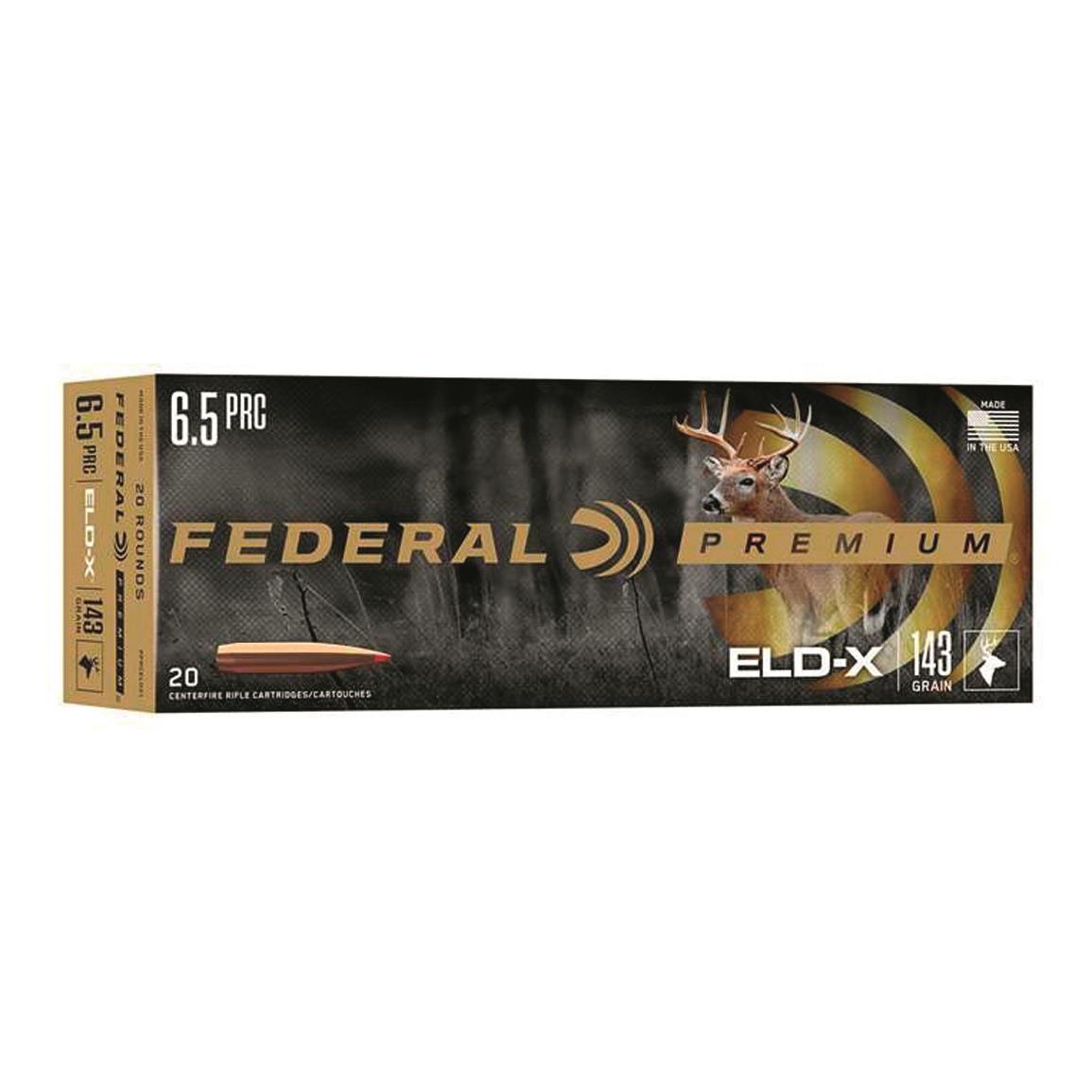
6.5 PRC (Precision Rifle Cartridge) was introduced by Hornady in 2018 specifically to push 6.5mm bullets faster than the Creedmoor from a short-action package. The case holds approximately 67.5 grains of water – roughly 29% more capacity than the Creedmoor. Standard loads push a 143gr ELD-X at 2,960 fps from a 24″ barrel, generating 2,782 ft-lbs of muzzle energy. That’s 260 fps and 467 ft-lbs more than the Creedmoor from the same bullet.

The 6.5 PRC uses a standard short-action (Remington 700 short-action compatible) with a longer 2.955″ COAL – it fits in the same action family as the Creedmoor but requires a PRC-specific magazine and a barrel chambered for the larger case. A factory 6.5 CM rifle cannot be converted to 6.5 PRC with a barrel swap alone; the magazine and potentially the bolt face require attention.
The velocity advantage of the PRC is real and consistent across bullet weights:
- 143gr ELD-X: 2,700 fps (CM) vs. 2,960 fps (PRC) – 260 fps difference
- 147gr ELD-M: 2,695 fps (CM) vs. 2,910 fps (PRC) – 215 fps difference
- 130gr Federal Terminal Ascent: 2,875 fps (CM) vs. 3,050 fps (PRC) – 175 fps difference
That velocity advantage translates directly to less drop, less wind drift, and more retained energy at distance. The question is whether the advantage is large enough to justify the PRC’s trade-offs.
The Numbers: Head-to-Head Ballistics
Trajectory Comparison (200-yard zero, 143gr ELD-X)
| Distance | 6.5 CM 143gr ELD-X | 6.5 PRC 143gr ELD-X | Difference |
|---|---|---|---|
| 200 yds | 0 (zero) | 0 (zero) | — |
| 300 yds | –7.2″ | –6.0″ | 1.2″ flatter |
| 400 yds | –21.0″ | –17.5″ | 3.5″ flatter |
| 500 yds | –42.8″ | –35.4″ | 7.4″ flatter |
| 600 yds | –74.2″ | –61.0″ | 13.2″ flatter |
| 800 yds | –172″ | –140″ | 32″ flatter |
| 1,000 yds | –348″ | –279″ | 69″ flatter |
Wind Drift Comparison (10 mph full-value crosswind, 143gr ELD-X)
| Distance | 6.5 CM | 6.5 PRC | Difference |
|---|---|---|---|
| 300 yds | 3.5″ | 2.9″ | 0.6″ |
| 400 yds | 6.2″ | 5.2″ | 1.0″ |
| 500 yds | 9.8″ | 8.2″ | 1.6″ |
| 600 yds | 14.2″ | 11.8″ | 2.4″ |
| 800 yds | 25.4″ | 21.0″ | 4.4″ |
| 1,000 yds | 40.1″ | 33.0″ | 7.1″ |
Energy Retention Comparison (143gr ELD-X)
| Distance | 6.5 CM | 6.5 PRC | Difference |
|---|---|---|---|
| Muzzle | 2,315 ft-lbs | 2,782 ft-lbs | +467 ft-lbs |
| 200 yds | 1,822 ft-lbs | 2,280 ft-lbs | +458 ft-lbs |
| 300 yds | 1,618 ft-lbs | 2,038 ft-lbs | +420 ft-lbs |
| 400 yds | 1,430 ft-lbs | 1,812 ft-lbs | +382 ft-lbs |
| 500 yds | 1,260 ft-lbs | 1,605 ft-lbs | +345 ft-lbs |
| 600 yds | 1,100 ft-lbs | 1,415 ft-lbs | +315 ft-lbs |
| 800 yds | 830 ft-lbs | 1,084 ft-lbs | +254 ft-lbs |
| 1,000 yds | 611 ft-lbs | 804 ft-lbs | +193 ft-lbs |
The energy difference is consistent and meaningful – the 6.5 PRC retains roughly 20–30% more energy at every distance. At 400 yards, the PRC carries 1,812 ft-lbs versus the Creedmoor’s 1,430 ft-lbs – the difference between adequate elk margin and comfortable elk margin. At 600 yards, the PRC still carries 1,415 ft-lbs versus the Creedmoor’s 1,100 ft-lbs.
Recoil Comparison (8-lb rifle)
| Cartridge | Load | Felt Recoil |
|---|---|---|
| 6.5 Creedmoor | 143gr at 2,700 fps | ~12–13 ft-lbs |
| 6.5 PRC | 143gr at 2,960 fps | ~17–19 ft-lbs |
The 6.5 PRC generates approximately 40–50% more recoil than the Creedmoor in comparable rifle weights. That’s the difference between 6.5 CM’s deer-mild recoil and .308 Winchester-class recoil. For most adult hunters it’s manageable; for recoil-sensitive shooters and youth hunters, the Creedmoor’s lower recoil is a real practical advantage.
Where the Differences Matter in Practice
Inside 300 Yards: Creedmoor Is Adequate, PRC Has No Practical Advantage
At 300 yards and under, the performance gap between these two cartridges is irrelevant for hunting purposes. The trajectory difference at 300 yards is 1.2 inches – easily within hold-over variation. The energy difference at 200 yards (1,822 vs. 2,280 ft-lbs) is real but both numbers represent substantial margin over what any deer or elk requires at that distance. The wind drift difference at 300 yards is 0.6 inches – invisible in practical field conditions.
A hunter whose shots are routinely inside 300 yards gains essentially nothing from the 6.5 PRC’s additional performance. They pay more per round, accept more recoil, and replace their barrel sooner for advantages that don’t manifest at the distances they shoot. For this hunter, the 6.5 Creedmoor is the right choice.
300–500 Yards: PRC Advantage Becomes Real
Between 300 and 500 yards, the PRC’s advantages become meaningful for hunting. At 400 yards, the PRC drops 3.5 inches less than the Creedmoor – on a pronghorn’s 6-inch kill zone, that’s a difference that matters when range estimation is uncertain by 25 yards. Wind drift at 400 yards is 1 inch less – still small in absolute terms but reducing the margin for wind reading error.
The energy advantage at 400 yards (382 ft-lbs more) is the most practically significant number for elk hunters. The Creedmoor’s 1,430 ft-lbs at 400 yards is at the lower end of what most hunters consider adequate for elk; the PRC’s 1,812 ft-lbs at 400 yards provides real confidence on elk at a distance where the Creedmoor requires careful bullet selection and ideal shot placement.
For hunters who regularly shoot pronghorn and mule deer at 300–400 yards in western country, the PRC’s flatter trajectory and better wind performance translate to cleaner first-shot hits under field conditions that aren’t always ideal.
500+ Yards: PRC Wins Meaningfully
Past 500 yards, the PRC’s advantages compound into a meaningfully different shooting experience. At 600 yards, the PRC drops 13.2 inches less than the Creedmoor and drifts 2.4 inches less in a 10 mph wind. On a 12-inch steel target at 600 yards, those margins determine whether the shot stays in the ring under field conditions. At 800 yards, the PRC drops 32 inches less – nearly 3 feet of additional holdover required from the Creedmoor.
For precision target shooters and PRS competitors who regularly shoot 600–1,000 yards, the PRC’s advantage is real and score-relevant. The better wind performance at distance means fewer misses attributable to wind reading imprecision. The flatter trajectory means less elevation dial, which means fewer turret errors.
Hunting Use Cases: Who Needs the PRC?
Whitetail Deer (Inside 300 Yards): Creedmoor
Standard whitetail hunting inside 300 yards does not benefit from the PRC’s additional performance. Both cartridges kill deer cleanly with any quality expanding hunting bullet. The Creedmoor’s lower recoil, cheaper ammunition, and better barrel life make it the better choice for a dedicated deer rifle that will accumulate hundreds of practice rounds over its life.
Elk (Inside 250 Yards): Creedmoor Is Adequate
Inside 250 yards, a 6.5 Creedmoor with Federal Terminal Ascent 130gr or Hornady ELD-X 143gr provides adequate elk performance with proper shot placement. The Creedmoor’s 1,822 ft-lbs at 200 yards is above the 1,500 ft-lbs commonly cited as the elk threshold. The qualification remains what it always is for Creedmoor on elk: use bonded or monolithic bullets, keep shots inside 300 yards, prioritize clean shot angles. The PRC provides more margin at these distances but isn’t necessary for success.
Elk (250–400 Yards): PRC Has a Real Advantage
This is the distance range where the PRC earns its place as an elk cartridge. At 350 yards, the PRC delivers approximately 1,900 ft-lbs versus the Creedmoor’s 1,520 ft-lbs – a 25% energy advantage that provides genuine additional margin on quartering shots through heavy elk bone. The PRC’s flatter trajectory also helps at these distances where range estimation uncertainty in mountain terrain can produce errors of 30–50 yards. A hunter who regularly takes 300–400-yard elk shots in open western country is the core PRC buyer.
Pronghorn (300–450 Yards): PRC Preferred
Pronghorn hunting routinely involves shots at 300–450 yards in open basins with significant wind. The 6.5 PRC’s 1-2 inch wind advantage at 400 yards and 3.5-inch trajectory advantage might seem small, but on a pronghorn’s 6-inch vital zone, those margins directly affect first-shot hit probability in field conditions. For dedicated open-country hunters who make these shots regularly, the PRC’s performance advantage justifies the trade-offs.
Mountain/Backcountry: Creedmoor (Weight Priority)
For hunters covering serious miles in backcountry terrain, the Creedmoor is the right call. The weight difference between rifles in comparable configurations is typically 0.2–0.5 lbs (PRC rifles often use 26″ barrels to maximize velocity, while Creedmoor is fully capable from 22–24″). More significantly, the Creedmoor’s lower recoil is a practical advantage in a lightweight 6.5-lb rifle where the PRC generates substantially more felt recoil in the same platform. A lightweight backcountry rifle in 6.5 PRC is a more punishing shooting experience than the same weight in 6.5 Creedmoor.
Target Shooting and Competition
Long-Range Target (600–1,000 Yards): PRC Wins
For dedicated 600–1,000-yard target shooting, the 6.5 PRC’s trajectory and wind performance advantages are real and score-relevant. At 1,000 yards, 7.1 inches less wind drift in a 10 mph crosswind and 69 inches less drop translate to more consistent hits without the same level of precision in wind reading and elevation dialing. For shooters who want to maximize their performance ceiling at extreme range, the PRC is the better cartridge.
The qualification: the 6.5 CM is capable at 1,000 yards and dominates entry-level and club-level PRS competition. Moving to PRC for its long-range advantages only makes sense if the shooter’s technique is refined enough that the cartridge – rather than execution – is the limiting factor. A beginning long-range shooter who switches to PRC doesn’t shoot better; they just have better ballistics on the same inconsistent shots.
PRS Competition: Creedmoor for Entry Level, PRC for Advanced
The 6.5 Creedmoor dominates club-level PRS competition and is fully competitive at regional events. Its lower recoil improves performance on multi-target strings where fast follow-up shots matter, and its cheaper ammunition enables more practice. The 6mm Creedmoor has largely displaced 6.5 CM at the top national level for its even better BC and lower recoil, but the 6.5 CM remains the right starting point for PRS beginners.
The 6.5 PRC makes more sense in PRS Gas Gun division and in hunting rifle competitions where the additional energy matters for hunting applications the competition tests. For standard bolt-gun PRS competition, the Creedmoor’s advantages in practice economics and recoil management make it the better competition cartridge at most skill levels. See our PRS Competition Guide for full competition context.
The Practical Trade-Offs
Ammunition Availability and Cost
The 6.5 Creedmoor has a significant lead in ammunition availability. Available at Walmart, rural hardware stores, and every sporting goods retailer nationwide. The 6.5 PRC is stocked at major retailers (Cabela’s, Bass Pro, Sportsman’s Warehouse) but not universally available in rural or regional shops. For hunters who buy ammunition at their destination or from small local dealers, the PRC’s availability gap is a real practical concern. This gap is narrowing as PRC adoption grows, but in 2025 the Creedmoor is still the safer choice for hunters who can’t guarantee ammunition supply from home.
Quality 6.5 PRC hunting loads (Hornady Precision Hunter 143gr ELD-X, Federal Terminal Ascent 130gr) run $3.00–$4.00 per round versus $2.50–$3.50 for equivalent 6.5 CM loads. For hunters who fire 50–100 rounds per year, the $25–$50 annual cost difference is negligible. For precision shooters firing 500+ rounds annually, it accumulates.
Barrel Life
The 6.5 PRC’s higher operating pressure and powder charge burns barrels faster than the Creedmoor. A quality 6.5 PRC barrel typically lasts 1,500–2,500 rounds before accuracy degradation; a 6.5 CM barrel lasts 2,500–3,500 rounds. For hunters who fire 100 rounds per year, neither barrel will need replacement in a normal hunting lifetime. For competitive shooters firing 1,000+ rounds annually, the PRC’s shorter barrel life translates to real replacement cost – roughly $400–$700 for a quality rebarrel, occurring 50% more frequently than with the Creedmoor.
Rifle Selection
The 6.5 Creedmoor has broader rifle selection at every price point, including more options under $700. The 6.5 PRC is available in quality mid-range and premium rifles (Tikka T3x, Bergara B-14, Browning X-Bolt, Christensen Mesa, Weatherby Model 307) but has fewer budget options and less total selection than the Creedmoor. For buyers with $600–$800 budgeted for a rifle, the Creedmoor opens more options.

Complete Comparison Table
| Category | 6.5 Creedmoor | 6.5 PRC | Winner |
|---|---|---|---|
| Muzzle velocity (143gr) | 2,700 fps | 2,960 fps | 6.5 PRC |
| Muzzle energy (143gr) | 2,315 ft-lbs | 2,782 ft-lbs | 6.5 PRC |
| Energy @ 400 yds | 1,430 ft-lbs | 1,812 ft-lbs | 6.5 PRC |
| Drop @ 400 yds (200-yd zero) | 21.0″ | 17.5″ | 6.5 PRC |
| Wind @ 400 yds (10 mph) | 6.2″ | 5.2″ | 6.5 PRC |
| Drop @ 1,000 yds | 348″ | 279″ | 6.5 PRC |
| Wind @ 1,000 yds (10 mph) | 40.1″ | 33.0″ | 6.5 PRC |
| Recoil (8-lb rifle) | 12–13 ft-lbs | 17–19 ft-lbs | 6.5 CM |
| Barrel life | 2,500–3,500 rds | 1,500–2,500 rds | 6.5 CM |
| Ammunition availability | Excellent | Good | 6.5 CM |
| Ammunition cost | Lower | Higher | 6.5 CM |
| Rifle selection | Excellent | Good | 6.5 CM |
| Budget options (under $700) | Several | Few | 6.5 CM |
| Deer hunting | Excellent | Excellent | Tie |
| Elk (inside 250 yds) | Adequate | More margin | 6.5 PRC edge |
| Elk (250–400 yds) | Marginal | Comfortable | 6.5 PRC |
| Pronghorn (300–450 yds) | Good | Better | 6.5 PRC |
| Long-range target (600+ yds) | Excellent | Better | 6.5 PRC |
| Practice economics | Better | Higher cost | 6.5 CM |
Who Should Buy Each Cartridge
Buy 6.5 Creedmoor if:
You’re a deer hunter whose shots are routinely inside 300 yards. You want the best starting point for learning long-range shooting without the barrel life and ammunition cost penalties of the PRC. You’re on a budget and need a quality rifle under $700. You hunt in remote areas where ammunition availability at the destination matters. You’re recoil-sensitive or buying for a youth hunter. You already own a 6.5 CM and shoot it well – the PRC doesn’t solve a problem the Creedmoor is creating inside 400 yards. You want maximum practice volume for minimum cost to develop long-range technique.
The 6.5 Creedmoor handles 90% of North American hunting scenarios without compromise, and for most hunters it’s the right cartridge without qualification.
Buy 6.5 PRC if:
You regularly hunt elk and expect shots between 250 and 400 yards. You hunt open-country pronghorn and mule deer where 350–450-yard shots are genuinely common in your specific hunting area. You’re building a dedicated long-range hunting rifle and want maximum performance past 500 yards. You’re an experienced long-range shooter whose technique is refined enough that the cartridge – not your execution – is the performance ceiling. You hunt western big game across multiple species and want one cartridge with genuine margin on anything from deer at 400 yards to elk at 350 yards. You’re in a position to source ammunition before every hunt rather than buying at the destination.
The honest summary:
The 6.5 Creedmoor is the right cartridge for most hunters and shooters. Its advantages over the .308 Winchester are more practically significant than the 6.5 PRC’s advantages over the Creedmoor, for most hunters at most distances. The PRC is the right step up for a specific buyer: open-country western hunters who regularly shoot past 300 yards at elk and want genuine energy margin at distance, and serious long-range shooters whose technique has exceeded what the Creedmoor’s ballistics can support.

The upgrade from Creedmoor to PRC costs you recoil tolerance, barrel life, ammunition cost, and rifle selection breadth. What you get in return is meaningful performance past 300 yards. That trade-off is worth it for the right hunter. It isn’t for the majority.
Frequently Asked Questions
Is 6.5 PRC worth it over 6.5 Creedmoor?
For most hunters, no – not as an upgrade. The performance difference inside 300 yards is negligible for hunting purposes, and most hunters take shots inside 300 yards. The PRC earns its keep for hunters who regularly shoot elk at 300–400 yards, pronghorn past 350 yards, or serious long-range target work past 600 yards where the trajectory and wind advantages are meaningful. If those scenarios describe your hunting, the PRC is worth the trade-offs. If you hunt whitetail inside 200 yards or occasionally stretch to 300 yards, the Creedmoor does everything you need.
Can 6.5 Creedmoor kill elk at 400 yards?
Yes, with qualifications. The Creedmoor retains approximately 1,430 ft-lbs at 400 yards with the 143gr ELD-X – above the 1,500 ft-lbs elk threshold with a narrow margin. Use bonded or monolithic bullets (Federal Terminal Ascent 130gr specifically), prioritize broadside shots, and have confirmed your rifle’s field accuracy at 400 yards before attempting it in the field. The 6.5 PRC at 400 yards delivers 1,812 ft-lbs – more comfortable margin with less precise bullet selection required. Both work; the PRC works with less precision in execution.
What rifles are available in 6.5 PRC?
The major production options are Tikka T3x ($875–$950), Bergara B-14 Hunter and HMR ($950–$1,150), Browning X-Bolt ($950–$1,150), Christensen Arms Mesa ($1,400–$1,600), Weatherby Model 307 ($1,100–$1,300), and Savage 110 Hunter ($600–$650 – one of the few budget options). The selection is good but narrower than 6.5 Creedmoor, particularly in the sub-$700 price range. See our Best One-Rifle Solution for Hunting and Western Big Game Rifles guides for platform recommendations in both calibers.
What’s the effective range of 6.5 PRC on elk?
With Federal Terminal Ascent 130gr or Hornady ELD-X 143gr, the 6.5 PRC provides elk-adequate energy (1,500+ ft-lbs) to approximately 550–600 yards – meaningfully further than the Creedmoor’s practical 400-yard elk ceiling. The practical hunting maximum for most shooters with confirmed field accuracy is 450–500 yards. Beyond that, wind reading precision and field position stability become the limiting factors regardless of cartridge choice. See our Elk Hunting Caliber Comparison for the full elk context including 7mm PRC.
Does 6.5 PRC shoot the same bullets as 6.5 Creedmoor?
Yes – both cartridges use the same 6.5mm (.264″) bullet diameter and can fire the exact same projectiles. The difference is the case capacity and operating pressure that drives those bullets faster in the PRC. Hornady ELD-X 143gr, Berger Hybrid 140gr, Sierra MatchKing 140gr, Federal Terminal Ascent 130gr, and Barnes LRX 127gr all work in both cartridges. Factory loads use the same bullets; handloaders can use identical projectiles with different powder charges and case dimensions.
How does 6.5 PRC compare to 7mm PRC?
The 7mm PRC uses a larger .284″ bullet diameter and generates more energy (3,402 ft-lbs at the muzzle with 175gr ELD-X vs. 2,782 ft-lbs for 6.5 PRC with 143gr ELD-X). The 7mm PRC has a higher-BC bullet option (175gr ELD-X at .689 G1 BC vs. the 6.5 PRC’s 143gr ELD-X at .625 G1 BC), which produces less wind drift at extreme range. For elk hunting past 350 yards, the 7mm PRC provides more energy margin than the 6.5 PRC. The 6.5 PRC has lower recoil (17–19 ft-lbs vs. 22–24 ft-lbs for 7mm PRC) and better barrel life. For deer and long-range target use, the 6.5 PRC is typically preferred for its lower recoil. For elk and large western game where maximum performance matters, the 7mm PRC is the stronger choice. See our 7mm PRC Caliber Guide for the full picture.
A:
Related Guides
- 6.5 Creedmoor Caliber Guide
- 6.5 PRC Caliber Guide
- 6.5 Creedmoor vs .308 Winchester
- 7mm PRC Caliber Guide
- Elk Hunting Caliber Comparison: 6.5 CM vs .308 vs 7mm PRC
- Western Big Game Rifles
- Elk Hunting Rifles Guide
- Pronghorn Hunting Rifles
- Mountain / Backcountry Hunting Rifles
- Best One-Rifle Solution for Hunting
- Long-Range Shooting Guide
- PRS Competition Guide
- Best Scopes for Long-Range Shooting
- Tikka T3x Complete Guide
- Bergara B-14 Series Guide