 Maksym Kovaliov
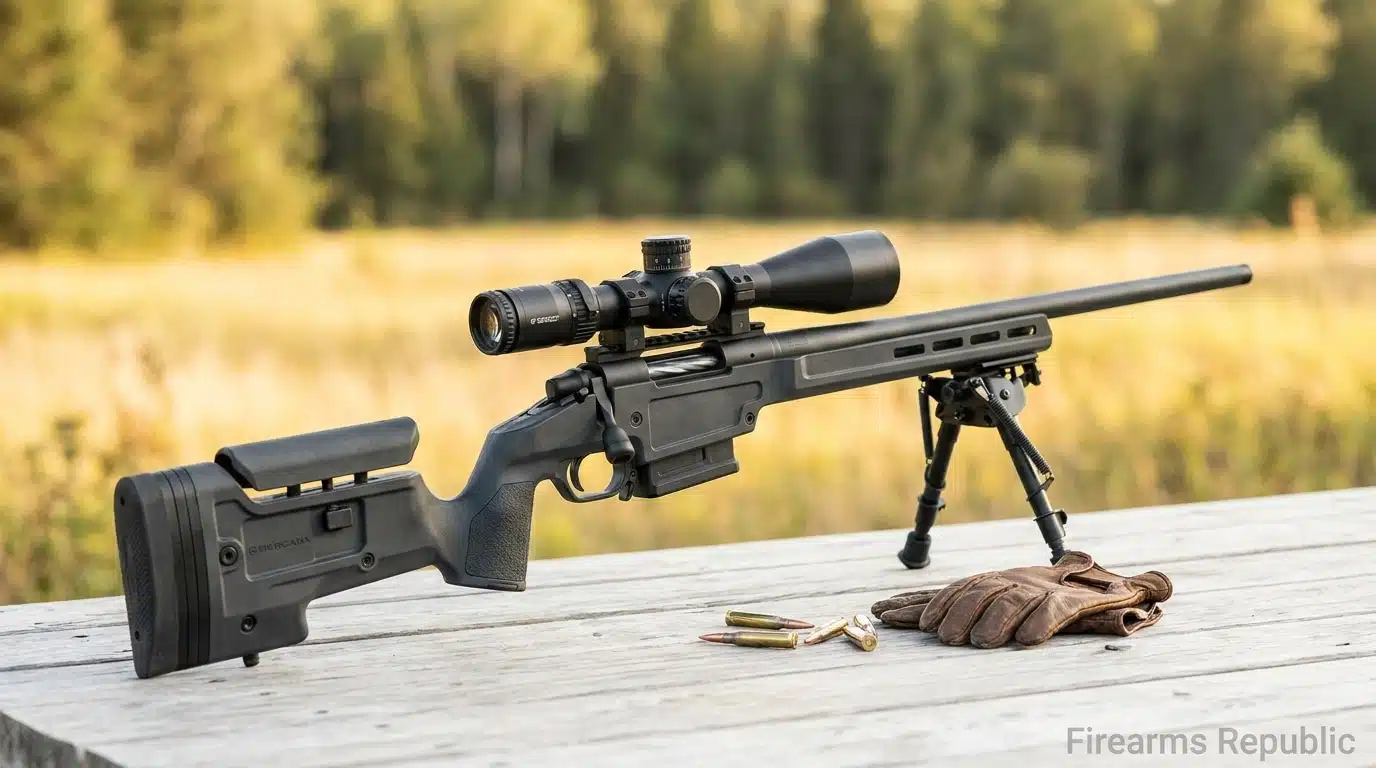


The Bergara B-14 arrived in the American market around 2015 with a proposition that initially seemed too good to be true: a Spanish-made bolt-action rifle with a Remington 700-compatible action, sub-MOA guaranteed accuracy from every production unit, and pricing that undercut the Tikka T3x while claiming to match it on accuracy. A decade later, Bergara has proven its case. The sub-MOA guarantee is not marketing language – it is consistently honored across the production range, verified by independent testing that has produced few exceptions. The Remington 700 bolt face compatibility is genuine and complete, giving B-14 owners access to the deepest aftermarket ecosystem in bolt-action rifles. And the accuracy claim holds: B-14 rifles routinely produce groups that match or slightly exceed the Tikka T3x at comparable barrel lengths. What Bergara trades for these advantages is trigger quality – the B-14’s factory trigger at 3–3.5 lbs is noticeably heavier and less crisp than the T3x’s 2 lb benchmark – and a bolt cycling feel that is smooth but short of the T3x’s almost frictionless standard. This guide covers every B-14 variant, how they compare to each other and to primary competitors, and which configuration serves each application best.
The Bergara B-14 Family: Every Significant Variant
B-14 Hunter – The Foundation Model
Price: $750–$850 | Weight: 7.0–7.5 lbs bare | Calibers: 6.5 CM, .308 Win, .30-06, 6.5 PRC, 7mm PRC, .300 Win Mag, 7mm Rem Mag, and others
The B-14 Hunter is the base model that establishes the platform’s reputation. It delivers Bergara’s sub-MOA guarantee in a standard synthetic stock hunting configuration. The barrel is Bergara’s in-house manufactured product – cold hammer-forged at the Bergara barrel manufacturing facility in Eibar, Spain, which has been producing rifle barrels since 1912. The barrel quality is the platform’s defining advantage: consistent bore dimensions and surface finish that produce the accuracy the guarantee requires.
The factory trigger at 3–3.5 lbs is the Hunter’s primary limitation for precision applications. It is not a bad trigger – the break is consistent and clean at its weight – but it is heavier than the T3x’s 2 lb benchmark and requires a heavier deliberate pull that some shooters find less natural than a lighter trigger. For hunters who shoot under field conditions at moderate distances, the 3–3.5 lb break is entirely adequate. For precision competition, a trigger upgrade is typically the first modification.
Remington 700 compatibility: The B-14 Hunter’s bolt face dimensions match the Remington 700’s standard and magnum bolt faces exactly. This means every stock, chassis, trigger, and barrel designed for the Remington 700 is compatible with the B-14 Hunter without modification. The Remington 700 aftermarket is the deepest in bolt-action rifles – MDT, KRG, Manners, McMillan, and hundreds of other manufacturers produce 700-compatible parts. The B-14 Hunter at $750–$850 accesses this entire ecosystem from day one.
B-14 HMR – The Precision Hunting Platform
Price: $950–$1,050 | Weight: 7.9 lbs bare | Calibers: 6.5 CM, .308 Win, 6.5 PRC, 7mm PRC, .300 Win Mag, .300 PRC, .338 Lapua
HMR stands for Hunting Match Rifle – a name that accurately describes the product. The B-14 HMR is the configuration where Bergara’s accuracy reputation is most clearly demonstrated. The heavier contour 24-inch barrel, chassis-compatible synthetic stock with aluminum pillars, extended AICS-compatible magazine, and Bergara’s sub-MOA guarantee in a hunting-weight package make the HMR the platform that competes most directly with the Tikka T3x CTR and the entry level of dedicated precision rifles.
The HMR’s stock is not a full aluminum chassis, but it is designed to accept MDT, KRG, and other Remington 700-compatible chassis with the same fit as a factory Remington 700. The pillar-bedded action and free-floating barrel produce the consistent stock-to-action geometry that supports precision accuracy.
Accuracy: The B-14 HMR in 6.5 CM routinely produces 0.5–0.7 MOA with quality factory ammo. With Hornady Precision Hunter 143gr ELD-X or Federal 140gr Terminal Ascent, 0.5 MOA groups are consistently achievable without handloads. With developed handloads (Berger 140gr Hybrid or Hornady 147gr ELD-M), sub-0.5 MOA is realistic in a properly broken-in barrel.
Best applications: Precision competition, long-range hunting, and hunters who want a rifle that serves both purposes without a separate platform for each.
B-14 Wilderness – The Field-Ready Configuration
Price: $850–$950 | Weight: 7.4–7.8 lbs bare | Calibers: 6.5 CM, .308 Win, .30-06, 6.5 PRC, 7mm PRC, .300 Win Mag
The Wilderness adds meaningful field functionality to the Hunter’s foundation: a Softtouch synthetic stock that maintains grip in wet conditions, Cerakote finish on all metal surfaces for corrosion resistance, and fluted bolt for debris clearance. For hunters in the Pacific Northwest, Alaska, and the northern tier where rifles are regularly exposed to rain, snow, and field conditions, the Wilderness’s finish protects the investment that the B-14 platform represents.
The Softtouch stock material is not merely cosmetic – it provides tactile grip that standard synthetic stocks lack in wet hands with gloves. For hunters who glass and stalk in all weather conditions with the rifle slung across a wet pack, the Wilderness handles field conditions better than the standard Hunter’s plain synthetic.
Weight: Slightly heavier than the Hunter due to the more substantial stock construction, but the difference is under 0.5 lbs in comparable configurations.
B-14 Ridgeback – The Adjustable Field Rifle
Price: $1,100–$1,300 | Weight: 8.2 lbs bare | Calibers: 6.5 CM, .308 Win, 6.5 PRC, 7mm PRC, .300 Win Mag
The Ridgeback applies a chassis-style stock with full adjustability – length of pull, comb height, and butt pad position – to the B-14 platform. This produces a rifle that fits a wider range of shooter body types and accommodates shooting with heavy clothing in cold weather without requiring a stock swap.
The Ridgeback’s adjustable stock does not make it a full chassis rifle – it lacks the aluminum bedding block and AICS magazine feeding of a dedicated chassis system – but it provides meaningful ergonomic flexibility that the standard synthetic stocks cannot match. For hunters who find the standard LOP either too long or too short, or who shoot both with and without heavy winter clothing, the Ridgeback’s adjustability is a genuine field advantage.
B-14 HMR Pro – The Competition-Ready Platform
Price: $1,400–$1,600 | Weight: 10.5 lbs | Calibers: 6.5 CM, .308 Win, 6.5 PRC, 7mm PRC, .300 Win Mag, .300 PRC
The HMR Pro fully crosses from hunting rifle to precision rifle category. The aluminum chassis stock, fully adjustable in all dimensions, folding mechanism, and enhanced AICS magazine feeding produce a PRS/NRL competition-ready platform from the factory. The Premier trigger (Bergara’s upgraded factory trigger at approximately 2–2.5 lbs) replaces the standard B-14 trigger, bringing pull weight closer to competition standard.
At $1,400–$1,600, the HMR Pro competes directly with the Ruger Precision Rifle ($1,499) and the lower tier of custom precision builds. Its advantage over the RPR is the Bergara barrel quality and sub-MOA guarantee; the RPR’s advantage is wider availability and a more established competition track record.
PRS competition context: The HMR Pro in 6.5 CM with the Premier trigger and Hornady Precision Hunter or quality handloads is a production-class PRS competitor that requires no aftermarket modifications to enter competition. For shooters who want to compete in PRS without building a custom rifle, the HMR Pro is one of the most complete factory solutions available. See our PRS Competition Guide.
B-14 Crest – The Lightweight Hunting Variant
Price: $1,200–$1,400 | Weight: 6.5 lbs bare | Calibers: 6.5 CM, .308 Win, 6.5 PRC, 7mm PRC, .300 Win Mag
The Crest takes the B-14’s accuracy foundation in a lighter direction – carbon fiber stock and fluted barrel reduce weight to 6.5 lbs bare, competitive with dedicated lightweight hunting platforms from Christensen and Fierce. For hunters who want Bergara’s barrel quality and sub-MOA accuracy in a backcountry-appropriate weight, the Crest represents a meaningful step up from the standard Hunter without the full premium of dedicated carbon-construction alternatives.
Honest comparison to Christensen Mesa: At $1,200–$1,400, the Crest is $100–$200 less than the Christensen Mesa. Both claim sub-MOA accuracy in approximately 6.5 lb configurations. The Christensen uses a full carbon fiber-wrapped barrel; Bergara uses a fluted stainless barrel with a carbon stock. Real-world accuracy from both platforms is similar; the Christensen’s carbon barrel runs cooler during multi-shot strings that backcountry hunting rarely produces.
The B-14 Barrel: Why It Matters
Bergara’s barrel manufacturing history is the foundation on which the entire B-14 reputation rests. The Bergara factory in Eibar, Spain began manufacturing rifle barrels in 1912 and supplies barrels to Weatherby, Springfield Armory, and other American rifle manufacturers in addition to the Bergara brand. The cold hammer-forging process used at Bergara produces barrels with consistent bore dimensions, a precisely controlled surface finish, and the stress relief that contributes to consistent accuracy across temperature changes.
The sub-MOA guarantee in practice: Every B-14 rifle that leaves the Bergara factory is tested for accuracy before shipping. Any rifle that does not group sub-MOA with Bergara-selected ammo is reworked before leaving the facility. This is not a statistical claim (“95% of B-14 rifles shoot sub-MOA”) – it is a production commitment that applies to every unit. In practice, independent testing of large B-14 samples has verified the guarantee consistently, with very few exceptions reported across thousands of production units.
Barrel break-in: Bergara recommends a specific break-in protocol for B-14 barrels: clean after every shot for the first 10 shots, then clean after every 5 shots for the next 20 shots, then clean normally. Following this protocol during the first range session produces barrels that perform consistently from early in their service life. Skipping break-in produces barrels that reach full accuracy potential after 50–100 rounds rather than 30–40 rounds.
B-14 Trigger Upgrade Options
The B-14’s factory trigger at 3–3.5 lbs is the most frequent upgrade target. Several drop-in options are available:
Timney 510 ($115–$135): The most commonly recommended B-14 trigger upgrade. Single-stage, adjustable from 1.5 to 4 lbs, clean break with minimal overtravel. Drop-in installation with no gunsmithing. The Timney 510 transforms the B-14 from a hunting rifle with an adequate trigger to a precision platform with a competition-quality trigger at a total investment well under $1,000.

Triggertech Primary ($130–$160): Two-stage option with Triggertech’s frictionless release technology. Adjustable from 1–3 lbs. Slightly more refined feel than the Timney at a slightly higher price. The first choice for B-14 shooters who prefer a two-stage trigger.
Jewell HVR ($175–$225): The precision benchmark for Remington 700-compatible triggers. Ultra-light adjustment range (0.5–1.5 lbs) with minimal sear engagement. For F-Class and bench rest competition where the lightest possible trigger is advantageous, the Jewell is the standard. For hunting, the Timney or Triggertech is more appropriate.
The Remington 700 compatibility that gives the B-14 access to the deepest stock and chassis aftermarket also gives it access to the deepest trigger aftermarket. Every Remington 700-compatible trigger from every manufacturer fits the B-14 without modification.
B-14 vs. Primary Competitors
B-14 Hunter vs. Tikka T3x Lite
T3x advantages: Better factory trigger (2 lbs vs. B-14’s 3–3.5 lbs), lighter weight in the Lite configuration (6.1 vs. 7.0–7.5 lbs), and 60-degree bolt lift.
B-14 advantages: Sub-MOA guarantee across production, Remington 700 bolt face compatibility for the deepest aftermarket, and slightly stiffer barrel profile that produces more consistent accuracy in warm conditions.
Verdict: The T3x is the better out-of-the-box shooting experience due to trigger quality and weight. The B-14 is the better platform for aftermarket development and provides a guaranteed accuracy floor that the T3x does not match explicitly. For hunters who want a factory rifle and never modify it, the T3x wins on trigger quality. For hunters who plan chassis, trigger, or barrel upgrades, the B-14’s Remington 700 compatibility is the more valuable platform feature. See our Tikka T3x Complete Guide.
B-14 HMR vs. Ruger Precision Rifle
RPR advantages: AICS magazine from the factory, adjustable chassis stock as standard, and established PRS competition track record.
B-14 HMR advantages: Bergara barrel quality and sub-MOA guarantee, lighter weight at equivalent accuracy capability, and $400–$550 lower price than the RPR.

Verdict: The B-14 HMR is the better value proposition for hunters who compete occasionally and want one platform for both purposes. The RPR is the better dedicated competition platform for shooters who prioritize the chassis ergonomics and do not need the hunting weight optimization.
B-14 Hunter vs. Savage 110 Hunter
Savage advantages: AccuTrigger (2.5 lbs minimum, better than B-14’s factory trigger), barrel-nut system for DIY rebarreling, and lower price.
B-14 advantages: Sub-MOA guarantee (Savage does not provide a factory accuracy guarantee), Remington 700 stock and chassis aftermarket access, and slightly more refined production consistency.
Verdict: The Savage wins on trigger quality and rebarreling flexibility. The B-14 wins on guaranteed accuracy and stock/chassis aftermarket depth. Choose Savage for trigger and barrel customization; choose Bergara for stock and chassis customization with a guaranteed accuracy floor. See our Savage 110 Series Guide.
Best Caliber Choices for the Bergara B-14
For Deer Hunting
6.5 Creedmoor in the B-14 Hunter is the primary deer hunting recommendation. Sub-MOA guarantee, the B-14’s barrel quality, and 6.5 CM’s versatility produce a hunting rifle that exceeds the accuracy requirements of any deer hunting scenario. See our 6.5 Creedmoor Caliber Guide and Whitetail Deer Hunting Rifles guide.
.308 Winchester for hunters who prioritize ammo availability and elk season versatility in a single platform. See our .308 Winchester Caliber Guide.
For Elk and Western Hunting
6.5 PRC in the B-14 HMR is the recommended elk configuration. The HMR’s heavier barrel provides maximum velocity consistency from the 6.5 PRC’s powder charge, and the sub-MOA accuracy guarantee with the 143gr ELD-X at 2,960 fps covers elk at 500 yards. See our 6.5 PRC Caliber Guide and Elk Hunting Rifles Guide.
7mm PRC in the HMR or Wilderness for hunters who want maximum wind performance and energy at western hunting distances. See our 7mm PRC Caliber Guide.
For Precision Competition
6.5 CM in the HMR Pro with Premier trigger is the production PRS competition configuration. With a Triggertech Primary upgrade ($130–$160) if the Premier trigger’s pull weight is not at the competitor’s preference, this is a complete sub-MOA precision platform for under $1,600 total.

.308 Win in the HMR Pro for F-Class and tactical precision competition. See our PRS Competition Guide and Long-Range Shooting Guide.
Complete B-14 Specifications Summary
| Model | Weight (bare) | Stock | Trigger Pull | Magazine | Sub-MOA Guarantee |
|---|---|---|---|---|---|
| B-14 Hunter | 7.0–7.5 lbs | Standard synthetic | 3–3.5 lbs | Detachable | Yes |
| B-14 HMR | 7.9 lbs | Pillar-bedded synthetic | 3–3.5 lbs | AICS 5-round | Yes |
| B-14 Wilderness | 7.4–7.8 lbs | Softtouch/Cerakote | 3–3.5 lbs | Detachable | Yes |
| B-14 Ridgeback | 8.2 lbs | Adjustable synthetic | 3–3.5 lbs | AICS 5-round | Yes |
| B-14 HMR Pro | 10.5 lbs | Aluminum chassis | 2–2.5 lbs (Premier) | AICS 10-round | Yes |
| B-14 Crest | 6.5 lbs | Carbon fiber | 3–3.5 lbs | Detachable | Yes |
Frequently Asked Questions
Q: Is the Bergara B-14 sub-MOA guarantee real?
A: Yes, and it is consistently honored across production. Independent reviewers who have tested large B-14 sample sizes report very few exceptions to the sub-MOA standard. The guarantee is based on production testing at the Bergara factory – every rifle is tested before shipping, and any unit that does not meet the standard is reworked. If you receive a B-14 that does not shoot sub-MOA with quality factory ammo, Bergara’s warranty process addresses it. This is not a conditional guarantee based on specific ammo or conditions; it is a production commitment.
Q: Does the Bergara B-14 need a trigger upgrade for hunting?
A: Not strictly. The factory 3–3.5 lb trigger is adequate for hunting inside 300 yards where field positions and conditions dominate accuracy more than trigger quality. For hunters who shoot at 400+ yards in field positions where trigger quality matters more, or for any precision competition use, a Timney 510 ($115–$135) or Triggertech Primary ($130–$160) is a significant improvement that brings the trigger to a genuinely excellent standard. The upgrade typically costs under $135 and takes 15 minutes to install.
Q: How does the Bergara B-14 compare to the Remington 700?
A: The B-14 is a better production rifle than the current Remington 700 in most configurations. Bergara’s Spanish manufacturing produces more consistent accuracy out of the box than Remington’s post-bankruptcy production, the sub-MOA guarantee is specific and consistently honored (Remington offers no equivalent guarantee), and the B-14’s factory trigger is comparable to or better than Remington’s X-Mark Pro. The B-14’s primary advantage over the Remington 700 for aftermarket builders is that it starts with a more accurate foundation while accessing the same Remington 700-compatible aftermarket. See our Remington 700 Platform Guide for full context on the Remington 700 ecosystem.
Q: Which B-14 is best for PRS competition?

A: The B-14 HMR Pro with a Triggertech Primary trigger upgrade is the most practical PRS competition setup within the B-14 family. The Premier trigger at 2–2.5 lbs from the factory is close to competition standard but the Triggertech at 1.5–2 lbs provides additional precision for stages where trigger quality determines hit or miss at 500+ yards. The HMR Pro’s aluminum chassis provides the adjustment and ergonomics that PRS stages demand. With Hornady Precision Hunter 143gr ELD-X or quality handloads, it competes in production class at sub-0.5 MOA.
Q: Can I use Remington 700 stocks and chassis on the Bergara B-14?
A: Yes, with no modification. The B-14’s action dimensions match the Remington 700 exactly, including the standard short-action and long-action footprints. Any stock or chassis designed for the Remington 700 – MDT ESS, KRG Bravo, Manners MCS-T Elite, McMillan A5 – installs on the B-14 as a direct replacement. The trigger guard and magazine well may require the chassis’s own bottom metal, which is standard for chassis installations regardless of the base action. This is the most valuable single feature of the B-14 platform for hunters and precision shooters who want to customize their rifle.