 Maksym Kovaliov
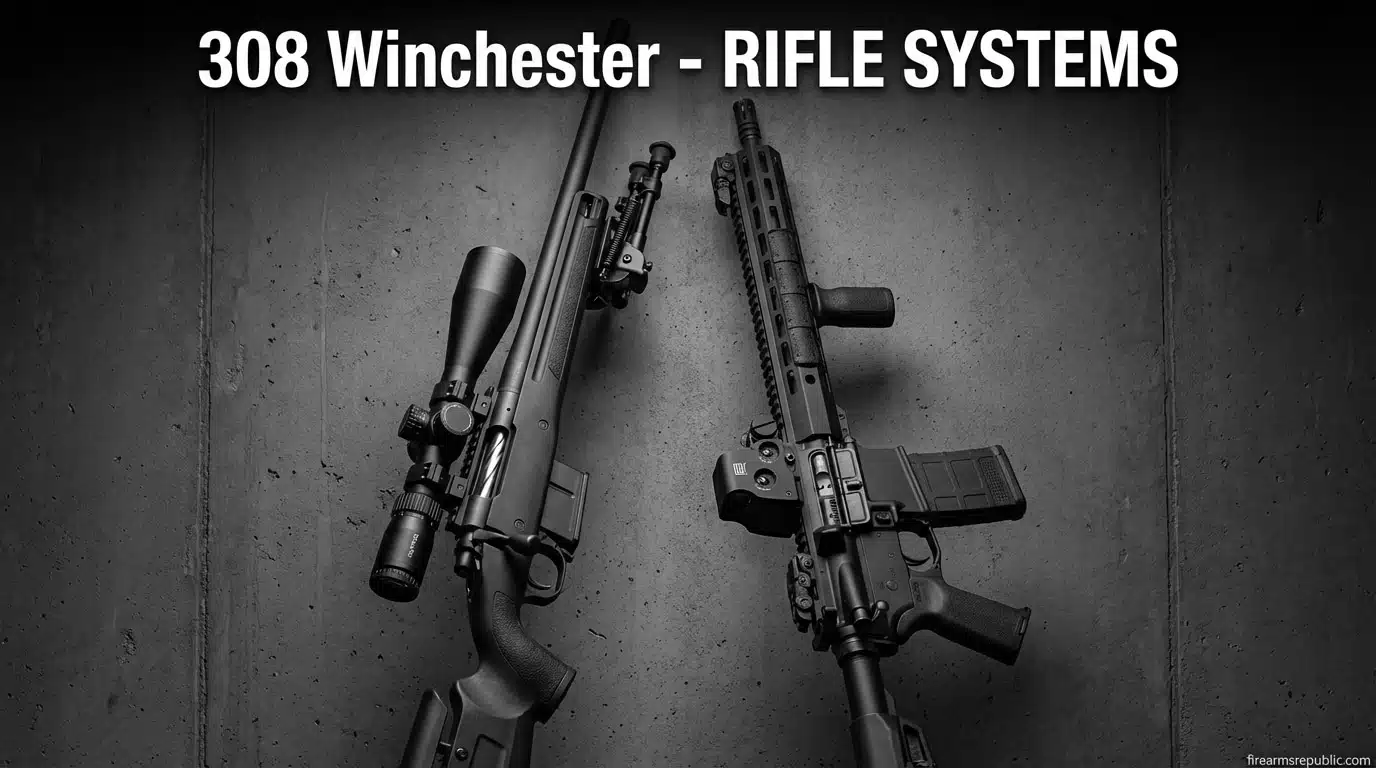
The .308 Winchester is the most proven centerfire rifle cartridge in America. It has killed more deer, won more long-range competitions, and served in more military and law enforcement rifles than any other round of the modern era. Introduced commercially in 1952 – and adopted by NATO as the 7.62×51mm a year later – the .308 has been refined, loaded, and shot for over 70 years across every possible use case. That depth of history shows up in practical ways: more factory loads, more rifle options, more reloading data, and wider rural ammo availability than any comparable cartridge. Where the 6.5 Creedmoor has taken the precision shooting community by storm since 2007, the .308 remains the default choice for hunters, military-pattern semi-auto shooters, and practical marksmen who want a cartridge with zero question marks. This guide covers the full picture – ballistics, comparisons, factory ammo, reloading, applications, and which rifles are worth your money at $0.80–$1.50 per round for quality factory loads.

What Is the .308 Winchester?
The .308 Winchester traces its lineage to the .30-06 Springfield – America’s military cartridge from World War I through Korea. In the late 1940s, Winchester and the U.S. military collaborated to develop a shorter, more efficient cartridge that achieved comparable .30-06 performance in a case small enough for semi-automatic battle rifles. The result was the T65 military case, commercialized by Winchester in 1952 as the .308 Winchester. NATO formally adopted it as the 7.62×51mm in 1954.

The case is 2.015″ long with a 2.800″ overall cartridge length, fitting perfectly in standard short-action rifles. The .308 and 7.62×51mm are dimensionally similar but not identical – 7.62×51 military brass has slightly thicker case walls and lower maximum pressure (60,191 PSI vs. 62,000 PSI for commercial .308). Modern commercial rifles chambered in .308 Winchester safely handle both, but the reverse is worth confirming before running commercial .308 in older military surplus rifles. The .30 caliber bore has a massive bullet selection: 110–220gr projectiles across every construction type imaginable, developed over 120+ years of .30-06 and .308 use.
Ballistics: The Real Numbers
The .308 Winchester is a versatile cartridge with a wide performance range depending on bullet weight. The 168gr class is the precision shooting standard; the 150–165gr range dominates hunting; heavier 175–185gr bullets are used by long-range precision shooters pushing the cartridge to its limits.

From a 24″ barrel with quality ammunition:
| Load | MV (fps) | 500 yd Velocity | 500 yd Energy | 1,000 yd Drop (zero @ 100) | 10 mph Wind @ 500 yd |
|---|---|---|---|---|---|
| 168gr Sierra MatchKing | 2,650 | 1,975 | 1,454 ft-lbs | -96″ | 10.4″ |
| 175gr Sierra MatchKing | 2,600 | 1,960 | 1,494 ft-lbs | -100″ | 9.8″ |
| 150gr Federal Power-Shok | 2,820 | 1,994 | 1,324 ft-lbs | -88″ | 11.8″ |
| 165gr Hornady SST | 2,700 | 1,978 | 1,432 ft-lbs | -96″ | 10.9″ |
| 180gr Nosler AccuBond | 2,570 | 1,910 | 1,459 ft-lbs | -108″ | 9.5″ |
Velocity from a 22″ barrel drops approximately 40–60 fps; from a 20″ barrel, 80–100 fps from 24″ figures. The .308 loses velocity faster than the 6.5 Creedmoor past 400 yards due to lower ballistic coefficients on .30 caliber bullets of equivalent weight. A 175gr Sierra MatchKing carries a G7 BC of .264, compared to .315 for a 140gr 6.5mm ELD-M. That gap becomes meaningful at 600 yards and beyond – the .308 drifts more in wind and drops more steeply. At 500 yards in a 10 mph crosswind, the .308 drifts roughly 10–11 inches vs. 7 inches for the 6.5 CM.
What the .308 does deliver at shorter and medium ranges is raw energy. A 165gr hunting bullet at 2,700 fps carries 2,670 ft-lbs at the muzzle and retains 1,432 ft-lbs at 500 yards – more than sufficient for any North American big game at practical hunting distances. The heavier .30 caliber bullet also creates wider wound channels than 6.5mm projectiles, which matters for cleanly taking larger animals and for shots that don’t land in the boiler room.
.308 Winchester vs. The Competition
.308 Winchester vs. 6.5 Creedmoor
This is the comparison that defined the past decade of precision shooting. On paper, the 6.5 CM wins at distance – higher BC bullets, less wind drift, flatter trajectory past 500 yards, and softer recoil. In practice, the .308 wins on availability, legacy data, terminal performance on larger game, and versatility in the AR-10/semi-auto platform. For hunters shooting inside 400 yards or running semi-auto rifles, the .308 remains fully competitive and arguably more practical. For precision bolt-gun shooters stretching past 600 yards in competition or recreation, the 6.5 CM’s advantages are real. Neither cartridge is objectively superior – the right choice depends on what you’re doing with it. For the full head-to-head, see our 6.5 Creedmoor vs. .308 Winchester guide.
.308 Winchester vs. .30-06 Springfield
The .30-06 pushes the same bullets 100–150 fps faster than the .308 thanks to its larger case. That velocity advantage matters in a few scenarios: very long ranges where retained velocity and energy become marginal, and with heavy bullets (180–220gr) where the .30-06’s case capacity shines. In return, the .308 works in short-action rifles, generates somewhat less recoil, and has broader factory ammo selection at major retailers. For most hunting applications inside 400 yards, the performance difference is smaller than bullet placement matters. The .30-06 makes sense if you already own one or specifically want the heavier bullet options; starting fresh, the .308’s rifle selection advantage is real. See our .30-06 Springfield Caliber Guide for a full comparison.
.308 Winchester vs. 7mm Rem Mag
The 7mm Rem Mag is a legitimate step up for long-range hunting – it pushes 160–175gr high-BC 7mm bullets to 3,000+ fps, generating a noticeably flatter trajectory and less wind drift than the .308 at extended ranges. The trade-offs are magnum recoil (18–22 ft-lbs vs. 14–16 for .308), a longer action requirement, faster barrel erosion, and higher ammo cost. For elk hunters in open western terrain who regularly see 400–600 yard shots, the 7mm Rem Mag’s advantages are meaningful. For deer hunters or those who stay inside 400 yards, the .308 handles the job with less wear on the shooter and the rifle. See our 7mm Rem Mag Caliber Guide for more.

.308 Winchester vs. 6.5 PRC
The 6.5 PRC is a specialist long-range cartridge that surpasses both the .308 and 6.5 CM at extended distances. It runs 140gr 6.5mm bullets 250+ fps faster than the CM, which translates to a genuine advantage past 800 yards. For most hunters and precision shooters, this is more than needed – the PRC’s advantages arrive at distances beyond what most field shooting requires. The .308 beats it on cost, ammo availability, rifle selection, and semi-auto compatibility. The PRC is worth considering if your specific shooting purpose consistently involves 800–1,500 yard precision work. See our 6.5 PRC Caliber Guide for the full breakdown.
Factory Ammunition: What to Buy
The .308 Winchester has the widest factory ammunition selection of any precision cartridge. Budget through match-grade options are available everywhere, from big-box retailers to rural hardware stores.
For precision and competition:
Federal’s 168gr Gold Medal Sierra MatchKing is the benchmark precision load – it has been winning long-range competitions since the 1990s and remains the standard by which other loads are judged. Expect 0.5–0.75 MOA from quality bolt-action rifles. Hornady’s 168gr ELD Match is the other top-shelf option, typically matching or slightly exceeding the SMK in factory rifle accuracy. Berger’s 175gr OTM Tactical is favored by precision shooters who push past 800 yards – the heavier bullet’s superior BC partially closes the .308’s gap with 6.5mm cartridges at distance.
For hunting:
Federal’s 165gr Trophy Bonded Tip and 165gr Nosler AccuBond are the premium bonded choices for elk and larger game – they penetrate deeply and hold together on shoulder shots. Hornady’s 150gr SST and 165gr SST are excellent whitetail loads at lower price points, offering reliable expansion from 100–500 yards. Winchester’s 150gr Power Point has been killing deer for 60 years – simple, affordable, and effective inside 300 yards. For elk where maximum penetration matters, the 180gr Nosler Partition remains one of the most field-proven bullets ever designed.
Budget practice:
Federal American Eagle 150gr FMJ ($18–$22/20 rounds) is the go-to range ammo. Magtech and PMC Bronze in 147gr or 150gr run $15–$18/20 and are reliable for volume training. Surplus 7.62×51 in bulk is extremely cost-effective for semi-auto training, though accuracy is variable and not suited for precision work.
| Load | Best For | Typical Price | Typical Accuracy |
|---|---|---|---|
| Federal 168gr Gold Medal SMK | Precision/Competition | $32/20 | 0.5–0.7 MOA |
| Hornady 168gr ELD Match | Precision/Competition | $30/20 | 0.5–0.7 MOA |
| Berger 175gr OTM Tactical | Long-Range Precision | $38/20 | 0.6–0.8 MOA |
| Hornady 165gr SST | Deer Hunting | $28/20 | 0.7–1.0 MOA |
| Federal 165gr Trophy Bonded Tip | Elk / Larger Game | $40/20 | 0.8–1.0 MOA |
| Federal AE 150gr FMJ | Range/Practice | $20/20 | 1.0–1.5 MOA |
| Winchester 150gr Power Point | Budget Deer Hunting | $22/20 | 1.0–1.5 MOA |
Reloading the .308 Winchester
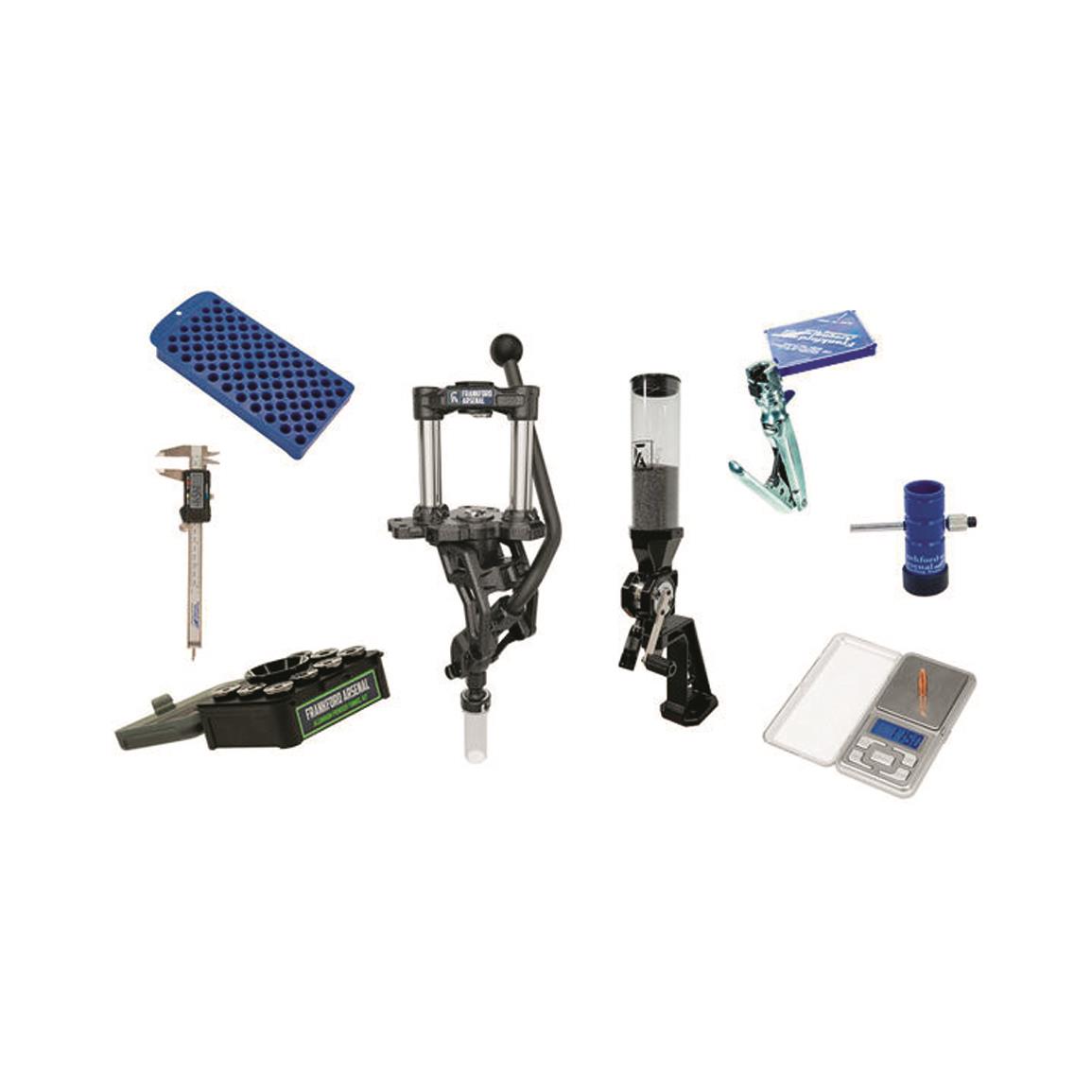
The .308 is arguably the best-supported cartridge in the reloading world. Seventy-plus years of published data, a huge reloading community, and excellent component availability make it the natural starting point for most new reloaders. Expect to cut per-round cost from $1.20–$1.50 to $0.45–$0.65 for quality match loads, and to improve accuracy meaningfully over factory ammunition.

Brass: Winchester and Federal factory brass is consistent and affordable – most reloaders use once-fired factory brass with good results for 4–6 loadings. For precision work, Lapua .308 brass ($90–$100/100) is the gold standard, with case life of 8–12+ firings and excellent consistency. Peterson brass ($65–$75/100) is an excellent domestic premium option. Keep brass sorted by headstamp and firing count when developing precision loads.
Powder: Varget is the community standard for .308 precision loads – temperature-stable, forgiving, and well-documented with every bullet weight from 155–175gr. Expect 2,620–2,680 fps with 44–46gr Varget behind a 168gr Sierra MatchKing in a 24″ barrel. IMR 4064 and Hodgdon BL-C(2) are the other high-performers in this cartridge. For heavy 175–185gr bullets, Reloder 15 and H4895 both perform well. The .308’s wide powder range makes it particularly forgiving for new reloaders building technique.
Bullets: The 168gr class is the competitive standard – Sierra 168gr MatchKing, Hornady 168gr ELD-M, and Berger 168gr Hybrid are all proven performers. For pushing past 800 yards, the 175gr Sierra MatchKing and Berger 175gr OTM Tactical are the traditional choices; the Hornady 175gr ELD-M is the newer high-BC option. Hunting reloaders should look at the 165gr Nosler AccuBond, 165gr Swift Scirocco, and 180gr Nosler Partition. Heavier bullets (185–210gr) are available for long-range precision but require careful stability checks given most factory twist rates.
Twist rate considerations: Most .308 rifles ship with a 1:10 or 1:11.25 twist. A 1:10 handles bullets through 175gr comfortably. The longer 185–210gr bullets prefer 1:10 or faster. If you’re running a standard factory rifle with a 1:11.25 twist, stick to 168–175gr as your upper limit for reliable stabilization.
Best Applications for the .308 Winchester
Whitetail and Mule Deer Hunting
The .308 Winchester is the benchmark deer cartridge for good reason. From 100–400 yards – the range of the vast majority of deer taken in the US – it hits hard, expands reliably, and kills cleanly with quality hunting bullets. At 165gr/2,700 fps, the muzzle energy of 2,670 ft-lbs drops to a still-lethal 1,432 ft-lbs at 500 yards. Any quality expanding bullet – the 165gr SST, 150gr Ballistic Tip, or 168gr ELD-X – performs reliably in deer-weight game across realistic hunting distances. The .308’s wide wound channels from .30 caliber bullets are forgiving on marginal hits, making it a reliable choice for hunters who may not place every shot perfectly. For a full breakdown of deer hunting rifle options, see our Whitetail Deer Hunting Rifles and Bolt-Action Rifles for Deer Hunting guides.
Elk and Larger Game
The .308’s .30 caliber bore and availability of premium 165–180gr bonded bullets make it a legitimate elk cartridge inside 400 yards with proper bullet selection. A 180gr Nosler Partition or 165gr Federal Trophy Bonded Tip through the vitals at 300 yards will kill elk cleanly and reliably. The honest constraint is range – past 400 yards, the .308’s retained energy and wind performance start to lag behind 7mm magnums and the 6.5 PRC for elk-sized game. Hunters who stay patient and disciplined about shot selection can run the .308 effectively on elk; those who might need to extend shots in open western terrain are better served by a larger cartridge. See our Elk Hunting Rifles Guide for cartridge-by-cartridge recommendations.
Tactical and Semi-Auto Shooting
This is where the .308 has its strongest and most unique position. The AR-10 / DPMS-pattern and SR-25-pattern semi-auto platforms built around 7.62×51/.308 are the dominant gas-gun competition and tactical tools in this bore diameter. For PRS gas gun competition, three-gun matches, and ranch or home defense at moderate distances, the semi-auto .308 is the mature, well-supported platform with decades of proven reliability. Our AR-10 Platform Guide and PRS Gas Gun Competition Guide cover this application in full detail.
Long-Range Precision (to 800 yards)
The .308 is genuinely capable to 800 yards with quality match ammunition and a skilled shooter. At 1,000 yards it remains doable but requires precise wind calls and comes with more drift to manage than the 6.5 CM or 6.5 PRC. Many serious precision shooters start on .308 because of the deep load development database, then move to higher-BC cartridges as they push distance. The 175gr Sierra MatchKing and 175gr Hornady ELD-M are the cartridge’s strongest long-range loadings – they close some of the BC gap with 6.5mm bullets and remain supersonic past 1,000 yards from 24″ barrels. For a complete long-range guide, see our Long-Range Shooting Guide.
Hog Hunting
The .308 is one of the best hog hunting cartridges available, particularly in semi-auto configurations for quick follow-up shots. Hogs are tough, can be large (200+ lbs), and are often shot in low-light conditions from elevated stands or spot-and-stalk at moderate distances. A 150–165gr expanding .308 load handles hogs cleanly inside 300 yards. For night hunting setups, suppressors pair well with the .308 – threaded barrels are widely available, and the .30 caliber bore gives access to durable suppressors rated for sustained fire. See our Hog Hunting Rifle Guide for platform-specific recommendations.
Rifles Chambered in .308 Winchester
The .308 Winchester is chambered in more production rifles than any other precision cartridge. Every major manufacturer offers .308 options across every price tier.

Budget ($400–$700):
The Savage Axis II ($350–$500) is the value leader in .308 – it regularly produces sub-MOA groups with quality ammo from rifles that cost less than most scopes. The Ruger American Gen II ($599–$649) adds AICS magazine compatibility and a better trigger to the budget bolt-action picture. The Mossberg Patriot ($350–$400) is a reliable hunting rifle with a smooth action for its price point. The Winchester XPR ($550–$650) offers a better-than-expected trigger and solid hunting performance.
Mid-range ($700–$1,200):
The Tikka T3x Lite ($800–$875) is the pick for hunters who want the smoothest bolt in this class – Tikka’s feed reliability and bolt lift are best-in-tier. The Bergara B-14 HMR ($950–$1,050) is the accuracy standard in mid-range bolt-actions, frequently delivering 0.5 MOA groups with Federal Gold Medal. The Howa 1500 ($600–$700) is often overlooked but offers Remington 700 footprint compatibility at an attractive price – relevant if you’re planning a chassis or stock upgrade.
Precision/Semi-Custom ($1,200–$2,500):
The Remington 700 in its various precision configurations remains the most aftermarket-supported platform in the world – MDT, KRG, Magpul, and every major chassis maker builds around the 700 footprint. The Bergara HMR Pro ($1,300–$1,450) is a ready-to-compete chassis rifle at a reasonable price. The Christensen Arms Mesa ($1,300–$1,450) brings a carbon-wrapped barrel to the equation for hunters who want sub-6 lb total weight.
Semi-Auto:
The Ruger SFAR ($1,100–$1,200) is the most innovative recent entry – an AR-15-sized rifle that chambers .308 in a significantly lighter and more compact package than traditional AR-10 builds. The Aero Precision M5 ($800–$1,000 barreled upper) is the enthusiast’s build platform of choice. For comprehensive semi-auto coverage, see our AR-10 Platform Guide and Remington 700 Platform Guide. Our Savage 110 Series, Ruger American, Tikka T3x, and Bergara B-14 platform guides cover each in full detail.
Barrel Life and Long-Term Ownership
The .308 Winchester is one of the easiest cartridges on barrel steel. Running at moderate pressure with relatively modest case capacity, most .308 barrels last 4,000–6,000 rounds before accuracy degrades noticeably – often 8,000–10,000 rounds in hunting rifles that aren’t pushed hot. This barrel life advantage over hotter cartridges like the 6.5 PRC (1,500–2,000 rounds) or .300 Win Mag (1,200–1,800 rounds) is a genuine long-term cost benefit. A competition shooter sending 1,000 rounds per year through a .308 can expect the barrel to outlast 5–6 seasons without replacement. For a hunting rifle at 100 rounds per year, a .308 barrel may outlast the practical life of the rifle.

Replacement barrels for Remington 700-footprint .308 rifles run $300–$700 for quality aftermarket options from Criterion, Bartlein, or Proof Research. Savage prefit .308 barrels start around $250. The cartridge’s popularity keeps supply strong and prices competitive. If you’re investing in a precision platform and care about total cost of ownership, the .308’s long barrel life is a meaningful advantage over faster-burning cartridges.
Suppressors and the .308 Winchester
The .308 Winchester is highly suppressor-compatible and widely used in suppressed configurations for hunting, competition, and tactical applications. The standard thread pitch is 5/8×24. Compatible suppressors include the SilencerCo Omega 300, Dead Air Sandman-S, Rugged Radiant 762, and OSS Helix 762 – all rated for sustained .308 fire. Expect a suppressed .308 to read 135–140 dB vs. 165+ dB unsuppressed, which is hearing-safe with electronic muffs for extended range sessions.
Subsonic .308 loads with 220gr cast or jacketed bullets can be run below the sound barrier for extremely quiet shooting – accurate to 150–200 yards and useful for pest control or backyard shooting where applicable. For most suppressed .308 use, supersonic hunting and match loads are the practical choice, and the suppressor’s primary benefit is reduced concussion and report rather than true hearing-safe operation without ear protection. See our Suppressor Buyer’s Guide and Best Suppressed Hunting Setups for the full picture.
Who Should Choose the .308 Winchester?
The .308 is your cartridge if:
You hunt deer, elk, or hogs at realistic distances – inside 400 yards for elk, 500 yards for deer – and want the widest factory ammo selection and best rural availability of any cartridge on the market. You want a semi-auto rifle for competition, defense, or ranch use and need the mature, widely-supported AR-10 platform. You’re a new reloader who wants the deepest load data and most forgiving cartridge to develop skills on. You want one rifle that serves deer hunting, range work, and occasional hog hunting without compromise.
Look elsewhere if:
You’re a precision shooter primarily engaging targets past 600 yards in wind – the 6.5 Creedmoor’s higher-BC bullets will drift less and require less correction. You’re hunting elk in open western terrain where shots regularly stretch past 400 yards – the 7mm PRC, 6.5 PRC, or .300 Win Mag offer meaningful performance advantages at those distances. You want the lightest possible recoil for extended shooting sessions or PRS competition – the 6.5 CM’s softer recoil is meaningful over a long day of stages.
Frequently Asked Questions
Is .308 Winchester the same as 7.62×51 NATO?
They’re closely related but not identical. The 7.62×51 NATO has slightly thicker brass case walls and lower maximum pressure than commercial .308 Winchester. Modern civilian .308 rifles safely chamber both cartridges. The practical difference is dimensional – NATO brass is slightly thicker, which reduces powder capacity minimally. Never run commercial .308 in older military surplus rifles unless the chamber is explicitly rated for .308 Winchester; the pressure difference can matter in tight chambers.
What is the effective range of the .308 Winchester for deer hunting?
With quality hunting loads, the .308 retains sufficient energy (1,000+ ft-lbs) for clean kills on deer-sized game to approximately 700–750 yards. Practically, most hunters set their personal limit at 400–500 yards based on their ability to read wind and hold steady in field conditions – the cartridge is capable further than most shooters can responsibly execute. Inside 400 yards, it’s one of the most reliable deer cartridges ever made.
What twist rate do I need for .308 Winchester?
A 1:10 twist rate stabilizes the full range of practical .308 bullets from 150gr through 175gr – this is the standard in most factory rifles. A 1:11.25 twist handles 168gr and lighter reliably but can struggle with 175gr depending on bullet length. For shooting 185–210gr long-range bullets, a 1:10 or faster is strongly preferred. Check your barrel’s twist before loading heavy projectiles.
How does .308 compare to .30-06 for hunting?
Performance inside 400 yards is nearly identical – the .30-06 gains 100–150 fps from its larger case, which translates to a small energy advantage at distance but minimal practical difference on deer or elk at hunting ranges. The .308 works in a short-action rifle, has a modest recoil edge, and offers broader ammo selection at major retailers. The .30-06 matters more with very heavy bullets (180–220gr) at longer ranges. For most hunters, the .308’s rifle selection and compactness make it the better starting point.
Is .308 Winchester good for long-range shooting past 1,000 yards?
The .308 can reach 1,000 yards – it remains supersonic to approximately 1,050 yards with 175gr match loads from a 24″ barrel. Past 800 yards, wind drift and drop management becomes demanding due to lower BC compared to high-BC 6.5mm or 7mm options. Serious 1,000-yard precision shooters typically move to 6.5 Creedmoor or 6.5 PRC for competition. The .308 is an excellent cartridge to 800 yards and a workable one to 1,000 yards for experienced shooters who understand its limitations.
What’s the best .308 load for elk hunting?
For elk, prioritize bonded or partition-style bullets that hold together through heavy bone and tissue. The Nosler 180gr Partition and Federal 165gr Trophy Bonded Tip are the proven standards. Hornady’s 178gr ELD-X is an excellent newer option with near-bonded penetration and a higher BC than older designs. Keep shots inside 400 yards, use at least a 165gr bullet, and select bonded construction for quartering shots or heavy-shoulder impacts.