 Maksym Kovaliov
Best Rifles, Calibers & Setups for Feral Hogs
Feral hogs are the most destructive invasive species in North America. Estimated at 6–9 million animals across 35 states – with the heaviest concentrations in Texas, Florida, Oklahoma, Georgia, and the Gulf Coast states – they cause approximately $1.5 billion in agricultural damage annually. Rooting destroys pastures and crops. Wallowing degrades water sources. Reproduction is relentless: a sow can produce two litters per year with 4–8 piglets each, meaning populations double every 4–6 months without active management.
The result is one of the most accessible and socially sanctioned hunting opportunities in the country. Most landowners in hog-affected states will grant hunting permission willingly – they’re losing money to hogs every week. Most states treat feral hogs as unprotected non-game animals with no season, no bag limit, and minimal regulatory burden. Night hunting with thermal optics and suppressors is legal across most of the South and Midwest. And the hunting itself – fast shots at multiple animals, often at night, in dense brush or open agricultural fields – demands a specific set of rifle capabilities that differ meaningfully from deer or elk hunting.
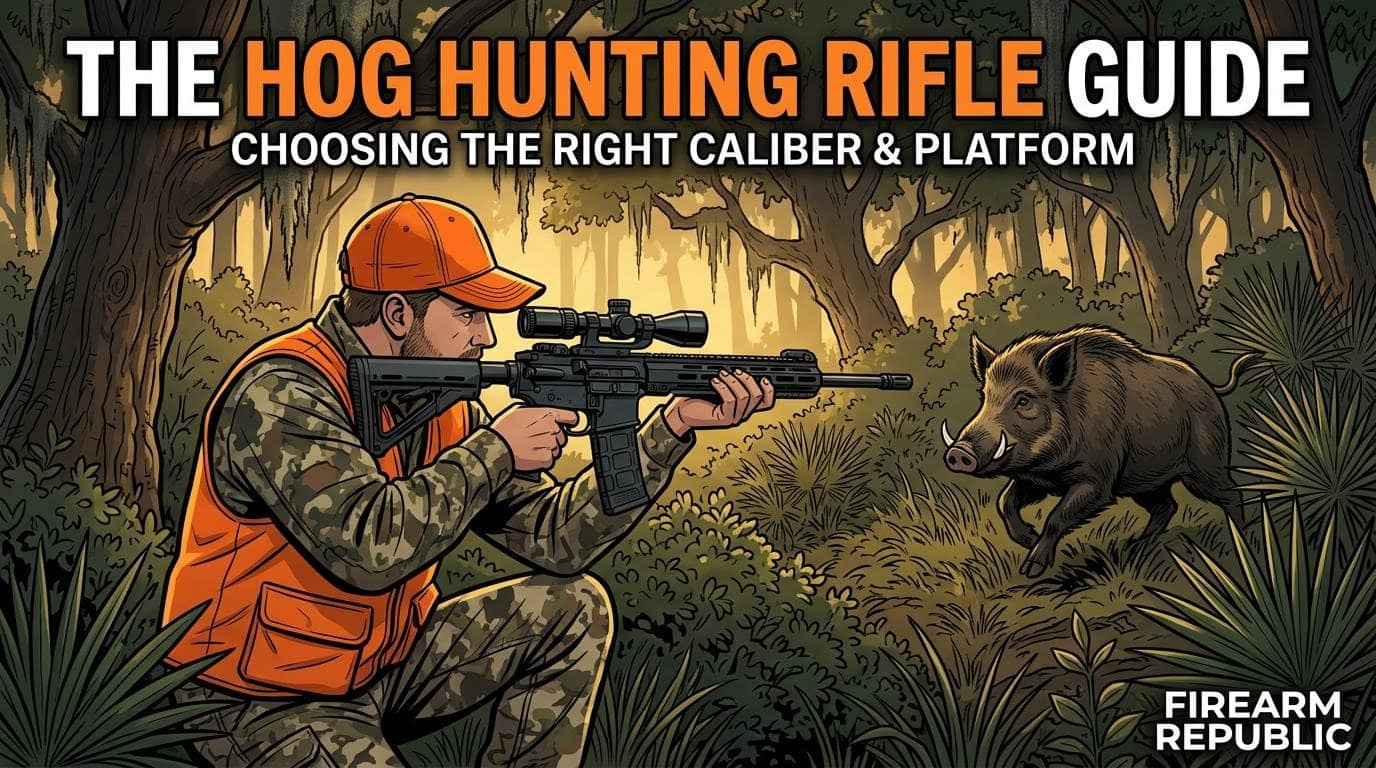
This guide covers everything you need for hog hunting: the biology that shapes the tactics, the caliber choices that work (and the ones that don’t), the right platforms for different scenarios, the best production rifles, and the setups that experienced hog hunters actually run.
Understanding Feral Hogs: Biology That Shapes Your Rifle Choice
Size and Toughness
Feral hogs are significantly tougher than deer of comparable size. Several anatomical features make them harder to kill cleanly:
The shoulder shield: Mature boars develop a cartilaginous plate – called the shield or cutaneous trunci – over their shoulders that can reach 1–2″ thick on large animals. This gristle plate is not bone, but it’s dense enough to deflect or stop inadequate bullets that would cleanly pass through a deer. Shots directly into the shield on a mature boar with marginal calibers or expanding varmint bullets frequently result in wounded animals.
Body structure: Hogs carry their vitals low and forward – the heart and lungs sit behind the front legs, lower in the chest cavity than on deer. New hunters who shoot hogs like deer (aiming for the shoulder) often miss the vitals entirely. The ideal shot placement is directly behind the ear for immediate brain shots, or a low shoulder shot that enters the front leg and angles into the chest cavity.
Adrenaline response: Wounded hogs are dangerous. A 200–300 lb boar that’s been poorly hit and is running in dense brush poses a genuine threat to hunters and dogs. Shot selection and adequate caliber choice aren’t just ethical considerations – they’re safety considerations.
Group Behavior and Speed
Hogs move in family groups called sounders – typically a mature sow, her offspring, and sub-adult pigs of both sexes. Sounders range from 4 to 30+ animals. Mature boars are often solitary except during the rut.
When a sounder is encountered, multiple animals present simultaneously. This is where semi-automatic rifles provide a genuine tactical advantage over bolt-actions – the ability to engage multiple targets before the group disperses into cover is real and practically significant. Experienced hog hunters using AR-15s or AR-10s frequently take 3–6 animals per encounter that a bolt-action shooter would reduce to 1–2.
Hogs are also fast – a 200 lb boar can cover 35 yards in under 3 seconds when startled. Running shot capability and fast follow-up shots matter in ways they don’t for stationary deer hunting.
Nocturnal Behavior
Feral hogs are predominantly nocturnal in areas with hunting pressure. In Texas and other heavily hunted states, daytime hog sightings are rare on pressured land – the animals learn quickly and shift feeding to the hours between 10 PM and 4 AM. This drives the demand for thermal and night vision optics and suppressed firearms that won’t alert the sounder before follow-up shots.
Caliber Guide for Hog Hunting
.223 Remington / 5.56 NATO – The High-Volume Choice
The .223 is the most common hog hunting caliber by sheer volume of rifles in use. It’s effective on hogs inside 150 yards with appropriate bullet selection – the caveat is that bullet choice matters more for hogs than for almost any other game animal.
What works: Barnes 62gr TSX, Federal 62gr Trophy Bonded, Hornady 75gr TAP. Bonded or solid copper bullets that won’t fragment on the shoulder shield and will penetrate to the vitals.
What doesn’t work: Standard varmint bullets – 55gr Hornady V-Max, Federal V-Shok, Remington AccuTip. These bullets are designed to fragment on prairie dogs and groundhogs. On the shield of a mature boar, they blow up on contact without penetrating. Numerous guides and hunters have reported wounding or losing hogs hit with varmint .223 loads. Use bonded or solid copper bullets exclusively for hogs in .223.
Practical limitations: On boars over 200 lbs, the .223 is marginal even with premium loads. It works with precise shot placement – behind the ear, tight behind the shoulder into the lung cavity. It fails consistently on quartering-to shots or shoulder hits on large animals. Know the limitation and don’t take marginal shots.
| Load | Bullet | Velocity | Energy | Notes |
|---|---|---|---|---|
| Barnes Vor-Tx 62gr TSX | 62gr TSX | 3,000 fps | 1,239 ft-lbs | Best .223 hog load – won’t fragment |
| Federal Premium 62gr Trophy Bonded | 62gr TBBC | 3,000 fps | 1,239 ft-lbs | Bonded, reliable penetration |
| Hornady Black 75gr TAP | 75gr OTM | 2,790 fps | 1,296 ft-lbs | Heavier bullet, better penetration |
| Hornady GMX 55gr | 55gr GMX | 3,240 fps | 1,282 ft-lbs | Solid copper, no fragmentation |
.308 Winchester – The Proven Standard
The .308 Winchester is the most universally recommended hog caliber for a reason: it delivers enough energy and bullet diameter to handle any size hog at any reasonable shot angle, with a wide selection of factory loads optimized for big game penetration. A 165gr Core-Lokt or 168gr Federal Fusion through the shoulder of a 300 lb boar does not require perfect shot placement – it handles the job.
At 2,700 ft-lbs of muzzle energy, the .308 is approximately twice the power of .223. This margin matters on large boars, quartering shots, and situations where the sounder is moving fast and shot selection is compromised.
The .308 is equally at home in bolt-action and semi-automatic (AR-10) configurations. The AR-10 in .308 is the standard recommendation for hunters who want maximum follow-up shot capability on large groups.
| Load | Bullet | Velocity | Energy | Notes |
|---|---|---|---|---|
| Federal Fusion 150gr | 150gr Fusion | 2,820 fps | 2,648 ft-lbs | Best value hog load |
| Hornady InterBond 165gr | 165gr InterBond | 2,700 fps | 2,670 ft-lbs | Bonded, controlled expansion |
| Federal Trophy Bonded 165gr | 165gr TBBC | 2,700 fps | 2,670 ft-lbs | Reliable on heavy boars |
| Barnes VOR-TX 168gr TTSX | 168gr TTSX | 2,650 fps | 2,620 ft-lbs | Lead-free, maximum penetration |
| Remington Core-Lokt 150gr | 150gr Core-Lokt | 2,820 fps | 2,648 ft-lbs | Budget, widely available |
.300 Blackout – The Suppressed Specialist
The .300 BLK in supersonic configuration (110–125gr) is adequate for hogs inside 150 yards with premium loads. Its real value in hog hunting is the suppressed subsonic configuration – 220gr subsonic loads at 1,000 fps for close-range shooting at night where noise management matters for multiple-animal engagement.
A suppressed .300 BLK AR-15 pistol (9″–10.5″ barrel) running subsonic loads is quiet enough that a miss or first shot often doesn’t disperse the sounder. Follow-up shots on the remaining animals are possible within seconds. This tactical advantage – keeping the group feeding while you work through it – is the .300 BLK’s primary hog hunting value.
Limitations: subsonic energy (490 ft-lbs at the muzzle, dropping to ~380 ft-lbs at 75 yards) is marginal on large boars. Restrict subsonic hog hunting to 75 yards maximum and use shots into the neck or directly behind the ear for clean kills on heavy animals. Supersonic .300 BLK extends the ethical range to 150 yards.
See the full .300 Blackout Caliber Guide for complete ballistics and load data.
6.5 Creedmoor – Long-Range Capability
For hunters operating in open agricultural terrain where hog shots extend to 300–500 yards, the 6.5 Creedmoor in an AR-10 or bolt-action provides a meaningful step up from .308 in long-range precision. Its higher BC bullets retain energy better at distance and drift less in wind than .308.
The 6.5 CM is not the standard hog hunting choice – most hog hunting happens inside 150 yards – but for hunters covering large fields from elevated stands or box blinds where 300-yard shots are common, the 6.5 CM’s flat trajectory and precise factory loads (Hornady ELD-X 143gr, Federal Gold Medal 140gr) are genuine advantages.
7.62×39 (AK-Pattern) – Budget-Effective at Close Range
The 7.62×39 in AK-pattern semi-automatics (AKM, Ruger American Ranch, CMMG Mk47) or the AR-15 in 7.62×39 upper configuration occupies a specific niche: affordable, reliable, adequate-energy hog hunting inside 150 yards from a semi-automatic platform.
At 1,500–1,600 ft-lbs of muzzle energy with 123gr loads, the 7.62×39 is significantly more effective on hogs than .223 and approaches .308 performance at close range. Ammunition is inexpensive ($0.25–$0.40/round for steel-cased training ammo), making it practical for high-volume hog control where cost per shot matters.
Limitations: accuracy past 200 yards is poor with standard AK-pattern barrels and ammunition. Not a precision hog rifle – a close-range, high-volume tool.
.30-06 Springfield – Traditional Power
The .30-06 in a bolt-action remains a capable hog rifle for hunters who own one and don’t want to buy a new platform. Its 2,900–3,000 ft-lbs of muzzle energy with 165–180gr loads exceeds .308 and handles any size hog at any shot angle. Slower follow-up shots than semi-automatics, but entirely adequate for stand hunting over bait or feeders.
Caliber Comparison for Hog Hunting
| Caliber | Energy at Muzzle | Max Ethical Range | Best Scenario | Semi-Auto Available? |
|---|---|---|---|---|
| .223 Rem (bonded) | 1,240 ft-lbs | 150 yards | Volume shooting, smaller hogs | Yes (AR-15) |
| 7.62×39 | 1,550 ft-lbs | 150 yards | Budget semi-auto, close range | Yes (AK, AR-15) |
| .300 BLK supersonic | 1,360 ft-lbs | 150 yards | Suppressed, dual-mode | Yes (AR-15) |
| .300 BLK subsonic | 490 ft-lbs | 75 yards | Suppressed night hunting | Yes (AR-15) |
| .308 Winchester | 2,700 ft-lbs | 400 yards | All-around, any size hog | Yes (AR-10) |
| 6.5 Creedmoor | 2,280 ft-lbs | 500 yards | Long-range open terrain | Yes (AR-10) |
| .30-06 Springfield | 2,900 ft-lbs | 400 yards | Bolt-action, heavy boars | Limited |
Platform Guide: Semi-Auto vs. Bolt-Action for Hogs
Semi-Automatic: The Hog Hunter’s Standard
The semi-automatic rifle is the dominant platform for hog hunting, and the reasoning is straightforward: hogs are hunted in groups. A sounder of 10–15 animals feeding in a food plot at night represents a limited engagement window before the group breaks for cover. Every second between shots is an animal that escapes into brush.
Semi-automatic follow-up capability – a second shot 0.5 seconds after the first rather than 2–3 seconds for a bolt cycle – translates directly into more animals harvested per encounter. For agricultural pest control where the goal is population reduction, not trophy collection, the semi-automatic’s rate of fire is the most practically valuable feature in the selection.
AR-15 (.223 / .300 BLK): The standard for smaller hog operations and suppressed setups. Light, maneuverable, inexpensive to run. Effective on hogs under 200 lbs with appropriate loads. The platform of choice for guided night hunts where multiple shooters work a sounder simultaneously.
AR-10 (.308 / 6.5 CM): The upgrade for hunters who want to handle large boars confidently and shoot to longer distances. Heavier and more expensive than AR-15, but the margin in terminal performance on heavy animals is genuine. The AR-10 in .308 is the most capable production hog rifle available.
Bolt-Action: The Stand Hunter’s Tool
Bolt-actions work for hog hunting in specific scenarios: stand hunting over bait, feeders, or water where animals approach to a fixed point at predictable distances. When you’re shooting from an elevated stand at 50–100 yards with time to aim carefully, the bolt-action’s lower follow-up speed is a minor limitation.
Bolt-actions offer advantages for some hog hunters: lighter weight for long walks to stand locations, better accuracy per dollar at longer ranges, simpler maintenance, and broader caliber selection including larger cartridges that don’t fit AR platforms.
When bolt-action makes sense for hogs:
- Stand hunting over feeders at known distances
- Long-range open-country shots (300+ yards)
- Hunters who already own a quality bolt-action in .308 or larger
- Suppressed bolt-action for hearing safety without semi-auto cycling concerns
Night Hunting: Thermal, Night Vision, and Suppressed Setup
Night hunting is where serious hog control happens. In Texas, Oklahoma, Florida, and most hog-affected states, thermal imaging and night vision equipment are legal for hog hunting. The practical result: hunters who run thermal can find and engage hogs in complete darkness, dramatically increasing harvest efficiency.
Thermal vs. Night Vision
Thermal imaging detects heat signatures – a hog’s body temperature glows clearly against cooler ground even in total darkness, dense vegetation, or light fog. Thermal scopes (Pulsar Thermion 2, ATN Thor 4, FLIR ThermoSight) show animals clearly at 200–500+ yards without any ambient light. The image is monochrome heat data, not visual – it’s ideal for detection and ranging but some hunters find target identification slightly slower than night vision for positive species ID.
Night vision (image intensification) amplifies available ambient light – starlight, moonlight, or infrared illuminator – to create a green-tinted image. Quality night vision (PVS-14, ATN X-Sight, AGM Rattler) provides excellent detail for species identification. It requires some ambient light or an IR illuminator; in total darkness without an illuminator, it fails where thermal succeeds.
The practical choice for most hog hunters: Thermal for detection and shooting; night vision for identification and navigation. Budget hunters typically start with thermal.
Recommended Thermal and Night Vision Optics
| Optic | Type | Range | Price | Notes |
|---|---|---|---|---|
| Pulsar Thermion 2 XP50 | Thermal rifle scope | 1,800m detection | $3,500 | Best image quality, plug-in power |
| ATN Thor 4 384 2–8x | Thermal rifle scope | 500m detection | $1,500 | Good value, ballistic calculator |
| FLIR ThermoSight Pro PTS536 | Thermal rifle scope | 1,500m detection | $4,500 | Military-grade, exceptional image |
| AGM Rattler TS25-384 | Thermal clip-on | 900m detection | $1,800 | Clip-on for existing scope |
| ATN X-Sight 4K Pro | Night vision | 250m | $700 | Budget night vision with day use |
| Armasight Contractor 640 | Thermal | 1,000m detection | $2,800 | Strong mid-range option |
Suppressed Night Hunting: The Complete Setup
The most effective hog hunting configuration for agricultural pest control combines thermal optics with a suppressed semi-automatic rifle. The suppressor reduces report enough that a first shot on a sounder doesn’t immediately scatter the remaining animals – in many cases, hogs a few yards from a suppressed shot continue feeding, allowing methodical engagement of multiple animals.
Ideal suppressed hog hunting setup:
- AR-10 in .308 Winchester with 16″–18″ barrel (larger animals, more energy)
- OR AR-15 in .300 BLK with 9″–10.5″ SBR/pistol (maximum suppressed performance)
- Quality .30-caliber suppressor (SilencerCo Omega 300, Dead Air Sandman-S)
- Adjustable gas block (Superlative Arms) for suppressed cycling reliability
- Pulsar Thermion 2 or ATN Thor 4 thermal scope
- White light or IR weapon light for close-range identification
Best Hog Hunting Rifles
AR-15 Platform (.223 / .300 BLK)
Daniel Defense DDM4 V7 .300 BLK ($2,000–$2,100) The premium choice for a suppressed hog hunting AR-15. 16″ cold hammer forged barrel, Daniel Defense’s quality control, reliable cycling of both subsonic and supersonic loads. The .300 BLK chambering is the right choice for suppressed hog hunting where dual-mode capability matters. At $2,000, it’s a serious investment – but it’s a production rifle you won’t need to second-guess in the field.
BCM RECCE-16 MCMR .223 ($1,500–$1,700) For hunters who want .223 over .300 BLK – maximum volume, lower ammunition cost, and excellent 16″ mid-gas reliability. BCM’s cold hammer forged chrome-lined barrel with a 1:7 twist runs 62gr bonded loads accurately and reliably. Pair with Barnes 62gr TSX or Federal 62gr Trophy Bonded for hog-appropriate terminal performance.
Ruger SFAR .223 ($1,100–$1,200) Ruger’s Small Frame Autoloading Rifle packages .308-class potential into a near-AR-15 weight package, but in .223 it’s the lightest and most maneuverable mid-tier AR-15 hog rifle available. At 6.3 lbs with a 16″ barrel, it carries comfortably through the brush and timber where night hog hunting often happens.
PSA PA-15 .223 ($500–$600) For budget-conscious hunters running hog control where high round counts matter more than premium quality: the PSA PA-15 is a functional AR-15 that runs bonded .223 loads reliably. Not a precision instrument – but for shooting hogs at 50 yards over a feeder, it doesn’t need to be. Upgrade the trigger and add a basic red dot and you have an effective hog rifle for under $800 total.
AR-10 Platform (.308 / 6.5 CM)
Ruger SFAR .308 Winchester ($1,150–$1,250) The Ruger SFAR in .308 is the most practical hog hunting AR-10 on the market for hunters who prioritize weight and maneuverability. At 6.8 lbs with a 16″ barrel, it weighs less than most .223 AR-15s while delivering full .308 power. Reliable, Glock magazine compatible (uses standard 20-round .308 magazines), and light enough to carry through dense south Texas brush without fatigue. The best single recommendation for hunters who want one rifle that handles any size hog at any realistic distance.
Aero Precision M5E1 .308 ($1,100–$1,300) Aero’s M5E1 is the builder’s platform – excellent quality, DPMS-pattern compatibility, and tight upper/lower fit at an accessible price. As a complete rifle or the foundation for a custom build, it’s reliable and accurate (1 MOA with quality loads). A strong choice for the hog hunter who wants to build their own suppressed setup with specific component choices.
DPMS G2 SASS .308 ($1,400–$1,600) DPMS built the G2 SASS (Semi-Automatic Sniper System) specifically as a precision semi-auto platform with a heavy 18″ barrel, adjustable Magpul PRS stock, and free-float handguard. Accuracy runs 0.75–1 MOA with quality loads – better than most hog situations require, but relevant for hunters making 300+ yard shots on open agricultural ground. Heavier than the SFAR at 9.5 lbs, but the stability for long shots is a real benefit from a supported position.
LaRue Tactical OBR 7.62 ($2,700–$2,900) The premium AR-10 for hunters who want no compromises. LaRue’s Optimized Battle Rifle in 7.62/.308 with an 18″ or 20″ barrel delivers 0.5 MOA accuracy, exceptional build quality, and the flat-top rail for any optic. Expensive – but relevant for hunters who run expensive thermal optics on a rifle that needs to perform precisely at distance. The OBR doesn’t limit your system.
Bolt-Action Hog Rifles
Ruger American Predator .308 ($500–$550) The best bolt-action value for hog hunting. Ruger’s adjustable Marksman trigger (3–5 lbs), 22″ medium-contour barrel, and green synthetic stock deliver 1 MOA accuracy from a practical field rifle. At $500, it leaves substantial budget for optics and a suppressor setup. A threaded-barrel version is available for $25 more. Strong recommendation for stand hunters who want suppressed capability without semi-automatic platform investment.
Savage 110 Tactical .308 ($750–$850) The Savage 110 Tactical brings an adjustable AccuStock (length of pull and cheek height), a 20″ medium-heavy barrel, and the AccuTrigger to a suppressor-ready platform. Threaded 5/8×24, compatible with any standard .308 suppressor. Accuracy runs 0.75 MOA with quality loads – better than needed for hogs but useful for the hunter who also uses the rifle for precision shooting.
Tikka T3x Lite .308 ($750–$850) For hunters who prioritize carry weight over stability from a rest, the T3x Lite at 6.0 lbs in .308 is the lightest quality bolt-action hog rifle available. The smooth action, excellent factory trigger (3 lbs), and sub-MOA accuracy make it a genuine field tool. Less appropriate for long suppressed sessions from a bench than a heavier rifle, but far more comfortable to carry through miles of south Texas brush.
AK-Platform (7.62×39)
PSAK-47 GF3 ($700–$800) Palmetto State Armory’s AK-47 pattern rifle runs reliably with steel-cased 7.62×39 ammunition – the budget ammunition that makes high-volume hog control cost-effective. At $0.25–$0.35/round for steel-cased 7.62×39, a 500-round hog control session costs $125–$175 in ammunition vs. $175–$275 for .223 and $400–$750 for .308. For hunters running multiple feeders with permission to shoot as many hogs as possible, the AK platform’s economics make sense.
CMMG Mk47 Mutant ($1,500–$1,700) CMMG’s Mk47 puts AK-pattern 7.62×39 into an AR-15 chassis – AR ergonomics, AR accessories, AR triggers, AK caliber. The result is a more ergonomic and accurate 7.62×39 platform than standard AK designs, with the ability to use standard AR components for upgrades. At $1,500, it’s a premium choice for the specific niche it fills.
Complete Rifle Comparison
| Rifle | Caliber | Price | Weight | Action | Accuracy | Best For |
|---|---|---|---|---|---|---|
| Ruger SFAR .308 | .308 Win | $1,200 | 6.8 lbs | Semi-auto | 1.5 MOA | Best all-around hog rifle |
| Daniel Defense DDM4 V7 | .300 BLK | $2,050 | 7.0 lbs | Semi-auto | 1 MOA | Suppressed premium |
| Aero Precision M5E1 | .308 Win | $1,200 | 8.5 lbs | Semi-auto | 1 MOA | Builder platform |
| DPMS G2 SASS | .308 Win | $1,500 | 9.5 lbs | Semi-auto | 0.75 MOA | Precision semi-auto |
| LaRue OBR 7.62 | .308 Win | $2,800 | 9.5 lbs | Semi-auto | 0.5 MOA | Premium no-compromise |
| BCM RECCE-16 .223 | .223 Rem | $1,600 | 6.9 lbs | Semi-auto | 1 MOA | Volume, suppressed |
| PSA PA-15 | .223 Rem | $550 | 6.5 lbs | Semi-auto | 2 MOA | Budget hog control |
| Ruger American Predator | .308 Win | $530 | 6.7 lbs | Bolt | 1 MOA | Budget bolt suppressed |
| Tikka T3x Lite | .308 Win | $800 | 6.0 lbs | Bolt | 0.75 MOA | Lightweight carry |
| Savage 110 Tactical | .308 Win | $800 | 8.7 lbs | Bolt | 0.75 MOA | Suppressed bolt |
| PSAK-47 | 7.62×39 | $750 | 7.7 lbs | Semi-auto | 2.5 MOA | Budget volume control |
Optics for Hog Hunting
Optic selection depends almost entirely on whether you’re hunting at night or during the day.
Daytime Hunting Optics
For daytime hog hunting at feeders, food plots, or during early morning and late evening hours:
Low Power Variable Optic (LPVO) – 1–6x or 1–8x: The best choice for most hog hunting scenarios where shots range from 30 to 200 yards. Fast acquisition at 1x for brush shooting, adequate magnification at 6–8x for 150–200 yard shots. Vortex Strike Eagle 1–6×24 ($250), Primary Arms ACSS 1–6x ($350), Leupold Mark 3HD 1.5–5x ($600).
Red Dot with Magnifier: Trijicon MRO + Trijicon 3x magnifier ($800 combined) is a fast, durable setup for shots inside 100 yards. Less useful at 150+ yards than a dedicated LPVO.
Fixed 4x: Trijicon ACOG 4×32 ($1,200) is the most durable daylight hog optic for brush hunting where tough construction matters more than variable magnification.
Night Hunting Optics
See the thermal and night vision comparison table above. For budget night hunting without dedicated thermal/NV:
White light system: A quality weapon light (Surefire Scout, Streamlight Protac Rail Mount) mounted to the rifle allows night hunting inside 75–100 yards at close range over feeders. Simple, inexpensive ($150–$250), and effective for close-range feeder hunting. The limitation: white light alerts the sounder and limits shots to the first few seconds before the group disperses.
IR laser + night vision: AN/PEQ-15 or equivalent IR laser + PVS-14 monocular allows precise aiming in night vision without the white light compromise. More expensive ($1,500–$3,000 for quality components) but more capable than white light.
Hog Hunting Tactics and Scenarios
Feeder Hunting
The most accessible entry point for hog hunting. Corn feeders (spinning or gravity) placed in areas with hog sign draw animals reliably within 50–100 yards. Elevated box blinds or ladder stands provide shooting lanes and keep human scent elevated.
Setup requirements:
- Feeder permit may be required – verify state regulations
- Shooting lanes cut or cleared to the feeder
- Camera (trail cam) to pattern hog activity by time and direction
- Optic appropriate for feeder distance (red dot or 1–4x for most setups)
- White light for close-range night shooting, or thermal for maximum effectiveness
Best rifle: Any reliable semi-auto in .223 bonded or .308 – distance is predictable and short. Suppressed setup optional but very effective at keeping animals at the feeder through multiple shots.
Food Plot Hunting
Similar to feeder hunting but on a larger scale. Winter wheat, turnips, and soybeans planted in 1–5 acre plots attract sounders consistently. Shots may range from 50 to 200 yards depending on plot size and stand placement.
Setup requirements:
- Elevated stand with clear view of the full plot
- Optic appropriate for maximum plot distance (1–6x LPVO or 3–9x for 200-yard shots)
- Shot capability at distance – .308 AR-10 or .223 with quality bonded loads
Spot-and-Stalk
Walking up on hogs during feeding periods – most practical at first and last light in areas with limited hunting pressure. Wind management is critical – hogs have exceptional noses and will scent a hunter from 300 yards upwind. The approach requires patience and a lightweight rifle that won’t fatigue over several miles of walking.
Best rifle: Ruger SFAR .308 (lightest .308 semi-auto), Tikka T3x Lite .308 bolt-action. Weight matters significantly over multiple miles in heat.
Helicopter Hunting
Legal in Texas and several other states for agricultural pest control. Aerial hog hunting from a helicopter with a semi-automatic rifle is among the most intense hog control methods available. High round count (100–300 rounds per session), fast moving targets, and extreme angles make this a unique application.
Best caliber: .223 or .300 BLK – lighter recoil for rapid follow-up shots in an unstable platform, and lighter ammunition for carrying volume. .308 is unnecessarily powerful and heavy for the close ranges involved.
Shot Placement: The Critical Variable
Shot placement is more important for hogs than for any other commonly hunted North American game. The shoulder shield and tough hide mean that marginal shots – especially into the front shoulder – frequently wound rather than kill.
Priority Shot Placements
Behind-the-ear / head shot: The fastest kill available on any size hog. Directly behind the ear aimed at the base of the skull or into the ear canal. Effective range limited to 100 yards for most hunters. Requires a stationary animal.
High shoulder (spine): A shot into the top of the shoulder, angled to break the spine immediately drops the animal regardless of size. High shoulder shots on large boars work reliably with .308 and larger calibers – with .223 they require perfect bullet placement.
Low shoulder / heart-lung: The standard deer hunting shot angled through the front leg into the chest cavity behind the shield. More forgiving than the head shot for moving animals. Works reliably with any adequate caliber.
What to Avoid
Direct shoulder shots on large boars: The shield stops inadequate bullets consistently. A 300 lb boar hit square in the shoulder with a .223 varmint bullet or a marginal expanding .308 load will run. Use bonded bullets and angle the shot past the shield or take a different shot angle.
Gut shots: Hogs move fast when hit in the paunch – they’ll travel 200–400 yards before stopping, often into dense brush where tracking is difficult and recovery of the carcass may be impossible.
Regulations: What You Need to Know
Hog regulations are simpler than big game regulations in most states – but there are state-specific rules that matter.
State-by-State Overview
Texas: Feral hogs classified as exotic livestock – no season, no bag limit, no license required on private land. Hunting from aircraft and vehicles legal with landowner permission. Night hunting with artificial light and thermal/night vision legal. Suppressor use legal for hunting. The most permissive hog hunting regulations in the country.
Florida: Hogs classified as non-native wildlife. No season, no bag limit, but hunting license required. Night hunting legal with landowner permission. Thermal and night vision legal.
Oklahoma: No closed season, no bag limit on private land. Hunting license required. Night hunting with artificial light legal for feral hogs specifically. Suppressors legal for hunting.
Georgia: No closed season, no bag limit on private land with landowner permission. License required. Check county-specific regulations – some counties have additional rules.
California: Hogs classified as game animals – hunting license and tags required. Night hunting prohibited. Suppressors prohibited for hunting. Lead ammunition restrictions apply.
What to verify in your state:
- License requirement for hog hunting specifically
- Night hunting with artificial light / thermal / night vision
- Suppressor legality for hunting
- Magazine capacity restrictions
- Baiting regulations (some states restrict corn feeders near public land)
- Required tags or reporting
Building a Complete Hog Hunting Setup
Budget Setup ($800–$1,200)
For the hunter starting out or managing agricultural pest control on a budget:
- Rifle: PSA PA-15 in .223 ($550) or PSAK-47 ($750)
- Optic: Vortex Crossfire II 2–7×32 ($150) or Holosun 510C red dot ($280)
- Ammo: Barnes VOR-TX 62gr TSX or Federal 62gr Trophy Bonded
- Light: Streamlight Protac Rail Mount ($150) for feeder hunting
- Total: $850–$1,180
Mid-Range Setup ($2,000–$3,500)
The serious hog hunter’s setup with suppressed capability:
- Rifle: Ruger SFAR .308 ($1,200)
- Suppressor: Dead Air Sandman-S ($900) + $200 NFA stamp
- Adjustable gas block: Superlative Arms ($90)
- Optic: Vortex Strike Eagle 1–6×24 ($250) or ATN Thor 4 thermal ($1,500 for night)
- Total (day): $2,640 + wait time
- Total (night): $3,890 + wait time
Premium Night Hunting Setup ($6,000–$9,000)
For the hunter running serious agricultural pest control at night:
- Rifle: Daniel Defense DDM4 V7 .300 BLK 9″ SBR ($2,100) or LaRue OBR .308 ($2,800)
- Suppressor: SilencerCo Omega 300 ($1,050) + $200 NFA stamp
- Thermal scope: Pulsar Thermion 2 XP50 ($3,500)
- Adjustable gas block: JP Enterprises ($130)
- IR laser: Steiner DBAL-A3 ($1,200) optional
- Total: $6,980–$8,880 + NFA wait times
Pros and Cons of Hog Hunting
✓ Advantages
- No season or bag limit in most states – hunt year-round as often as landowner permits
- Landowner access – most affected landowners welcome hunters; permission is easier than any big game hunting
- High action volume – sounders of 10–20 animals create multi-shot opportunities unavailable in deer hunting
- Night hunting legality – thermal optics and night hunting are legal in most hog states, enabling the most effective hunting hours
- Meat quality – younger hogs (under 100 lbs) produce excellent table fare; older boars are less desirable but still usable with proper processing
- Justified pest control – hog hunting has direct, measurable agricultural benefit; landowners benefit tangibly from every animal removed
✗ Challenges
- Access concentration – the best-managed hog properties are controlled by outfitters and guides; free public-land hog hunting is limited in many states
- Equipment investment – effective night hunting with thermal optics requires $1,500–$4,000 in optics alone before the rifle
- Dangerous when wounded – a wounded boar in dense brush is genuinely dangerous; shot placement and adequate caliber are safety issues, not just ethical ones
- Population replacement – hogs reproduce fast enough that no hunting pressure sustains population reduction long-term without trapping programs running in parallel
- Processing logistics – harvesting 5–8 hogs in a single night session requires either an outfitter with processing capability or significant personal logistics for field dressing and transport
Frequently Asked Questions
Q: What is the best caliber for hog hunting?
A: For most hunters, .308 Winchester is the best single answer – it handles any size hog at any realistic shot angle, is available in both semi-automatic (AR-10) and bolt-action platforms, and factory ammunition selection is excellent. For hunters specifically targeting suppressed night hunting, .300 Blackout in a 9″–10.5″ AR-15 with subsonic loads is the most effective close-range suppressed option. For hunters wanting maximum volume and lower ammunition cost, .223 Remington with bonded bullets (Barnes TSX, Federal Trophy Bonded) is adequate on hogs under 200 lbs. The critical caveat for .223: use bonded or solid copper bullets only – varmint bullets fail consistently on the shoulder shield of mature boars.
Q: Is an AR-15 or AR-10 better for hog hunting?
A: It depends on the hog size and shooting distance you’re dealing with. The AR-15 in .223 or .300 BLK is lighter, cheaper to run, and adequate for hogs under 200 lbs inside 150 yards with premium loads. The AR-10 in .308 or 6.5 CM handles any size hog at any realistic distance with more margin for imperfect shot placement. If you hunt in Texas or the Deep South where 300–400 lb boars are common and shots occasionally extend to 200–300 yards over open agricultural ground, the AR-10 in .308 is the right tool. For smaller hogs on tighter terrain, the AR-15 is lighter and easier to handle.
Q: Do I need a suppressor for hog hunting?
A: You don’t need one, but it’s the single most effective upgrade for night sounder hunting. A suppressed rifle keeps the remaining animals feeding after the first shot long enough for 2–5 follow-up shots before the group disperses. Without suppression, the first shot disperses the sounder immediately – you’re limited to 1–2 animals per encounter in most situations. If hog population control on agricultural land is your goal, the ROI on a suppressor is real and significant. The investment – $900–$1,100 for a quality .30 caliber can plus the $200 NFA stamp and 6–10 month wait – is justified for anyone doing serious hog management.
Q: Can I shoot hogs at night?
A: In most hog-affected states, yes – but regulations vary. Texas, Florida, Oklahoma, Georgia, and most Gulf Coast states allow night hunting for feral hogs with artificial light, thermal optics, and night vision. California prohibits night hunting for any animal. Some states allow night hunting on private land only with landowner permission. Verify your specific state’s regulations before hunting at night – the rules change regularly and county-level restrictions sometimes differ from state law.
Q: What bullet should I use for hogs with .223?
A: Use bonded or solid copper bullets exclusively. Specifically: Barnes VOR-TX 62gr TSX, Federal Premium 62gr Trophy Bonded, Hornady 75gr TAP, or Hornady GMX 55gr. These bullets are engineered to maintain integrity through the shoulder shield of a mature boar and penetrate to the vitals. Standard FMJ training ammo will pass through cleanly at close range but lacks expansion. Varmint bullets – V-Max, AccuTip, BlitzKing – will fragment on the shoulder shield without penetrating, consistently resulting in wounded animals. The bullet choice for .223 hog hunting is not optional – it’s the difference between clean kills and wounded hogs.
Q: How close do hogs need to be for a clean kill with .300 Blackout subsonic?
A: Inside 75 yards for ethical hog hunting with subsonic .300 BLK loads (220gr at 1,000 fps). At the muzzle, subsonic energy is approximately 490 ft-lbs – adequate for clean kills with precise shot placement. At 75 yards, energy has dropped to roughly 380–400 ft-lbs. Shot placement is more critical than with supersonic loads – aim for the neck or directly behind the ear for the fastest kill on large boars. Body shots on heavy boars with subsonic .300 BLK at distance risk wounding. Inside 50 yards with a behind-the-ear shot, subsonic .300 BLK kills cleanly on any size hog.
Related Guides
- .300 Blackout Caliber Guide – Full breakdown of the suppressor specialist
- AR-10 Platform Guide – .308 semi-auto platform in depth
- AR-15 Platform Guide – .223 platform and caliber options
- .308 Winchester Caliber Guide – Full caliber breakdown
- Suppressor Buyer’s Guide – NFA process, best cans by caliber
Related Application Guides
- Small Game Hunting Rifles
- Best Suppressed Hunting Setups
- AR-15 for Hunting Guide
- Night Hunting Guide