 Maksym Kovaliov
The Honest Beginner’s Guide
Buying your first rifle is one of the most consequential decisions a new shooter makes – and one of the most confusing. The internet offers no shortage of opinions, most of them from experienced shooters who’ve forgotten what it’s like to know nothing about the platform, recoil, calibers, or what a particular rifle actually feels like to shoot for the first time.
This guide is written for the new shooter. Not the enthusiast who wants to argue about BCG coatings or barrel steel – the person who wants a reliable, affordable rifle that won’t intimidate them on the first range session, that they can grow with as their skills develop, and that makes sense financially before they know exactly what direction their shooting will take.
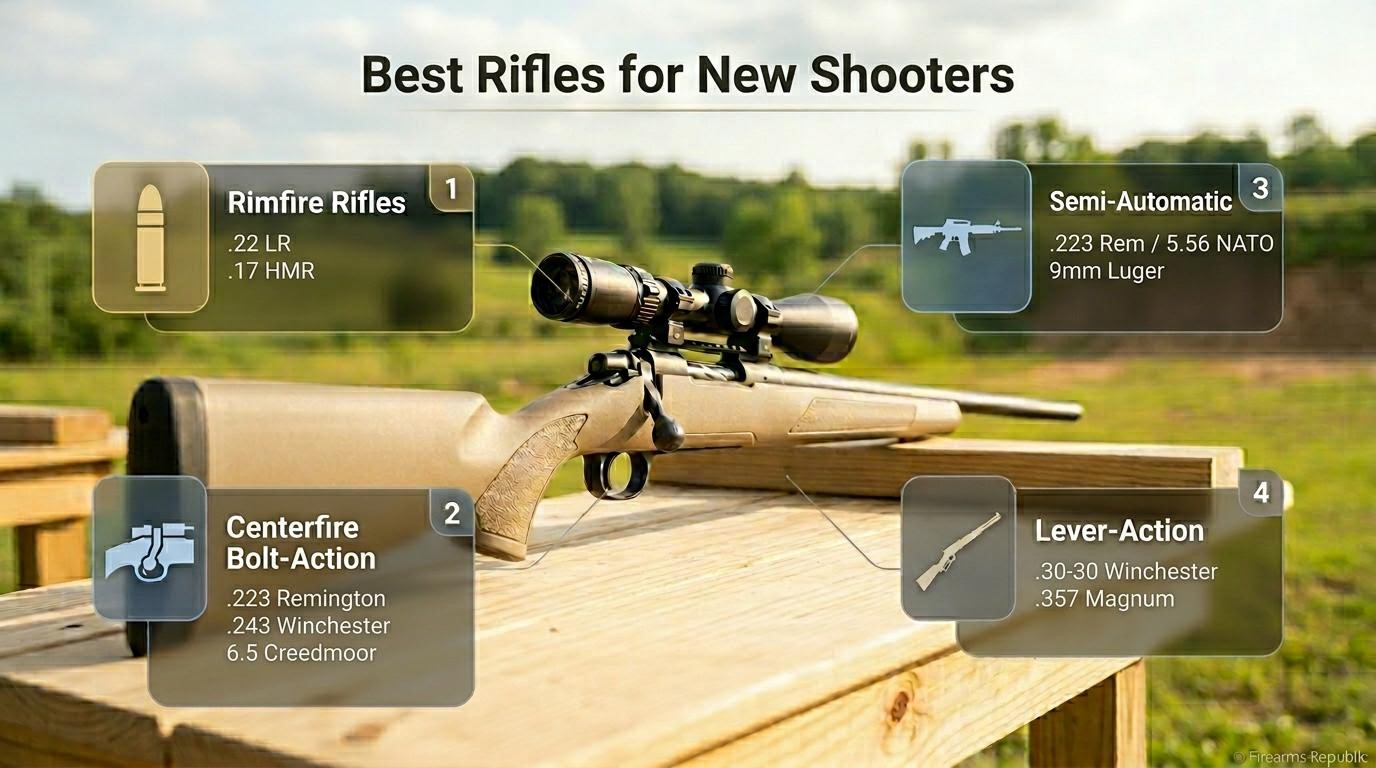
We cover every major category: rimfire for learning fundamentals, centerfire bolt-actions for hunting, semi-automatic options for versatility and home defense, and lever-actions for the traditionalist. Honest assessments, no filler, and a clear answer for every shooter profile.
Before You Buy: Five Questions to Answer First
The right first rifle depends entirely on your answers to these five questions. Take them seriously before reading further – the wrong rifle for your actual use case is money spent twice.
1. What is the primary purpose? Hunting, home defense, range shooting, and competition all point toward different rifles. A .22 LR bolt-action is a great learner; it’s a poor home defense option. An AR-15 is versatile and competition-capable; it’s not the ideal first hunting rifle for a beginner.
2. What is your realistic budget – all in? The rifle price is not the total cost. Budget for: rifle, optic or sights, ammunition (plan for 500 rounds minimum to learn fundamentals), cleaning kit, and safe storage. A $350 rifle with a $200 scope and $150 in ammunition is a $700 purchase. Plan accordingly.
3. What is your physical build and recoil tolerance? Recoil is the single biggest reason new shooters develop bad habits (flinching, rushing shots) or stop shooting entirely. Be honest about this. A 120 lb person shooting a .300 Win Mag on their first range session is going to have a bad time. Start lighter than you think you need to.
4. Do you have access to someone experienced who can teach you? If yes, let that person guide your platform choice – learning on someone else’s rifle before buying is always valuable. If no, prioritize simplicity of operation over features.
5. What state do you live in? AWB states (California, New York, New Jersey, Massachusetts, Connecticut, Maryland) restrict certain features on semi-automatic rifles. If you live in one of these states, verify any semi-automatic rifle’s compliance before purchasing.
The Case for Starting with .22 LR
Before discussing specific rifles, this needs to be said clearly: the single best thing a new shooter can do is spend significant time with a .22 LR rifle before transitioning to centerfire.
The reasoning is not about power or hunting capability – it’s about fundamentals. Trigger control, sight alignment, breathing, and follow-through are learned skills. The .22 LR allows you to develop these skills at $0.05–$0.08 per round rather than $0.35–$1.50 per round. You can shoot 500 rounds in a session for $25–$40, building the muscle memory that makes everything else easier.
Recoil from centerfire rifles – even mild calibers like .223 – creates a physical anticipation response in new shooters. The brain learns to brace for impact before the shot, causing the muzzle to dip microscopically before the trigger breaks. This is called flinching, and it’s extraordinarily difficult to unlearn once established. The .22 LR produces negligible recoil, allowing new shooters to develop proper trigger pull without the flinch reflex interfering.
This is not a suggestion to avoid centerfire rifles. It’s a suggestion to shoot .22 LR first, regularly, and deliberately before moving to heavier calibers. The transition to centerfire will be dramatically smoother.
Category 1: Rimfire Rifles (.22 LR) – Best Starting Point
Ruger 10/22 Carbine – The Default Recommendation
Price: $300–$350 | Action: Semi-auto | Caliber: .22 LR | Capacity: 10 rounds
The Ruger 10/22 has been in continuous production since 1964. Over 7 million have been manufactured. Its reputation for reliability is not marketing – it is the most consistently reliable semi-automatic rimfire ever produced, running virtually every .22 LR load without complaint due to its rotary magazine design that removes the feed angle issues that trip up other rimfire semi-autos.
For a new shooter, the 10/22’s semi-automatic action removes the manual bolt manipulation that some beginners find distracting while learning trigger and sight fundamentals. The 18.5″ barrel delivers full .22 LR velocity. The standard carbine stock fits most adults adequately out of the box. The aftermarket is enormous – if you decide to upgrade the stock, trigger, or barrel later, every component exists at every price point.
Practical first setup: Ruger 10/22 Carbine ($330) + Weaver 3–9×32 rimfire scope ($80) + 500 rounds CCI Mini-Mag ($30) = $440 total.
Limitations: Semi-automatic action is mechanically more complex than a bolt-action; more parts to understand during cleaning. Some new shooters benefit from learning on a bolt-action that forces a deliberate cycle between shots.
Savage Mark II FV-SR – Best Value Bolt-Action .22 LR
Price: $270–$310 | Action: Bolt | Caliber: .22 LR | Capacity: 10 rounds
The Savage Mark II FV-SR is the best-value bolt-action .22 LR for new shooters who want to learn deliberate, one-shot-at-a-time fundamentals. The AccuTrigger – adjustable from 2.5 to 6 lbs – is genuinely excellent for a $300 rifle, giving new shooters a clean, consistent break that teaches proper trigger pull without fighting a heavy, mushy factory trigger. The 21″ heavy barrel with a threaded muzzle (1/2×28) provides excellent accuracy and is suppressor-ready for future use.
The bolt-action forces a deliberate process: aim, shoot, manually cycle the bolt, aim again. This rhythm builds stronger fundamentals than a semi-auto for pure accuracy development.
Practical first setup: Savage Mark II FV-SR ($290) + Vortex Crossfire II 2–7×32 ($140) + 500 rounds CCI Mini-Mag ($30) = $460 total.
Marlin XT-22 – Traditional Alternative
Price: $230–$280 | Action: Bolt | Caliber: .22 LR | Capacity: 7 rounds (tubular)
Marlin’s bolt-action .22 LR offers a more traditional wood-and-steel aesthetic for new shooters who find the tactical look of modern synthetic rifles off-putting. The tubular magazine loads through the stock – a different mechanism than detachable box magazines, worth understanding. Accuracy is adequate; the factory trigger is heavier than the Savage Mark II’s AccuTrigger. At $250, it leaves more budget for optics and ammunition.
CZ 457 American – Premium Rimfire for the Serious Beginner
Price: $500–$575 | Action: Bolt | Caliber: .22 LR (.17 HMR / .22 WMR available) | Capacity: 5 rounds
If budget allows, the CZ 457 is a significant step above entry-level rimfire rifles. The cold hammer forged barrel, adjustable trigger (factory set at 2.2 lbs – exceptional for a factory rifle), and interchangeable barrel system make it a rifle that new shooters won’t outgrow. Accuracy is substantially better than entry-level options: 0.5 MOA at 50 yards with quality ammunition. The investment makes sense for shooters who are serious about developing precision skills from the start, plan to compete in rimfire events, or want a long-term quality tool rather than a learning beater.
Rimfire Comparison
| Rifle | Price | Action | Trigger | Accuracy | Best For |
|---|---|---|---|---|---|
| Ruger 10/22 Carbine | $330 | Semi-auto | 5 lbs (upgradeable) | 1.5 MOA | Volume training, reliability |
| Savage Mark II FV-SR | $290 | Bolt | AccuTrigger 2.5 lbs | 0.75 MOA | Fundamentals, suppressed |
| Marlin XT-22 | $255 | Bolt | 5 lbs | 1.5 MOA | Traditional, budget |
| CZ 457 American | $540 | Bolt | 2.2 lbs | 0.5 MOA | Long-term precision tool |
Category 2: Centerfire Bolt-Action – Best for Hunting
Ruger American Rifle – The Most Recommended First Centerfire
Price: $450–$530 | Action: Bolt | Calibers: .243 Win, 7mm-08, .308 Win, 6.5 CM, .30-06, and more
The Ruger American is the most frequently recommended first centerfire bolt-action for good reason: it delivers genuine performance at a price that doesn’t require a significant financial commitment before a new shooter knows what they want. The adjustable Marksman trigger (3–5 lbs), cold hammer forged barrel, and Ruger’s rotary magazine system all exceed what the price suggests. Accuracy runs 1–1.5 MOA with factory ammunition – more than adequate for hunting and learning.
The synthetic stock handles weather, the action cycles smoothly, and the rifle is available in virtually every popular hunting caliber. It’s not the most impressive rifle on a gun store shelf – but it’s honest value that new hunters can carry hard and shoot a lot without worrying about it.
Best caliber choices for new shooters:
- .243 Winchester – lightest recoil of the deer-capable calibers; excellent for youth and smaller-framed new hunters
- 7mm-08 Remington – mild recoil, excellent deer and elk cartridge, underappreciated
- 6.5 Creedmoor – the modern standard; slightly more recoil than 7mm-08, significantly better long-range performance
- .308 Winchester – the traditional choice; available everywhere, heavier recoil than the above options but manageable
Practical first hunting setup: Ruger American .308 ($480) + Vortex Crossfire II 3–9×40 ($170) + Weaver rings ($30) + 200 rounds Federal PowerShok ($140) = $820 total.
Savage 110 Apex Hunter XP – Best Ready-to-Hunt Package
Price: $500–$580 | Action: Bolt | Calibers: .243 Win, 7mm-08, .308 Win, 6.5 CM, .30-06, .300 Win Mag | Includes: Vortex Crossfire II 3–9×40 scope
The Savage 110 Apex Hunter XP solves the new hunter’s biggest practical problem: it ships with a scope already mounted and bore-sighted. The included Vortex Crossfire II 3–9×40 is a legitimately good optic – not a scope-shaped decoration. The AccuFit stock system adjusts length of pull and comb height with included spacers, fitting the rifle to shooters of different heights and arm lengths without aftermarket purchases.
The AccuTrigger (adjustable to 2.5 lbs) is Savage’s standout feature at this price point. Combined with the scope package, a new hunter can purchase this rifle and drive to the range for a first sighting-in session without any additional purchases except ammunition.
Recommended for: New hunters who want to minimize decision complexity and show up ready to shoot.
Mossberg Patriot Synthetic – Budget Entry Point
Price: $370–$430 | Action: Bolt | Calibers: .243 Win, 7mm-08, .308 Win, .30-06, .300 Win Mag, 6.5 CM
Mossberg’s Patriot is the most affordable centerfire bolt-action from a major manufacturer with a reputation for quality control. The LBA (Lightning Bolt Action) trigger adjusts from 2–7 lbs, the fluted bolt cycles smoothly, and the synthetic stock handles field conditions without care. Accuracy runs 1–1.5 MOA with factory ammunition – consistent with rifles at twice the price.
At $400, the Patriot leaves more budget for optics, ammunition, and training than higher-priced options. The right choice when the total system budget is tight and the optic needs to be prioritized.
Tikka T3x Lite – The Step-Up for Serious New Hunters
Price: $750–$850 | Action: Bolt | Calibers: .243 Win, 7mm-08, .308 Win, 6.5 CM, .30-06
The Tikka T3x Lite is the rifle that new hunters often wish they’d bought first after outgrowing their entry-level rifle. The smoothest bolt action in the sub-$1,000 category – Tikka’s detachable magazine, crisp 3 lb factory trigger, and cold hammer forged barrel produce a noticeably more refined shooting experience than Ruger or Savage alternatives. Accuracy is consistently sub-MOA with quality factory loads.
At 6.0 lbs in .308, it’s light enough to carry all day on a mountain hunt. The synthetic stock requires no maintenance. And the T3x platform has an excellent aftermarket for stocks and chassis upgrades if the shooter develops precision shooting interests.
The price premium over the Ruger American ($270–$320 more) is justified if the buyer plans to keep this rifle long-term rather than upgrade in 2–3 years. The T3x Lite is a rifle serious shooters don’t feel compelled to replace.
Bergara B-14 Timber – Best Wood-Stock Entry in Centerfire
Price: $850–$950 | Action: Bolt | Calibers: .243 Win, 6.5 CM, .308 Win, .30-06, 7mm Rem Mag
For new hunters who want traditional aesthetics without sacrificing performance, the Bergara B-14 Timber delivers a walnut stock, Bergara’s excellent B-14 action, and the brand’s reputation for sub-MOA accuracy at a price that doesn’t reach custom territory. The two-stage trigger is adjustable and clean. Available in the calibers that matter for North American hunting.
At $900, it’s a serious rifle that rewards a serious buyer – not the first recommendation for a new shooter on a budget, but the right answer for the buyer who wants to start with a quality rifle and not think about replacing it.
Centerfire Bolt-Action Comparison
| Rifle | Price | Weight | Trigger | Accuracy | Best For |
|---|---|---|---|---|---|
| Mossberg Patriot | $400 | 6.5 lbs | LBA 2–7 lbs | 1.5 MOA | Tightest budget |
| Ruger American | $490 | 6.1 lbs | Marksman 3–5 lbs | 1.25 MOA | Best value overall |
| Savage 110 Apex XP | $545 | 8.2 lbs | AccuTrigger 2.5 lbs | 1 MOA | Ready-to-hunt package |
| Tikka T3x Lite | $800 | 6.0 lbs | Factory 3 lbs | 0.75 MOA | Long-term quality |
| Bergara B-14 Timber | $900 | 7.2 lbs | Two-stage adj. | 0.75 MOA | Traditional aesthetics |
Category 3: Semi-Automatic – Versatile and Competition-Ready
Smith & Wesson M&P15 Sport II – Best First AR-15
Price: $700–$800 | Action: Semi-auto | Caliber: 5.56 NATO / .223 Rem | Capacity: 30 rounds (varies by state)
The M&P15 Sport II is the most recommended first AR-15 for new shooters who want an entry-level, mil-spec-compatible semi-automatic from a major manufacturer with consistent quality control. The Melonite-finished barrel offers corrosion resistance approaching chrome-lining without the cost premium. The 1:8 twist handles the full range of .223/5.56 bullet weights from 55gr training loads to 77gr precision rounds. The flat-top Picatinny rail accepts any optic.
What the Sport II doesn’t have: a forward assist and dust cover on some configurations. These are minor omissions for a sporting rifle – neither affects reliability in civilian use. What it does have: Melonite barrel, functional trigger, reliable operation, and S&W’s warranty.
For new AR owners: Start with the stock configuration. Run 500 rounds to understand how the platform functions before changing anything. The first upgrade should be an optic (Vortex Crossfire Red Dot, $180, or Strike Eagle 1–6×24, $250) and a quality sling (Magpul MS1, $40). Trigger, handguard, and stock upgrades come later after you understand what you actually want to change and why.
Ruger AR-556 – Reliable Mil-Spec Entry
Price: $750–$850 | Action: Semi-auto | Caliber: 5.56 NATO / .223 Rem | Capacity: 30 rounds
Ruger’s AR-556 is the consistent alternative recommendation to the M&P15 Sport II. Both are mil-spec compatible, both are from major manufacturers with quality control, and both deliver reliable operation with standard 5.56 ammunition. The AR-556 adds a forward assist and dust cover that the base Sport II omits. The 1:8 twist barrel is chrome-lined – a durability advantage for shooters who plan to put significant round counts through the rifle.
At $800, the AR-556 costs slightly more than the Sport II and delivers slightly more completeness out of the box. Both are correct answers – buy whichever is available at the better price.
Ruger SFAR (.308 Winchester) – Semi-Auto with Hunting Capability
Price: $1,150–$1,250 | Action: Semi-auto | Caliber: .308 Win | Capacity: 20 rounds
For new shooters who specifically want a semi-automatic rifle capable of big game hunting from day one, the Ruger SFAR in .308 Winchester is the unique recommendation. At 6.8 lbs – barely heavier than the AR-15-pattern rifles above – it delivers full .308 power in a package that doesn’t feel like carrying a full AR-10. The 16″ barrel is legal without NFA paperwork. The SFAR is DPMS-pattern compatible for future upgrades.
The .308 Winchester in this platform is more recoil than a first-time shooter should start with – plan to shoot the rifle with .308 training loads (Federal American Eagle, PMC Bronze) at a range session before attempting hunting, not the other way around.
Semi-Auto Comparison
| Rifle | Price | Weight | Caliber | Twist | Best For |
|---|---|---|---|---|---|
| S&W M&P15 Sport II | $750 | 6.5 lbs | 5.56 / .223 | 1:8 | First AR, budget |
| Ruger AR-556 | $800 | 6.5 lbs | 5.56 / .223 | 1:8 | Mil-spec completeness |
| Ruger SFAR .308 | $1,200 | 6.8 lbs | .308 Win | 1:10 | Hunting-capable semi-auto |
Category 4: Lever-Action – Traditional and Approachable
The lever-action is the most underrated first rifle recommendation for new shooters who are intimidated by the semi-automatic platform’s mechanical complexity or the tactical aesthetics of AR-pattern rifles. Lever-actions are approachable, traditional in appearance, mechanically simple, and available in calibers that handle deer and larger game with authority.
Henry Frontier .22 LR – Best Entry Lever-Action
Price: $380–$430 | Action: Lever | Caliber: .22 LR | Capacity: 21 rounds (tubular)
Henry’s Frontier is the best .22 LR lever-action available. American-made walnut stock, octagon barrel, smooth lever cycling, and Henry’s reputation for quality and customer service. The tubular magazine holds 21 rounds of .22 LR – loaded through the muzzle end of the tube, which is an unusual but smooth mechanism once learned.
For new shooters who respond well to traditional aesthetics, the Henry Frontier delivers a genuine quality firearm at an accessible price. Accuracy is excellent (1 MOA at 50 yards with quality ammunition) and reliability is very good with high-velocity loads.
Henry Big Boy Classic .357 Magnum / .44 Magnum
Price: $900–$1,050 | Action: Lever | Calibers: .357 Magnum / .38 Special, .44 Magnum / .44 Special, .45 Colt
The Henry Big Boy in .357 Magnum is the recommendation for new shooters who want a traditional lever-action capable of hunting deer at moderate distances (inside 150 yards) and who want pistol-caliber ammunition compatibility. A .357 Magnum lever-action from a 20″ barrel drives a 158gr bullet at 1,800 fps – approximately 50% more velocity than from a 4″ pistol barrel. If you own a .357 Magnum revolver, your handgun and rifle share the same ammunition.
Recoil with .357 Magnum is very manageable – less than a .308 bolt-action. The .38 Special load option in the same rifle allows inexpensive practice ammunition. An excellent and underrated recommendation for new shooters who hunt in wooded terrain at close range.
Marlin 336 .30-30 Winchester – Classic Deer Lever-Action
Price: $700–$800 | Action: Lever | Caliber: .30-30 Winchester | Capacity: 6 rounds
The .30-30 Winchester lever-action is the configuration that has killed more whitetail deer than any other in American history. The Marlin 336 in .30-30 is a reliable, compact rifle effective inside 200 yards on deer-sized game. Recoil is moderate – more than 7mm-08 or 6.5 CM but less than .308 in similar rifle weight. The compact overall length (37″ for the 20″ barrel version) handles well in dense timber.
For new hunters in the East or Midwest who hunt wooded terrain where shots rarely exceed 100 yards, the Marlin 336 in .30-30 is a traditional, capable, and affordable deer rifle that requires no modification or upgrades to be fully effective.
Caliber Guide for New Shooters
Caliber choice is the most anxiety-inducing decision for first-time rifle buyers. Here is the honest guide:
Recoil by Caliber (10 lb Rifle, Standard Loads)
| Caliber | Recoil Energy | Recoil Velocity | Classification |
|---|---|---|---|
| .22 LR | 0.2 ft-lbs | 1.4 fps | Negligible |
| .243 Winchester | 8.8 ft-lbs | 9.6 fps | Mild |
| 7mm-08 Remington | 11.7 ft-lbs | 11.4 fps | Mild–moderate |
| 6.5 Creedmoor | 12.0 ft-lbs | 11.5 fps | Mild–moderate |
| .308 Winchester | 15.8 ft-lbs | 13.6 fps | Moderate |
| .30-06 Springfield | 17.6 ft-lbs | 14.5 fps | Moderate–heavy |
| .300 Win Mag | 26.8 ft-lbs | 20.0 fps | Heavy |
| .338 Lapua | 40.0 ft-lbs | 25.0 fps | Very heavy |
Caliber Recommendations by Use Case
Learning fundamentals only: .22 LR. No other answer.
First deer hunting rifle: 6.5 Creedmoor or 7mm-08 Remington. Both offer mild-to-moderate recoil, excellent factory ammunition, and effective range past 400 yards. The 6.5 CM has better long-range ballistics; the 7mm-08 has slightly less recoil and an established track record. Either is correct.
Youth or smaller-framed new hunters: .243 Winchester. The lightest-recoiling cartridge fully capable of ethical deer and pronghorn hunting. Excellent factory ammunition options. The right choice when recoil sensitivity is a real concern.
New hunter who also wants home defense capability: .308 Winchester semi-automatic (AR-10 or Ruger SFAR). Handles deer and elk, provides adequate defensive capability. More recoil than 6.5 CM but universally available ammunition.
Home defense primary, hunting secondary: 5.56 NATO / .223 in an AR-15. Best semi-automatic defensive platform with adequate hunting capability for deer inside 200 yards with appropriate loads.
Traditional hunting, wooded terrain: .30-30 Winchester in a lever-action. Effective to 200 yards, mild recoil in a full-weight lever-action, and an 125-year track record on North American deer.
First Optic Recommendations
Every new shooter overcomplicates optic selection. For a first rifle:
Red Dot (Semi-Auto, Close Range)
Holosun 510C ($280): 2 MOA dot with 32 MOA circle, solar-powered backup, excellent battery life. The best budget red dot for an AR-15.
Vortex Crossfire Red Dot ($180): Simpler than the Holosun but fully adequate for 0–200 yard shooting. Lower cost leaves more budget for ammunition.
Low Power Variable (AR-15, Versatile)
Vortex Strike Eagle 1–6×24 ($250): The most recommended LPVO for first AR-15 buyers. 1x magnification for close-range use, 6x for 200–300 yard precision. The ACSS reticle (Primary Arms version) provides ballistic compensation without mental math.
Primary Arms SLx 1–6×24 ACSS ($350): Slightly better glass than the Strike Eagle at a modest price premium. The ACSS reticle is the most intuitive holdover system for new shooters learning to engage at varied distances.
Bolt-Action Hunting Scopes
Vortex Crossfire II 3–9×40 ($170): The default recommendation for first bolt-action hunting rifles. 3x at minimum magnification for brush and timber; 9x for 300-yard precision. Vortex’s unconditional lifetime warranty means a damaged scope is replaced without documentation or argument – a genuine advantage for new hunters who may not be gentle with equipment.
Nikon ProStaff 3–9×40 ($150): Competitive with the Crossfire II in optical quality, slightly lower cost. Good choice when budget is tight.
Leupold VX-Freedom 3–9×40 ($300): The step up from Vortex in optical quality – noticeably cleaner glass at the edges and in low light. Worth the premium if the budget exists.
Safe Storage for New Rifle Owners
Safe storage is not optional for responsible rifle ownership. It’s a legal requirement in some states and a moral obligation everywhere. For new owners:
Biometric or combination quick-access safes ($150–$400): GunVault NanoVault, Fort Knox PB1, Stack-On Quick-Access. Prevent unauthorized access while maintaining quick access for defensive purposes.
Full-size rifle safes ($400–$1,500): American Security BF Series, Liberty Centurion. Store multiple rifles with fire protection. The right investment for households with children or multiple firearms.
Trigger locks and cable locks (free–$25): The minimum acceptable solution for transport or temporary storage. NSSF’s Project ChildSafe provides free trigger locks through participating law enforcement agencies in most states.
Cable locks through most gun stores ($10–$20): Many states require a locking device to be sold with any firearm purchase. Use it.
Never store ammunition with an unlocked firearm. Separate storage of firearm and ammunition is the minimum safe storage standard.
First Range Session: What to Expect
A realistic first range session guide for new shooters:
Start at 25 yards, not 100. The goal of the first session is trigger control and sight picture – not distance. A new shooter who develops good fundamentals at 25 yards will shoot well at 100; a new shooter who struggles to hit paper at 100 will develop bad habits trying to compensate for poor technique.
Shoot no more than 100 rounds. Fatigue causes flinching and bad habits. Stop the session while you’re still shooting well, not after you’ve been struggling for an hour.
With centerfire rifles, take a break every 20 rounds. Sustained fire in a new shooter builds physical and mental tension. Short breaks reset the experience.
Dry fire at home before live fire. Trigger manipulation without ammunition reveals and trains proper technique without the noise and recoil that can interfere with developing feel. Verify the rifle is unloaded – visually and physically – before dry firing, and confirm it multiple times.
Ear and eye protection are not optional. Any centerfire rifle without a suppressor produces sound levels that cause permanent hearing damage. Double hearing protection (foam plugs under muffs) for sensitive shooters or indoor ranges. Quality eye protection – not sunglasses – deflects case debris that can and does bounce back from indoor range partitions.
Common Mistakes New Shooters Make
Buying too much rifle for their first purchase. A .338 Lapua Magnum is a phenomenal long-range cartridge. It is not a first rifle. Recoil sensitivity in new shooters is real – start lighter and work up.
Skipping .22 LR practice. The most experienced competitive shooters in the country still use .22 LR for practice. There is no shooter who is too good for rimfire fundamentals training.
Buying a cheap optic for an expensive rifle. A $100 scope on a $900 rifle is a bad decision. The optic is the interface between the shooter and the target – it deserves proportional investment. A quality $170 Vortex Crossfire II on a $400 Mossberg Patriot is a better system than a $100 no-name scope on a $900 rifle.
Neglecting cleaning. A rifle that isn’t cleaned becomes less reliable and less accurate over time. Clean after every range session, even if it’s brief. The process takes 15–20 minutes for a bolt-action, 20–30 for an AR-15.
Not seeking instruction. There is no substitute for hands-on coaching from a qualified instructor. NRA Basic Rifle courses, USCCA courses, and local range instruction programs teach safe handling and fundamentals faster than any amount of reading. The investment (typically $75–$150 for a basic course) pays for itself in ammunition saved by developing proper technique early.
Recommended First Rifle by Shooter Profile
| Shooter Profile | Recommended Rifle | Caliber | Price |
|---|---|---|---|
| Pure beginner, fundamentals focus | Ruger 10/22 or Savage Mark II | .22 LR | $290–$330 |
| Youth hunter (under 16) | Ruger American Compact | .243 Win or 7mm-08 | $490 |
| Adult deer hunter, budget | Mossberg Patriot | 6.5 CM or .308 | $400 |
| Adult deer hunter, best value | Ruger American | 6.5 CM or 7mm-08 | $490 |
| New hunter, ready-to-shoot pkg | Savage 110 Apex Hunter XP | 6.5 CM or .308 | $550 |
| Hunter wanting long-term quality | Tikka T3x Lite | 6.5 CM or .308 | $800 |
| First AR-15, home defense | S&W M&P15 Sport II | 5.56 NATO | $750 |
| Traditional aesthetic preference | Henry Frontier (.22 LR) or Marlin 336 (.30-30) | .22 LR / .30-30 | $380–$780 |
| Hunting + home defense one rifle | Ruger SFAR | .308 Win | $1,200 |
Frequently Asked Questions
Q: What is the best first rifle for a complete beginner with no shooting experience?
A: The Ruger 10/22 Carbine in .22 LR ($330) is the single best first rifle for a shooter with no previous experience. The negligible recoil eliminates the flinch reflex that ruins fundamentals in new centerfire shooters. The ammunition is inexpensive enough ($0.05–$0.08/round) to shoot 300–500 rounds per session, which is the volume required to actually develop muscle memory. The 10/22’s reliability means malfunctions won’t interrupt the learning process. The semi-automatic action removes manual bolt operation as a distraction while learning sight picture and trigger control. Once fundamentals are established – typically after 500–1,000 rounds over several sessions – transitioning to centerfire is straightforward. Skip this step and you’ll spend twice as much ammunition money correcting a flinch that developed from starting too heavy.
Q: What caliber should a new deer hunter choose?
A: 6.5 Creedmoor is the modern standard recommendation. It produces less recoil than .308 Winchester or .30-06 (the traditional default recommendations), offers better long-range ballistics than 7mm-08, and factory ammunition from Hornady, Federal, and Nosler is widely available and genuinely excellent. A new hunter who puts 100 rounds through a 6.5 CM rifle before deer season will be comfortable with the recoil and calibrated to the trajectory. The .308 Winchester is a completely valid alternative if ammunition availability is a concern in your area – it remains the most widely stocked centerfire hunting cartridge in the country. Avoid .300 Win Mag and .30-06 as first centerfire hunting calibers – the recoil is manageable with practice, but it’s more than necessary for deer and doesn’t help with developing fundamentals.
Q: Is an AR-15 a good first rifle?
A: For adults purchasing primarily for home defense, range shooting, and potential competition, yes – an AR-15 in 5.56 NATO is a capable and appropriate first rifle. The controls are standardized, training resources are everywhere, the platform is versatile, and recoil is light. The objections to AR-15 as a first rifle come down to two practical concerns: complexity and legal geography. An AR-15 has more parts to understand, clean, and maintain than a bolt-action; new owners who don’t commit to learning the platform thoroughly will have more malfunctions due to improper maintenance. And in AWB states (California, New York, New Jersey, Massachusetts, Connecticut, Maryland), AR-15s require featureless or fixed-magazine configurations that add cost and reduce ergonomics. For new hunters specifically, a bolt-action in 6.5 CM or .308 is simpler and more appropriate. For everyone else, an AR-15 is a legitimate first centerfire rifle.
Q: How much should I budget for my first rifle setup?
A: Budget for the complete system, not just the rifle. The rifle itself is one component:
- Rifle: $300–$900 depending on category
- Optic: $150–$350 for a quality first scope or red dot
- Rings and bases: $25–$60
- Ammunition – initial 500 rounds: $25–$275 depending on caliber (.22 LR is $25; .308 is $200–$275)
- Cleaning kit: $30–$60
- Storage (minimum): $25 for a cable lock; $150–$400 for a quick-access safe
- Range fees: $15–$30 per session at most ranges
Realistic minimum total for a functional system: $550–$600 for a .22 LR setup; $900–$1,100 for a centerfire bolt-action hunting setup; $1,100–$1,400 for a complete AR-15 setup. Budget buyers who cut corners on the optic or skip the ammunition investment tend to be disappointed.
Q: Do I need a suppressor as a new shooter?
A: You don’t need one, but hearing protection – electronic muffs or foam plugs – is non-negotiable. Suppressors are genuinely useful (hearing safety, reduced noise for neighbors, less flinch induction) but they require a $200 NFA tax stamp and a 6–10 month wait time. For new shooters, the priority order is: quality rifle, quality optic, adequate ammunition for training, then consider a suppressor as a future enhancement once you know your platform and intended use well. If you’re specifically building for home defense and quiet operation matters from day one, a 9mm AR-9 PCC with a suppressor or a .300 BLK AR-15 with a suppressor are legitimate configurations – but they’re more appropriate second or third purchases than first rifles for most people.
Q: How do I know when I’m ready to move from .22 LR to centerfire?
A: You’re ready when you can demonstrate consistent fundamentals at .22 LR – not when you’ve shot a certain number of rounds. Specifically: you should be able to shoot a 1″ group at 25 yards consistently (5 out of 5 shots in the group), you should be able to call your shots before seeing the target (knowing where each shot went by feel and sight picture before looking), and you should not be aware of the trigger breaking during a good shot (it should feel like a surprise when the rifle fires, not an anticipation). When these three things are true, you’re ready for centerfire. Most shooters reach this point after 300–600 rounds of deliberate practice over several sessions. Rushing past .22 LR before fundamentals are solid guarantees a longer and more expensive path to competence with centerfire.
Related Guides
- AR-15 Platform Guide – Complete AR-15 breakdown for new owners
- AR Rimfire Platform Guide – .22 LR on the AR chassis
- 6.5 Creedmoor Caliber Guide – The modern deer hunting standard
- .308 Winchester Caliber Guide – Full caliber breakdown
- Small Game Hunting Rifles – .22 LR in the field
Related Application Guides
- Whitetail Deer Hunting Rifles
- Home Defense Rifle Guide
- Youth and New Shooter Introduction