 Maksym Kovaliov
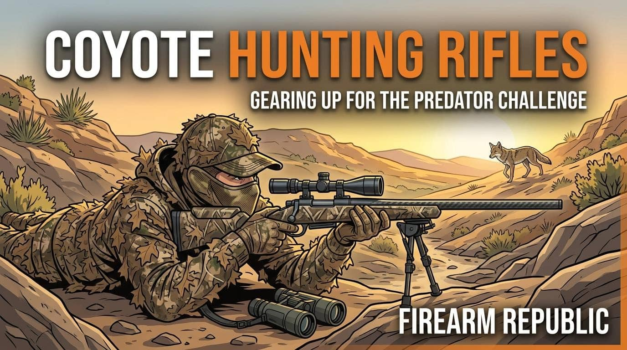
Coyote hunting is the most technically demanding rifle application that does not involve dangerous game. The target is small – a 25–45 lb animal presenting a 4–6 inch vital zone – and it is often moving, often suspicious, and often encountered at distances that test both shooter and equipment. Called coyotes may present at 20 yards or 400 yards, requiring a setup that handles both scenarios. Coyotes shot at sunrise from 300 yards across a snow-covered field demand a different rifle than coyotes decoyed to a squeaking mouse call in Kansas brush at 50 feet. Unlike deer or elk where the animal presents itself in a predictable context, coyote hunting produces genuine uncertainty about the distance, direction, and behavior of the shot that demands versatile, accurate equipment and developed shooting skills. This guide covers every element of the coyote hunting rifle equation: cartridges, platforms, setups for different terrain types, and the specific skills that determine whether a coyote stand produces results or a barking dog in the middle distance trotting away.
What Coyote Hunting Demands from a Rifle
The coyote hunting brief is specific and in some ways more demanding than deer hunting.
Small vital zone: A coyote’s heart-lung zone measures 4–6 inches in diameter. At 200 yards, this subtends approximately 1.0–1.5 MOA. A rifle that shoots 1.5 MOA with hunting ammo will miss or wound a significant percentage of coyotes at 200 yards. Genuine 0.75–1.0 MOA accuracy with the hunting load is the practical minimum for ethical coyote work at 200 yards. At 300 yards, the vital zone subtends approximately 0.8–1.0 MOA – demanding sub-1 MOA accuracy for consistent results.
Variable distances: Called coyotes work the wind. They may circle to 300 yards downwind before committing, or they may sprint in to 20 yards without hesitation. A coyote hunting rifle needs to handle both extremes – the close-range snap shot and the deliberate 300-yard set-piece – with the same optic setup.
Fur damage considerations: Many coyote hunters sell or keep pelts. Some cartridges – particularly frangible varmint loads at high velocity – produce significant pelt damage at close range. Hunters who value pelt condition think about bullet construction and velocity differently than those who are purely predator controlling.
Wind: Open-country coyote hunting in the Great Plains, the West, and agricultural Midwest involves wind that tests cartridge selection. A 10 mph crosswind at 300 yards moves a .223 Rem 55gr load approximately 7.5 inches – more than the entire vital zone of the target. Coyote hunting past 200 yards in variable wind requires cartridges with better BC than standard .223 Rem provides.
Shot volume: Serious coyote hunters run stands multiple times per night and per day across a season. Equipment that handles high round counts, manages heat during multi-shot sequences (a called coyote followed by a second that responds to the shot), and cycles fast for follow-up opportunities is meaningfully better in this application than dedicated precision equipment optimized for single shots.
Best Cartridges for Coyote Hunting
.223 Remington – The Volume Standard
The .223 Rem is the most widely used coyote cartridge in North America because it solves the volume problem: affordable practice ammo, affordable hunting ammo, and rifles that are widely available and well-supported. At 50–200 yards in moderate wind, the 55gr V-MAX or 60gr V-MAX produces effective performance on coyotes with reasonable accuracy requirements.
The limitation past 200 yards: Wind sensitivity is the .223’s honest constraint for coyote hunting. At 300 yards in a 15 mph crosswind – standard afternoon wind in the Great Plains – a 55gr load drifts approximately 11 inches. That is more than twice the coyote’s vital zone. Experienced coyote hunters time shots to wind lulls and read wind carefully. Those who do not do this consistently wound coyotes rather than recovering them.
Best coyote loads: Hornady 55gr V-MAX ($0.65–$0.80/round) for close-to-moderate range explosive fragmentation. Hornady 75gr BTHP Match ($0.90–$1.00/round) for better wind performance past 200 yards at the cost of less dramatic fragmentation. The 77gr SMK is the best .223 coyote load for 200–300 yard work in wind.
Pelt damage: At close range (inside 100 yards) with 55gr V-MAX loads, .223 produces significant exit wound damage. For fur hunters, 60–75gr hollow points at moderate velocity or subsonic .300 BLK produce much less pelt damage than frangible varmint loads. See our .223 Remington Caliber Guide.
.22-250 Remington – The Maximum Velocity Option
The .22-250 at 3,700–4,000 fps with 40–55gr bullets is the traditional long-range coyote cartridge for bolt-action hunters who want maximum velocity and the flattest trajectory available in a practical varmint round. At 300 yards in a 15 mph crosswind, a 55gr V-MAX from a .22-250 drifts approximately 7.5 inches – not dramatically better than .223 Rem with the same bullet, because wind drift is primarily a function of BC rather than velocity.
Where the .22-250 earns its reputation is trajectory: zeroed at 200 yards, the 55gr V-MAX from a .22-250 drops approximately 5 inches at 300 yards vs. 7.5 inches from a .223 Rem. This flatter trajectory reduces the impact of range estimation errors – if you misjudge a coyote at 280 yards as 250, the .22-250 misses by less. For open-country coyote hunters who take deliberate shots at known distances, this advantage is modest but real. See our .22-250 Remington Caliber Guide.
.243 Winchester with Light Loads
The .243 Win’s 75–80gr varmint loads at 3,400–3,500 fps produce better wind performance than either .223 Rem or .22-250 because the heavier, wider 6mm bullet carries better BC. At 300 yards in a 15 mph crosswind, a 75gr Hornady V-MAX drifts approximately 7.0 inches – better than .22-250 with the same wind at similar distances, and dramatically flatter trajectory than heavier .243 hunting loads. For coyote hunters who also deer hunt with a .243 Win, light-bullet loads provide genuine predator hunting performance from the same platform. See our .243 Winchester Caliber Guide.
6.5 Grendel and 6mm ARC with Light Loads
For AR-15 platform coyote hunters who want better wind performance than .223 Rem provides, the 6.5 Grendel with 90–100gr hollow point loads or the 6mm ARC with 90gr V-MAX produce meaningfully better wind resistance from the same AR-15-format rifle. The BC advantage of these cartridges extends the ethical coyote range to 300+ yards in wind that would push .223 Rem past its practical limit.
The trade-off: Higher per-round cost and the requirement for a dedicated upper assembly. For hunters who call coyotes occasionally alongside other hunting, the cost and platform change may not justify the improvement. For dedicated coyote hunters who run many stands per season, the performance improvement at 200–300 yards justifies the step up. See our 6.5 Grendel Caliber Guide and 6mm ARC Caliber Guide.
.17 HMR – The Specialized Rimfire Option
In states where .17 HMR is legal for coyotes (verify state regulations – some states require minimum centerfire energy for coyotes), it is effective inside 125 yards on smaller coyotes with good shot placement. The .17 HMR at 125 yards carries approximately 120 ft-lbs – sufficient for clean kills on coyotes with precise heart-lung shots, but marginal enough that shot placement discipline must be higher than with any centerfire option. For hunters who call coyotes in settings where close shots are the norm and suppressed operation is preferred, a suppressed .17 HMR bolt-action is the quietest legal coyote hunting setup available. See our .17 HMR Caliber Guide.
.300 Blackout Suppressed – The Stealth Option
For hunters who run multiple stands in a night on the same property, a suppressed .300 Blackout in subsonic or supersonic configuration is the lowest-noise option that does not require sacrificing effectiveness. At supersonic with 110–125gr loads, the .300 BLK carries 1,200–1,400 ft-lbs at the muzzle – sufficient for coyotes inside 200 yards. Subsonic 220gr loads at 1,050 fps carry approximately 540 ft-lbs and are effective on coyotes inside 75 yards. The dramatically reduced report from a suppressed supersonic .300 BLK is the key advantage: coyotes on a larger property may not associate the sound of a suppressed rifle with danger, allowing subsequent stands to produce results that a full-report rifle would have compromised. See our .300 Blackout Caliber Guide.
Cartridge Comparison for Coyote Hunting
| Cartridge | Load | 300 yd Drop (200 yd zero) | 15 mph Wind @ 300 yd | Best Range | Pelt Damage |
|---|---|---|---|---|---|
| .17 HMR | 17gr V-MAX | -10.8″ | 11.4″ | Under 125 yds | Minimal |
| .223 Rem | 55gr V-MAX | -11.8″ | 11.2″ | 50–200 yds | High (close) |
| .223 Rem | 77gr SMK | -13.8″ | 8.5″ | 100–300 yds | Moderate |
| .22-250 | 55gr V-MAX | -8.0″ | 10.8″ | 50–300 yds | High (close) |
| .243 Win | 75gr V-MAX | -8.5″ | 9.8″ | 100–300 yds | Moderate |
| 6mm ARC | 90gr V-MAX | -10.2″ | 7.5″ | 100–350 yds | Moderate |
| .300 BLK | 110gr FMJ | -29.0″ | 17.2″ | 50–200 yds | Variable |
Best Rifles for Coyote Hunting
Best Bolt-Action: Savage Axis II Predator in .223 Rem or .22-250 ($400–$480)
The Savage Axis II Predator with heavy barrel and AccuTrigger is the most capable and affordable dedicated coyote rifle available. The heavy barrel profile maintains accuracy during the multi-shot strings that occur when a second coyote responds to the first shot, and the AccuTrigger at 2.5–3 lbs enables the precision shot placement that small-target coyote work demands. In .22-250, the 26-inch barrel option maximizes velocity for flat-trajectory open-country work. In .223 Rem, the lower per-round cost enables more practice volume. See our Savage 110 Series Guide.
Best Budget AR-15: PSA or Anderson in .223 Rem with 20″ Heavy Barrel ($650–$900 complete)
For volume coyote hunters who want semi-auto follow-up capability at the lowest cost, a quality AR-15 in .223 Rem with a 20″ heavy barrel and a LaRue MBT-2S trigger ($85–$100) produces 0.75–1.0 MOA accuracy at a total investment under $900. The 20″ barrel maximizes .223 Rem velocity for longer-range work and provides the stiffness that supports accuracy in extended sessions. The semi-auto format is a genuine practical advantage when two or three coyotes respond to a call simultaneously. See our AR-15 Platform Guide.
Best Precision Coyote Rifle: Tikka T3x Varmint in .22-250 Rem ($950–$1,100)
The Tikka T3x Varmint’s heavy 23.5-inch barrel in .22-250 Rem produces the best combination of velocity, accuracy, and heat resistance available in a production bolt-action coyote rifle. The T3x’s factory trigger at 2 lbs is a meaningful advantage over competing heavy-barrel varmint rifles, enabling the precise shot placement that 300-yard coyote work requires. For coyote hunters who prioritize accuracy and shooting experience over cost, the T3x Varmint is the benchmark. See our Tikka T3x Complete Guide.
Best AR-15 for Extended Range: Aero Precision M4E1 Upper with 18″ 6mm ARC Barrel ($900–$1,400 built)
For coyote hunters who want to extend effective range to 300+ yards in wind from an AR-15 platform, a quality 6mm ARC upper on an existing or new lower receiver provides the best BC-driven wind performance available in the AR-15 format. The 6mm ARC’s 90gr V-MAX at 3,100 fps produces 7.5 inches of wind drift at 300 yards in a 15 mph crosswind vs. the .223 Rem’s 11.2 inches with 55gr V-MAX – a meaningful improvement for eastern open-country and plains coyote hunting where afternoon wind is the constant. A Geissele SSA-E trigger ($230) completes the precision setup.
Best Night Hunting Platform: Suppressed AR-15 in .300 BLK ($1,200–$2,500 with suppressor)
Night hunting for coyotes with thermal or night vision optics has become the dominant method on many agricultural properties. For this application, a suppressed AR-15 in .300 BLK with a Dead Air Nomad-30 or SilencerCo Omega 300 produces the quiet report that preserves multiple stand opportunities on the same property in a single night. The .300 BLK’s short action cycling in an AR-15 platform allows rapid follow-up shots on groups of coyotes without the mechanical noise of a bolt-action. See our Suppressor Buyer’s Guide.
Coyote Hunting Setup by Terrain
Open Plains and Agricultural Fields (200–400 Yards)
The Great Plains coyote hunting context – calling across winter wheat fields, CRP ground, and open farmland in Kansas, Nebraska, Oklahoma, and the Dakotas – produces the longest and most wind-exposed shots in predator hunting.
Recommended setup: Tikka T3x Varmint in .22-250 Rem or Savage 110 Predator in .22-250 with a 4–16x scope (Vortex Viper HS or equivalent), bipod, and a rear bag. A rangefinder is essential. Calling techniques in open country involve electronic callers (e.g., Fox Pro) set 50–100 yards downwind of the shooter’s position to create separation between the sound source and the rifle.
Shot sequence: Most productive open-country coyote calling involves waiting for the coyote to commit to the caller before shooting. Shots inside 200 yards in calm conditions allow any quality setup. Shots at 250–350 yards in afternoon wind require the .22-250’s flatter trajectory and a practiced wind-read before the shot.
Eastern and Midwest Agricultural (50–200 Yards)
Coyote hunting in the Midwest and eastern farmland – fence rows, woodlot edges, creek bottoms, and CRP – produces shorter shots with more variables. Coyotes in this terrain often appear suddenly at close range after using cover to approach the call.
Recommended setup: AR-15 in .223 Rem with 1–6x LPVO or red dot, or a compact bolt-action in .223 Rem or .243 Win. The 1–6x LPVO’s 1x true red dot capability handles surprise 20-yard shots; the 6x handles deliberate 200-yard shots. The AR-15’s semi-auto format is more practical in this environment where multiple coyotes in a farm field may require rapid sequential shots.
Western Mountain and Canyon Country (Variable)
Mountain and canyon coyote hunting in the Rocky Mountain West involves terrain that can produce shots from 30 to 400 yards without prediction. A coyote in a brushy canyon bottom may come to 30 yards; one spotted on a ridge line opposite may require a 350-yard shot.
Recommended setup: A versatile bolt-action in 6mm ARC or 6.5 Grendel for AR-15 hunters, or a .243 Win bolt-action for those who want a traditional setup. The key is a scope with a wide enough magnification range (2–10x or 3–12x) and a rangefinder that confirms distance before the shot. Mountain wind requires better BC bullets than .223 Rem provides at the longer shots this terrain produces.
Night Hunting Considerations
Night hunting for coyotes is legal in most states and has grown significantly with the availability of affordable thermal and night-vision optics. Several specific considerations apply:
Equipment: Thermal monoculars or clip-on objectives (FLIR Scout TK, Pulsar Axion) identify coyotes in the dark. Thermal scope systems (Pulsar Trail, FLIR PTS233) allow aiming and shooting without a separate observation device. Night vision is the alternative with more natural-looking imagery but requires some ambient light or an infrared illuminator.
Suppressor advantage: The reduced report of a suppressed rifle matters more in night hunting than in day hunting because the lower noise signature may allow additional stands on the same property without alarming the area’s remaining coyote population. The .300 BLK suppressed platform has become the default choice for dedicated night hunters for this reason.
Electronic callers and decoys: Electronic callers (Fox Pro, ICOtec) with wireless remote operation allow the caller to be placed away from the shooter’s position, creating realistic separation between sound source and shooter. Decoys that move (Mojo Critter, Flambeau Masters Series) attract coyotes’ visual attention away from the shooter’s position. These tools work in daylight; in thermal night hunting they are less critical because the shooter’s heat signature is less visible to coyotes at distance.
See our Night Hunting Rifles & Optics Guide for full night hunting equipment and technique coverage.
Optics for Coyote Hunting
For Close to Moderate Range (Under 200 Yards)
A 1–6x LPVO provides the most versatility for the variable distances coyote calling produces. At 1x, a called coyote at 25 yards can be engaged quickly. At 6x, a 200-yard deliberate shot is precise. Vortex Strike Eagle 1–6×24 ($300–$350) and Leupold Mark 3HD 1.5–5×20 ($350–$400) cover the practical range. See our Best LPVO Scopes for AR-15 guide.
For Extended Range (Up to 350 Yards)
A 4–16x variable with side-focus parallax adjustment handles 300–350 yard coyote shots with the precision the small target requires. Vortex Viper HS 4–16×44 ($420–$480) is the standard mid-tier choice. Side-focus parallax adjustment is non-negotiable for 200+ yard coyote hunting – a scope with fixed parallax introduces aiming errors at distances other than the fixed setting. See our Best Hunting Scopes guide.
Frequently Asked Questions
What is the best rifle for coyote hunting?
For most hunters, an AR-15 in .223 Rem with a quality trigger (LaRue MBT-2S or Geissele SSA-E) and a 1–6x LPVO for moderate-range work, or a Savage Axis II Predator or Tikka T3x Varmint in .22-250 for open-country bolt-action precision. The AR-15’s semi-auto follow-up capability is practically useful when multiple coyotes respond to a call; the bolt-action’s accuracy potential is better for single-shot deliberate 300+ yard work.
What caliber kills coyotes the most effectively?
The .22-250 with 55gr V-MAX is the classic answer for explosive, immediate incapacitation at moderate to long range. For hunters who also want to preserve pelts, the 60–75gr hollow point .223 Rem loads or a suppressed .300 BLK supersonic produce much less pelt damage. For 300+ yard work in wind, the 6mm ARC or 6.5 Grendel with 90–100gr hollow point loads provide better wind resistance than either .223 Rem or .22-250 with comparable bullets.
Is .17 HMR adequate for coyotes?
Marginal and situational. At 125 yards with good shot placement through the heart-lung zone, it will kill a coyote. The energy at that distance (~120 ft-lbs) is at the lower bound for reliable incapacitation on a 35–45 lb animal. Shot placement errors that are recoverable with centerfire cartridges result in wounding with .17 HMR. For hunters who specifically want a rimfire for coyotes, the .17 HMR is the best rimfire option – but a centerfire is the more ethical and reliable choice.
Do I need a suppressor for coyote hunting?
Not required, but genuinely useful for specific hunting scenarios. On private property where multiple nights of hunting are planned, a suppressed setup’s lower noise signature preserves subsequent stand opportunities. In areas near residences where shot report is a community consideration, a suppressor reduces that impact. For public land and general coyote hunting, a suppressor is a quality-of-life improvement rather than a necessity.
What electronic caller is best for coyote hunting?
Fox Pro Shockwave ($280–$320) and ICOtec GC500 ($160–$200) are the primary recommendations at different price points. Both produce quality sound reproduction, accept wireless remote operation, and handle field conditions reliably. The Fox Pro’s sound quality and library depth make it the premium choice; the ICOtec is the value alternative. Place the caller 50–75 yards downwind of your position to create realistic separation between the sound source and the shooter.
How do I set up for a coyote stand?
Set up with wind in your face or crossing your position (never at your back). Position yourself with the sun behind you when possible. Place the electronic caller 50–75 yards downwind of your shooting position. Get stable – bipod, rear bag, shooting sticks, or prone with a pack rest. Call for 15–20 minutes, starting with subtle sounds (mouse squeaks, cottontail in distress) before escalating to louder, more aggressive coyote vocalizations. Most productive calling occurs at dawn, dusk, and on overcast days. Allow 30 minutes between stands to let the area resettle before starting again nearby.