 Maksym Kovaliov
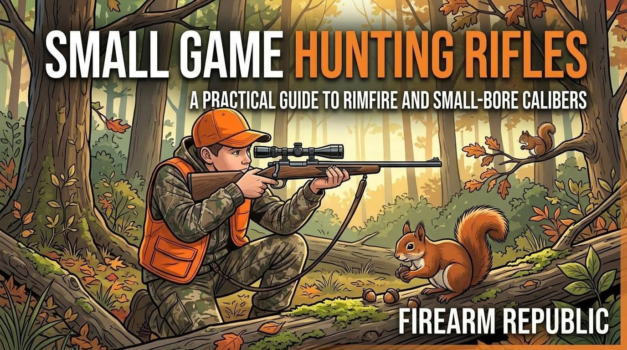
Small game hunting is where most American hunters start – and where many of the best hunters spend the bulk of their time afield. Squirrel season opens weeks before deer, rabbit hunting stretches from October through February across most of the country, and prairie dog towns offer some of the most volume-intensive rifle shooting available without a trip to a formal range. Yet small game rifles get less attention than any other category in the firearms press.
This guide fixes that. Small game hunting covers a wider range of scenarios than most shooters realize – from 20-yard shots at squirrels in hardwood canopy to 300-yard prairie dog shots in open Wyoming terrain – and the right rifle, caliber, and setup differs significantly between them. We cover every meaningful caliber, the best platform options across price points, and the specific setups that work in real hunting conditions.
Defining “Small Game” – What We’re Hunting
Small game hunting in the U.S. covers animals that fall into a few distinct categories:
Tree squirrels – Fox squirrel, gray squirrel, and western gray squirrel. Shots typically 15–60 yards from elevated positions or ground level in hardwood timber. A destroyed squirrel is a wasted squirrel – shot placement and caliber selection matter for keeping meat intact.
Cottontail and jackrabbit – Cottontails are hunted in brush and field edges at 10–50 yards, often with dogs. Jackrabbits in open western terrain can require shots to 150 yards. Jackrabbits are often pest control as much as hunting.
Grouse and pheasant (rifle hunting) – Legal with rifle in some states; shot placement is critical. Rifles are used where shotguns are impractical or where ranges extend beyond shotgun capability.
Hare – Snowshoe hare in northern states, similar shots and scenarios to cottontail but larger target.
Prairie dogs and ground squirrels – Varmint hunting that blurs the line between small game and pest control. Prairie dog towns involve extremely high shot volumes at 50–300 yards. A completely different technical challenge from woodland squirrel hunting.
Groundhog / Woodchuck – Agricultural pest targets from 50 to 300+ yards, often with precision rifles from field positions or fence lines.
Crow and raven – Legal in most states year-round as unprotected species; rifle hunting requires precise shot placement.
Understanding which of these you’re primarily hunting determines everything about the right caliber and platform choice.
Caliber Guide for Small Game
.22 LR – The Universal Small Game Cartridge
The .22 LR has been the standard small game cartridge in North America for over a century, and nothing has displaced it for woodland small game hunting. It’s accurate enough for head shots on squirrels at 75 yards, quiet enough to hunt without disturbing neighbors or other game, and cheap enough to allow the practice volume that builds the precision small game hunting demands.
Strengths:
- Negligible recoil – ideal for youth hunters and high-volume sessions
- Hearing-safe suppressed with standard velocity loads
- Inexpensive – $0.04–$0.08/round bulk, $0.12–$0.20 for quality hunting loads
- Minimal meat damage on squirrel and rabbit with solid or expanding bullet
- Available everywhere
Limitations:
- Effective range approximately 75 yards for hunting; 100 yards maximum for confident shots
- Susceptible to wind drift past 75 yards – a 10 mph crosswind moves a 40gr bullet 4–5 inches at 100 yards
- Marginal on jackrabbit past 75 yards – insufficient energy for clean kills
- Not appropriate for groundhog past 100 yards
Best .22 LR loads for small game:
| Load | Bullet | Velocity | Best For |
|---|---|---|---|
| CCI Mini-Mag HP | 36gr HP | 1,260 fps | General squirrel / rabbit |
| CCI Velocitor | 40gr HP | 1,435 fps | Maximum .22 LR performance |
| Federal Premium Game-Shok | 38gr HP | 1,260 fps | Clean kills, good expansion |
| CCI Quiet-22 | 40gr LRN | 710 fps | Suppressed, pest control |
| Eley Subsonic Hollow | 38gr HP | 1,040 fps | Suppressed precision |
.17 HMR – The Precision Small Game Upgrade
The .17 HMR (Hornady Magnum Rimfire) was introduced in 2002 and quickly established itself as the best small game and varmint cartridge for shots from 75 to 175 yards. It drives a 17gr or 20gr bullet at 2,375–2,550 fps from a 20″ barrel – nearly twice the velocity of .22 LR – with a trajectory so flat it requires minimal hold compensation to 150 yards.
Strengths:
- Dramatically flatter trajectory than .22 LR – 2.5″ drop at 150 yards vs. 12″ for .22 LR
- Less wind drift than .22 LR – a 10 mph wind moves a 17gr V-Max 2.8″ at 150 yards vs. 7″ for a .22 LR
- Reliable expansion at all ranges with V-Max bullets
- Accurate – quality .17 HMR rifles routinely produce 0.5 MOA at 100 yards
- Effective to 200 yards on prairie dogs and groundhogs
Limitations:
- Ammunition cost – $0.18–$0.30/round, significantly more than .22 LR
- Explosive fragmentation makes .17 HMR inappropriate for squirrel (destroys meat)
- Limited availability in rural areas compared to .22 LR
- Not hearing-safe unsuppressed for most shooters
- Suppressors are less effective than on subsonic .22 LR (still supersonic through suppressor)
Best .17 HMR loads for small game:
| Load | Bullet | Velocity | Best For |
|---|---|---|---|
| Hornady V-Max 17gr | 17gr V-Max | 2,550 fps | Prairie dog, groundhog |
| CCI GamePoint 20gr | 20gr JSP | 2,375 fps | Rabbit, jackrabbit (heavier bullet) |
| Federal V-Shok 17gr | 17gr Speer TNT | 2,530 fps | Varmints |
.22 WMR (.22 Magnum) – The Middle Ground
The .22 WMR (Winchester Magnum Rimfire) predates the .17 HMR by four decades and occupies a different niche – more energy than .22 LR, less precision than .17 HMR, but with ammunition that hits the sweet spot for jackrabbit and larger small game out to 125 yards.
Strengths:
- More energy than .22 LR – a 40gr .22 WMR load at 1,875 fps produces 311 ft-lbs vs. 140 ft-lbs for .22 LR
- Less explosive than .17 HMR with appropriate hunting bullets – better for squirrel and rabbit meat preservation
- Available in combination guns (rifle/shotgun) for mixed hunting
- Better terminal performance than .22 LR on jackrabbit and hare
Limitations:
- Expensive relative to performance – $0.25–$0.40/round for a caliber that doesn’t match .17 HMR at range
- Fewer rifle options than .22 LR or .17 HMR
- Not as flat-shooting as .17 HMR
Best .22 WMR loads:
| Load | Bullet | Velocity | Best For |
|---|---|---|---|
| Hornady V-Max 30gr | 30gr V-Max | 2,200 fps | Varmints, prairie dog |
| CCI Maxi-Mag 40gr | 40gr JHP | 1,875 fps | Jackrabbit, hare |
| Federal Premium 30gr | 30gr V-Shok | 2,200 fps | General purpose |
.223 Remington / 5.56 NATO – The Varmint Standard
When the target is prairie dogs, groundhogs, or coyotes at 100–400 yards, the .223 Remington takes over from rimfire options. It’s the most popular varmint cartridge in the country – accurate, widely available, affordable (by centerfire standards), and available in every rifle platform from bolt-action to semi-automatic AR-15.
Strengths:
- Flat trajectory – 3″ drop at 300 yards with a 100-yard zero and 55gr bullet
- Excellent accuracy potential – quality .223 barrels routinely produce 0.5 MOA
- Wide bullet selection – 35gr to 77gr for different applications
- Available in every platform type
- Relatively quiet for centerfire (still requires hearing protection)
Limitations:
- Dramatically more expensive than rimfire – $0.35–$0.55/round
- More meat damage than rimfire on small targets – inappropriate for squirrel
- Over-penetration risk in agricultural settings
- Report is louder than rimfire even with a suppressor (supersonic crack)
Best .223 loads for varmint hunting:
| Load | Bullet | Velocity | Best For |
|---|---|---|---|
| Hornady Varmint Express 55gr | 55gr V-Max | 3,240 fps | Prairie dog, general varmint |
| Federal V-Shok 43gr | 43gr Speer TNT HP | 3,300 fps | Maximum fragmentation, prairie dog |
| Nosler Varmageddon 55gr | 55gr FB Tipped | 3,240 fps | Long-range varmints |
| Sierra BlitzKing 55gr | 55gr BlitzKing | 3,240 fps | Accuracy + fragmentation |
.22-250 Remington – The Long-Range Varmint Specialist
When prairie dog or groundhog shots consistently stretch past 250 yards, the .22-250 Remington offers a meaningful step up from .223. It drives a 55gr bullet at 3,680 fps – approximately 450 fps faster than .223 – producing a flatter trajectory and less wind drift at extended range.
Strengths:
- 3,680 fps (55gr) from a 24″ barrel – the fastest factory .22 caliber available
- 3″ drop at 350 yards vs. 6″ for .223 at the same distance
- Wind drift reduced approximately 15–20% vs. .223 at 300 yards
- Available in all major bolt-action varmint platforms
Limitations:
- Barrel wear – the .22-250 is notoriously hard on barrels; expect 2,000–3,000 rounds before accuracy degrades vs. 8,000–10,000 for .223
- More expensive ammunition – $1.00–$1.80/round for quality factory loads
- Excessive for anything inside 200 yards
- Loud – significantly more report than .223
Caliber Selection Summary
| Caliber | Best Range | Primary Game | Cost/Round | Noise | Meat Damage |
|---|---|---|---|---|---|
| .22 LR | 0–75 yards | Squirrel, rabbit | $0.05–$0.08 | Low | Minimal |
| .17 HMR | 50–175 yards | Rabbit, prairie dog, groundhog | $0.20–$0.30 | Moderate | High (V-Max) |
| .22 WMR | 0–125 yards | Jackrabbit, hare | $0.25–$0.40 | Moderate | Low–moderate |
| .223 Rem | 75–350 yards | Prairie dog, groundhog, coyote | $0.35–$0.55 | Loud | High |
| .22-250 Rem | 150–400+ yards | Prairie dog, groundhog (long range) | $1.00–$1.80 | Very loud | Very high |
Platform Guide: Which Action Type for Small Game?
Bolt-Action
The default choice for precision small game and varmint hunting. Bolt-actions offer the best inherent accuracy of any repeating action, handle a wide range of pressures and cartridges, and are typically the lightest option in any given caliber. For squirrel hunting where deliberate single shots are the norm, prairie dog shooting where maximum accuracy per shot matters, or any application where the rifle will be carried for hours in varied terrain, bolt-action is the right starting platform.
Best bolt-action small game calibers: .22 LR, .17 HMR, .22 WMR, .22-250
Semi-Automatic
Semi-automatic rifles – AR-15 in .223 for varmints, AR rimfire or dedicated .22 LR rifles for woodland small game – offer rapid follow-up shot capability that changes the character of hunting. For prairie dog towns where multiple targets present simultaneously, cottontail hunting with a dog where shots come fast, or pest control scenarios, the semi-automatic’s speed advantage is genuine.
Best semi-auto small game platforms: AR-15 (.223, .22 LR conversion), dedicated .22 LR AR (M&P15-22), Ruger 10/22
Lever-Action
Lever-action .22 LR rifles – Marlin 39A, Henry Classic, Winchester Model 9422 – are traditional small game tools with a devoted following. They’re typically heavier and slower to reload than bolt-actions but have a handling quality that many hunters prefer. Accuracy is comparable to entry-level bolt-actions. A good choice if you value tradition and an all-weather tool that requires minimal maintenance.
Single-Shot
Falling-block and break-action single shots (Ruger No. 1, Thompson/Center Encore, H&R Handi-Rifle) are the deliberate hunter’s choice. One shot forces discipline, reduces the temptation for spray-and-pray at marginal ranges, and is entirely adequate for squirrel, rabbit, and woodchuck where careful shot placement is required anyway. Available in every small game caliber from .22 LR through .22-250.
Best Small Game Rifles by Category
Best .22 LR Bolt-Action Rifles
Ruger American Rimfire ($350–$400) Ruger’s budget bolt-action .22 LR is the most recommended entry-level small game rifle in the category. The adjustable trigger (2.5–5 lbs), 18″ cold hammer forged barrel, and rotary magazine system deliver genuine accuracy – 0.75–1 MOA at 50 yards with quality ammunition – at a price that leaves budget for a quality scope. The synthetic stock handles weather without care. Standard and threaded barrel versions available; threaded for $25 more is worth it for future suppressor use.
CZ 457 American ($500–$600) The CZ 457 is the precision choice in .22 LR bolt-actions. The cold hammer forged barrel, adjustable trigger (factory set at 2.2 lbs), and interchangeable barrel system make it genuinely competitive at rimfire precision events. Accuracy is a step above the Ruger American – expect 0.5 MOA at 50 yards with Eley or SK match ammunition. Available in .22 LR, .17 HMR, and .22 WMR with barrel swaps. At $550, it’s the best precision small game rifle under $700.
Savage Mark II FV-SR ($280–$320) Savage’s value-leader in .22 LR bolt-actions. The AccuTrigger (user-adjustable to 2.5 lbs) is the best factory trigger at this price point, the 21″ heavy barrel with threaded muzzle (1/2×28) is suppressor-ready, and accuracy runs 0.75–1 MOA with quality ammunition. The FV-SR is the specific variant to seek out – the heavy barrel and threaded muzzle make it ideal for a suppressed small game setup. At $300, nothing else delivers this combination.
Tikka T1x MTR ($500–$550) Tikka’s rimfire leverages the same smooth action and cold hammer forged barrel technology as the centerfire T3x. The result is the smoothest bolt-action in .22 LR under $600 – butter-smooth cycling, a clean factory trigger at 3 lbs, and thread-ready barrel. Accuracy matches the CZ 457. An excellent choice if you value tactile quality and plan to use the same manual of arms as a T3x centerfire.
Best .17 HMR Bolt-Action Rifles
Savage B.Mag ($350–$400) Savage’s purpose-built .17 HMR and .22 WMR platform with the AccuTrigger and a 22″ heavy barrel. Accurate (0.5 MOA at 100 yards with Hornady V-Max) and affordable. The B.Mag is the standard recommendation for a dedicated .17 HMR rifle.
Ruger American Rimfire .17 HMR ($370–$420) The same Ruger American platform in .17 HMR – the cold hammer forged barrel and rotary magazine translate well to the magnum rimfire cartridge. Accuracy is 0.5–0.75 MOA at 100 yards. A slightly softer recommendation than the Savage B.Mag due to trigger quality, but more widely available.
CZ 457 Varmint .17 HMR ($600–$650) CZ’s heavy-barreled varmint version in .17 HMR is the precision choice. The heavier barrel profile reduces harmonic variation and keeps shots consistent during extended prairie dog sessions. 0.4–0.5 MOA at 100 yards with Hornady V-Max. A serious rifle for serious varmint hunters.
Best .223 / .22-250 Varmint Rifles
Savage 12 Varminter ($700–$800) Savage’s dedicated varmint platform in .223 or .22-250 with a heavy 26″ stainless barrel, AccuTrigger, and a design built around long-range accuracy from a bench or bipod. Consistent 0.5 MOA groups with quality ammunition. The go-to recommendation for a dedicated varmint rifle at this price point.
Ruger American Predator (.223 / .22-250) ($500–$550) Ruger’s Predator is the value leader in centerfire small game and varmint rifles. The 22″ medium-contour barrel in .223 or .22-250, green synthetic stock (designed for field carry as much as bench shooting), and Ruger’s Marksman Adjustable trigger deliver 1 MOA accuracy at a budget-accessible price. The most recommended affordable .223 varmint rifle for field hunting – it’s lighter and more practical to carry than heavy-barreled bench rifles.
Tikka T3x Varmint (.223 / .22-250) ($900–$1,000) Tikka’s T3x Varmint brings the T3x’s legendary smooth bolt and exceptional factory accuracy to a heavy-barreled varmint configuration. The 23.3″ heavy barrel and adjustable cheekpiece make it a legitimate precision varmint tool. Accuracy runs 0.5 MOA with quality factory loads. The smoothest cycling varmint rifle in the mid-range category.
Bergara B-14 HMR .223 ($950–$1,050) Bergara’s B-14 HMR in .223 is the crossover choice between varmint rifle and long-range precision tool. The threaded heavy barrel, AICS-compatible magazine system, and adjustable HMR stock make it a dual-purpose rifle: capable at prairie dogs to 400 yards and competitive in precision shooting formats. A significant step up in build quality from Savage and Ruger alternatives.
Best Semi-Auto Small Game Rifles
Smith & Wesson M&P15-22 Sport ($450–$500) The best AR-platform .22 LR for squirrel, rabbit, and general small game. Runs reliably with CCI Mini-Mag, comes with M-LOK handguard and adjustable stock, and shares the AR-15’s manual of arms exactly. At $450, it’s the right choice for AR-15 owners wanting a rimfire companion. See the full AR Rimfire Platform Guide for detailed breakdown.
Ruger 10/22 Carbine ($300–$350) The most reliable semi-automatic rimfire ever made. The 10/22 has been in production since 1964 and has earned its reputation through decades of field use. Rotary 10-round magazine feeds virtually every .22 LR load without complaint – the reliability floor of the 10/22 significantly exceeds any AR rimfire design. Standard carbine stock, 18.5″ barrel, and a massive aftermarket for stocks, barrels, triggers, and optic mounts. At $300, it’s the best small game semi-auto for hunters who prioritize reliability over AR platform familiarity.
Ruger 10/22 Takedown ($450–$500) The Takedown version separates into two pieces – barrel/forend and action/stock – for storage in a backpack or discreet carry case. 18.5″ barrel, same action reliability as the standard 10/22. Genuinely useful for hunting situations where pack space is limited – backcountry trips, canoe hunting, travel. A significant practical advantage over standard carbines for mobile hunters.
CMMG Mk4 .22 LR ($700–$800) CMMG’s dedicated AR-15-pattern .22 LR upper on a standard lower receiver. Better reliability than conversion kits, true AR-15 controls and dimensions, threaded barrel standard. The right choice for competitive shooters who want a dedicated .22 LR upper on their existing lower – same trigger, same everything. See the AR Rimfire Platform Guide for full comparison.
Complete Rifle Comparison
| Rifle | Caliber | Price | Action | Weight | Accuracy | Best For |
|---|---|---|---|---|---|---|
| Ruger American Rimfire | .22 LR | $380 | Bolt | 5.1 lbs | 0.75 MOA | General small game |
| Savage Mark II FV-SR | .22 LR | $300 | Bolt | 6.0 lbs | 0.75 MOA | Suppressed setup |
| CZ 457 American | .22 LR | $550 | Bolt | 5.8 lbs | 0.5 MOA | Precision rimfire |
| Tikka T1x MTR | .22 LR | $525 | Bolt | 5.5 lbs | 0.5 MOA | Quality / feel |
| Savage B.Mag | .17 HMR | $380 | Bolt | 5.0 lbs | 0.5 MOA | .17 HMR value |
| CZ 457 Varmint | .17 HMR | $625 | Bolt | 6.5 lbs | 0.4 MOA | .17 HMR precision |
| Ruger American Predator | .223 | $530 | Bolt | 6.7 lbs | 1 MOA | Field varmint |
| Savage 12 Varminter | .22-250 | $760 | Bolt | 8.9 lbs | 0.5 MOA | Bench varmint |
| Bergara B-14 HMR | .223 | $1,000 | Bolt | 8.7 lbs | 0.5 MOA | Precision varmint |
| Ruger 10/22 Carbine | .22 LR | $330 | Semi-auto | 5.0 lbs | 1.5 MOA | Reliability |
| S&W M&P15-22 Sport | .22 LR | $475 | Semi-auto | 5.0 lbs | 1.5 MOA | AR training |
Optics for Small Game Rifles
Optic selection follows the hunting scenario as much as the caliber.
.22 LR Woodland Hunting (Squirrel, Rabbit)
Shots are close – 15 to 75 yards – and targets are in timber or brush. A fixed 4x scope or low variable 2–7x is the right tool. Higher magnification makes target acquisition slow and field of view too narrow in heavy cover. The Bushnell Banner 2–7×35 ($85) and Nikon ProStaff Rimfire II 3–9×40 ($120) are the standard recommendations at this use case.
Red dots (Vortex Crossfire Red Dot, $60) work well for squirrel hunting where shots are inside 50 yards and fast acquisition in trees matters more than precision at distance.
.17 HMR and .22 WMR (Open Country)
Shots stretch to 150–200 yards. A 3–9×40 or 4–12×40 scope with a fine crosshair or BDC reticle is appropriate. The Vortex Diamondback 3–9×40 ($200) and Nikon Prostaff 3–9×40 ($150) are solid choices. For precision prairie dog or groundhog shooting at the limits of .17 HMR range, move up to a 4–12x or 6–18x with a parallax adjustment.
.223 and .22-250 Varmint Rifles
Long-range varmint shooting demands real glass. At 300+ yards on a 3″ prairie dog, image quality and precise reticle adjustment matter. A 6–24x or 8–32x side-focus scope is the standard for dedicated varmint work. The Vortex Viper PST 6–24×50 ($600) and Bushnell Elite 4500 4–16×40 ($500) represent the price/performance sweet spot. Mil-based reticles (Vortex EBR-1, Nightforce MOAR) allow precise wind and elevation holds without constant turret adjustment during active prairie dog sessions.
Hunting Scenarios and Recommended Setups
Squirrel Hunting in Hardwood Timber
The scenario: Fox and gray squirrels in mixed oak-hickory timber. Shots from 15 to 60 yards, often through branches and leaf cover. Meat preservation is a priority – a destroyed squirrel is a ruined meal.
Recommended setup:
- Rifle: Ruger American Rimfire or CZ 457 in .22 LR
- Ammo: CCI Mini-Mag 36gr HP or Federal Gold Medal Target (for clean head shots)
- Optic: Fixed 4x or 2–7x variable
- Suppressor: Ideal – reduces noise and allows multiple shots in an area without spooking remaining squirrels
Shot placement: Head shots only on squirrels with any expanding .22 LR load. Body shots with hollow points destroy the hindquarters. A solid round (CCI Standard, Federal Value Pack) through the shoulder at close range is more forgiving for body shots.
Cottontail Rabbit Hunting
The scenario: Cottontails in brush piles, fence rows, and field edges. Dogs push rabbits to standing hunters; shots are fast, 15–40 yards, often at moving targets.
Recommended setup:
- Rifle: Ruger 10/22 or M&P15-22 (semi-auto for running shots) or Marlin 39A (lever-action tradition)
- Ammo: CCI Mini-Mag 36gr HP or Federal AutoMatch
- Optic: Red dot or 2–4x – fast acquisition matters more than magnification
- Alternative: .22 WMR in a bolt-action for hunters who regularly take 50–75 yard shots in open country
Note: Many states require small game to be unprocessed until returning from the field – know regulations on transporting rabbits with evidence of species.
Jackrabbit Hunting in the West
The scenario: Black-tailed and white-tailed jackrabbits in open sagebrush, agricultural fields, and desert scrub. Shots range from 30 to 150 yards. Jackrabbits are large – 5 to 12 lbs – and require more energy than cottontails for clean kills.
Recommended setup:
- Rifle: CZ 457 or Savage B.Mag in .17 HMR, or bolt-action .22 WMR
- Ammo: .17 HMR CCI GamePoint 20gr (heavier bullet for better penetration on large jackrabbits), .22 WMR CCI Maxi-Mag 40gr JHP
- Optic: 3–9×40 with BDC or ballistic reticle for .17 HMR hold compensation
Prairie Dog Towns
The scenario: Black-tailed prairie dog colonies in short-grass prairie (SD, WY, MT, CO). Targets are 3–4″ in diameter at 50–350 yards. High shot volume – 200–500 rounds in a day session is not unusual. Multiple shooters working adjacent dog towns from a prone position or shooting bench.
Recommended setup – moderate range (to 200 yards):
- Rifle: Ruger American Predator in .223, Savage 12 Varminter in .223
- Ammo: Hornady Varmint Express 55gr V-Max, Federal V-Shok 43gr
- Optic: Vortex Viper PST 6–24×50 or Bushnell Elite 4500
Recommended setup – long range (to 350 yards):
- Rifle: Savage 12 Varminter or Bergara B-14 HMR in .22-250
- Ammo: Hornady Varmint Express 55gr V-Max, Nosler Varmageddon 55gr
- Optic: 8–32x side-focus, mil-based reticle for wind holds
Practical note: Prairie dog shooting often happens on Bureau of Land Management (BLM) or private agricultural land. Obtain landowner permission before accessing private land – most ranchers welcome prairie dog hunting as pest control and will provide access willingly.
Groundhog / Woodchuck Hunting
The scenario: Groundhogs at field edges, fence rows, and agricultural ground from New England to the Midwest. Shots from 50 to 300+ yards from field positions, vehicles, or improvised rests. Challenging because groundhogs are alert, fast to den, and require precise shots to prevent wounded animals disappearing underground.
Recommended setup:
- Rifle: .22-250 or .223 in heavy-barreled bolt-action; .17 HMR for shots inside 175 yards
- Ammo: .22-250 Hornady V-Max 55gr, .223 Federal V-Shok 43gr
- Optic: 4–16x minimum; 6–24x preferred for consistent hits past 200 yards
- Rest: Bipod or shooting sticks – clean prone or sitting position mandatory for groundhog at distance
Suppressors and Small Game
The suppressor is more practical for small game hunting than any other hunting application. The reasons are straightforward:
- Multiple shots without dispersing remaining game – A suppressed .22 LR in squirrel timber allows follow-up shots on a second or third squirrel in the same tree without the report that scatters the group. This is a genuine hunting advantage, not just a comfort feature.
- Hearing safety – Small game hunting often involves multiple shots per hour over a full day. Cumulative noise exposure from an unsuppressed .22 LR across a full season is meaningful.
- Neighbor relations – In agricultural and semi-rural areas where pest control is ongoing, suppressed shooting reduces friction with neighbors and bystanders.
Suppressor requirements for small game: The hunting animal will be harvested in a state with legal suppressor hunting (most states – verify yours). Some states have added suppressor hunting permissions in recent years; consult your state wildlife agency.
Recommended suppressors for small game rifles:
| Suppressor | Caliber | Length | Weight | Price | Notes |
|---|---|---|---|---|---|
| SilencerCo Sparrow 22 | .22 LR | 5.1″ | 4.5 oz | $450 | Best all-around rimfire can |
| Dead Air Mask HD | .22 LR / .17 HMR | 5.4″ | 7.9 oz | $550 | Rimfire and .17 HMR rated |
| SilencerCo Harvester EVO | .223 | 7.5″ | 14.8 oz | $950 | Centerfire varmint |
| Dead Air Sandman-S | .223 | 6.8″ | 17.5 oz | $900 | Full-power centerfire |
State Regulations: What to Check Before You Hunt
Small game regulations vary more than most hunters realize. Before the season opens:
Check these specifics in your state:
- Season dates – Small game seasons vary widely; some states have year-round squirrel seasons, others open October 1
- Bag limits – Typically 5–10 squirrels per day, 3–6 rabbits per day; varies by species and state
- Caliber restrictions – Some states specify minimum or maximum calibers for certain game; .22 LR is universally legal for small game where it’s legal to hunt
- Semi-automatic restrictions – A small number of states restrict semi-automatic rifles for certain game; verify before using an AR platform
- Suppressor hunting legality – As of 2025, 42 states allow suppressor use for hunting; 8 states do not (verify current status as regulations change)
- Lead ammunition restrictions – California prohibits lead ammunition for all hunting; several other states have zone-specific restrictions
- Migratory bird rules – Crow and dove hunting are federally regulated; specific season and method restrictions apply regardless of state law
Pros and Cons: Small Game Hunting Rifles
✓ Advantages of Small Game Hunting
- Season length – Small game seasons are typically longer than big game; squirrel and rabbit seasons often run October through February
- Accessibility – Small game is on public land in every state; you don’t need a lease or landowner relationship to start
- Volume of shooting – Prairie dog and varmint hunting offers shot volumes that big game hunting never provides; this builds field shooting skills directly
- Cost – .22 LR ammunition and affordable rimfire rifles make small game the most accessible hunting category financially
- Food value – Squirrel and rabbit are excellent table fare; this is genuine harvest hunting, not just recreation
✗ Limitations
- Public land pressure – Quality squirrel and rabbit habitat on public land is hunted heavily in many states; productive hunting requires scouting and willingness to go where others don’t
- Caliber transitions – The right caliber for squirrels (low-power .22 LR) is different from the right caliber for prairie dogs (.223, .22-250), requiring different rifles or significant compromise
- Physical demands of varmint shooting – Prairie dog hunting requires sustained prone or seated positions across a full day; this is physically demanding in ways that stand-and-walk hunting is not
Frequently Asked Questions
What is the best all-around small game rifle?
There is no single answer because “small game” spans squirrel in timber (15–60 yards, quiet required) to prairie dog at 300 yards (maximum range and precision required). For woodland small game – squirrel, rabbit, grouse – the Ruger American Rimfire in .22 LR at $380 is the best all-around choice: accurate, affordable, suppressor-ready, and practical in every woodland scenario. For the hunter who also wants varmint capability to 200 yards, the CZ 457 in .17 HMR ($550) covers both applications. For dedicated varmint hunting past 200 yards, step to a Ruger American Predator in .223 ($530).
Is .22 LR enough for rabbits and squirrels?
Yes – .22 LR is entirely adequate for squirrel and cottontail rabbit inside 75 yards with proper shot placement. Use hollow point ammunition (CCI Mini-Mag HP, Federal Game-Shok HP) for clean kills. The limitation is range and wind sensitivity – past 75 yards, wind drift and velocity drop make clean kills less reliable. For jackrabbit or hare, step up to .22 WMR or .17 HMR for better terminal performance at the distances western hunting typically requires.
Can I hunt small game with an AR-15 in .223?
Yes, with important caveats. The .223 is legal for small game in most states and is the right choice for prairie dogs and groundhogs. It is not appropriate for squirrel or rabbit – the explosive fragmentation of varmint bullets destroys meat completely, and even the report and concussion of a .223 firing in timber disrupts remaining game in a way that .22 LR does not. Use .223 for open-country varmints; use .22 LR or .17 HMR for woodland small game.
What scope magnification do I need for small game hunting?
It depends entirely on the hunting scenario. For squirrel and rabbit in timber at 15–60 yards, a fixed 4x or 2–7x variable is ideal – high magnification narrows field of view and slows target acquisition in cover. For .17 HMR hunting at 75–175 yards, a 3–9x is appropriate. For prairie dog and groundhog at 100–350+ yards, a 6–24x or 8–32x side-focus scope with a precision reticle is the right tool. Buying too much magnification for a woodland small game rifle is a common mistake – you’ll miss shots in cover that a lower-power optic would have caught.
Do I need a suppressor for small game hunting?
You don’t need one, but it’s one of the most practical hunting applications for a suppressor. In squirrel hunting, a suppressed .22 LR allows multiple shots in the same tree without dispersing the group – a direct hunting advantage. For pest control and agricultural small game work, suppressed shooting reduces neighbor friction and keeps sessions going without complaint. It’s worth considering if you plan serious volume small game hunting. The investment ($450–$550 for a quality .22 LR can plus the $200 NFA stamp and wait time) pays back quickly if you hunt squirrel or rabbit regularly.
What’s the difference between .17 HMR and .22 WMR for small game?
They serve different needs. The .17 HMR shoots a 17gr bullet at 2,550 fps – far faster and flatter-shooting, with dramatically less wind drift than .22 WMR. It’s the better choice for prairie dogs, groundhogs, and varmints where range and precision matter. The limitation is that .17 HMR’s V-Max bullets fragment explosively on impact – great for pest control, destructive for squirrel and rabbit meat. The .22 WMR shoots a 40gr bullet at 1,875 fps – more energy per bullet, better penetration, and with JSP or JHP bullets, more meat-friendly terminal performance. Choose .17 HMR for varmints and open-country jackrabbit; choose .22 WMR if meat preservation on larger small game is a priority.
Related Guides
- AR Rimfire Platform Guide – .22 LR on the AR chassis, full breakdown
- AR-15 Platform Guide – .223 varmint capable platform
- .22 LR Caliber Guide – Full caliber breakdown
- .17 HMR Caliber Guide – Precision rimfire cartridge guide
- Suppressor Buyer’s Guide – NFA process, best cans by caliber
Related Application Guides
- Youth and New Shooter Introduction
- Varmint Hunting Rifles
- Hog Hunting Rifle Guide
- Best Suppressed Hunting Setups