 Maksym Kovaliov
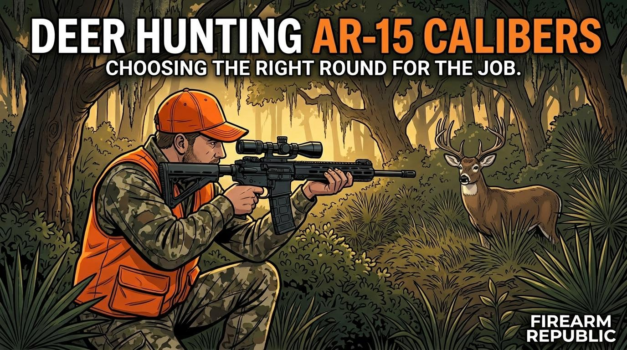
Deer hunting with an AR-15 has shifted from niche novelty to mainstream practice across the American South, Midwest, and expanding portions of the West over the past 15 years. The reasons are practical rather than ideological: hunters who already own AR-15s for home defense, training, or competition want to use the same platform for deer season. The semi-auto follow-up shot is genuinely useful on running deer in agricultural fields and dense Southern timber. And for hunters who reload or buy ammo online, the AR-15’s modular design means a single lower receiver can switch between calibers with an upper swap. The challenge is that the standard .223 Remington – the AR-15’s native cartridge – is marginal for deer in most contexts, illegal in many states, and genuinely inferior to the purpose-designed deer cartridges that fit the same AR-15 platform with a simple upper swap. This guide covers every viable AR-15 deer hunting caliber honestly: what works, what is marginal, what the states allow, and how to build the most capable AR-15 deer hunting setup for your specific hunting situation.
.223 Remington / 5.56 NATO for Deer: The Honest Assessment
Start here because it is the question everyone asks first.
.223 Rem is legal for deer in approximately 20 US states. The remaining states prohibit it based on minimum caliber (.243 or larger is common), minimum bullet diameter, or minimum energy requirements. Before assuming .223 Rem is an option, verify your specific state’s regulations – this is non-negotiable and enforcement is real.
Where .223 Rem is legal for deer, it works under specific conditions:
- Shots inside 150 yards
- Broadside or slight quartering-to presentation
- Quality bonded or heavy-for-caliber expanding bullets (62–77gr)
- Precise shot placement through the heart-lung zone
Where .223 Rem fails on deer:
- Quartering-away or frontal shots where the bullet must travel through more tissue and bone before reaching vitals
- Shots past 200 yards where impact velocity drops below reliable bullet expansion range
- Running deer where shot placement precision is reduced
- Large-framed deer, particularly big-bodied northern whitetail and mule deer where the thin bullet fails to drive deep enough
The practical verdict: .223 Rem is a technically legal deer cartridge in some states that requires more care and precision than any alternative in this guide. It is not the right choice for hunters who want confidence across the full range of deer hunting scenarios. It is the right choice for hunters who are specifically limited to .223, understand its requirements, and practice disciplined shot selection.
For deer hunting, the recommended minimum is a purpose-designed deer cartridge in the AR-15 platform. Several options exist and all outperform .223 Rem for this application significantly. See our .223 Remington Caliber Guide for full context.
The Best AR-15 Deer Hunting Calibers, Ranked
1. 6.5 Grendel – Best All-Around AR-15 Deer Cartridge
The 6.5 Grendel is the most capable, versatile, and well-rounded AR-15 deer hunting cartridge available. It requires a dedicated upper (Grendel-specific bolt, barrel, and magazines), but delivers terminal performance and effective range that no other AR-15-platform deer cartridge can match.
Why it leads: At 300 yards, the 123gr SST from a 20″ barrel carries approximately 1,280 ft-lbs – 130% more energy than the .223 Rem at the same distance and above the practical minimum for deer at that range. At 200 yards the 123gr SST impacts at 2,350+ fps, well within the bullet’s expansion range, delivering the reliable kill that deer hunters need. The 6.5mm bore’s high-BC 123gr bullet class also produces the best wind performance of any AR-15 deer cartridge – 7.8 inches in a 10 mph crosswind at 300 yards. In states that allow AR-15 deer hunting, the Grendel handles shots to 350 yards confidently with quality bullets.
Best loads: Hornady 123gr SST ($28/20) for general deer hunting. Federal 120gr Trophy Bonded ($36/20) for bonded construction on quartering shots and larger deer. Hornady 123gr ELD-M should not be used for deer hunting – it is a match projectile not designed for hunting expansion.
Platform requirements: Grendel-specific bolt carrier group, 1:8 twist barrel, Type II Grendel magazines (ASC or PMAG Grendel). Upper swap onto any standard AR-15 lower. Recommended barrel length: 18–20″ for optimal velocity and maneuverability balance.
Honest limitation: Energy drops more steeply past 350 yards than the 6mm ARC, and the 123gr bullet at 2,200+ fps impact velocity requires quality expanding bullets for reliable performance at longer range where velocity has dropped. See our 6.5 Grendel Caliber Guide.
2. 6mm ARC – Best Long-Range AR-15 Deer Option
The 6mm ARC offers the best wind performance of any AR-15 deer cartridge, making it the choice for open-country deer hunters who face 200–300 yard shots across fields and draws where wind is a consistent factor. The 103gr ELD-X at 2,800 fps from a 24″ barrel carries 1,119 ft-lbs at 500 yards – above the practical minimum for deer – with wind drift that is meaningfully better than the Grendel at extended ranges.
Why it competes with the Grendel: The 6mm ARC‘s 108gr ELD-M achieves a G7 BC of .368 vs. the Grendel’s 123gr at .252–.270. At 300 yards in a 10 mph crosswind the 6mm ARC drifts 5.8 inches vs. 7.8 inches for the Grendel. For open-field deer hunters who face significant wind at 200–300 yards, this difference is practical.
Best loads: Hornady 103gr ELD-X ($32–$38/20) is the primary deer hunting load. It is specifically designed for controlled expansion across the velocity range the 6mm ARC produces at hunting distances. Do not use the 108gr ELD-M for deer – it is a match bullet without a hunting expansion profile.
Platform requirements: Same Grendel/ARC bolt face – ARC-specific barrel (1:7.5 or 1:8 twist), ARC bolt carrier group, and Grendel-compatible magazines. Upper swap onto standard AR-15 lower.
Honest limitation: Energy retention on deer is slightly lower than the Grendel at moderate ranges – the lighter 103gr bullet carries less energy at 300 yards (approximately 1,050 ft-lbs from an 18″ barrel) than the Grendel’s 123gr (approximately 1,280 ft-lbs). For close-range timber deer shots inside 150 yards where penetration depth matters on quartering animals, the Grendel’s heavier bullet is more reliable. For open-field shots at 200–300 yards in wind, the ARC’s BC advantage makes it the better tool. See our 6mm ARC Caliber Guide.
3. .350 Legend – Best for Straight-Wall States
The .350 Legend is specifically engineered for deer hunters in the Midwest straight-wall cartridge states – Ohio, Indiana, Michigan, Iowa, and others that require straight-wall (non-bottleneck) cartridges for deer hunting. This immediately eliminates the 6.5 Grendel and 6mm ARC, which are bottleneck cartridges, from the eligible pool in these states. The .350 Legend steps in as the most capable straight-wall option in the AR-15 format.
Why it matters: The .350 Legend fires a .357 diameter 150–170gr bullet at 2,100–2,325 fps from a 16″ barrel. At 150 yards it carries approximately 1,200–1,400 ft-lbs – more than adequate for deer at the practical shooting distances that agricultural Midwest hunting produces. In dense hardwood stands and CRP field hunting where shots rarely exceed 150 yards, the .350 Legend hits hard and cycles reliably in standard AR-15-format rifles with the appropriate barrel and magazine.
Best loads: Winchester 150gr Deer Season XP ($28–$34/20) is the purpose-designed deer load with consistent expansion. Federal 180gr Trophy Bonded ($36–$42/20) provides bonded construction for quartering shots. Hornady 170gr FTX ($30–$36/20) is the rimless version designed for the .350 Legend platform.
Platform requirements: .350 Legend-specific barrel and bolt face. Some manufacturers use a modified AR-15 lower with a straight-wall-specific magazine; others use standard STANAG magazines with a spacer. Verify compatibility before building. Recommended barrel length: 16–18″ for the close-range applications typical in straight-wall states.
Honest limitation: The .350 Legend is a short-range cartridge. Past 200 yards, energy and trajectory make it a poor choice for ethical deer hunting compared to every bottleneck option in this guide. Its purpose is specific: deer hunting in straight-wall states at realistic agricultural and timber hunting distances. See our Straight-Wall AR Calibers Guide for full context.
4. .300 Blackout – Situational Deer Use
The .300 Blackout is primarily a suppressed CQB cartridge optimized for subsonic performance, but it serves as a deer hunting cartridge in a narrow and specific context. Supersonic .300 Blackout loads – 110–125gr at 2,200–2,350 fps – produce approximately 1,200–1,400 ft-lbs at the muzzle, dropping to 800–900 ft-lbs at 200 yards. This energy profile makes it capable for deer inside 150 yards on broadside shots.
Where it works for deer: Close-range deer hunting inside 125 yards where the ability to run suppressed is the primary consideration. The suppressed .300 Blackout with 220gr subsonic loads is genuinely quiet and does not require a suppressor-specific zero shift that makes follow-up shots complicated. For deer hunters who also run .300 Blackout for other purposes and hunt in close range, it is an acceptable option within its limits.
Where it fails for deer: Past 150 yards, energy and bullet performance become genuinely marginal on deer. The .300 Blackout is not a 200-yard deer cartridge in any configuration. Hunters who need effective range past 150 yards should choose one of the three options above.
Best hunting loads: Hornady 135gr FTX Black ($30–$36/20) or Remington 125gr Managed Recoil for close-range supersonic use. See our .300 Blackout Caliber Guide.
5. .223 Remington – Minimum Option Where Legal
Already covered above. For deer hunting in states where it is legal, the recommended loads are: Federal 62gr Trophy Bonded JSP ($42–$50/20), Hornady 60gr TAP FPD ($38–$46/20), or Black Hills 77gr OTM ($50–$60/20) for precision-oriented hunters who want maximum BC at the cost of reduced terminal performance vs. expanding loads. None of these transform .223 Rem into a 300-yard deer cartridge – they are the best available options within the cartridge’s limitations.
Side-by-Side Caliber Comparison
| Caliber | Max Ethical Deer Range | 200 yd Energy | Straight-Wall States | Legal for Deer (est.) | Platform Change |
|---|---|---|---|---|---|
| 6.5 Grendel | 350 yards | ~1,500 ft-lbs | No | ~40 states | New upper required |
| 6mm ARC | 400 yards | ~1,400 ft-lbs | No | ~40 states | New upper required |
| .350 Legend | 175 yards | ~900 ft-lbs | Yes | Straight-wall states | New upper required |
| .300 BLK (supersonic) | 125 yards | ~900 ft-lbs | No | ~40 states | New upper required |
| .223 Rem / 5.56 | 150 yards | ~650 ft-lbs | No | ~20 states | Standard AR-15 |
State Regulations: What You Must Check
Deer hunting regulations for AR-15-pattern and semi-automatic rifles vary dramatically by state. Before purchasing any upper or building any deer hunting AR-15, verify four things in your state’s current hunting regulations:
1. Is a semi-automatic rifle legal for deer in your state?
Several states prohibit or restrict semi-automatic centerfire rifles for deer hunting. California, Connecticut, and several others have restrictions beyond caliber that affect platform legality. Check your state’s big game hunting regulations for specific semi-auto rifle language.
2. What is the minimum caliber or bullet diameter?
Most states that allow centerfire rifle deer hunting specify a minimum caliber – typically .22 centerfire, .243, or .25 caliber. States with .243 minimums eliminate .223 Rem from legal deer use. Know your state’s specific minimum.
3. Are straight-wall cartridges required?
Iowa, Ohio, Michigan, Indiana, and several other Midwest states require straight-wall cartridges for certain zones or seasons. In these states, the 6.5 Grendel and 6mm ARC are not legal for deer hunting and the .350 Legend is the primary AR-15 option.
4. Is there a minimum energy requirement?
A few states specify minimum energy at impact (typically 900–1,000 ft-lbs) rather than caliber minimums. Verify whether your state uses an energy-based restriction in addition to or instead of caliber restrictions.
Update annually: Deer hunting regulations change. A caliber that was legal last year may not be legal this year. Check your state fish and wildlife agency’s current year regulations – not outdated third-party sources – before deer season.
Building the Best AR-15 Deer Hunting Upper
For hunters committed to AR-15 deer hunting, building a dedicated deer hunting upper produces a more capable tool than buying an entry-level complete rifle.
Components for a 6.5 Grendel Deer Upper
Barrel: 18–20″ length, 1:8 twist, chrome-moly or stainless steel. Criterion Barrels ($250–$350) and Wilson Combat ($250–$350) are the quality standards. Ballistic Advantage ($200–$280) provides solid accuracy at a lower price point. An 18″ barrel balances velocity (approximately 2,380–2,430 fps with 123gr) and rifle handling in heavy cover. A 20″ barrel adds 50–60 fps for maximum performance at 300+ yards.
Bolt Carrier Group: Must be Type II Grendel/ARC pattern. Toolcraft ($120–$150) and Sharps Bros ($130–$160) are quality production options. The BCG is the single component where quality matters most in the Grendel platform – avoid the cheapest available options.
Upper Receiver: Aero Precision M4E1 ($100–$130) or BCM standard upper ($130–$160). The upper receiver is the least critical component for accuracy.
Handguard: A free-floated M-LOK handguard improves accuracy by eliminating pressure on the barrel. 12–15″ handguards provide sufficient length for a forward grip or bipod while keeping total length manageable in timber. $80–$150 from Aero Precision, BCM, or Midwest Industries.
Muzzle Device: A quality muzzle brake (APA Little Bastard, Precision Armament M11) reduces the modest Grendel recoil further and improves follow-up shot tracking. A thread protector is the minimalist option for noise-sensitive situations. A suppressor host (Dead Air Keymicro, SilencerCo Sparrow 22) adds hearing protection value for deer hunters who run cans.
Complete upper cost: $700–$1,100 depending on component selection. Adding to an existing AR-15 lower with a quality trigger already installed produces a sub-MOA deer hunting AR-15 for this investment.
Trigger Upgrade – Non-Negotiable for Deer Hunting
A factory mil-spec trigger at 6–8 lbs with significant creep is inadequate for 250–350 yard deer shots. The trigger is the component that most directly determines shot placement at field distances.
Geissele SSA-E ($230): The benchmark. 2.3 lb total pull, two-stage break. The recommended upgrade for any AR-15 that will be used for deer at 200+ yards.
CMC Flat Bow 3.5 lb Single Stage ($165–$180): Budget-accessible single-stage option with a clean break. Adequate for deer hunting.
LaRue MBT-2S ($85–$100): Outstanding value – a quality two-stage trigger at a price that makes the upgrade financially trivial. The most recommended budget trigger for an AR-15 deer hunting build.
Practical Field Considerations for AR-15 Deer Hunting
Magazine capacity in the field: Most AR-15 deer hunting scenarios are served by a standard 20 or 26-round Grendel magazine. The practical hunting benefit of more rounds is minimal – deer hunting does not require the round counts that 3-gun competition does. A 10-round magazine is often more comfortable in field positions where a full 30-round magazine interferes with prone shooting.
Safety and handling: The AR-15’s ambidextrous safety and familiar controls are ergonomically well-suited to hunting situations where the rifle must be kept on safe while moving through the woods and made ready quickly when a deer presents. Hunters transitioning from traditional bolt guns should practice with empty chamber until AR-15 safety manipulation becomes automatic.
Weather and storage: AR-15 platforms are designed for field conditions and handle rain, dust, and cold reliably in quality builds. After hunting in wet conditions, field strip and lightly oil the bolt carrier group to prevent surface rust. Store with a snap cap or empty chamber indicator to prevent dry-fire damage over the off-season.
Zeroing for deer distances: For the 6.5 Grendel and 6mm ARC, a 200-yard zero keeps most hunting loads within ±3 inches from 0–250 yards – a practical hunting zero that minimizes holdover at the ranges these cartridges are used for deer. A 100-yard zero produces more drop past 200 yards and requires additional holdover math in field situations. For the .350 Legend and .300 BLK, a 100-yard zero with noted drop at 150 yards is more practical given their shorter effective ranges.
Recommended Complete AR-15 Deer Setups
For deer hunting in standard centerfire states:
Rifle: PSA or Aero Precision AR-15 lower with Geissele SSA-E trigger ($500–$700) Upper: 18″ Criterion 6.5 Grendel barrel, Type II BCG, Aero Precision upper and M-LOK handguard ($700–$900) Optics: Vortex Razor 1–6x or Strike Eagle 1–6×24 ($300–$500) Magazines: ASC 17-round Grendel magazines ($25–$30 each) Ammo: Hornady 123gr SST Total: $1,500–$2,100
For straight-wall state deer hunting:
Rifle: PSA AR-15 lower or complete rifle, .350 Legend upper ($700–$1,000) Optics: Vortex Crossfire II 2–7×32 ($150–$180) or red dot for close-range timber hunting Ammo: Winchester 150gr Deer Season XP Total: $850–$1,200
For combined deer/hog hunting in the South:
Rifle: Complete AR-15 in 6.5 Grendel or 6mm ARC ($1,200–$1,800) Optics: Trijicon VCOG 1–6×24 ($1,500) or Vortex Razor 1–10×24 ($1,500) for both close-range hogs and 300-yard deer Suppressor: Dead Air Wolverine (rimfire/small caliber, not rated for Grendel) or SilencerCo Omega 300 Total: $2,000–$3,500 depending on suppressor choice
Frequently Asked Questions
Q: Is 6.5 Grendel better than 6mm ARC for deer hunting?
A: For most deer hunting scenarios, yes. The Grendel’s 123gr bullet carries more energy at 200–300 yards than the ARC’s 103gr bullet and penetrates more reliably through heavy-boned deer and quartering shots. The ARC’s advantage is wind performance at 300+ yards in open field conditions. For timber and close-range deer hunting inside 250 yards, the Grendel’s energy margin is meaningful. For open-field hunting where wind and range combine to challenge the shooter, the ARC’s BC advantage becomes relevant. Most deer hunters are better served by the Grendel; hunters who specifically face long, windy shots at 250–350 yards may prefer the ARC.
Q: What AR-15 calibers are legal for deer in most states?
A: The 6.5 Grendel, 6mm ARC, .300 Blackout (supersonic), and any other cartridge that meets a state’s minimum caliber and energy requirements. In non-straight-wall states, the Grendel and ARC are the most capable options and are legal wherever semi-automatic centerfire rifles are legal for deer. Always verify your specific state’s current regulations – state laws vary significantly and change annually.
Q: Can I use my standard AR-15 lower for deer hunting with the Grendel?
A: Yes. The 6.5 Grendel and 6mm ARC use standard AR-15 lower receivers. You need only purchase or build a Grendel/ARC-specific upper assembly (barrel, BCG, magazines). The lower receiver, trigger, stock, and pistol grip are all fully compatible.
Q: How far can I ethically shoot a deer with a 6.5 Grendel AR-15?
A: With 123gr SST or quality bonded loads and quality shot placement from a stable field position, 300–350 yards represents the practical ethical ceiling for most hunters. At 350 yards from an 18″ barrel, the 123gr SST carries approximately 1,100–1,150 ft-lbs – above the floor for deer but with less margin than closer shots. Experienced hunters who train in field positions and know their specific rifle’s performance at distance have extended this to 350 yards in calm conditions. In wind, the ethical ceiling compresses.
Q: Do I need a suppressor for AR-15 deer hunting?
A: No – it is an option, not a requirement. Suppressed AR-15 deer hunting has practical advantages: reduced noise signature that allows repositioning after a missed shot without spooking the herd, hearing protection without separate ear pro, and in some states reduced report that avoids alerting neighboring landowners. The NFA process (Form 4, approximately 6–12 month wait, $200 tax stamp) is the barrier. Hunters who have experience with suppressors from other applications will find the deer hunting application natural. For hunters considering their first suppressor, a .30-caliber can that covers both the Grendel/ARC and any centerfire defensive rifle is the most versatile choice.
Q: What is the best scope for an AR-15 deer rifle?
A: An LPVO (low power variable optic) in 1–6x or 1–8x is the ideal deer hunting scope for an AR-15. At 1x it functions as a red dot for close-range timber shots; at 6–8x it provides enough magnification for precise shot placement at 300–350 yards on deer-sized vitals. The Vortex Strike Eagle 1–8×24 ($350–$400) and Leupold Mark 3HD 1.5–5×20 ($350–$400) are practical choices at mid-tier pricing. Vortex Razor HD Gen III 1–10×24 ($1,500) is the premium option for hunters who want competition-grade glass. See our Best LPVO Scopes for AR-15 guide for full optic recommendations.