 Maksym Kovaliov
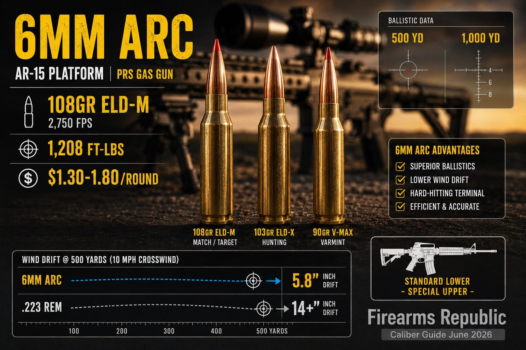
The 6mm ARC is one of the most intelligently designed AR-15 cartridges introduced in the last decade – built from the ground up to deliver genuine long-range precision from a standard AR-15 platform without the compromises that define every other AR-15 cartridge in the precision space. Hornady developed it in 2020 in partnership with a classified U.S. military unit that needed a short-action cartridge capable of reliable terminal performance and 1,000-yard accuracy from a compact gas-operated rifle. What they produced is a 6mm cartridge that runs high-BC 105–108gr bullets at 2,750 fps from a 24″ barrel – delivering wind performance that exceeds the 6.5 Creedmoor in a package that fits a standard AR-15 bolt face and magazine well. At $1.30–$1.80 per round for quality factory ammo, it sits at a modest premium over .308 but delivers ballistics that justify every cent for long-range-focused shooters. This guide covers what makes the 6mm ARC genuinely different, where it excels, where it has limitations, and whether it belongs in your safe.
What Is the 6mm ARC?
ARC stands for Advanced Rifle Cartridge. The design brief was specific and demanding: create a cartridge that fits the AR-15 bolt face (.378″ bolt face diameter), feeds from a standard AR-15 magazine, and stabilizes high-BC 6mm projectiles at velocities sufficient for 1,000-yard terminal performance. The platform constraint was non-negotiable – it had to work in an AR-15-sized rifle, not an AR-10.
Hornady based the 6mm ARC on the 6.5 Grendel case, necked down to accept .243 caliber (6mm) bullets. The case runs at a moderate 52,000 PSI maximum pressure, which contributes to long barrel life and reliable function in gas-operated platforms. The result is a cartridge with a 1.490″ case length and 2.260″ overall length – shorter than the 6.5 Grendel and fitting comfortably in modified AR-15 lower receivers with a Grendel/ARC-pattern bolt and barrel.
The critical design insight was bullet selection. The 6mm bore diameter gives access to some of the highest BC projectiles of any rifle caliber. Specifically, the Hornady 108gr ELD-M with a G7 BC of .368 – loaded in the 6mm ARC – produces ballistic performance that rivals or exceeds the 6.5 Creedmoor in wind drift while operating in a platform 2–3 lbs lighter. That’s not a minor achievement. The 6.5 Grendel with 123gr bullets runs a G7 BC of roughly .252–.270; the 6mm ARC with 108gr bullets jumps that to .368. The ballistic improvement is substantial and is the entire reason the cartridge exists.
Ballistics: The Numbers That Matter
The 6mm ARC’s ballistic case rests almost entirely on the performance of the 108gr ELD-M – it’s the load the cartridge was designed around and the load that makes its reputation. From a 24″ barrel, that bullet exits at approximately 2,750 fps. From a more typical AR-15 length of 18″, expect around 2,550–2,600 fps. From a 24″ bolt-action barrel, some handloaders push past 2,800 fps.
| Load | MV (24″, fps) | 500 yd Velocity | 500 yd Energy | 500 yd Drop (100 yd zero) | 10 mph Wind @ 500 yd |
|---|---|---|---|---|---|
| 108gr ELD-M (24″) | 2,750 | 2,245 | 1,208 ft-lbs | -47″ | 5.8″ |
| 105gr BTHP (24″) | 2,800 | 2,255 | 1,185 ft-lbs | -45″ | 6.1″ |
| 103gr ELD-X (24″) | 2,800 | 2,210 | 1,119 ft-lbs | -44″ | 6.5″ |
| 108gr ELD-M (18″) | 2,575 | 2,095 | 1,055 ft-lbs | -53″ | 6.4″ |
| 90gr Varmint (24″) | 3,150 | 2,315 | 1,069 ft-lbs | -37″ | 8.2″ |
The wind performance numbers deserve particular attention. At 500 yards, the 108gr ELD-M drifts 5.8″ in a 10 mph crosswind – compared to 6.8″ for the 6.5 CM 140gr ELD-M and 10.2″ for the .308 168gr SMK. At 1,000 yards, the gap widens: the 6mm ARC drifts approximately 24″ in a 10 mph wind vs. 29″ for the 6.5 CM. That’s a meaningful advantage for competitive precision shooters who live in wind.
The energy picture is more nuanced. The 6mm ARC’s lighter bullets carry less energy downrange than the 6.5 CM. At 500 yards, the 108gr ELD-M delivers roughly 1,208 ft-lbs – below the 6.5 CM’s 140gr at 1,440 ft-lbs. At 1,000 yards, the gap continues. For pure target shooting and steel engagement, retained energy is largely irrelevant. For hunting, it matters: the 6mm ARC’s energy retention limits it to deer-sized game inside 400–450 yards, while the 6.5 CM stretches credibly to 600–700 yards on the same game.
6mm ARC vs. The Competition
6mm ARC vs. 6.5 Grendel
The 6.5 Grendel is the closest platform comparison – same bolt face, same magazine compatibility, same AR-15 lower receiver. The 6mm ARC wins on wind performance (BC advantage of 108gr 6mm vs. 123gr 6.5mm is significant), while the 6.5 Grendel wins on energy retention and hunting versatility. A 123gr 6.5 Grendel at 500 yards carries approximately 1,350 ft-lbs vs. 1,208 ft-lbs for the 108gr ARC. For hunters using AR-15s on deer and medium game, the Grendel’s energy margin is worth considering. For precision target shooters and long-range competitors, the ARC’s wind performance is the deciding factor. See our 6.5 Grendel Caliber Guide for the full breakdown.
6mm ARC vs. 6.5 Creedmoor
These two cartridges operate on entirely different platforms – the ARC in an AR-15, the 6.5 CM in a bolt-action or AR-10. The comparison matters for shooters deciding between an AR-15-based precision setup and a traditional bolt-action. The 6mm ARC wins on wind performance (better BC bullets in flight), platform weight (AR-15 is 2–3 lbs lighter than an AR-10 or heavy bolt gun), and semi-auto rate of fire. The 6.5 CM wins on energy retention, hunting versatility, ammo availability, and reloading component depth. For a dedicated long-range precision rig, the 6.5 CM in a quality bolt-action remains a better all-around choice. For a lightweight semi-auto with genuine 1,000-yard capability, the 6mm ARC offers something nothing else can – see our 6.5 Creedmoor Caliber Guide for the full comparison.
6mm ARC vs. .223 Remington / 5.56 NATO
The .223/5.56 runs bullets with G7 BCs in the .150–.220 range. The 6mm ARC’s 108gr ELD-M at .368 G7 is roughly double that. At 500 yards in a 10 mph crosswind, a 77gr .223 drifts approximately 14–16 inches vs. 5.8 inches for the 6mm ARC. Beyond 400 yards, the performance gap between these cartridges is enormous. The 6mm ARC was specifically designed to make the AR-15 platform credible at 800–1,000 yards – a range at which .223 is genuinely limited. The trade-off is magazine capacity (typically 17–26 rounds for ARC vs. 30 for .223) and per-round cost.
6mm ARC vs. .224 Valkyrie
The .224 Valkyrie is Federal’s previous attempt to bring long-range AR-15 performance to market. It uses .224 caliber (5.56mm-bore) bullets in a larger case derived from the 6.8 SPC. With 90gr Berger bullets, it achieves respectable wind performance. The 6mm ARC with 108gr ELD-M consistently outperforms it in BC and wind drift – the 6mm bore’s bullet selection advantage is simply larger than the .224 bore. Additionally, the 6mm ARC’s moderate pressure produces better barrel life and more reliable semi-auto function. The .224 Valkyrie has largely been displaced by the 6mm ARC in the semi-auto precision market and currently has more limited factory ammo support.
Factory Ammunition: What to Buy
The 6mm ARC’s factory ammo selection is narrower than established cartridges – this is a young cartridge and the selection will expand, but current availability is more limited than .308 or 6.5 CM. Hornady is the primary manufacturer, with Federal, Nosler, and Black Hills now chambering loads.
For precision and competition:
Hornady 108gr ELD-M ($30–$35/20 rounds) is the reference load and what the cartridge was built around. It’s the right choice for any shooter prioritizing long-range precision or competition. Accuracy from quality rifles runs 0.5–0.7 MOA consistently. Hornady’s 105gr BTHP is a slightly more affordable competition option that performs nearly as well at closer distances. Black Hills 108gr Hornady ELD-M is loaded with the same projectile and runs at similar pricing – worth trying if your rifle shows a preference for specific brass.
For hunting:
Hornady 103gr ELD-X ($32–$38/20 rounds) is the primary factory hunting load. The ELD-X bullet is designed for controlled expansion across a wide velocity range, which matters as velocity drops at longer shooting distances. For deer inside 300 yards, it performs well. Federal is developing hunting loads in 6mm ARC; check current offerings at time of purchase. Nosler has introduced a 90gr E-Tip for hunters in lead-free zones or those who prefer monolithic construction.
Budget and practice:
Hornady Steel Match 105gr BTHP in steel case runs $18–$22/50 rounds and is adequate for practice and confirming zero. It won’t match brass-cased match ammo for precision, but the price-per-round for high-volume training is meaningful. Federal American Eagle has introduced a 108gr BTHP practice load at competitive pricing.
| Load | Best For | Typical Price | Typical Accuracy |
|---|---|---|---|
| Hornady 108gr ELD-M | Precision/Competition | $33/20 | 0.5–0.7 MOA |
| Hornady 105gr BTHP | Precision/Competition | $29/20 | 0.6–0.8 MOA |
| Black Hills 108gr ELD-M | Precision/Competition | $35/20 | 0.5–0.7 MOA |
| Hornady 103gr ELD-X | Deer Hunting | $35/20 | 0.7–0.9 MOA |
| Nosler 90gr E-Tip | Lead-Free Hunting | $36/20 | 0.8–1.0 MOA |
| Hornady Steel Match 105gr | Budget Practice | $20/50 | 1.0–1.5 MOA |
One honest note on availability: the 6mm ARC does not yet have the distribution depth of .308 or 6.5 CM. Rural gun stores and sporting goods shops may carry limited or no stock. Online purchase and ordering ahead is more important with this cartridge than with established calibers.
Reloading the 6mm ARC
Reloading extends the 6mm ARC’s performance ceiling significantly – handloads can push the 108gr ELD-M to 2,800+ fps from a 24″ barrel while maintaining the velocity consistency (single-digit SD) that precision shooting demands. Component availability is improving but still developing; expect to source most components online rather than at local stores.
Brass: Hornady factory brass performs consistently and is adequate for most precision applications. Lapua does not yet offer 6mm ARC brass (as of early 2026), which is the primary gap in the premium brass market. Peterson brass ($70–$80/100) is available and delivers consistent weight sorting and tight primer pockets suitable for match reloading. ADG (Alpha Munitions) brass is another quality domestic option.
Powder: The 6mm ARC case is relatively small, requiring powders in the medium-fast burn rate range. Hodgdon H4350 is the community standard, delivering 2,740–2,780 fps with the 108gr ELD-M at safe pressures from a 24″ barrel. Reloder 16 is an excellent temperature-stable alternative that many semi-auto shooters prefer for consistent function across temperature extremes. Varget works with lighter 90–103gr bullets but tends to fill the case excessively at max charges with the 108gr. Avoid slow-burning powders – the case simply doesn’t have the capacity to generate sufficient velocity at safe pressures.
Bullets: The 108gr ELD-M is the match bullet of choice and the reason the cartridge exists. Berger 105gr BT Target and 105gr Hybrid are popular alternatives with similar BC characteristics. For hunting, the 103gr ELD-X and Nosler 95gr Partition are field-proven. The 90gr Hornady V-MAX and Sierra 90gr BlitzKing are excellent varmint options that push past 3,100 fps and produce dramatic fragmentation at high velocity.
Twist rate: The 6mm ARC requires a 1:7.5 or 1:8 twist to stabilize the long 108gr ELD-M reliably. A 1:7.5 twist handles the full range of 90–108gr bullets with margin. A 1:8 stabilizes 90–108gr in most conditions but may be marginal at altitude or extreme cold with 108gr. Verify your barrel twist before loading heavy bullets and test stability at extended range.
Semi-auto considerations: For AR-15 platforms, pay attention to primer choice and seating depth. Magnum primers are not recommended – the 6mm ARC operates at moderate pressures and magnum ignition increases pressure inconsistently. Seat primers slightly below flush and use standard small rifle or small rifle match primers. Bullet seating depth matters more in semi-auto ARC rifles than in bolt guns – test for reliable feeding at your chosen COAL.
Best Applications for the 6mm ARC
PRS and NRL Competition – Semi-Auto Division
The 6mm ARC’s primary purpose in the competition world is PRS/NRL gas gun division – it’s the closest thing to an ideal semi-auto precision cartridge the AR-15 platform has ever had. The combination of genuine 1,000-yard wind performance, manageable recoil in a light platform, and semi-auto follow-up shot capability is exactly what gas gun competitors need. Stage designers at major PRS/NRL matches regularly include 800–1,000 yard targets; the 6mm ARC handles these with the kind of BC advantage that makes wind calls more forgiving. Shooters transitioning from 6.5 CM bolt guns to semi-auto competition will find the 6mm ARC’s wind drift characteristics familiar and the lighter platform a genuine ergonomic benefit. Our PRS Competition Guide and PRS Gas Gun Competition Guide cover division specifics and setup recommendations.
Long-Range Precision – 500 to 1,000 Yards
The 6mm ARC is a legitimate 1,000-yard cartridge from both bolt-action and semi-auto platforms, and for precision shooters who want to run an AR-15-format rifle at extended range, there is simply no better option available. The 108gr ELD-M’s G7 BC of .368 means that at 1,000 yards in a 10 mph crosswind, you’re dealing with approximately 24 inches of drift – less than the 6.5 Creedmoor and dramatically less than any .224 bore cartridge. Quality handloads in a quality barrel produce sub-0.5 MOA groups at 300 yards and consistent 1–1.5 MOA at 1,000 yards. The platform weight advantage of an AR-15 vs. an AR-10 or heavy bolt gun is meaningful when shooting from field positions. See our Long-Range Shooting Guide for the full equipment and technique framework.
Deer Hunting with an AR-15
The 6mm ARC expands the ethical hunting range of the AR-15 platform significantly. Where the .223 Remington is limited to close-range deer hunting in states that allow it, the 6mm ARC with 103gr ELD-X or quality bonded bullets is a confident deer cartridge inside 350–400 yards. The 103gr ELD-X at 2,800 fps carries 1,119 ft-lbs at 500 yards – adequate for deer but approaching the low end of the ethical margin at that distance. For hunters who want AR-15 ergonomics for deer hunting and regularly shoot inside 300 yards, the 6mm ARC is a natural fit. For shots stretching past 400 yards on deer, consider the 6.5 Grendel’s slightly better energy retention or step up to an AR-10-based platform. See our Deer Hunting AR-15 Calibers guide for a full caliber comparison in this context.
Varmint and Predator Hunting
At the light end of its bullet range, the 6mm ARC becomes a fast-stepping varmint cartridge. The 90gr V-MAX at 3,150 fps produces explosive fragmentation on prairie dogs, ground squirrels, and coyotes, with a flat trajectory that simplifies range estimation at varmint distances (50–350 yards). The semi-auto platform pairs particularly well with varmint hunting – follow-up shots on running prairie dogs or coyotes are quick and reliable. The recoil in this loading is minimal. For coyote hunters specifically, the 6mm ARC’s combination of reach and terminal performance at 200–400 yards is highly effective. See our Coyote Hunting Rifles guide and Varmint Hunting Rifles Guide for full application breakdowns.
Backcountry and Mountain Use
The 6mm ARC in a lightweight AR-15 platform can produce a genuinely capable mountain hunting setup. A quality 18″ barreled AR-15 in 6mm ARC runs 6–7 lbs before optics – comparable to ultralight bolt-actions and lighter than most AR-10 configurations. The semi-auto action allows quick follow-up shots in the kind of chaotic, high-stress shooting situations that mountain hunting sometimes produces. The cartridge’s wind performance is meaningful at altitude where wind speeds increase in exposed terrain. The honest limitation is hunting application – at mountain hunting ranges where shots can stretch past 400 yards on deer and elk-sized game, the 6mm ARC’s energy retention is the limiting factor. It’s a better mountain varmint and deer cartridge than an elk cartridge. See our Mountain / Backcountry Hunting Rifles guide for full platform recommendations.
Rifles and Platforms for the 6mm ARC
The 6mm ARC requires specific components that differ from standard AR-15 parts – the bolt, barrel, and magazine must all be ARC-specific. The lower receiver and most furniture are interchangeable with standard AR-15 components, which keeps build costs manageable.
Factory rifles:
The Ruger Precision Rifle in 6mm ARC ($1,499–$1,599) was one of the first factory complete rifles and remains one of the most popular – the chassis platform, AICS magazine compatibility, and adjustable stock make it competition-ready out of the box. Savage MSR 15 Long Range in 6mm ARC ($1,300–$1,499) is a direct competitor at a slightly lower price point with a quality two-stage trigger. Christensen Arms CA-15 G2 in 6mm ARC ($2,200–$2,500) brings carbon fiber construction for those prioritizing weight savings. LWRCI and Aero Precision both offer 6mm ARC uppers and complete rifles in the $900–$1,800 range depending on configuration.
AR-15 upper builds:
The most cost-effective path to 6mm ARC for existing AR-15 owners is an upper receiver build or purchase. A dedicated 6mm ARC upper swaps onto any standard AR-15 lower. You need: a 6mm ARC barrel (1:7.5 or 1:8 twist), a 6mm ARC/Grendel bolt carrier group, a 6mm ARC-pattern magazine, and a standard AR-15 upper receiver. Barrels from Proof Research, Criterion, Bartlein, and Wilson Combat are all quality options. A complete upper build runs $700–$1,200 depending on barrel and BCG selection.
Bolt-action options:
While the 6mm ARC was designed for semi-auto platforms, bolt-action rifles are available and achieve slightly higher velocities through better case sealing. Bergara’s HMR Pro and custom builders like GA Precision have chambered 6mm ARC bolt guns. In bolt-action format, the cartridge’s velocity is pushed 50–75 fps higher than semi-auto equivalents, and barrel life extends to 3,500–4,500 rounds vs. 2,500–3,500 for semi-auto.
Barrel Life and Platform Maintenance
The 6mm ARC’s moderate pressure (52,000 PSI max) and efficient case design produce solid barrel life for a precision cartridge. Semi-auto barrels using quality match-grade steel typically see 2,500–3,500 rounds before accuracy begins to degrade. Bolt-action barrels run 3,500–4,500 rounds. Both figures are better than the 6.5 PRC or .300 Win Mag, though below the .308 Winchester’s 4,000–6,000 round expectancy.
For semi-auto competition shooters putting 2,000–3,000 rounds per year through their rifle, plan on barrel replacement roughly every 12–18 months of active competition. Quality replacement barrels from Proof Research, Krieger, or Criterion run $350–$700, installed by a competent AR-15 armorer rather than requiring gunsmithing. This is a meaningful ongoing cost to budget for if you shoot high volumes.
Gas system maintenance matters more than with bolt guns. Run an adjustable gas block and set it to the minimum gas needed for reliable function with your primary load. Over-gassing accelerates bolt carrier group wear and increases felt recoil. A quality adjustable block (Superlative Arms, Seekins, JP Enterprises) runs $60–$100 and pays for itself quickly in reduced component wear.
Who Should Choose the 6mm ARC?
The 6mm ARC is your cartridge if:
You want a semi-auto AR-15 platform capable of genuine 800–1,000 yard precision and wind performance that rivals or exceeds the 6.5 Creedmoor. You’re a PRS or NRL gas gun competitor who needs the best long-range ballistics available in an AR-15 format. You already own AR-15 components and want a precision upgrade that reuses your lower receiver and furniture. You’re a deer or predator hunter who wants AR-15 ergonomics with effective range beyond what .223 or even 6.5 Grendel provides. You reload and can manage a somewhat younger, developing component ecosystem.
Look elsewhere if:
You want the deepest possible factory ammo selection and the ability to walk into any rural sporting goods store and buy ammunition – the 6mm ARC is not there yet and may never reach .308 distribution levels. You’re primarily a hunter who shoots deer or elk at ranges past 400 yards and needs maximum energy retention – the 6.5 Creedmoor, 6.5 PRC, or even 6.5 Grendel serve that role better. You’re a precision shooter who prefers a bolt-action platform and doesn’t require the semi-auto format – the 6.5 Creedmoor in a quality bolt gun offers broader ammo selection and deeper component availability. You’re on a tight budget and need affordable practice ammo availability – steel-case practice options exist but are more limited than for established calibers.
Frequently Asked Questions
Q: Is the 6mm ARC a standard AR-15 cartridge?
A: It uses a standard AR-15 lower receiver but requires a dedicated 6mm ARC upper, barrel, bolt carrier group, and magazines. The bolt face is the same as the 6.5 Grendel (.378″ diameter), which is different from standard .223/5.56 AR-15 bolts. You cannot simply swap a 6mm ARC barrel onto a standard .223 AR-15 upper without also replacing the bolt carrier group and ensuring magazine compatibility. For existing AR-15 owners, the most practical path is purchasing a complete 6mm ARC upper assembly.
Q: How does 6mm ARC accuracy compare to bolt-action precision rifles?
A: In optimized semi-auto builds with quality barrels and matched handloads, 6mm ARC AR-15s achieve 0.5–0.7 MOA at 100 yards – competitive with quality bolt-action precision rifles. The semi-auto action introduces slightly more mechanical variables than a bolt gun, but quality builds running consistent handloads close that gap substantially. Factory ammo accuracy runs 0.7–1.0 MOA in most rifles. For those who need absolute maximum precision, a quality bolt-action in 6.5 CM or 6mm ARC still edges a well-built semi-auto at extended range.
Q: Can you hunt deer with a 6mm ARC?
A: Yes, inside 350–400 yards with the right bullet. Use the Hornady 103gr ELD-X or a quality bonded 90–105gr hunting bullet, prioritize broadside shots, and keep shots inside 350 yards for maximum ethical confidence. The cartridge carries sufficient energy for clean deer kills at those distances. It’s not the best choice for elk or animals larger than deer, where a heavier, larger-diameter cartridge provides more margin for imperfect shot placement.
Q: What magazines does the 6mm ARC use?
A: The 6mm ARC uses the same magazines as the 6.5 Grendel – ASC (American Shooting Components) Grendel/ARC magazines are the most widely used option. These typically run 10, 15, 17, and 26-round capacities. Standard AR-15 .223/5.56 magazines do not feed 6mm ARC reliably. PMAG produces a Grendel/ARC-compatible magazine that is becoming the community standard for competition use.
Q: What is the effective range of the 6mm ARC?
A: As a target cartridge, the 6mm ARC is effective to 1,000+ yards in skilled hands with quality handloads – the BC numbers support it. As a hunting cartridge on deer-sized game, the practical limit is 400–450 yards based on energy retention. As a varmint cartridge with 90gr loads, 300–400 yards is the effective range before bullet fragmentation becomes inconsistent. The target shooting capability is the cartridge’s headline achievement; hunting range is more limited than a 6.5 Creedmoor by a meaningful margin.
Q: How does 6mm ARC barrel life compare to 5.56 NATO?
A: Noticeably shorter. A quality 5.56 NATO barrel in an AR-15 typically lasts 10,000–20,000 rounds before accuracy degrades. A 6mm ARC barrel runs 2,500–3,500 rounds in semi-auto configuration – roughly 5–8x shorter life. The trade-off is the dramatic precision and long-range performance improvement. Competition shooters and serious long-range practitioners find the trade-off worthwhile; casual shooters who run high round counts and don’t require precision past 300 yards may prefer a .223 platform for its lower ongoing maintenance costs.