 Maksym Kovaliov
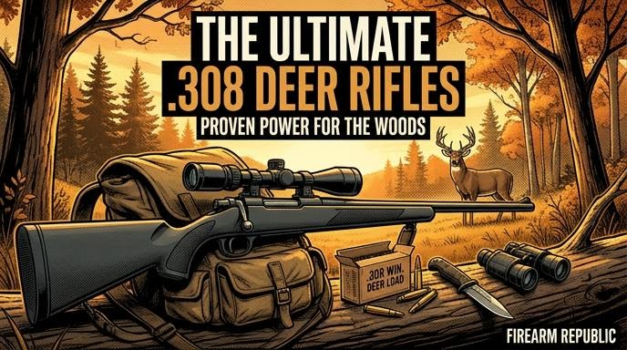
The .308 Winchester has killed more deer than arguably any other centerfire cartridge in the last 60 years, and it’s not hard to understand why. At 2,620 fps with a 165gr Federal Trophy Bonded Tip, it generates 2,515 ft-lbs of muzzle energy – enough for ethical shots on whitetail past 400 yards and elk inside 250. Recoil is manageable at 16–18 ft-lbs in a 7.5-lb rifle. Ammunition is available at every sporting goods store in America, from $1.20/round bulk FMJ to $3.50/round premium hunting loads. And the short-action cartridge fits into lighter, shorter rifles than the .30-06 while giving up only 150–200 fps in practical hunting configurations. This guide covers the best bolt-action .308 rifles for deer hunting across every price point – budget options that genuinely perform, mid-range rifles that hit the sweet spot, and premium platforms worth the investment for hunters who want the best.
Why .308 Winchester for Deer?
The .308 doesn’t need much selling to anyone who’s hunted deer for more than a season, but it’s worth being specific about what it does well and where it has genuine limitations compared to alternatives like 6.5 Creedmoor.
Where .308 wins:
The .30-caliber bullet diameter (.308″) is meaningfully larger than the 6.5mm (.264″), and that translates to a larger wound channel on close-range and broadside shots inside 200 yards. In dense eastern hardwoods where shots average 80–100 yards, the heavier .30-caliber bullet crashes through shoulder bones and brush more reliably than lighter, faster 6.5mm options. A 180gr Nosler Partition hitting a whitetail’s shoulder at 75 yards is going through it regardless of bone – that’s not always true of lighter hunting bullets.
The .308’s energy margin also matters for hunters who occasionally pursue elk, black bear, or hogs in the same season. At 200 yards, a .308 with a 165gr hunting load retains around 2,000 ft-lbs – comfortably above the 1,500 ft-lbs threshold commonly cited for elk. The 6.5 Creedmoor is also adequate on elk, but the .308 provides more margin, especially on quartering or angled shots where penetration depth matters more than trajectory. For a full caliber comparison, see our 6.5 Creedmoor vs .308 Winchester guide.
Where .308 loses ground:
Past 300 yards in wind, the 6.5 Creedmoor’s higher-BC bullets drift noticeably less. A 10 mph crosswind moves a 165gr .308 bullet about 8.5″ at 400 yards; the same wind moves a 143gr 6.5 CM bullet about 6.5″ – a 2-inch difference that matters when your kill zone is 8″. Drop is also steeper: the .308 drops roughly 34″ at 400 yards from a 200-yard zero versus 28″ for the 6.5 CM. For eastern and midwestern whitetail hunters, this difference is largely irrelevant. For western hunters regularly shooting past 300 yards in variable wind, it’s worth considering.
Recoil is real but manageable. A .308 in a 7.5-lb rifle generates 16–18 ft-lbs of recoil energy – about 25–30% more than 6.5 Creedmoor. Most adult hunters handle this without issue, but recoil-sensitive hunters (youth, smaller-framed shooters, those with shoulder injuries) may prefer the 6.5 CM or 7mm-08. A good recoil pad and proper stock fit reduce perceived recoil significantly.
Budget Tier: Best .308 Rifles Under $700
Ruger American Gen II – Best Budget .308 Deer Rifle
Price: $600–$680 street Weight: 6.3 lbs (bare rifle) Barrel: 22″ threaded, 1:10 twist Trigger: Marksman Adjustable, 3–5 lbs user-adjustable Magazine: AICS-compatible detachable box, 4 rounds (10-round available) Accuracy: Sub-MOA guarantee
The Ruger American Gen II is the honest answer when budget is the primary constraint. The AICS-compatible magazine is a genuine differentiator at this price point – it opens the door to 10-round magazines and means the rifle shares a feeding standard with considerably more expensive platforms. The factory-threaded 22″ barrel with 5/8×24 threads is ready for a suppressor or muzzle brake without additional machining. The Marksman trigger adjusts from 3 to 5 lbs; set to 3 lbs with a few hours of dry-fire practice, it’s workable for hunting.
Accuracy is consistently sub-MOA with quality hunting ammunition. Most Gen II rifles in .308 produce 0.7–0.9 MOA with Federal Gold Medal 168gr or Hornady ELD-X 178gr – that’s 0.7–0.9″ at 100 yards, meaning a 3–4″ group at 400 yards with proper technique. For deer hunting, that’s more than sufficient. The rifle’s main limitation is factory trigger quality and a synthetic stock that won’t win any aesthetic awards. Neither matters in the field. See our Ruger American Complete Guide for the full platform breakdown.
Savage Axis II XP – Best Complete Package Under $500
Price: $420–$480 street (includes 3-9×40 scope) Weight: 6.5 lbs (bare rifle) Barrel: 22″, 1:10 twist (non-threaded) Trigger: AccuTrigger, 2.5–6 lbs adjustable Magazine: Detachable box, 4 rounds Accuracy: Sub-MOA guarantee
The Savage Axis II XP comes with a Weaver 3-9×40 scope included – a functional if basic optic – making the total package cost under $500 for a ready-to-hunt .308 deer rifle. The real story here is the AccuTrigger. Adjustable from 2.5 to 6 lbs, it’s the best factory trigger in the under-$500 price range by a wide margin. Set at 3 lbs, it’s genuinely crisp and consistent. The Axis II’s barrel is accurate – sub-MOA with the right ammunition – and the rifle’s light weight (6.5 lbs) makes it easy to carry.
The compromises are real: the included scope is adequate but not exceptional, the stock is basic, and the barrel isn’t threaded. For a new hunter or budget-constrained buyer who wants a functional deer rifle without separate optic selection, the Axis II XP represents honest value. Plan to upgrade the scope within a season or two.
Mossberg Patriot – Overlooked Value
Price: $380–$450 street Weight: 6.5 lbs Barrel: 22″, 1:10 twist Trigger: LBA adjustable, 2–7 lbs Magazine: Detachable box, 5 rounds Accuracy: Sub-MOA guarantee
The Mossberg Patriot doesn’t get the attention it deserves. At under $450, it delivers a detachable box magazine, an adjustable trigger (LBA system, 2–7 lbs), a spiral-fluted bolt that reduces drag, and legitimate sub-MOA accuracy. The fluted bolt is an unusual feature at this price – a functional advantage in wet or dirty conditions. The Patriot’s stock is comfortable and includes a soft grip surface. It’s a better out-of-box experience than the Savage Axis at a lower price.
The limitation: aftermarket support is thin. If you want to upgrade the stock, trigger, or optic mounting system, the Ruger and Savage ecosystems offer more options. For a hunter who wants a reliable deer rifle at the lowest responsible price and has no plans to modify it, the Patriot earns its keep.
Mid-Range Tier: Best .308 Rifles $700–$1,100
Tikka T3x Lite – Best Mid-Range .308 Deer Rifle
Price: $875–$950 street Weight: 6.1 lbs (bare rifle) Barrel: 22.4″, 1:11 twist Trigger: Single-stage adjustable, 2–4 lbs, factory ~2.5 lbs Magazine: Proprietary detachable box, 3 rounds (6-round available) Accuracy: Sub-MOA guarantee (typically 0.5–0.7 MOA)
The Tikka T3x Lite is the best rifle in the mid-range price category for most deer hunters. At 6.1 lbs bare and typically 7.4–7.7 lbs scoped, it’s the lightest option at this price point without stepping into custom ultralight territory. The factory trigger is genuinely excellent – breaking cleanly at 2.5 lbs with minimal overtravel, it rivals triggers that cost $150+ to replace on competing platforms. The three-lug 70-degree bolt cycles faster and smoother than competitors; the T3x action’s reputation for butter-smooth operation is earned.
Accuracy in .308 is consistently 0.5–0.7 MOA with quality ammunition. Federal Gold Medal 168gr or Hornady Precision Hunter 178gr ELD-X both perform well in T3x barrels. The rifle’s synthetic stock won’t impress anyone looking at it on a shelf, but it handles well in the field and doesn’t shift zero in wet conditions the way some laminate stocks can.
The Tikka’s main limitation for hunters who plan to modify the platform: its magazine is proprietary and its action doesn’t accept Remington 700-pattern aftermarket stocks and triggers without adapter work. For a dedicated hunting rifle used as delivered, that’s irrelevant. For context on the broader platform capability, see our Tikka T3x Complete Guide.
Winchester Model 70 Featherweight – Classic Performance
Price: $900–$1,000 street Weight: 6.75 lbs Barrel: 22″, 1:10 twist Trigger: MOA trigger, 3–5 lbs adjustable Magazine: Internal with hinged floorplate, 5 rounds Accuracy: Sub-MOA guarantee
The Winchester Model 70 Featherweight is the rifle for hunters who want traditional aesthetics without sacrificing performance. The controlled-round feed (CRF) action is the defining feature – the claw extractor grabs the case as it exits the magazine rather than camming over it, providing positive extraction even in dirt and cold conditions and eliminating the occasional failure-to-feed that can occur in push-feed designs. For Alaska hunters and dangerous game guides, CRF is considered essential. For whitetail in Ohio, it’s a reliability advantage that rarely gets tested but matters when it does.
The walnut stock Featherweight is genuinely attractive – the 14.5″ length of pull and slim forend balance well and point naturally at moving deer. The internal magazine with hinged floorplate is faster to unload safely than a detachable box (drop the plate, ammunition falls clear) though it limits capacity to 5 rounds. At $900–$1,000, the Model 70 Featherweight competes directly with the Tikka T3x Lite. The Tikka has a better factory trigger and is slightly lighter. The Model 70 has the CRF action, better aesthetics, and a legacy that matters to some hunters. Both are excellent choices – pick based on what you value.
Browning X-Bolt Hunter – Best All-Around Mid-Range
Price: $900–$1,050 street Weight: 6.5 lbs Barrel: 22″ free-floating, 1:10 twist Trigger: Feather Trigger, 3.5 lbs factory Magazine: Detachable rotary box, 4 rounds Accuracy: Sub-MOA guarantee
The Browning X-Bolt Hunter earns its place through a combination of light weight, wide caliber availability, and excellent recoil management. The Inflex recoil pad is the best factory pad in the category – the X-Bolt in .308 generates noticeably less perceived recoil than competing rifles at similar weight. For hunters who shoot their rifles frequently and care about long-day comfort, that’s meaningful.
The four-lug rotary bolt provides positive lockup, and the detachable rotary magazine is smooth to load and reliable to feed. Accuracy is sub-MOA with quality ammunition; most X-Bolts in .308 settle into 0.7–0.9 MOA with Federal Premium or Hornady Precision Hunter loads. The Feather Trigger is the one consistent criticism – it breaks at 3.5 lbs with more travel than ideal. It’s adequate for hunting, but it’s behind the Tikka’s factory trigger by a noticeable margin. If trigger quality is your priority at this price point, the T3x Lite wins. If recoil management and caliber selection matter more, the X-Bolt is the better platform.
Premium Tier: Best .308 Rifles $1,100–$1,800
Bergara B-14 Hunter – Best Premium Value
Price: $950–$1,100 street Weight: 7.0 lbs Barrel: 22″, 1:10 twist Trigger: Bergara Performance Trigger, ~3 lbs Magazine: Detachable box (AICS-compatible), 5 rounds Accuracy: Sub-MOA guarantee (0.5 MOA typical)
The Bergara B-14 Hunter sits at the upper end of mid-range pricing but delivers accuracy and platform versatility that justify the step up. Built on a Remington 700 footprint, the entire ecosystem of aftermarket triggers, stocks, chassis systems, and accessories fits it directly – TriggerTech triggers drop in without modification, McMillan and Manners stocks bed to it, MDT and KRG chassis systems fit without adapter plates. If you start with a hunting rifle and want to eventually configure it for long-range precision shooting, the B-14 Hunter is the platform to build on.
The Spanish-manufactured Bergara barrel is the real differentiator. Most B-14 Hunters in .308 produce 0.5–0.7 MOA groups with quality ammunition – that’s precision-rifle accuracy in a hunting-weight package. The Bergara Performance Trigger breaks cleanly at 3 lbs with minimal creep. The AICS-compatible magazine works with the same aftermarket box magazines as the Ruger American Gen II and most precision rifles. At 7.0 lbs bare and 8.5+ lbs scoped, it’s heavier than the Tikka T3x Lite – for stand hunters, irrelevant; for hunters covering serious western miles, it matters. See our Bergara B-14 Series Guide for a full breakdown.
Christensen Arms Mesa – Best Lightweight Premium
Price: $1,400–$1,600 street Weight: 6.5 lbs with carbon fiber barrel Barrel: 22″ carbon fiber wrapped, 1:10 twist Trigger: TriggerTech Primary, 1.5–4 lbs Magazine: Detachable box (AICS-compatible), 4 rounds Accuracy: Sub-MOA guarantee (0.5 MOA typical)
The Christensen Arms Mesa is the choice when you want premium performance without a weight penalty. The carbon fiber-wrapped barrel brings rifle weight to 6.5 lbs while maintaining a 22″ barrel length – full velocity without the weight of a steel-barreled rifle at the same length. The TriggerTech Primary trigger (included on the Mesa) adjusts from 1.5 to 4 lbs and is one of the cleanest factory triggers available at any price. Carbon fiber barrels also stiffen faster under heat than steel, which improves accuracy in strings of fire – meaningful for hunters who take a follow-up shot.
At $1,400–$1,600, the Mesa commands a significant premium over the Bergara B-14 Hunter. For backcountry and western hunters who prioritize every ounce, the investment makes sense. For eastern whitetail hunters who mostly hunt from stands, the extra $400–$500 over a B-14 Hunter delivers diminishing returns. See our Mountain / Backcountry Hunting Rifles guide for context on where lightweight premium rifles earn their cost.
Comparison: Best .308 Deer Rifles by Price
| Rifle | Price | Weight | Trigger | Accuracy | Magazine | Best For |
|---|---|---|---|---|---|---|
| Mossberg Patriot | $420 | 6.5 lbs | LBA adj. | Sub-MOA | Detach. 5rd | Lowest budget |
| Savage Axis II XP | $450 | 6.5 lbs | AccuTrigger | Sub-MOA | Detach. 4rd | Best package deal |
| Ruger American Gen II | $650 | 6.3 lbs | Marksman adj. | Sub-MOA | AICS 4rd | Best budget overall |
| Tikka T3x Lite | $900 | 6.1 lbs | Excellent 2.5 lbs | 0.5–0.7 MOA | Prop. 3rd | Best mid-range |
| Winchester Model 70 FW | $950 | 6.75 lbs | MOA adj. | Sub-MOA | Internal 5rd | CRF, traditional |
| Browning X-Bolt Hunter | $975 | 6.5 lbs | Feather 3.5 lbs | Sub-MOA | Rotary 4rd | Recoil management |
| Bergara B-14 Hunter | $1,050 | 7.0 lbs | Bergara ~3 lbs | 0.5 MOA | AICS 5rd | Best premium value |
| Christensen Mesa | $1,500 | 6.5 lbs | TriggerTech | 0.5 MOA | AICS 4rd | Lightweight premium |
Optics for .308 Deer Rifles
The right optic depends heavily on your hunting environment. The .308’s effective range window – 200–400 yards for most hunters – defines what magnification is actually useful.
For eastern timber and midwestern agriculture (shots inside 200 yards): A 2-7×32 or 3-9×40 is the right configuration. The Vortex Crossfire II 3-9×40 ($180) is the best budget hunting scope available – clear enough for hunting, durable enough to hold zero season after season. The Leupold VX-Freedom 3-9×40 ($300) is a meaningful step up in glass quality. Keep it simple: a standard duplex reticle zeroed at 150 yards puts you within 3″ of point of aim from 50 to 250 yards with most .308 hunting loads.
For mixed terrain and occasional shots to 300 yards: The Vortex Viper HD 3-9×40 ($400) or Leupold VX-3HD 3-9×40 ($550) are both excellent choices that won’t become the limiting factor in the system. A BDC reticle calibrated for .308 can simplify holdover at 250–300 yards, though a simple duplex with practiced holdover works equally well.
For western open country and shots to 400+ yards: Step up to a 4-16x or 4-14x configuration. The Vortex Viper PST Gen II 2-10×32 ($750) is outstanding glass with an illuminated reticle and capped turrets. At this range window, a quality MRAD or MOA reticle with a matching turret system simplifies the math significantly and reduces the risk of error on a long shot.
One consistent recommendation regardless of budget: spend at least as much on the optic as you spent on the rifle. A $650 Ruger American Gen II paired with a $150 scope is a worse hunting system than the same rifle paired with a $500 scope. The optic is the interface between hunter and target – it’s not where to economize.
Best .308 Ammunition for Deer Hunting
For whitetail and mule deer at moderate range (0–250 yards): Hornady American Whitetail 150gr InterLock is the best value hunting load – consistently accurate, reliable expansion, widely available around $28–$32 per box of 20. Winchester Deer Season XP 150gr is engineered specifically for whitetail with a large polymer tip and proven expansion. Federal Power-Shok 150gr is the budget standard that works.
For deer and elk versatility: Federal Premium Trophy Bonded Tip 165gr and Nosler Partition 165gr or 180gr are the go-to choices for hunters who want one load that handles both whitetail and elk. The bonded construction ensures the bullet retains 85–90% of its weight through heavy bone – critical on quartering elk shots. Hornady ELD-X 178gr is an alternative with higher BC (.530) for better long-range performance.
For maximum long-range performance (300+ yards): Hornady ELD-X 178gr, Federal Terminal Ascent 185gr, or Berger Hunting VLD 168gr combine high-BC projectiles with reliable terminal performance. Note that Sierra MatchKing and Hornady ELD Match bullets – while extremely accurate – are not designed to expand reliably on game and should not be used for hunting.
Pros and Cons of .308 Winchester for Deer
Strengths: ✓ Massive ammunition selection at every price point – available everywhere ✓ Adequate for elk, black bear, and hogs without a separate rifle ✓ Short-action cartridge fits lighter, shorter rifles than .30-06 ✓ 60+ years of North American hunting success – terminal performance well proven ✓ Wide selection of quality rifles at every price point ✓ Manageable recoil for most adult hunters (16–18 ft-lbs in 7.5-lb rifle) ✓ Affordable practice ammunition via mil-surplus and bulk FMJ
Limitations: ✗ Wind drift and drop exceed 6.5 Creedmoor past 300 yards ✗ More recoil than 6.5 CM or 7mm-08 – relevant for youth and recoil-sensitive shooters ✗ Not the optimal choice for 400+ yard shots in variable wind ✗ Slightly heavier ammunition than 6.5 CM – marginal but real on long backcountry trips
Frequently Asked Questions
Q: Is .308 Winchester good for deer hunting?
A: Yes – the .308 is one of the best deer cartridges available. A 150–165gr hunting bullet at 2,620–2,820 fps generates 2,300–2,900 ft-lbs of muzzle energy, providing clean kills on whitetail from 30 yards to 400+ yards with proper shot placement. The broad selection of quality hunting ammunition, wide availability, and proven terminal performance make it one of the most reliable choices for North American deer hunting at any range.
Q: What’s better for deer hunting – .308 or 6.5 Creedmoor?
A: Both are excellent for deer. The .308 hits harder at close range and is more capable on larger game like elk. The 6.5 Creedmoor drifts less in wind, drops less past 300 yards, and generates less recoil. For eastern hunters with shots inside 200 yards, the difference is marginal. For western hunters shooting regularly past 300 yards in wind, the 6.5 CM is the better tool. See our full 6.5 Creedmoor vs .308 Winchester comparison for a detailed breakdown.
Q: What’s the effective range of .308 Winchester for deer?
A: In practical hunting conditions with a quality rifle and hunting ammunition, 400 yards is a reasonable maximum for most hunters. Energy retention is adequate (1,300+ ft-lbs) out to 500 yards with 168–178gr loads, but wind drift and drop management at that distance requires significant practice and favorable conditions. For new hunters, 200 yards is the appropriate starting maximum – get comfortable there before extending range.
Q: Which .308 rifle is best for a new deer hunter?
A: The Ruger American Gen II for hunters who want maximum value and future upgrade potential (AICS magazine, threaded barrel), or the Savage Axis II XP for hunters who want a complete package under $500 without separate optic selection. Both deliver sub-MOA accuracy and reliable performance. Pair either with a quality 3-9×40 scope – don’t compromise on the optic. See our Best Rifles for New Shooters guide for a broader look at entry-level options.
Q: What bullet weight is best for deer hunting with .308?
A: 150gr for deer-only hunting at moderate ranges (inside 250 yards) – the lighter bullet moves faster, shoots flatter, and expands reliably. 165gr is the best all-around deer and elk load – enough weight and diameter for elk at moderate distances, still shoots flat enough for 300-yard deer shots. 180gr for elk, black bear, and large game where deep penetration matters more than trajectory. For most whitetail hunters, 150gr Federal Power-Shok or 165gr Federal Trophy Bonded Tip covers everything they’ll encounter.
Q: Do I need a muzzle brake on a .308 deer rifle?
A: Probably not. At 16–18 ft-lbs of recoil in a standard-weight rifle, .308 is manageable for most adult hunters without a brake. A quality recoil pad (Pachmayr Decelerator or Limbsaver slip-on) reduces perceived recoil significantly and is a cheaper solution. Muzzle brakes also substantially increase muzzle blast – in a hunting context, that blast can affect nearby hunters and damage hearing more than the recoil does. If you’re highly recoil-sensitive, consider a 6.5 Creedmoor instead. If you’re committed to .308 and find recoil genuinely problematic, the Ruger American Gen II’s threaded barrel accepts a brake easily.