 Maksym Kovaliov
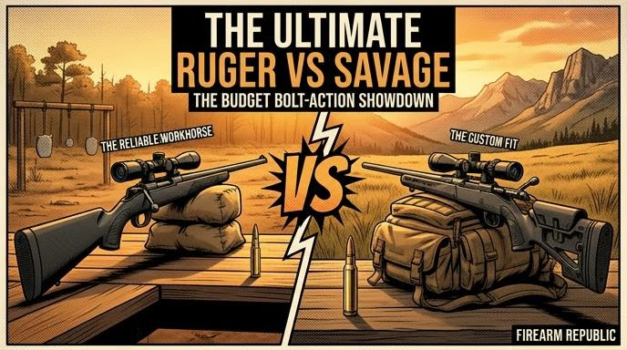
Two rifles dominate the sub-$700 bolt-action market: the Ruger American and the Savage 110. Between them, they’ve probably accounted for more first deer rifles purchased in the last decade than everything else in the price range combined. They’re both genuinely good – sub-MOA accurate, reliable, available in every relevant hunting caliber, and sold at prices that leave budget for a quality optic. But they’re not the same rifle, and for specific hunters with specific priorities, one is clearly the better choice. This guide breaks down the head-to-head comparison across every meaningful category: trigger, accuracy, ergonomics, aftermarket, caliber selection, and real-world field performance. The answer isn’t the same for every buyer, but by the end of this guide you’ll know which one it is for you.
The Rifles at a Glance
Ruger American Gen II ($599–$679 street) launched its current generation with a meaningful upgrade over the original – the primary changes being a factory-threaded barrel (5/8×24 on most calibers), an AICS-compatible magazine system replacing the proprietary rotary magazine, and a slightly improved Marksman adjustable trigger. The Gen II is available in most common hunting calibers from .223 to .300 Win Mag, in multiple stock configurations including a compact youth model, and with either blued or Ruger Gray Cerakote finish options. Weight runs 6.1–6.4 lbs depending on caliber, and the 22″ barrel is standard on most configurations.
Savage 110 ($549–$649 street for the base Hunter configuration) is the current iteration of a design that dates to 1958 and has been continuously refined since. The AccuTrigger – Savage’s factory adjustable trigger – has been standard equipment since 2003 and remains the most talked-about feature of the platform. The 110 is available in a wider caliber range than almost any other production rifle, from .204 Ruger through .338 Lapua, in both short and long action configurations. Weight runs 7.0–7.5 lbs in standard configurations – notably heavier than the Ruger American. See our Savage 110 Series Guide for the full platform overview.
Trigger: Savage 110 Wins Clearly
The AccuTrigger is the Savage 110’s defining advantage over the Ruger American. Adjustable from 2.5 to 6 lbs with a set screw accessible without disassembly, it breaks cleanly at the user-set weight with minimal perceptible creep or overtravel. At 2.5 lbs – the minimum – it’s genuinely competitive with aftermarket triggers costing $150–$200. At 3 lbs, it’s the best factory hunting trigger in the sub-$650 price range without meaningful qualification.
The Ruger American’s Marksman trigger adjusts from 3 to 5 lbs and is a meaningful improvement over the original Ruger American’s non-adjustable trigger. But it’s not in the AccuTrigger’s league. The Marksman has more travel and a less distinct break than the AccuTrigger; set to 3 lbs, it’s workable for hunting but noticeably inferior to the Savage in feel. Experienced shooters transitioning from a quality trigger to a Marksman feel the difference immediately; new shooters may not notice as much.
For hunters who prioritize trigger quality for either hunting or occasional precision use, the Savage 110 wins this category clearly. The AccuTrigger at 2.5–3 lbs is the budget rifle trigger other manufacturers are trying to match.
Winner: Savage 110
Accuracy: Effectively a Tie
Both rifles carry sub-MOA accuracy guarantees, and both generally deliver on that claim. In independent testing across multiple calibers and sources, the Ruger American Gen II and Savage 110 Hunter both produce 0.7–1.0 MOA groups with quality hunting ammunition and 0.5–0.8 MOA with quality match ammunition. Occasional samples of both rifles produce exceptional results (0.3–0.4 MOA); occasional samples produce mediocre results (1.2–1.5 MOA with specific loads). Both are typical of production rifle accuracy at this price point.
The honest nuance: the Savage 110’s barrel manufacturing has a strong reputation built over decades of production, and the AccuTrigger’s cleaner break makes extracting the rifle’s accuracy potential marginally easier for most shooters – a shooter with a cleaner trigger pulls fewer shots. But the underlying mechanical accuracy of the two platforms is comparable, and real-world group sizes with the same hunter behind both rifles are not reliably distinguishable.
Where accuracy differences do emerge is in barrel-to-barrel consistency. The Ruger American Gen II’s cold hammer-forged (CHF) barrel is generally more consistent from sample to sample than Savage’s button-rifled barrel – less variance in the tails of the distribution. Most Savage 110s shoot well; some shoot better than the Ruger; some shoot worse. Most Ruger Americans shoot consistently in the 0.7–1.0 MOA range.
Winner: Tie (edge to Ruger on consistency)
Ergonomics and Stock Fit
This category is more personal than most comparisons acknowledge, but some meaningful differences exist.
Weight: The Ruger American Gen II at 6.1–6.4 lbs is meaningfully lighter than the Savage 110 Hunter at 7.0–7.5 lbs. That 0.6–1.1 lb difference is noticeable on an all-day carry in the field. For western hunters covering miles, spot-and-stalk deer hunters, or any hunter who values a light carry rifle, the Ruger’s weight advantage is real. For stand hunters and bench shooters, the Savage’s additional weight actually reduces felt recoil slightly and steadies the rifle.
Length of pull and stock geometry: The Ruger American Gen II’s stock has a 13.75″ LOP and a pistol grip geometry that most shooters find comfortable. The Gen II’s compact model (12″–13.5″ adjustable LOP) is the best production adjustable youth/compact stock in the price range. The Savage 110’s stock geometry is more traditional; LOP is 13.75″ standard on most configurations. The Savage 110 is also available with adjustable stocks in several configurations (110 Tactical, 110 Precision) that the base Hunter lacks.
Feel in hand: The Ruger American’s softer grip panels and slightly slimmer forend feel more refined than the Savage’s harder synthetic. This is a minor distinction that won’t affect hunting performance but matters to buyers who handle both at a counter before purchasing.
Bolt feel: The Savage 110’s 60-degree bolt lift requires less hand movement to cycle than the Ruger American’s 70-degree lift, which is a minor ergonomic advantage in rapid cycling scenarios. Neither is notably smooth or rough at this price point – both are average factory bolt actions that improve with use.
Winner: Ruger American (lighter weight, better compact option)
Magazine System: Ruger American Wins
The Ruger American Gen II’s switch to an AICS-compatible detachable box magazine system is the most meaningful single upgrade over the original American and gives it a clear advantage over the Savage 110 Hunter’s proprietary magazine.
AICS-compatible magazines are the standard interface of the precision rifle world. A 10-round AICS magazine ($25–$40 aftermarket) drops into the Ruger American Gen II’s mag well and provides double the factory capacity with a widely available and affordable component. The same magazine standard is shared with the Bergara B-14, Tikka’s AICS-compatible models, the Ruger Precision Rifle, and dozens of chassis systems. If you ever put the Ruger American into an aftermarket chassis, the magazine transfers.
The Savage 110 Hunter ships with a 4-round detachable box magazine that uses a proprietary Savage-pattern interface. Aftermarket magazines are available but cost more than AICS options and are from a narrower field of manufacturers. The Savage 110 in chassis configurations (110 Precision, MDT chassis) uses different magazine standards depending on the configuration – some accept AICS, others use the Savage proprietary pattern.
For hunters who will never need more than 4 rounds in the field, this distinction is largely academic. For hunters who want the option to run higher-capacity magazines, or for anyone who plans to eventually move the action into an aftermarket chassis, the Ruger American’s AICS compatibility is a genuine advantage.
Winner: Ruger American
Barrel and Muzzle: Ruger American Wins
The Ruger American Gen II’s factory-threaded 22″ barrel (5/8×24 on most centerfire calibers) is a meaningful practical advantage over the Savage 110 Hunter’s non-threaded barrel. Threading allows immediate attachment of a suppressor, muzzle brake, or compensator without a trip to a gunsmith. For the growing number of hunters pursuing suppressed hunting setups, starting with a threaded barrel rather than paying $80–$150 for gunsmith threading on an unthreaded barrel is real savings. See our Best Suppressed Hunting Setups guide for what the threaded barrel enables.
The Savage 110 Hunter’s barrel is unthreaded in the base configuration. The Savage 110 Tactical and 110 Carbon configurations include threaded barrels, but these cost $200–$400 more than the base Hunter. The Hunter model is simply not suppressor-ready out of the box.
Both rifles use free-floating barrels, which is standard for production bolt-action rifles at this price. Neither requires bedding work to achieve their factory accuracy.
Winner: Ruger American
Aftermarket and Upgrade Path
Both rifles have significant aftermarket ecosystems, but they’re structured differently.
Ruger American aftermarket: The AICS magazine compatibility and standard trigger guard footprint allow most common upgrades. Trigger replacement options include the Timney American ($150) and Rifle Basix ($95), which provide aftermarket-quality breaks. Stock upgrades include Boyd’s laminate and synthetic options ($150–$250). The platform doesn’t have the depth of the Remington 700 ecosystem, but a hunter who wants to improve the trigger and stock has clear, affordable options.
Savage 110 aftermarket: The Savage platform’s aftermarket is deep and purpose-built. The AccuStock system in higher-end Savage models provides aluminum bedding and stock channel. The Savage prefit barrel system is the standout feature – a competent home mechanic can swap Savage prefit barrels using a barrel nut wrench and headspace gauges without gunsmithing, making the 110 platform one of the most accessible DIY barrel-replacement systems available. Trigger options beyond the AccuTrigger include TriggerTech Primary ($130) and Rifle Basix ($95). Stock options include MDT chassis ($450–$700) and Boyds options ($150–$250).
For hunters who plan to upgrade over time or who eventually want to rechamber to a different caliber, the Savage 110’s prefit barrel system is a meaningful practical advantage. For hunters who want a hunting rifle that works as delivered, both platforms provide what they need.
Winner: Savage 110 (prefit barrel system is unique at this price)
Caliber Selection: Savage 110 Wins
The Savage 110’s caliber breadth is genuinely impressive. The platform is available in everything from .204 Ruger varmint calibers through .338 Lapua Magnum in various configurations. Common hunting calibers – .243 Winchester, 7mm-08, 6.5 Creedmoor, .308 Winchester, .30-06 Springfield, 7mm Rem Mag, .300 Win Mag – are all available in the base 110 Hunter configuration. Niche calibers including .22-250, .25-06, .270 WSM, and .300 WSM are available in specific 110 configurations.
The Ruger American Gen II covers the core hunting calibers well – .243, .308, 6.5 Creedmoor, .30-06, 7mm-08, .300 Win Mag – but its total caliber count is narrower than the Savage 110 family. Hunters looking for .22-250, 7mm WSM, or unusual hunting calibers are more likely to find the Savage 110 in their chosen chambering.
Winner: Savage 110
Head-to-Head Comparison Table
| Category | Ruger American Gen II | Savage 110 Hunter | Winner |
|---|---|---|---|
| Price | $599–$679 | $549–$649 | Tie (Savage slightly cheaper) |
| Weight | 6.1–6.4 lbs | 7.0–7.5 lbs | Ruger American |
| Trigger | Marksman 3–5 lbs | AccuTrigger 2.5–6 lbs | Savage 110 |
| Accuracy | Sub-MOA (0.7–1.0 MOA) | Sub-MOA (0.7–1.0 MOA) | Tie |
| Magazine | AICS-compatible | Proprietary | Ruger American |
| Threaded barrel | Yes, factory | No (base Hunter) | Ruger American |
| Aftermarket | Good | Better (prefit barrel) | Savage 110 |
| Caliber selection | Good | Excellent | Savage 110 |
| Stock adjustability | Youth/compact option | Standard (adj. on Tactical) | Ruger American |
| Bolt lift | 70-degree | 60-degree | Savage 110 |
Who Should Buy the Ruger American Gen II
The suppressor-ready buyer: The factory-threaded barrel and AICS magazine make the Ruger American Gen II the better starting point for a hunter planning to add a suppressor. Buying a rifle that’s already threaded and already accepts 10-round magazines from day one is worth the minor price premium over the unthreaded Savage Hunter. Pair with a Dead Air Sandman-S or SilencerCo Omega 300 and you have a complete suppressed hunting system without gunsmithing.
The lightweight carry hunter: At 6.1–6.3 lbs, the Ruger American Gen II in 6.5 Creedmoor is among the lightest production bolt-action rifles at this price. Spot-and-stalk hunters, western hunters covering miles, and anyone who prioritizes carry weight over bench performance will find the Ruger’s weight advantage meaningful over a full day in the field. The Savage 110’s extra 0.6–1.0 lb adds up.
The youth hunter buyer: The Ruger American Compact with 12″–13.5″ adjustable LOP is the best youth-oriented adjustable-stock production rifle under $700. The same rifle fits a 10-year-old today and a 14-year-old in four years without modification. No equivalent compact adjustable configuration exists in the Savage 110 Hunter lineup at this price. See our Youth Hunting Rifles Guide for context on this use case.
The first-rifle buyer who wants simplicity: The Ruger American Gen II is a cleaner, simpler out-of-box experience than the Savage 110. Nothing to adjust, nothing to calibrate, nothing to worry about. Mount a scope, zero it, hunt. For a buyer who doesn’t want to spend time optimizing the AccuTrigger and just wants a reliable deer rifle, the Ruger American delivers a functional package without requiring any setup beyond scope mounting.
Who Should Buy the Savage 110 Hunter
The trigger-focused buyer: If trigger quality is the deciding factor, the Savage 110 wins every time. The AccuTrigger adjusted to 2.5–3 lbs is a fundamentally better trigger than the Marksman at any setting. For hunters who shoot frequently, care about technique development, or have experience with quality triggers on other rifles, the AccuTrigger’s advantage is tangible in every shooting session. No other production rifle under $700 offers a comparable factory trigger.
The DIY builder and upgrader: The Savage prefit barrel system is unique in the production rifle market. A hunter who wants to start with a 6.5 Creedmoor hunting rifle today and rechamber to 6.5 PRC or .300 Win Mag in two years can swap Savage prefit barrels without gunsmithing for $200–$300 in parts. This is impossible on the Ruger American without professional gunsmithing. For hunters who think of their rifle as a platform to develop over time rather than a finished product, the Savage 110 is the right investment.
The heavy-caliber hunter: The Savage 110’s heavier weight (7.0–7.5 lbs) is a liability for carry hunters but an advantage in managing the recoil of magnums. A Savage 110 Hunter in .300 Win Mag generates approximately 26 ft-lbs of felt recoil; a Ruger American in the same chambering, being lighter, generates slightly more. For hunters who primarily hunt from stands or blinds and are shooting heavy magnums for elk or moose, the Savage’s extra weight works in their favor.
The unusual-caliber hunter: Hunters who need .22-250, .25-06, 6.5 Creedmoor in a left-hand action, or any of the Savage 110’s more niche chamberings will find the Savage 110 family covers their needs when the Ruger American doesn’t.
The Bottom Line
Neither rifle is universally better – they make different trade-offs that favor different buyers. But if forced to pick one answer:
For most hunters buying their first or primary deer rifle, the Savage 110 Hunter is the slightly better choice – the AccuTrigger at $549–$649 is genuinely the best factory trigger in the price range and makes the rifle more rewarding to shoot and easier to develop technique on. The caliber breadth and prefit barrel system add long-term flexibility that the Ruger American doesn’t match.
The Ruger American Gen II is the better choice if any of these apply: you plan to suppress the rifle, you want the lightest possible package, you’re buying for a youth hunter who needs an adjustable stock, or you specifically value AICS magazine compatibility for future platform development.
The price difference between the two is small enough that caliber selection, planned upgrades, and personal preference should drive the final decision more than cost. Both rifles kill deer reliably, both deliver on their sub-MOA claims, and both represent genuine value at their price points. For most hunters, the one they can handle in person at a gun counter and feels right is the right choice.
Frequently Asked Questions
Q: Is the Ruger American or Savage 110 more accurate?
A: Both carry sub-MOA guarantees and both generally deliver 0.7–1.0 MOA with quality hunting ammunition. In independent testing, neither rifle is consistently more accurate than the other – individual samples vary more than the platform difference. The Ruger American’s cold hammer-forged barrel tends to produce more consistent sample-to-sample results; the Savage 110’s AccuTrigger makes extracting accuracy from the platform slightly easier for most shooters. For practical hunting use, both are more than accurate enough for ethical shots at any deer-hunting distance.
Q: Which has the better trigger – Ruger American or Savage 110?
A: The Savage 110’s AccuTrigger is clearly better. Adjustable from 2.5 to 6 lbs with a clean, predictable break, it’s the best factory trigger in the sub-$700 production rifle market. The Ruger American’s Marksman trigger is adjustable and workable but has more travel and a less distinct break than the AccuTrigger. If trigger quality is the deciding factor, choose the Savage 110.
Q: Which is better for a first deer rifle?
A: Both work well. The Savage 110’s AccuTrigger helps new hunters develop correct trigger technique, which has long-term benefits for their shooting. The Ruger American’s lighter weight and simpler out-of-box experience are advantages for hunters who want less complexity. For youth hunters specifically, the Ruger American Compact’s adjustable LOP makes it the better platform. See our Best Rifles for New Shooters for a broader comparison including other budget options.
Q: Can I suppress the Ruger American or Savage 110?
A: The Ruger American Gen II comes factory-threaded (5/8×24) and is suppressor-ready out of the box. The Savage 110 Hunter base model does not come threaded – a gunsmith can thread the barrel for $80–$150. The Savage 110 Tactical and Carbon configurations include threaded barrels but cost more. For hunters planning a suppressed setup from the start, the Ruger American Gen II is the more practical starting point. See our Suppressor Buyer’s Guide for the full NFA process.
Q: Which is better for elk hunting – Ruger American or Savage 110?
A: Both are adequate platforms for elk in appropriate calibers (6.5 Creedmoor with bonded bullets, .308 Winchester, .30-06, .300 Win Mag). The Savage 110’s heavier weight (7.0–7.5 lbs) manages magnum recoil slightly better for hunters in elk country who choose .300 Win Mag or 7mm Rem Mag. The Ruger American’s lighter weight is an advantage for western hunters covering miles to find elk. Caliber selection (use bonded or monolithic bullets regardless of platform) matters more than the choice between these two rifles for elk specifically. See our Elk Hunting Caliber Comparison for the full elk caliber picture.
Q: Is the Savage 110 or Ruger American better for long-range shooting?
A: For dedicated long-range use (600+ yards), neither the base Hunter nor Gen II configurations are the right choices – purpose-built platforms like the Bergara B-14 HMR, Savage 110 Tactical, or Ruger Precision Rifle are better optimized. That said, between the two base models, the Savage 110’s AccuTrigger makes 500-yard shooting more accessible for most shooters, and the Savage prefit barrel system makes rechambering to a higher-BC cartridge (6.5 PRC, .300 Win Mag) possible without gunsmithing. For hunters who also shoot long range recreationally, the Savage 110 platform has a clearer upgrade path toward precision rifle territory. See our Long-Range Shooting Guide for what the discipline actually requires.