 Maksym Kovaliov
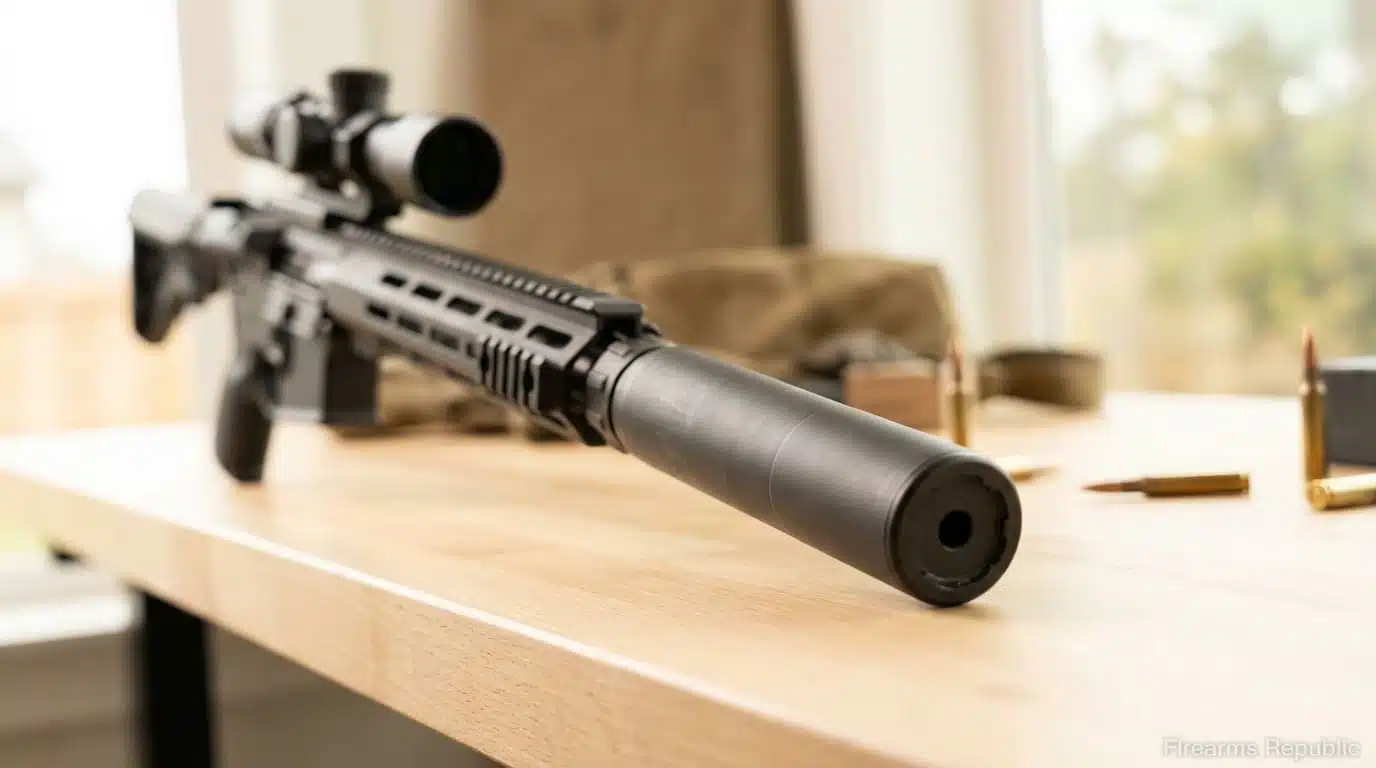
A suppressor is the most misunderstood accessory in the firearms industry. Movies have conditioned the public to believe suppressors make rifles whisper-quiet – a barely audible “pew” across a room. The reality is more nuanced: a quality suppressor on a rifle is still loud by everyday standards (130–140 dB for most centerfire setups), but it drops the report below the threshold of immediate hearing damage, significantly reduces noise signature, and changes the shooting experience in ways that consistent owners say are worth the investment.
The landscape changed significantly in 2025 and 2026. The “One Big Beautiful Bill” (H.R.1), signed into law on July 4, 2025, eliminated the $200 NFA tax stamp for suppressors, SBRs, SBSs, and AOWs effective January 1, 2026. The registration process, background checks, and ATF Form 4 approval all remain in place – but the financial barrier that existed since 1934 is gone. This guide covers how suppressors work technically, what to look for when buying, and the complete current picture of what the purchase process actually looks like in 2026.
How Suppressors Work
The Basic Mechanism
A suppressor is a series of baffles – internal chambers – threaded onto or over a rifle’s muzzle. When the firearm fires, propellant gas follows the bullet down the barrel and exits the muzzle at high pressure. Without a suppressor, this gas expands explosively into open air, creating the muzzle blast that constitutes most of a firearm’s report.
The suppressor’s baffles trap and slow this gas, allowing it to cool and expand gradually rather than explosively. The result is a significant reduction in muzzle blast. What the suppressor cannot reduce: the mechanical noise of the action cycling and – critically – the sonic crack produced by any supersonic projectile.
The Sonic Crack Problem
A supersonic bullet traveling faster than approximately 1,125 fps creates a small sonic boom that propagates outward from the bullet’s path. This crack is produced by the bullet, not the muzzle, and a suppressor does nothing to reduce it.
This is why suppressed 5.56 NATO is not nearly as quiet as suppressed 9mm subsonic. The 5.56 bullet’s sonic crack is present regardless of the suppressor. A 9mm 147gr subsonic load at 950 fps produces no sonic crack – with a quality suppressor, the report is dominated only by mechanical action noise. Genuinely quiet. The 5.56 remains recognizably a rifle shot, just significantly reduced in peak level.
What the Decibel Numbers Mean
Suppressor manufacturers report decibel reduction – typically 25–35 dB depending on caliber and suppressor design.
| Sound Level | dB | Notes |
|---|---|---|
| Normal conversation | 60 dB | Reference point |
| Power tools | 95 dB | Circular saw at 3 feet |
| Immediate damage threshold | 140 dB | Single-shot risk |
| Unsuppressed 5.56 NATO | 165 dB | Significant hearing damage |
| Suppressed 5.56 NATO | 133–138 dB | Reduced – still requires protection |
| Unsuppressed 9mm pistol | 160 dB | Significant hearing damage |
| Suppressed 9mm subsonic | 115–120 dB | Below immediate damage threshold |
| Unsuppressed .22 LR | 140 dB | At immediate damage threshold |
| Suppressed .22 LR subsonic | 110–115 dB | Hearing-safe for most shooters |
Practical takeaway: suppressed .22 LR and subsonic 9mm PCC are genuinely hearing-safe in most circumstances without additional protection. Suppressed 5.56 or .308 is significantly quieter than unsuppressed but still warrants hearing protection for extended sessions. The “movie silencer” does not exist with supersonic ammunition.
The Purchase Process in 2026
What Changed – and What Didn’t
The One Big Beautiful Bill eliminated the $200 NFA tax stamp effective January 1, 2026. This is the most significant change to suppressor acquisition since the NFA was passed in 1934. The $200 payment required since the 1930s is gone – but the NFA process and registry remain in place. You still need to complete the ATF Form 4 and pass a background check.
What is gone: The $200 tax stamp fee.
What remains unchanged:
- ATF Form 4 (Application for Tax Paid Transfer – now $0 transfer)
- FBI fingerprint cards
- Passport photos
- Background check
- ATF approval and wait period before you can take possession
- NFA registry – your suppressor is registered to you
The ATF temporarily shut down the eForms system on December 26, 2025 to implement new form formats with a $0 tax field, relaunching on January 1, 2026 with updated workflows designed to handle the expected surge in new submissions.
What to Expect: Wait Times in 2026
150,000 NFA applications were filed on the first day after the $0 tax stamp became official. This surge is reshaping wait time expectations dramatically compared to late 2025 when eForms were processing in as few as days.
Current guidance for 2026: expect wait times to lengthen significantly from late-2025 lows as ATF processes the backlog of new submissions. Plan for 4–10 months as a working estimate – the $0 stamp removed a major incentive to delay purchasing, and the resulting surge is real.
Individual vs. Trust Registration
Individual registration requires fingerprints, passport photos, and CLEO (Chief Law Enforcement Officer) notification – the county sheriff or chief of police in your jurisdiction. CLEO notification is not an approval requirement, but some jurisdictions have historically created friction. The suppressor is registered to you personally – no one else can legally possess it without you present.
NFA Trust registration is the recommended approach for most buyers. A trust allows multiple responsible persons (spouse, adult children, shooting partners) to legally possess and use the suppressor. Eliminates CLEO friction. Each responsible person on the trust submits fingerprints and photos. Many NFA dealers provide basic trust templates at no additional cost; attorney-prepared trusts run $75–$150.
State Legality
As of 2026, suppressor ownership is legal in 42 states. The eight states that prohibit civilian suppressor ownership: California, Delaware, Hawaii, Illinois, Massachusetts, New Jersey, New York, and Rhode Island. Suppressor hunting permission is a separate question from ownership – some states allow ownership but restrict use in the field. Verify your state’s hunting regulations annually.
Suppressor Construction: What to Look For
Monocore vs. Stacked Baffle
Monocore suppressors use a single machined core with integrated baffles. Easier to clean (the core removes as one piece) and consistent in baffle spacing. Replacing a damaged baffle requires replacing the entire core.
Stacked baffle suppressors use individual baffles separated by spacers. Modular design allows individual baffle replacement and, in some suppressors, adjustable length by removing the front module. Better for high-volume cleaning since each baffle surface is individually accessible.
Materials
Stainless steel: Most durable. Handles sustained rapid fire and high-temperature shooting without degrading. Heavy – a full-length stainless .30 caliber suppressor weighs 17–22 oz. Best for high-volume use.
Titanium: Lighter than stainless (12–16 oz for comparable designs) with similar strength. Costs $200–$400 more than equivalent stainless. Right choice for hunters who carry suppressed rifles long distances.
Aluminum: Lightest material. Only appropriate for .22 LR and other low-pressure rimfire cartridges – aluminum baffles fail quickly under centerfire rifle pressures.
Inconel: A nickel-chromium superalloy used for first baffles (blast baffles) in high-performance suppressors. Handles the extreme heat and pressure load that the first baffle absorbs from every shot.
Direct Thread vs. Quick Detach (QD)
Direct thread suppressors thread directly onto the barrel’s muzzle threads. Simpler, typically less expensive, slightly better for accuracy (most consistent alignment). The limitation: moving the suppressor between rifles with different thread pitches requires adapters and takes time.
QD suppressors use a muzzle device that stays on the barrel permanently, with the suppressor attaching and detaching in seconds. Move between multiple rifles quickly without tools. QD mounts add 0.5″–1.5″ of length and $50–$150 in cost. Some QD systems produce slightly more point-of-impact shift than direct thread – test with your specific combination.
Sealed vs. Serviceable
Sealed suppressors are welded permanently and cannot be disassembled. Lighter and less expensive. Cleaned by soaking in solvents (acetone, ultrasonic cleaners). Not ideal for .22 LR where lead fouling is heavy.
Serviceable suppressors disassemble for cleaning. Required for .22 LR suppressors due to heavy lead fouling. Preferred for any high-volume centerfire use. More complex construction and higher cost.
Thread Pitches: Match Your Barrel
Every suppressor attachment depends on matching the muzzle thread pitch to the suppressor’s mount.
| Caliber | Standard Thread Pitch |
|---|---|
| 5.56 / .223 | 1/2×28 |
| .308 / 7.62mm | 5/8×24 |
| 9mm | 1/2×28 |
| .45 ACP | 5/8×24 |
| .22 LR | 1/2×28 |
| 6.5 Creedmoor | 5/8×24 |
| .300 Blackout | 5/8×24 (some 1/2×28 – verify barrel) |
Multi-caliber suppressor use across different thread pitches requires adapter mounts ($20–$40 each). If you plan to share one suppressor across multiple rifles, verify thread pitch compatibility or budget for adapters before purchasing.
Setup Considerations for Semi-Automatic Rifles
Adjustable Gas Block – Strongly Recommended
Suppressors increase back pressure in a semi-automatic rifle’s gas system. The suppressor slows gas expansion at the muzzle, causing more gas to return through the gas port. Without compensation: increased bolt carrier velocity, faster cycling, increased extraction force, and reliability issues with subsonic loads.
An adjustable gas block ($90–$130) allows reducing gas flow to match suppressed conditions. For any suppressed semi-automatic build this is a practical necessity, not a luxury:
- Superlative Arms Adjustable Gas Block: $90 – the standard recommendation
- JP Enterprises Adjustable Gas Block: $130 – wider adjustment range
- SLR Rifleworks Sentry: $95 – strong competitive option
Point-of-Impact Shift
All suppressors shift point of impact compared to an unsuppressed rifle. The suppressor changes barrel harmonics and adds muzzle weight. Typical shift: 0.5″–2″ at 100 yards. Most shooters re-zero with the suppressor attached and leave it on permanently. If you alternate suppressed and unsuppressed, document both zeros or use a QD mount with repeatable indexing.
Length and Balance
A suppressor changes how the rifle handles. A 9″–10.5″ SBR barrel plus a 7″ suppressor results in approximately 16.5″–17.5″ of barrel-plus-suppressor – about the same overall as an unsuppressed 16″ rifle. This is why short-barreled configurations are popular for suppressed builds: the suppressor restores the length the short barrel removed, while the overall suppressed package stays compact.
Best Suppressors by Caliber
.22 LR – Rimfire Cans
Prioritize serviceability for .22 LR – lead fouling is severe and a sealed rimfire can fills up and degrades without regular cleaning.
| Suppressor | Length | Weight | dB (approx.) | Price |
|---|---|---|---|---|
| SilencerCo Sparrow 22 | 5.1″ | 4.5 oz | ~113 dB | $450 |
| Dead Air Mask HD | 5.4″ | 7.9 oz | ~112 dB | $550 |
| Ruger Silent-SR | 5.3″ | 4.5 oz | ~115 dB | $449 |
| Gemtech Mist | 4.7″ | 4.0 oz | ~117 dB | $400 |
Best choice: SilencerCo Sparrow 22 – the benchmark rimfire suppressor. Fully serviceable, rated for .22 LR, .17 HMR, and .22 WMR, and the most widely supported rimfire can in the market. The Dead Air Mask HD adds pistol caliber compatibility if you want one can for both a rimfire rifle and a 9mm pistol.
9mm / PCC – Pistol Caliber Cans
These suppressors handle 9mm, .45 ACP, and PCC rifles in those calibers. With subsonic 147gr 9mm, they deliver genuinely hearing-safe operation.
| Suppressor | Length | Weight | Rating | Price |
|---|---|---|---|---|
| SilencerCo Omega 9K | 5.1″ | 9.0 oz | 9mm–.45 ACP | $900 |
| Dead Air Wolfman | 6.3″ / 4.5″ | 10.9 oz | 9mm–.45 ACP | $1,100 |
| SilencerCo Osprey 9 | 8.1″ | 11.0 oz | 9mm–.45 ACP | $950 |
| Gemtech GM-9 | 7.2″ | 10.8 oz | 9mm | $650 |
Best choice: SilencerCo Omega 9K for compact builds and pistol use – the smallest quality 9mm suppressor available. Dead Air Wolfman for buyers who want modular length flexibility between pistol and PCC configurations.
5.56 / .223 – AR-15 Cans
The most commonly owned rifle suppressors in the U.S. Must handle full 5.56 NATO pressure and are often rated for multiple calibers.
| Suppressor | Length | Weight | Rating | Price |
|---|---|---|---|---|
| SilencerCo Saker ASR 556 | 6.9″ | 17.5 oz | 5.56–7.62×39 | $900 |
| Dead Air Sandman-S | 6.8″ | 17.5 oz | 5.56–.300 WM | $900 |
| SilencerCo Omega 36M | 7.1″ | 14.8 oz | 5.56–.338 LM | $1,100 |
| Rugged Surge 762 | 7.5″ | 13.5 oz | 5.56–.308 | $750 |
| Griffin Armament Recce 5 | 5.5″ | 14.0 oz | 5.56 | $700 |
Best choice: Dead Air Sandman-S for buyers who want the widest caliber rating (5.56 through .300 Win Mag) at a competitive price. SilencerCo Saker ASR 556 for the most popular QD system with the largest dealer network. Griffin Recce 5 for the best value dedicated 5.56 suppressor.
.30 Caliber – .308 / 6.5 CM / AR-10
Full-power .30 caliber suppressors must handle significantly higher peak pressures than 5.56 cans. Construction quality matters more here.
| Suppressor | Length | Weight | Rating | Price |
|---|---|---|---|---|
| SilencerCo Omega 300 | 7.8″ | 14.2 oz | .30 cal–.300 WM | $1,050 |
| Dead Air Sandman-L | 9.0″ | 22.0 oz | 5.56–.300 WM | $950 |
| Dead Air Sandman-S | 6.8″ | 17.5 oz | 5.56–.300 WM | $900 |
| Thunderbeast Ultra 7 | 7.0″ | 13.0 oz | .30 cal bolt only | $1,150 |
| SureFire SOCOM300-SPS | 7.7″ | 19.0 oz | .30 cal semi-auto | $1,400 |
Best choice: SilencerCo Omega 300 – lightweight titanium, rated through .300 Win Mag, and the most widely recommended .30 caliber suppressor for versatile use across bolt-action and semi-automatic rifles. Dead Air Sandman-S for buyers who want maximum caliber coverage in a compact, durable package at a lower price point.
Multi-Caliber – One Can for Multiple Rifles
With the $0 tax stamp eliminating the $200-per-item cost barrier, multi-caliber suppressors are more compelling than ever for shooters with multiple platforms.
SilencerCo Hybrid 46M ($1,150): Rated from 5.56 NATO to .46 caliber – covers an AR-15 in 5.56, an AR-10 in .308, a .300 BLK pistol, and a .45 ACP PCC with one suppressor and thread pitch adapters. The single most versatile suppressor available.
Dead Air Nomad-L ($1,050): Rated from 5.56 to .300 Win Mag. Full-length stainless construction with Dead Air’s Keymo QD system. Best choice for Dead Air system users who want consistent QD mounts across their rifle collection.
Rugged Obsidian 45 ($550): Rated for pistol calibers through .45 ACP – covers 9mm, .40 S&W, .45 ACP, and .300 BLK subsonic. The budget multi-caliber option for pistol and PCC use.
Suppressor and Caliber Pairing Guide
| Primary Rifle | Recommended Suppressor | Why |
|---|---|---|
| AR-15 in 5.56 only | Griffin Recce 5 ($700) or Saker ASR ($900) | Dedicated 5.56 value or best QD system |
| AR-15 in .300 BLK | Dead Air Sandman-S ($900) | Handles both supersonic and subsonic .300 BLK |
| AR-10 in .308 / 6.5 CM | SilencerCo Omega 300 ($1,050) | Lightweight, full .30 cal rating |
| Multiple centerfire rifles | SilencerCo Hybrid 46M ($1,150) | Covers 5.56 through .46 cal |
| .22 LR rimfire | SilencerCo Sparrow 22 ($450) | Benchmark rimfire can |
| 9mm PCC or pistol | SilencerCo Omega 9K ($900) | Most compact quality 9mm can |
| .22 LR + 9mm combo | Dead Air Mask HD ($550) | Rated for both calibers |
Suppressed Hunting
Suppressor ownership is legal in 42 states. Hunting with a suppressor is a separate question – some states allow ownership but restrict suppressor use in the field.
States with broad suppressor hunting permission: Texas, Florida, Alabama, Georgia, Oklahoma, Tennessee, Arizona, Colorado, Montana, Wyoming, South Dakota, and most other non-restricted states.
States that prohibit suppressor hunting: Iowa and Vermont as of 2025 – verify current status as regulations change annually.
How to verify: Your state wildlife agency website lists hunting equipment regulations. Search “[your state] suppressor hunting regulations” and verify before each season – laws in this area have been changing frequently.
Hunting applications where suppressors provide a genuine tactical or practical advantage:
- Hog hunting at night – suppressed first shot keeps sounders engaged for follow-up shots
- Small game in timber – suppressed .22 LR allows multiple shots without dispersing remaining animals
- Pest control – agricultural operations benefit from reduced noise impact on livestock and neighbors
- Youth and new shooter hunting – reduced report eliminates flinch induction and hearing risk for first-time hunters
Total Cost of Suppressor Ownership in 2026
With the $200 tax stamp eliminated, the cost structure of suppressor ownership has changed. Budget for the complete system:
| Item | Cost |
|---|---|
| Suppressor (mid-range .30 cal) | $900–$1,100 |
| NFA tax stamp | $0 (as of Jan 1, 2026) |
| NFA trust (recommended) | $0–$150 |
| Compatible muzzle device (QD) | $60–$150 |
| Adjustable gas block (semi-auto) | $90–$130 |
| Suppressor cleaning kit | $30–$60 |
| Total (mid-range .30 cal setup) | $1,080–$1,590 |
The elimination of the $200 stamp reduces the total system cost meaningfully – but more significantly, it removes the psychological barrier that caused many buyers to delay. The suppressor’s retail price remains the dominant cost.
Maintenance
Cleaning Schedule
Suppressors accumulate carbon fouling (all calibers) and lead fouling (.22 LR and other lead-bullet calibers) over time. Reduced effectiveness and increased weight are the indicators that cleaning is needed.
| Suppressor Type | Cleaning Interval |
|---|---|
| Rimfire (.22 LR) – serviceable | Every 500–1,000 rounds |
| Centerfire rifle – serviceable | Every 3,000–5,000 rounds |
| Centerfire rifle – sealed | Solvent soak every 5,000–10,000 rounds |
| Suppressed subsonic 9mm | Every 1,500–2,000 rounds |
Cleaning Methods
Serviceable suppressors: Disassemble and clean each baffle individually. Carbon responds to standard bore solvent (Hoppe’s No. 9, M-Pro 7). Lead fouling (in rimfire cans) requires dedicated lead solvent or ultrasonic cleaning. Dry thoroughly before reassembly – moisture inside a sealed suppressor causes corrosion.
Sealed suppressors: Submerge in acetone (for carbon) or ultrasonic cleaner with appropriate solution. Allow complete drying before reinstalling. Do not use heat to accelerate drying.
Never use steel brushes inside a suppressor – they damage baffle surfaces. Bronze or nylon only.
Pros and Cons
✓ Advantages
- Hearing protection – the primary practical benefit; cumulative hearing damage from unsuppressed shooting is permanent
- $0 tax stamp – the $200 financial barrier eliminated since January 1, 2026
- Reduced noise signature – dramatically less disruptive to neighboring properties, fellow hunters, and livestock; agricultural landowners regularly grant suppressed hunters access specifically for this reason
- Hearing-safe subsonic shooting – suppressed .22 LR, 9mm PCC, and .300 BLK subsonic are genuinely hearing-safe; a qualitatively different shooting experience
- Faster follow-up shots – reduced blast and recoil allows faster, more accurate follow-up shots; most pronounced in precision shooting
- Sounder management in hog hunting – suppressed first shots keep the group engaged for multiple-animal engagement
- Training value – reduced noise enables range communication without shouting; less intimidating for new shooters
✗ Disadvantages
- Wait time – the surge in Form 4 submissions following the $0 stamp change means wait times in 2026 are expected to be long; 4–10 months is the working estimate
- Cost – retail price of quality suppressors ($450–$1,400) remains unchanged; only the stamp fee was eliminated
- Maintenance – carbon and lead fouling require periodic cleaning; sealed suppressors require solvent soaks
- Weight and length – a .30 caliber suppressor adds 12–22 oz and 7–9″ to the rifle
- POI shift – requires re-zeroing with suppressor attached
- State restrictions – ownership prohibited in 8 states; hunting use restricted in others
- NFA paperwork burden – the approved Form 4 must be kept permanently as proof of legal ownership; losing it creates complications
Frequently Asked Questions
Q: Do I still need to fill out paperwork to buy a suppressor in 2026?
A: Yes – the NFA registration process remains fully in place. All that changed when the law went into effect on January 1, 2026 is that anyone who goes to purchase a suppressor can do so without having to pay the $200 tax that was previously required. You still submit an ATF Form 4, provide fingerprint cards and passport photos, pass a background check, and wait for ATF approval before taking possession. The suppressor remains on the NFA registry. The only thing eliminated is the $200 fee itself.
Q: How quiet is a suppressed rifle?
A: It depends entirely on caliber and whether the ammunition is supersonic. A suppressed .22 LR with standard velocity ammunition produces approximately 110–115 dB – below the threshold of immediate hearing damage and genuinely hearing-safe for most shooters. A suppressed 9mm PCC with 147gr subsonic loads produces approximately 115–120 dB – similar. A suppressed .308 Winchester with standard supersonic loads produces approximately 130–132 dB – significantly quieter than unsuppressed (165 dB) but still louder than most extended-session hearing protection thresholds. The “movie silencer” does not exist with supersonic ammunition.
Q: How long is the wait to get a suppressor in 2026?
A: Significantly longer than late 2025. 150,000 NFA applications were filed on the first day after the $0 tax stamp became official – a surge that will take the ATF time to process. Late 2025 eForms were processing in days; 2026 wait times are expected to extend to several months as ATF adapts to the increased volume. Plan for 4–10 months as a working estimate. Use eForms rather than paper submission – electronic processing is consistently faster.
Q: Should I register a suppressor as an individual or through a trust?
A: For most buyers, a trust is the better choice. An NFA trust eliminates CLEO sign-off requirements (some local officials create friction), allows multiple responsible persons – spouse, adult children – to legally possess and use the suppressor without you being present, and simplifies estate planning for NFA items. Many NFA dealers provide basic trust templates at no cost; attorney-prepared trusts run $75–$150. The trust approach is the standard recommendation in the NFA community and adds minimal complexity relative to the benefits.
Q: Can I use one suppressor on multiple rifles?
A: Yes. One registered suppressor can be moved between any of your personally owned rifles, provided the suppressor’s bore diameter accommodates the calibers involved and thread pitch or QD mounts are compatible. A Dead Air Sandman-S on a 5/8×24 QD mount moves between a .308 AR-10, a 6.5 CM bolt-action, and a .300 BLK AR-15 pistol seamlessly. Thread pitch adapters ($20–$40) cover calibers with different muzzle threads. Multi-caliber suppressors like the SilencerCo Hybrid 46M are built specifically for maximum cross-platform coverage and are particularly compelling now that the per-item stamp fee is gone.
Q: What is the best first suppressor to buy?
A: By primary use:
- AR-15 in 5.56 or .300 BLK: Dead Air Sandman-S ($900) – handles both calibers, excellent build quality, wide caliber rating
- AR-10 or bolt-action in .308 / 6.5 CM: SilencerCo Omega 300 ($1,050) – lightweight titanium, versatile, the most recommended .30 cal suppressor
- Multiple platforms across calibers: SilencerCo Hybrid 46M ($1,150) – one suppressor from 5.56 to .46 caliber
- .22 LR: SilencerCo Sparrow 22 ($450) – the benchmark rimfire suppressor
- 9mm PCC or pistol: SilencerCo Omega 9K ($900) – most compact quality 9mm can
If uncertain about your long-term direction, the Sandman-S or Omega 300 cover virtually every centerfire rifle you’re likely to own and are the suppressor community’s most consistent recommendations.
Related Guides
- AR-15 Platform Guide – Gas system setup for suppressed builds
- AR-9 / PCC Platform Guide – Best suppressed 9mm PCC setups
- AR-10 Platform Guide – .308 suppressed builds and gas systems
- .300 Blackout Caliber Guide – The suppressor specialist cartridge
- AR Rimfire Platform Guide – .22 LR suppressed training
Related Application Guides
- Hog Hunting Rifle Guide – Suppressed night hunting setups
- Small Game Hunting Rifles – Suppressed rimfire hunting
- Home Defense Rifle Guide – Suppressed home defense options