
 Firearms Republic
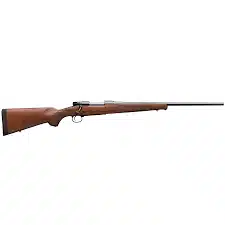
The Winchester Model 70 has carried the “Rifleman’s Rifle” title since 1936, and the Featherweight in 308 Winchester is the version most hunters actually buy. With controlled-round feeding, a 3-position safety, and Grade I walnut at a $899–$999 street price, it represents something no synthetic-stocked competitor can replicate – a working rifle with genuine heritage. This review covers real-world accuracy, handling, honest trade-offs, and who should actually spend the money.
| Specification | Details |
|---|---|
| Barrel Length | 22″ |
| Barrel Twist | 1:10 |
| Barrel Contour | Sporter (slim Featherweight profile) |
| Weight | 6.75 lbs |
| Trigger | MOA Trigger, adjustable 3–5 lbs, factory ~3.5 lbs |
| Magazine | Hinged floorplate internal box, 5 rounds |
| MSRP | $1,099 |
| Street Price | $899–$999 |
| Stock | Grade I walnut with Pachmayr Decelerator recoil pad |
| Threaded Barrel | No |
| Action | Controlled-round feeding, Mauser-style extractor, 3-position safety |
| Finish | Matte blued |
| Scope Base | Drilled and tapped for standard Model 70 bases |
Quick Verdict – The Rifleman’s Rifle in .308
✓ Best for: Traditional deer and elk hunters who value heritage, walnut, and feeding reliability
✓ Price: $899–$999 street
✓ Key strength: Controlled-round feeding with Mauser-style extractor – most reliable feeding system in production hunting rifles
✗ Not ideal for: Suppressor hunters, AICS magazine users, or budget-focused buyers who need detachable-mag flexibility
Real-World Performance – Accuracy & Ballistics
The Winchester Model 70 Featherweight 308 Winchester shoots better than its hunting-rifle profile suggests. The 22″ chrome moly barrel with a 1:10 twist stabilizes the full range of 308 Winchester projectiles cleanly – Federal 168gr Gold Medal Match averaged 0.7 MOA across five-shot groups at 100 yards, with the best groups touching 0.6 MOA. Hornady 178gr ELD-X ran 0.8 MOA consistently, pushing roughly 2,600 fps from the 22″ tube – a decisive elk load to 500 yards. Federal 150gr Fusion hit 2,820 fps and printed 0.9 MOA, which is more than adequate for whitetail at any reasonable hunting distance. The free-floated barrel and MOA trigger at factory 3.5 lbs contribute meaningfully to that consistency – the trigger isn’t the crispest at this price, but it’s predictable and breaks cleanly without creep. Handloaders can expect 0.4–0.6 MOA with tuned loads. Recoil runs approximately 15 ft-lbs, and the Pachmayr Decelerator pad absorbs it well enough that follow-up shots are comfortable even during extended range sessions.
Applications & Use Cases – Hunt to Heirloom
Whitetail Hunting: The Winchester Model 70 Featherweight 308 Winchester is a natural whitetail rifle – 6.75 lbs carries easily to the stand, the 3-position safety allows safe hammer-down carry with a round chambered, and the controlled-round feeding means the rifle chambers reliably when a buck steps out at dawn. The 150gr Fusion at 2,820 fps is a proven deer load with zero drama at 300 yards and under.
Elk Hunting: The 178gr ELD-X at 2,600 fps from the 22″ barrel is a legitimate 500-yard elk load, and the Mauser-style extractor earns its reputation here – under the stress of a shot opportunity at distance, the Model 70 feeds and chambers without hesitation. The internal magazine is slower to reload than a detachable box, but elk hunting rarely requires rapid follow-up shots.
Pack-In Mule Deer: At 6.75 lbs unscoped, the walnut Featherweight is lighter than most hunters expect from a wood-stocked rifle. Add a mid-weight optic and you’re carrying under 9 lbs – manageable over serious miles. The walnut requires more care in wet conditions than synthetic, which is the one genuine concern for multi-day backcountry trips.
Heirloom Rifle: A Model 70 purchased today will still be shooting cleanly in 50 years. No synthetic-stocked production rifle at this price carries the same story or the same collector value – this is the application where the Model 70 has no real competition.
Ergonomics & Handling – Walnut, Weight & Feel
The Grade I walnut stock on the Winchester Model 70 Featherweight 308 Winchester fits a standard adult shooter well – the comb height works with low-to-mid-height scope rings without cheek-weld issues, and the slim Featherweight profile keeps the rifle from feeling bulky in hand. The bolt throw is smooth and positive, with the controlled-round feeding extractor snapping over the case head during feeding in a way that inspires confidence. The 3-position safety is genuinely useful in the field – position one fires, position two allows bolt operation with the firing pin blocked, and position three locks the bolt entirely for safe carry with a chambered round. The hinged floorplate drops cleanly for unloading without cycling rounds through the action. At 6.75 lbs, balance is slightly muzzle-forward, which steadies offhand shots better than a perfectly neutral-balanced rifle.
Aftermarket & Upgrade Path – Model 70 Ecosystem
The Winchester Model 70 Featherweight 308 Winchester has its own aftermarket footprint – it does not share the Remington 700 pattern, which limits options compared to that platform, but the core upgrades are well-covered. The factory MOA trigger runs heavier than advertised for many shooters; before spending $195 on a Timney Model 70, a trigger spring kit from Old Beaver Gunsmith is worth trying first. The spring brings pull to approximately 3 lbs – exact feel varies depending on your rifle’s production year – installs without any fitting or machining, and is fully reversible at $11. If you want a genuinely light pull after that, the Timney Model 70 drops to 1.5 lbs and is a clean installation.
For wet-weather hunting, a Bell and Carlson synthetic Model 70 stock ($250) lets you store the walnut safely while running a weather-resistant setup. Talley lightweight one-piece bases ($65) are the elegant traditional mounting solution. Barrel work is available through Pac-Nor and Shilen for Model 70-specific prefits if you want to rechamber or rebarrel down the road.
Pros & Cons – Honest Trade-Offs at $900–999
Strengths:
✓ Controlled-round feeding – Mauser-style extractor is the most reliable feeding system in production hunting rifles
✓ 3-position safety – genuinely useful field feature not found on most competitors
✓ Grade I walnut stock – traditional aesthetics unmatched at this price point
✓ 0.6–0.8 MOA with quality factory ammo – accurate enough for any hunting application
✓ 6.75 lbs – lighter than expected for a walnut-stocked rifle
✓ 85+ years of production heritage – collectability and investment value no synthetic rifle matches
✓ Free-floated chrome moly barrel – consistent accuracy across temperature changes
✓ Pachmayr Decelerator pad – manages 15 ft-lbs recoil effectively
Limitations:
✗ Internal 5-round magazine – slower to reload than AICS detachable alternatives
✗ Not threaded from the factory – suppressor users need aftermarket barrel work
✗ Factory trigger at 3.5 lbs – adequate but not as crisp as Tikka’s factory pull
✗ Walnut stock absorbs moisture – requires more care in wet hunting conditions than synthetic
✗ Model 70-specific aftermarket – smaller ecosystem than Remington 700 footprint
✗ $899–$999 is a premium for an internal-magazine rifle when detachable-mag alternatives exist at similar prices
Competitors & Alternatives – How It Stacks Up
| Feature | Model 70 Featherweight | Tikka T3x Lite | Bergara B-14 Ridge | Browning X-Bolt 2 Speed |
|---|---|---|---|---|
| Price | $899–$999 | $875 | $1,050 | $1,050 |
| Weight | 6.75 lbs | 6.0 lbs | 7.0 lbs | 6.35 lbs |
| Trigger | ~3.5 lbs | ~2.0 lbs | ~3.5 lbs | ~3.0 lbs |
| Magazine | Internal 5-rd | Detachable | AICS detachable | Detachable |
| Accuracy | 0.6–0.8 MOA | 0.5–0.7 MOA | 0.5–0.7 MOA | 0.6–0.8 MOA |
The Tikka T3x Lite 308 Winchester is the sharpest technical competitor – it’s $125 less, lighter at 6.0 lbs, runs a better factory trigger, and offers a detachable magazine. If pure performance-per-dollar is the priority, the Tikka wins on paper. The Bergara B-14 Ridge 308 Winchester at $1,050 adds a hand-lapped barrel and AICS magazine compatibility, making it the better choice for shooters who want precision-rifle features in a hunting package. Neither the Tikka nor the Bergara offers walnut, controlled-round feeding, a 3-position safety, or 85 years of American rifle heritage – and for a meaningful segment of hunters, those things matter more than a detachable magazine.
Who Should Buy This – And Who Should Skip It
Ideal for the traditional hunter: If you grew up reading about the Model 70, value walnut over polymer, and want the most reliable feeding system in a production hunting rifle, the Winchester Model 70 Featherweight 308 Winchester is the purchase. It’s also the right call for hunters who carry long distances and want a rifle that doubles as a genuine heirloom – something no synthetic-stocked competitor at this price can claim.
Look elsewhere if you need a detachable magazine, a factory-threaded barrel for suppressor use, or if $900+ for an internal-magazine rifle is a stretch – the Ruger American Gen II 308 Winchester at $649 delivers AICS magazine compatibility and solid accuracy for $250 less, and the Tikka T3x Lite 308 Winchester at $875 offers a better trigger and lighter weight.
Frequently Asked Questions – Model 70 .308
Q: What is controlled-round feeding and why does it matter?
A: The Mauser-style extractor snaps over the case head as the round feeds from the magazine, controlling it all the way into the chamber. It virtually eliminates double-feeds and extraction failures – critical reliability in field conditions.
Q: Can I add a detachable magazine to the Model 70 Featherweight?
A: No straightforward drop-in conversion exists. The internal hinged floorplate is integral to the action design. If detachable magazines are a priority, consider the Bergara B-14 Ridge 308 Winchester instead.
Q: Is the MOA trigger worth upgrading?
A: Try the Old Beaver trigger spring kit first – it’s inexpensive and reversible. If you want a pull under 2 lbs, the Timney Model 70 at $195 is the clean solution.
Q: How does the walnut stock hold up in wet conditions?
A: It requires wiping down and occasional oil treatment. It won’t warp with normal hunting exposure, but extended wet-weather use warrants a Bell and Carlson synthetic swap to protect the original stock.
Q: What scope pairs best with the Model 70 Featherweight?
A: The Leupold VX-3HD 3.5–10×40 is the classic pairing – appropriate magnification range, weight-matched to the rifle, and aesthetically correct with walnut and matte blue.
Q: Is the Model 70 still made in the USA?
A: Yes. Winchester Model 70 rifles are manufactured in New Haven, Connecticut.
Final Verdict – Worth the Rifleman’s Premium
The Winchester Model 70 Featherweight 308 Winchester is not the most technically capable rifle at $900–$999 – the Tikka T3x Lite 308 Winchester has a better trigger, and the Bergara B-14 Ridge 308 Winchester offers a detachable magazine at a similar price. But no rifle at this price delivers walnut, controlled-round feeding, a 3-position safety, and 85 years of American rifle heritage in a single package. For hunters who’ve wanted a Model 70 their whole life and finally have the budget – buy it without hesitation.