 Maksym Kovaliov
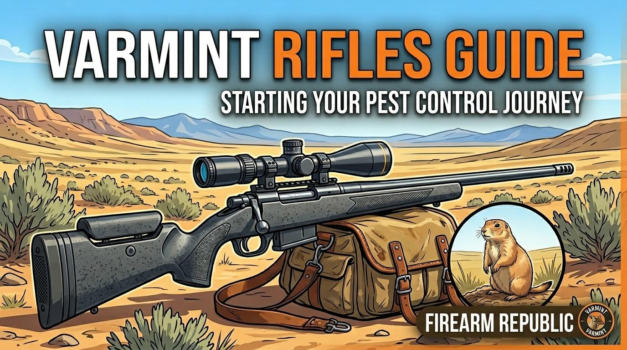
Varmint hunting occupies a unique position in American shooting culture – it is the application that produces the most rounds fired per season, demands the most consistent precision at moderate ranges, and tolerates the least error in ballistic performance because the targets are small. A prairie dog presents a 3-inch vital zone at 200 yards. A ground squirrel at 100 yards offers less margin for error than any deer at any distance. Getting hits consistently on small, distant targets in wind requires flat trajectory, genuine accuracy, and bullets that produce enough energy for clean kills without merely clipping the target and allowing it to escape into its burrow. This guide covers every element of building a capable varmint hunting setup: the right cartridges for every varmint application, the right rifles at every budget, optics, and how to approach the specific skills that separate consistent varmint hunters from frustrated ones.
What Varmint Hunting Demands From a Rifle
The varmint hunting brief is specific enough to shape equipment choices in ways that differ from deer or elk hunting.
Small target size: Prairie dogs present roughly a 3-inch vital zone. Ground squirrels less than 2 inches. Coyotes offer 6–8 inches of vital area but can run after a marginal hit in a way deer cannot. Consistent hits on small targets at variable distances require a combination of flat trajectory, minimal wind drift, and shooter skill that exceeds what deer hunting demands.
High shot volumes: A productive prairie dog town session involves 50–200 shots over a day of shooting. A serious varmint hunter who sets up at 150 yards on a dog town might fire 300 rounds across a long weekend. This shot volume shapes cartridge selection – barrel heat, ammo cost, and recoil management all matter in ways they do not for deer hunters who fire 5–10 rounds per season.
Variable distances: Prairie dog hunting on the Great Plains may involve shots from 50 yards to 350 yards across the same setup position. Knowing holdover for multiple ranges simultaneously, or having a scope with a BDC reticle or dialed elevation, is practical rather than optional.
Range discipline: Wind is the defining challenge of long-range varmint hunting. A 10 mph wind at 200 yards moves a .22-250 55gr bullet approximately 3 inches – the entire vital zone of a prairie dog. Reading and timing shots for wind lulls is the skill that separates 50% hit rates from 90% hit rates at varmint distances.
Best Varmint Cartridges
Rimfire Options – Close Range (Under 150 Yards)
.22 LR: The default close-range varmint cartridge for squirrels, rabbits, and pest control on farms. Inside 75 yards with quality standard-velocity loads, it is the most cost-effective and low-noise option available. Wind sensitivity limits its practical ceiling to 75–100 yards on small targets. See our .22 LR Caliber Guide.
.17 HMR: The step up for hunters who need consistent performance to 150 yards. The 17gr V-MAX at 2,550 fps from a rifle barrel drifts 3.8 inches at 150 yards in a 10 mph crosswind – dramatically better than any .22 LR load at the same distance. For squirrel and prairie dog hunting inside 150 yards where the cost of centerfire ammo feels excessive, the .17 HMR is the correct choice. See our .17 HMR Caliber Guide.
Centerfire Varmint Cartridges
.223 Remington / 5.56 NATO: The most affordable centerfire varmint cartridge and the default for high-volume prairie dog shooting. At 40–55gr in an AR-15 or bolt gun, it produces explosive fragmentation on prairie dogs to 250 yards in calm conditions. The limitation is wind sensitivity – the lighter bullets drift 3–4 inches at 200 yards in a 10 mph wind, which is the full vital zone of a prairie dog. Experienced varmint hunters who read wind carefully shoot .223 effectively to 250 yards. In gusty conditions, the effective ceiling compresses significantly. See our .223 Remington Caliber Guide.
.22-250 Remington: The classic high-velocity varmint cartridge that has defined prairie dog and coyote hunting for 60 years. The 55gr V-MAX at 3,700–3,800 fps from a 24″ barrel produces a trajectory so flat that holdover to 300 yards is minimal, and the explosive fragmentation leaves no doubt about hits. At 300 yards in a 10 mph wind the 55gr load drifts approximately 5 inches – better than .223 but still requiring attention. For bolt-action varmint hunters who want maximum velocity and the flattest trajectory available in a practical centerfire cartridge, the .22-250 is the definitive choice. See our .22-250 Remington Caliber Guide.
.243 Winchester with light loads: The dual-purpose nature of the .243 Win means that hunters who use it for deer also have access to 55–75gr varmint loads that push 3,500–3,900 fps – faster than any .22-250 load from a comparable barrel. The flat trajectory and explosive fragmentation of the .243 Win at varmint velocities is genuinely impressive, and hunters who own a .243 Win for deer have an effective varmint rifle without buying a second platform. See our .243 Winchester Caliber Guide.
.204 Ruger: The specialist choice for maximum velocity varmint work. The .204 Ruger fires 32–40gr bullets at 4,000–4,225 fps – the fastest production centerfire varmint cartridge available. Explosive fragmentation is guaranteed at virtually any practical range. The honest limitation is ammo availability and rifle selection: the .204 is a niche cartridge with narrower factory ammo options and fewer production rifles than .22-250 or .223. For dedicated varmint hunters who want maximum velocity and are comfortable sourcing ammo online, it is a genuine specialist tool.
6mm ARC and 6.5 Grendel with light loads: Both AR-15-platform cartridges produce useful varmint performance with 75–90gr 6mm and 90–100gr 6.5mm bullets at 3,000–3,100 fps. The advantage over .223 Rem is wind performance from the higher-BC bullet designs. Hunters who use these cartridges for deer hunting get varmint capability from the same platform with a load change. See our 6mm ARC Caliber Guide and 6.5 Grendel Caliber Guide.
Varmint Cartridge Comparison at 250 Yards
| Cartridge | MV (fps) | 250 yd Velocity | 250 yd Drop (100 yd zero) | 10 mph Wind @ 250 yd | Cost/Round |
|---|---|---|---|---|---|
| .17 HMR (17gr V-MAX) | 2,550 | 1,617 | -8.1″ | 5.9″ | $0.28–$0.42 |
| .223 Rem (55gr V-MAX) | 3,240 | 2,452 | -7.2″ | 5.8″ | $0.50–$0.75 |
| .22-250 (55gr V-MAX) | 3,750 | 2,706 | -5.4″ | 4.9″ | $0.65–$0.90 |
| .243 Win (75gr V-MAX) | 3,350 | 2,650 | -5.8″ | 4.5″ | $0.65–$0.85 |
| .204 Ruger (32gr V-MAX) | 4,225 | 2,764 | -4.3″ | 7.8″ | $0.80–$1.10 |
Best Varmint Rifles by Platform
Bolt-Action Varmint Rifles
Bolt-action rifles dominate serious precision varmint shooting because they offer the most consistent action-to-barrel bedding, the heaviest barrel profiles that resist heat-induced accuracy shifts during long sessions, and the most accurate trigger options at every price point.
Budget: Savage Axis II Varmint ($400–$480)
The Savage Axis II Varmint’s heavy barrel profile is the standout feature at this price – the 22″ medium-heavy barrel resists heat shift better than sporter-weight barrels and produces consistent accuracy across long prairie dog sessions. The AccuTrigger is genuinely adjustable from 2.5–6 lbs. In .22-250 or .223 Rem, it delivers 0.75–1.0 MOA accuracy that is more than sufficient for varmint work inside 300 yards. The cheapest path to a functional heavy-barrel varmint bolt gun.
Mid-Range: Ruger Precision Rimfire or American Varmint ($450–$600)
The Ruger American Varmint in .22-250 or .204 Ruger provides a 26″ heavy barrel, adjustable Marksman trigger, and 0.75 MOA accuracy in a package that punches well above its price. The long barrel maximizes velocity from the .22-250 – a 26″ barrel adds approximately 100 fps over a 22″ barrel at this cartridge’s burn rate. For varmint hunters who want to maximize the .22-250’s velocity potential, the 26″ heavy-barrel Ruger American Varmint is a purpose-built tool at an accessible price.
Mid-Range Premium: Savage 12 F/TR or Model 12 Varminter ($700–$900)
Savage’s Model 12 series represents the transition to serious precision varmint equipment. The laminate or synthetic stock provides more consistent bedding than injection-molded stocks, the heavy barrel profile minimizes heat-related point-of-impact shift, and the AccuTrigger in adjusted form produces a clean 2 lb break. In .22-250 Rem, it delivers sub-half-MOA accuracy from quality handloads – the threshold that makes 300-yard prairie dog hunting consistently achievable.
Premium: Tikka T3x Varmint ($950–$1,100)
Tikka’s T3x Varmint applies the legendary T3x trigger and action to a purpose-built varmint platform with a heavy contour barrel that maintains point of impact across extended shooting sessions. The 23.5″ heavy barrel in .22-250 Rem produces factory-loaded velocity figures while maintaining the consistent lockup that produces sub-MOA accuracy. For hunters who want the best production varmint bolt gun without custom pricing, the T3x Varmint is the benchmark. Available in .22-250 Rem, .223 Rem, and .308 Win. See our Tikka T3x Complete Guide.
Precision Custom-Grade: Bergara B-14 HMR or Custom Build ($950–$2,500)
The Bergara B-14 HMR’s chassis-compatible design and heavy contour barrel produce competitive varmint accuracy in a package that accommodates aftermarket stocks and chassis for hunters who want maximum ergonomic adjustment. For hunters who want to build a dedicated precision varmint platform on a proven action, the Savage Model 10/12 actions, Tikka T3x, and Remington 700-footprint actions all support extensive aftermarket modifications including custom barrels in specialized varmint calibers. See our Bergara B-14 Series Guide and Remington 700 Platform Guide.
Semi-Auto Varmint Rifles
Semi-automatic platforms – primarily AR-15 pattern – provide the most practical setup for high-volume prairie dog shooting where shots are fired rapidly at multiple targets across a setup position. The follow-up shot speed of a semi-auto in a target-rich environment outweighs the slight accuracy advantage of quality bolt-action platforms.
Budget: PSA or Anderson AR-15 in .223 Rem ($500–$800 complete)
An entry-level AR-15 in .223 Rem with a 20″ heavy or government-profile barrel delivers adequate varmint accuracy at the most accessible price point. For hunters whose shots stay inside 200 yards and who prioritize shot volume over long-range precision, the standard AR-15 platform in .223 Rem with 40–55gr V-MAX loads handles prairie dog sessions effectively. The trade-off is wind sensitivity – .223 Rem at 200+ yards in canyon wind is genuinely challenging without careful wind reading.
Mid-Range: Ruger AR-556 or Aero Precision M4E1 with Match Barrel ($800–$1,300)
Stepping up to a quality AR-15 with a 1:8 twist 18–20″ stainless or chrome-moly barrel improves consistency and enables the full bullet weight range from 40gr to 77gr. A quality trigger (LaRue MBT-2S or Geissele SSA-E) transforms AR-15 varmint accuracy from 1.5–2.0 MOA to 0.75–1.0 MOA – meaningful when the targets are 3 inches in diameter at 250 yards.
Precision AR-15 Varmint: 6mm ARC or 6.5 Grendel Upper ($900–$1,500 upper)
For the most capable semi-auto varmint setup, a 6mm ARC upper on a quality lower with a match trigger produces the best combination of BC, wind performance, and accuracy available in an AR-15 format. The 90gr Hornady V-MAX in 6mm ARC at 3,100 fps produces devastating fragmentation inside 300 yards with significantly better wind performance than .223 Rem – 5.2 inches vs. 9.8 inches in a 10 mph wind at 300 yards. This is the precision varmint semi-auto setup for hunters who want maximum performance from the AR-15 platform.
Best Optics for Varmint Hunting
Varmint shooting demands more from optics than deer hunting because the targets are smaller, ranges are more variable, and shots are taken more rapidly in sequence. Getting the optics right for varmint work is as important as cartridge selection.
Magnification
For prairie dog and ground squirrel hunting at 100–350 yards, a 6–24x or 8–32x variable is the practical range. At 6x, a prairie dog at 150 yards subtends approximately 2 MOA of the visual field – enough to confirm the target but not enough for precise holdover placement on the 3-inch vital zone. At 20–24x, the same target presents clearly and the crosshair can be placed with the precision that varmint hunting requires.
Fixed-power scopes in the 16–24x range are popular with bench-style prairie dog hunters who set up at known distances and rarely adjust magnification mid-session. Variable-power scopes are more practical for hunting situations where distance changes and close encounters at 50 yards may alternate with 300-yard shots.
Parallax Adjustment
Side-focus (side-wheel) parallax adjustment is non-negotiable for varmint work past 100 yards. A scope set for 100-yard parallax introduces ranging errors at 200–300 yards that shift point of impact by 1–2 inches or more when the shooter’s eye is not perfectly centered in the exit pupil. Side-focus adjustment allows precise parallax correction at each target distance. Most quality varmint scopes include side-focus as standard; avoid any scope for varmint use that lacks this feature.
Recommended Scopes
Budget: Vortex Crossfire II 6–18×44 ($220–$270) – Side-focus adjustment, crisp second focal plane reticle, adequate low-light performance for morning and evening varmint sessions. The most recommended entry-level varmint scope for hunters who want adequate performance without significant investment.
Mid-Range: Vortex Viper HS 4–16×44 ($420–$480) or Leupold VX-3HD 4.5–14×40 ($480–$550) – Quality glass with low-light performance that extends useful shooting hours beyond what budget options provide. Side-focus parallax, quality reticles, and durability that handles field conditions.
Premium: Nightforce SHV 5–20×56 ($750–$900) or Vortex Razor HD 5–20×50 ($1,200–$1,400) – Exceptional glass clarity, precise parallax adjustment, and first focal plane reticle options for hunters who want the most accurate holdover system available. At premium price points, the glass quality genuinely produces more shots on small targets in marginal light compared to budget alternatives.
See our Best Scopes for Long-Range Shooting guide and Best Hunting Scopes guide for full optic comparisons.
Specific Varmint Hunting Applications
Prairie Dog Hunting
Prairie dog hunting on the Great Plains – Kansas, South Dakota, Wyoming, Colorado, Montana – is the most demanding varmint application in terms of range and precision. A productive prairie dog town presents targets from 50 to 400 yards simultaneously, the wind is almost never calm, and hit rates below 60% are frustrating enough to prompt equipment evaluation.
Setup approach: Establish a shooting position that maximizes comfortable shots at the highest-density area of the town. Most experienced prairie dog hunters carry two rifles – a light .22-250 or 6mm ARC for 50–250 yard shots and a heavier-barreled precision rifle for deliberate 250–400 yard shots. The two-rifle approach manages barrel heat from the high shot volumes that close-range positions generate.
Barrel heat management: A heavy barrel in .22-250 begins producing heat-shift issues after 10–15 rounds in rapid succession on a warm day. After a rapid string, letting the barrel cool to touchable temperature before returning to a precision hold is the discipline that maintains accuracy across long sessions.
Range cards: For prairie dog hunting at multiple known distances (the town’s water source at 175 yards, the burrow cluster at 280 yards, the far mound at 350 yards), a simple range card noting elevation holds at each distance saves mental arithmetic during active shooting.
Ground Squirrel Hunting
Ground squirrel and Belding’s squirrel hunting in California, Oregon, and the Mountain West presents smaller targets than prairie dogs at comparable ranges. The .17 HMR handles this application effectively inside 125 yards. Centerfire options – .22-250 with 40gr V-MAX, .223 Rem with 40gr V-MAX – produce the explosive fragmentation needed for clean kills on 2-inch targets at 100–200 yards.
Woodchuck and Groundhog Hunting
Eastern woodchuck hunting is the traditional varmint hunting application for farmers and rural hunters in the Mid-Atlantic and Northeast. Woodchucks present a slightly larger target than prairie dogs and are typically shot from field edges at 50–250 yards. The .22-250 is the classic eastern woodchuck cartridge. The .17 HMR is adequate inside 125 yards. The .243 Win with 75gr V-MAX is the choice for hunters who want to use their deer rifle for both applications.
Coyote Hunting
Coyote varmint hunting – as distinct from predator calling where shots break at calling distances – involves shooting at distances from 50 to 400 yards depending on terrain and approach method. Coyotes at 200–400 yards require more energy and penetration than prairie dogs – a 55gr .223 Rem bullet that explosively fragments on a prairie dog may not cleanly kill a 30–40 lb coyote if the shot is marginal. For dedicated coyote work at extended range, the 75–77gr .223 Rem loads, .22-250 with 60gr bonded or heavy bullets, or the 6.5 Grendel with 100gr loads are more reliable on animals this size. See our Coyote Hunting Rifles guide for dedicated predator hunting coverage.
Reloading for Varmint Hunting
The shot volumes of serious varmint hunting make reloading economically compelling. At 300 rounds per prairie dog weekend, factory .22-250 at $0.75–$0.90 per round costs $225–$270. Handloads of equivalent quality cost $0.30–$0.45 per round with bulk component purchases – $90–$135 for the same session.
Best reloading setup for varmint:
For volume varmint reloading, a progressive press (Dillon 550C, RCBS Pro Chucker 5) that processes 300–500 rounds per hour is more practical than single-stage or turret presses that top out at 50–100 rounds per hour. The investment in a progressive press – $450–$600 – pays back within one prairie dog season for serious shooters.
Powder for .22-250: Hodgdon H4380 and Varget are the community standards for 55–60gr bullets, producing consistent velocity with temperature stability relevant for summer varmint shooting. IMR 4064 is the classic alternative. CFE 223 meters well in progressive press powder measures and produces good velocity.
Bullets for varmint reloading: Hornady 40gr V-MAX and 50gr V-MAX in bulk boxes of 250 or 500 dramatically reduce per-bullet cost. Sierra 40gr BlitzKing and Nosler 40gr Ballistic Tip are alternatives. For coyote, Hornady 60gr V-MAX or Sierra 55gr BlitzKing provide more reliable terminal performance on larger animals.
Who Should Focus on Varmint Hunting?
Varmint hunting is the application that produces the best shooters because it demands the skills that transfer most directly to precision hunting: reading wind, executing consistent trigger technique, understanding ballistics across variable distances, and maintaining focus across long sessions. Hunters who dedicate a portion of their shooting year to serious varmint work – prairie dog trips in June, woodchuck hunting in July, squirrel work through fall – consistently develop better all-around shooting skills than those who only hunt deer.
For new shooters who want to accelerate skill development at reasonable cost, a .17 HMR bolt gun for close-range squirrel work is the most cost-effective starting point. For experienced hunters who want to push their long-range skills before fall elk or mule deer season, a quality .22-250 bolt-action setup with a quality variable scope provides the most challenging and skill-building varmint experience available at any price.
Frequently Asked Questions
Q: What is the best varmint rifle for prairie dogs?
A: For bolt-action dedicated prairie dog work, the Tikka T3x Varmint in .22-250 Rem with a 20–24x scope. It delivers the combination of flat trajectory, explosive fragmentation, and consistent accuracy across long shooting sessions that prairie dog hunting at 50–350 yards demands. For high-volume semi-auto shooting, a quality AR-15 in .223 Rem with a 6–18x scope handles the close-range prairie dog shooting that semi-auto format suits best.
Q: What is the maximum range for prairie dog hunting?
A: For most hunters with standard factory varmint loads, 300 yards is the practical ceiling where consistent hits on 3-inch targets in moderate wind are achievable with practiced technique. Experienced shooters with precision rifles, quality handloads, and sophisticated wind-reading skills extend this to 400 yards. Past 400 yards, shot volume drops dramatically and wind reading demands exceed what most hunters develop – the shots become more about favorable conditions than repeatable technique.
Q: Is .17 HMR good enough for prairie dogs?
A: Yes, inside 150 yards in calm to light wind conditions. At 100 yards the 17gr V-MAX produces reliable explosive kills on prairie dogs. At 150 yards in moderate wind, the .17 HMR’s energy is approaching its lower bound for reliable kills on small, tough-to-hit targets. For hunters shooting inside 125 yards in a relatively sheltered position, the .17 HMR is a cost-effective and low-noise choice. For open terrain where wind is consistent and shots extend to 200+ yards, the .22-250 or .223 Rem provides more margin. See our .17 HMR Caliber Guide.
Q: Does barrel twist rate matter for varmint shooting?
A: Yes, critically. Varmint hunting uses both very light, fast bullets (35–40gr at 3,800+ fps) and heavier match-grade bullets (60–77gr at 3,000–3,200 fps). A 1:12 twist stabilizes 35–55gr varmint bullets well but may not stabilize 69–77gr match bullets. A 1:8 twist handles 40–77gr reliably. A 1:7 twist stabilizes 62–90gr but can over-stress lighter 35–45gr varmint bullets at high velocity, sometimes causing jacket failures. For a dedicated .223 varmint rifle, a 1:9 twist is the traditional standard for the 40–55gr range. For a dual-purpose .223 that shoots both varmint and match loads, 1:8 is the most versatile choice.
Q: How do I manage barrel heat during long prairie dog sessions?
A: Rotate between two rifles when possible – the two-rifle approach is the standard for serious prairie dog hunters for exactly this reason. With a single rifle, fire strings of 5–8 rounds, then transition to a different target area or take a natural break, allowing the barrel to cool to touchable temperature before returning to maximum precision effort. A heavy contour barrel (Varmint or Bull profile) retains and radiates heat differently than a sporter barrel – it takes longer to heat up and longer to cool down, but maintains consistent point of impact better during moderate strings than a thin sporter barrel that heats quickly.
Q: What binoculars do I need for prairie dog hunting?
A: A quality 8×42 or 10×42 binocular for spotting and confirming targets at distance – Vortex Viper HD ($450–$500), Leupold BX-4 Pro Guide ($400–$450), or Zeiss Terra ED ($350–$400) represent the practical quality range for varmint hunting. A spotting scope (20–60x) is useful for confirming hits at 300+ yards where binoculars cannot resolve the impact clearly. A rangefinder confirms distances beyond visual estimation accuracy – essential for setting scope elevation holds at variable prairie dog town distances.