 Maksym Kovaliov
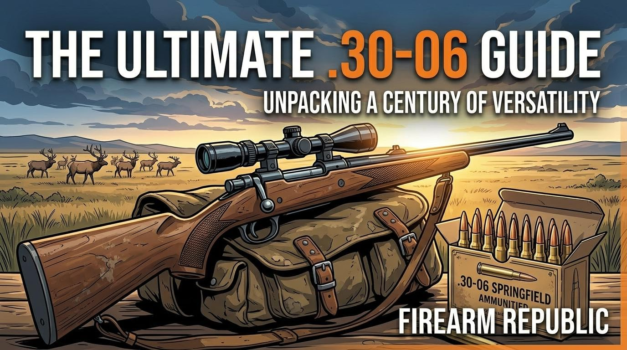
The .30-06 Springfield is the cartridge that defined American big game hunting for the 20th century – and a case study in how thoroughly a well-designed cartridge can outlast the era that produced it. Adopted by the US Army in 1906, it served American soldiers through two World Wars, Korea, and beyond before being replaced militarily by the 7.62×51 NATO in the 1950s. In the civilian hunting market, it never left. Seventy years after its military retirement, the .30-06 remains one of the top-selling centerfire hunting cartridges in the country, stocked in every rural hardware store from Maine to Montana, chambered in more production hunting rifles than almost any other cartridge, and trusted by hunters across every North American game species from whitetail to moose to brown bear. At $1.40–$2.50 per round for quality factory hunting loads, it costs slightly more than the .308 Win but delivers 100–150 fps more velocity with comparable bullet weights – enough to meaningfully extend effective hunting range and improve energy delivery on large game. This guide covers everything: honest ballistics, comparisons to modern alternatives, the specific applications where the .30-06 still makes sense, and where newer cartridges have genuinely surpassed it.
What Is the .30-06 Springfield?
The .30-06 Springfield was developed by the US Army Springfield Armory beginning in 1900 as an improvement on the .30-03 cartridge, with the final specification adopted in 1906 – hence the designation. The case was designed around the military requirement for a flat-shooting, hard-hitting cartridge capable of reliable performance at 1,000 yards in belt-fed machine guns and accurate long-range fire from bolt-action rifles. The resulting case dimensions – 2.494″ case length and 3.340″ overall length – established the long-action cartridge standard that has been used ever since.
The .30-06 operates at 60,000 PSI maximum pressure and produces its characteristic performance by combining a relatively large case capacity with .308 caliber bullets. The case holds approximately 68 grains of water – more than the .308 Win’s 56 grains – which is the fundamental source of its velocity advantage over the shorter cartridge. This additional powder capacity allows the .30-06 to push 150–180gr bullets 100–150 fps faster than the .308 Win, closing the gap with magnum cartridges at a fraction of their recoil and cost.
The long-action requirement is both the cartridge’s primary limitation and an increasingly minor one. Modern long-action rifles have shed much of the weight penalty that originally justified choosing short-action alternatives – a Tikka T3x Lite in .30-06 weighs essentially the same as the same rifle in .308 Win. The longer bolt throw of a long-action is still real but is a minor ergonomic consideration rather than a meaningful performance trade-off.
Ballistics: The Numbers That Matter
The .30-06’s ballistic profile is defined by versatility across bullet weights. From a 24″ barrel, 150gr bullets reach 3,000–3,050 fps, 165gr at 2,850–2,900 fps, 180gr at 2,700–2,750 fps, and 220gr cast or round nose loads at 2,400–2,450 fps. This weight range – from 110gr to 220gr – is broader than the .308 Win in practical terms and means the .30-06 genuinely serves applications from varmints with frangible loads to the largest North American game with heavy bonded bullets.
| Load | MV (24″, fps) | 400 yd Velocity | 400 yd Energy | 400 yd Drop (100 yd zero) | 10 mph Wind @ 400 yd |
|---|---|---|---|---|---|
| 150gr ELD-X | 3,000 | 2,328 | 1,808 ft-lbs | -26″ | 9.5″ |
| 165gr ELD-X | 2,870 | 2,268 | 1,886 ft-lbs | -29″ | 9.2″ |
| 180gr AccuBond | 2,740 | 2,150 | 1,849 ft-lbs | -33″ | 9.8″ |
| 180gr ELD-X | 2,750 | 2,167 | 1,877 ft-lbs | -33″ | 9.5″ |
| 220gr RN (Remington) | 2,410 | 1,757 | 1,509 ft-lbs | -47″ | 13.2″ |
| 165gr GMX (lead-free) | 2,870 | 2,230 | 1,820 ft-lbs | -29″ | 9.6″ |
The 400-yard table focus reflects the .30-06’s practical hunting envelope more honestly than 500-yard figures. At 400 yards with 165–180gr loads, the cartridge carries 1,849–1,886 ft-lbs – comfortably above the thresholds needed for ethical kills on elk, and more than double what deer require. The .30-06 is a genuine 400-yard hunting cartridge for game of all sizes found in North America.
The comparison to the .308 Win at 400 yards is the relevant ballistic story: the .30-06 carries approximately 200–300 ft-lbs more energy at 400 yards due to its velocity advantage. At 200 yards that gap shrinks to 150–200 ft-lbs. At 100 yards it is approximately 100 ft-lbs. The velocity advantage compounds at distance and is most meaningful in the 300–500 yard hunting range where the .30-06’s extra powder capacity earns its keep.
Recoil in a 9 lb rifle runs approximately 18–20 ft-lbs with standard 180gr hunting loads – more than the 7mm-08 (11–13 ft-lbs) and .308 Win (14–16 ft-lbs), but noticeably less than any belted magnum. Most adult hunters manage it comfortably through a full hunting season. Youth hunters and recoil-sensitive adults may find it at the upper edge of comfortable, particularly with 180–220gr loads.
.30-06 Springfield vs. The Competition
.30-06 vs. .308 Winchester
The .308 Win fires the same bullet diameter at 100–150 fps less velocity, fits in a short-action rifle, and has a broader factory ammo selection at major retailers. The .30-06 counters with more powder capacity, better performance on large game at 300–500 yards, access to the 200–220gr bullet class at useful velocity, and slightly better terminal performance on game requiring maximum penetration depth. For deer inside 300 yards, the .308 Win is fully capable and its short-action compactness is a practical advantage. For elk, moose, and bear at 300–500 yards, the .30-06’s velocity advantage produces meaningfully better energy retention. The decision is primarily about intended game size and range. See our .308 Winchester Caliber Guide.
.30-06 vs. 6.5 Creedmoor
The 6.5 CM generates approximately half the recoil of the .30-06 and achieves better BC-driven wind performance past 500 yards with 140gr high-BC bullets. The .30-06 hits harder on large game at all practical hunting distances due to larger bullet diameter and higher retained energy with heavier loads. For deer hunters who never engage targets past 400 yards, the 6.5 CM’s ballistic advantages at distance are largely academic and its softer recoil is genuinely practical. For hunters targeting elk, moose, and large bear where .30-caliber bullet diameter and heavy bullet penetration matter, the .30-06 provides energy margins the 6.5 CM cannot match. See our 6.5 Creedmoor Caliber Guide.
.30-06 vs. 7mm Rem Mag
The 7mm Rem Mag pushes .284 caliber bullets 100–150 fps faster than the .30-06 pushes comparable weight .30-caliber bullets, generating approximately 2–4 ft-lbs more recoil and producing better ballistic coefficients with the highest-BC 7mm bullets. For hunting applications inside 500 yards, the practical performance difference between a 165gr .30-06 load and a 160gr 7mm Rem Mag load is modest – both are competent elk cartridges. Past 500 yards in wind, the 7mm Rem Mag’s BC advantage begins to matter. For hunters who want maximum long-range performance in a non-magnum package, the 7mm Rem Mag is the better modern choice. For those who value the .30-06’s universal ammo availability and the 200–220gr heavy bullet option for large dangerous game, the Springfield remains relevant. See our 7mm Rem Mag Caliber Guide.
.30-06 vs. .300 Winchester Magnum
The .300 Win Mag pushes comparable bullet weights roughly 200–250 fps faster than the .30-06 and generates approximately 7–9 ft-lbs more recoil. For elk and moose inside 400 yards, the .30-06 does the job without the added punishment. Past 500 yards on large dangerous game or in conditions where maximum energy margin is wanted, the .300 Win Mag’s velocity advantage is genuine. The .30-06’s argument against the .300 Win Mag is practical: it delivers 90–95% of the .300 Win Mag’s hunting effectiveness at 65–70% of the recoil, with wider ammo availability and lower per-round cost. For hunters whose shots stay inside 400 yards on any North American game, the .30-06 is the more sensible choice. See our .300 Win Mag Caliber Guide.
Factory Ammunition: What to Buy
The .30-06 Springfield has the broadest and most historically deep factory ammunition selection of any hunting cartridge in the American market. Every manufacturer loads it in more configurations than any other caliber, rural availability is universal, and the price range spans from sub-$1-per-round bulk practice loads to premium $4-per-round match grade offerings.
For elk, deer, and all-around big game:
Hornady 180gr ELD-X ($50–$60/20 rounds) is the benchmark modern all-around hunting load – controlled expansion across the wide velocity range the .30-06 produces from 100 to 500 yards, and BC high enough for consistent accuracy to 400 yards. Federal Premium 180gr Trophy Bonded Tip ($55–$65/20 rounds) is the bonded choice for elk and moose hunters who want maximum penetration on quartering shots and heavy-boned animals. Nosler 180gr AccuBond ($55–$65/20 rounds) has a decades-long track record on elk and is the load many experienced western guides specify for clients – proven terminal performance across thousands of documented hunts. Federal 165gr Trophy Bonded Tip ($52–$62/20 rounds) is the preferred load for deer and lighter elk work where the 165gr provides better BC than the 180gr while delivering adequate penetration.
For deer at moderate ranges:
Federal 150gr Trophy Bonded ($48–$58/20 rounds) is the go-to lighter load for deer hunters who want a flatter trajectory and are comfortable with the slightly reduced penetration depth of the lighter bullet. Remington Core-Lokt 180gr PSP ($24–$32/20 rounds) is the classic affordable deer and elk load – not a modern high-BC design, but a soft-point that has taken more deer and elk than virtually any premium alternative through sheer volume of use over 80+ years. Winchester 180gr Power Point ($22–$30/20 rounds) is a similar traditional option at comparable pricing.
For large and dangerous game:
Federal 220gr Woodleigh Hydrostatically Stabilized ($70–$85/20 rounds) and Nosler 200gr Partition ($55–$68/20 rounds) are the premium options for moose, large bear, and maximum penetration applications. The 220gr round-nose loads – Remington Core-Lokt 220gr, Winchester Super-X 220gr – are the classic dense-timber and large bear loads that leverage the .30-06’s case capacity at its heaviest end.
For practice:
Federal American Eagle 150gr FMJ ($22–$28/20 rounds) is the standard range ammo. PMC 150gr FMJ ($18–$24/20 rounds) is the most affordable consistent option. Both deliver 1–1.5 MOA accuracy adequate for zeroing and practice.
| Load | Best For | Typical Price | Typical Accuracy |
|---|---|---|---|
| Hornady 180gr ELD-X | Elk/all-around hunting | $55/20 | 0.7–0.9 MOA |
| Federal 180gr Trophy Bonded | Elk/moose (bonded) | $60/20 | 0.7–1.0 MOA |
| Nosler 180gr AccuBond | Guided elk hunts | $60/20 | 0.7–0.9 MOA |
| Federal 165gr Trophy Bonded | Deer + light elk | $57/20 | 0.7–0.9 MOA |
| Nosler 200gr Partition | Moose/bear | $62/20 | 0.8–1.1 MOA |
| Remington 180gr Core-Lokt | Classic budget elk/deer | $28/20 | 1.0–1.5 MOA |
| Federal AE 150gr FMJ | Range practice | $24/20 | 1.0–1.5 MOA |
Reloading the .30-06 Springfield
The .30-06 is the benchmark for reloading simplicity – 120 years of documented load data, component availability from every manufacturer, and a case design that is forgiving of minor variations in sizing and seating depth. For reloaders who want to develop loads without extensive experimentation, the .30-06’s published data library is unmatched.
Brass: Lapua .30-06 Springfield brass ($70–$80/100) is available and worth the investment for precision work – consistent case weights and excellent primer pocket life. Federal and Winchester brass perform well for hunting reloads at lower cost. Remington brass is adequate but shows more weight variation than premium alternatives. Case life with conservative sizing runs 8–12 firings. The non-belted design means straightforward sizing without the belt-specific headspacing considerations of magnum cartridges.
Powder: The .30-06’s large case works with a wide range of medium to medium-slow powders. Hodgdon H4350 is the community standard for 165–180gr hunting bullets – excellent temperature stability and velocity-to-pressure ratios. Expect 2,780–2,820 fps with 180gr ELD-X and approximately 57–58gr H4350 from a 24″ barrel. Varget works well with lighter 150–165gr bullets. H4831SC is excellent with 180–200gr hunting loads and meters cleanly. IMR 4350 and IMR 4451 are classic alternatives with extensive published data. For the heaviest 200–220gr loads, H1000 and Retumbo produce the best velocity at safe pressures. The variety of suitable powders is the broadest of any cartridge in this guide series.
Bullets: The .30-caliber bore has the deepest bullet selection of any caliber – hunting, match, cast, and specialty options exist across the full 100–220gr weight range. For hunting: 180gr ELD-X, 180gr AccuBond, 165gr SST, 180gr Partition, and 200gr Partition cover every game application. For precision: 168gr Sierra MatchKing, 175gr Sierra MatchKing, and 195gr Berger Hybrid are the competition standards – though the .30-06 is not a common precision competition chambering due to the 6.5 CM and similar cartridges’ BC advantages. For the largest game and bear: 220gr Woodleigh, 220gr Sierra RN, and 200gr Trophy Bonded provide maximum penetration depth with the .30-06’s case capacity behind them.
Twist rate: Standard .30-06 production rifles use 1:10 twist, which stabilizes the full practical bullet weight range from 150–200gr reliably. Some older military-surplus rifles and vintage sporters use 1:12 twist, which may struggle to stabilize the longest 200–220gr projectiles at the lower muzzle velocities those bullets achieve. Verify twist before loading heavy bullets in vintage actions.
Best Applications for the .30-06 Springfield
Elk Hunting – The Classic Application
The .30-06 Springfield is the cartridge that built the tradition of elk hunting in America. At 400 yards, the 180gr AccuBond or ELD-X carries 1,850+ ft-lbs and impacts at 2,150+ fps – fully within the bullet’s expansion range and delivering the wound channels elk-sized animals require. The 165gr Trophy Bonded at 300 yards produces 2,000+ ft-lbs with impact velocity that ensures reliable expansion. For hunters who draw coveted elk tags in open western country where shots may stretch to 350–400 yards, the .30-06 provides genuine confidence without the recoil punishment of a magnum. Many experienced elk hunters and guides who could run any cartridge choose the .30-06 specifically because they can shoot it accurately under field conditions that a heavier-recoiling magnum would compromise. See our Elk Hunting Rifles Guide and Elk Hunting Caliber Comparison for full context.
Moose and Large North American Game
The .30-06’s ability to run 200–220gr bonded and solid bullets at meaningful velocity is the application that distinguishes it from short-action alternatives. A 200gr Nosler Partition at 2,500 fps generates momentum and penetration depth that no 6.5mm or 7mm cartridge can replicate – relevant when facing a moose or bear where the shot may need to break heavy bone before reaching vitals. Alaska guides who work with hunters across a broad range of cartridges consistently respect the .30-06 with heavy bullets for moose and bear precisely because of this capability. For the North American hunter whose trip of a lifetime includes moose in British Columbia or bear in Alaska, the .30-06’s heavy-bullet capability provides legitimate peace of mind that short-action deer cartridges cannot. See our Bear Hunting Rifles Guide for dangerous game context.
All-Around North American Big Game
The .30-06’s single most compelling argument in 2025 is versatility. Load it with 150gr at 3,000 fps for pronghorn and deer in open country; shift to 165gr for standard elk and mule deer use; run 180gr bonded for late-season bull elk and mountain mule deer where the shot might not be ideal; reach for 200gr for moose and large bear when the application demands maximum penetration. No other non-magnum cartridge covers this range with factory ammo available everywhere at practical pricing. For the hunter who takes one rifle across a variety of North American game over years of hunting, the .30-06’s bullet weight range is a genuine practical advantage that newer precision cartridges do not replicate. Our Best One-Rifle Solution for Hunting guide covers the single-rifle selection framework.
Deer Hunting – The Reliable Standard
For the overwhelming majority of American deer hunters who shoot inside 200 yards in agricultural fields, food plots, and timber – the .30-06 is massively more cartridge than required but does the job with a consistency that has defined generations of American hunting culture. The Core-Lokt 180gr PSP at $28 per box may not be a modern high-BC design, but it has produced clean kills on deer across 80 years and remains the rifle that countless American hunters were handed by their fathers and grandfathers. There is something to be said for a cartridge whose track record is measured in generations rather than seasons. See our Whitetail Deer Hunting Rifles guide for complete deer hunting platform comparisons.
International and Remote Hunting
Like the 7mm Rem Mag, the .30-06 Springfield offers the kind of global distribution that modern alternatives have not yet achieved. From a lodge in Argentina to a plains game operation in Namibia to a guided hunt in New Zealand, the .30-06 is stocked, understood, and accepted. For hunters who travel internationally and want confidence that ammunition is available if checked bags go astray or customs creates complications, the .30-06’s worldwide distribution provides genuine logistical security. Most international outfitters who provide complimentary rifles to clients stock .30-06 or .308 Win above all other calibers.
Western Big Game – Mule Deer and Pronghorn
In open western country where mule deer and pronghorn shots stretch to 300–400 yards, the .30-06 with 150–165gr loads handles the application confidently. The 150gr ELD-X zeroed at 200 yards drops approximately 10 inches at 350 yards – a manageable holdover for hunters who know their zero. Wind drift at 350 yards in a 10 mph crosswind runs approximately 8–9 inches with 165gr hunting loads – real but predictable with practice. For the western hunter who wants one rifle for both deer and elk on the same hunt, the .30-06’s versatility across bullet weights is genuinely useful. See our Mule Deer Hunting Rifles guide and Western Big Game Rifles guide.
Rifles Chambered in .30-06 Springfield
The .30-06 has been chambered in production rifles for nearly 120 years and the current selection covers every tier from entry-level hunting rifles to semi-custom precision builds.
Entry-level and hunting:
The Remington Model 700 in .30-06 is the historic standard – still widely available in multiple configurations despite the brand’s bankruptcy and reorganization. The Winchester Model 70 ($900–$1,100) with its controlled-round-feed action remains the preferred choice of many guides and hunters who value reliability above all else – the Model 70’s “three position safety” and controlled feed are genuinely useful features for field hunting. The Ruger American ($500–$600) in .30-06 brings AICS magazine compatibility and good accuracy at accessible pricing. Savage 110 ($700–$850) in .30-06 delivers the AccuTrigger advantage at mid-tier pricing.
Mid-range hunting:
The Tikka T3x Lite ($900–$1,000) in .30-06 is the premium production hunting choice – European action quality, outstanding factory trigger, and sub-MOA accuracy in a 6.1 lb package. Browning X-Bolt ($900–$1,100) in .30-06 is a consistent performer. Weatherby Vanguard ($700–$850) provides Weatherby accuracy in a more accessible price point than the Mark V.
Classic and vintage:
The .30-06’s longevity means a rich secondary market in vintage sporters. Springfield 1903 military actions sporterized by custom gunsmiths, Winchester pre-64 Model 70 actions, and Mauser 98 sporters in .30-06 represent a tradition of American rifle building that no modern cartridge can access. For collectors and hunters who value historical connection alongside hunting capability, the .30-06 in a classic action is the only choice.
Barrel Life and Long-Term Ownership
The .30-06 Springfield’s long case and moderate pressure produce barrel life comparable to the .308 Win – most shooters report 4,000–6,000 rounds before accuracy begins to degrade. For hunters at 50–100 rounds annually, a barrel effectively lasts a lifetime. The non-belted case design simplifies reloading and sizing, Lapua brass is available, and the die selection from every major manufacturer is the broadest of any cartridge. Long-term ownership costs are lower than any magnum alternative and comparable to the .308 Win.
One practical note on long-action rifles: they tend to weigh 4–6 oz more than equivalent short-action rifles from the same manufacturer due to the longer receiver. In practice this difference is rarely perceived in the field and the weight of the cartridge itself (slightly heavier cases than .308-family) is negligible. The long-action stigma in a world of short-action popularity is more perception than reality – modern long-action rifles are not meaningfully heavier, longer, or harder to handle than their short-action equivalents.
Who Should Choose the .30-06 Springfield?
The .30-06 Springfield is your cartridge if:
You hunt elk, moose, and large North American game with one rifle and want a proven cartridge that covers the full range of North American game from deer to bear with appropriate factory ammo selections – no other non-magnum cartridge does this as completely. You hunt in locations where ammo availability may be uncertain and want a cartridge with the most universal distribution of any centerfire hunting round in existence. You already own a .30-06 in good condition and a switch to a modern alternative would provide marginal ballistic improvement that does not justify the cost and disruption of platform change. You value the depth of reloading data, component availability, and the ability to build loads for any North American application from published, thoroughly tested data covering 120 years of development.
Look elsewhere if:
You exclusively hunt deer inside 300 yards and find 18–20 ft-lbs of recoil at the upper edge of comfortable – the 6.5 CM, 7mm-08, or .243 Win deliver adequate performance with notably less punishment. You prioritize precision competition or long-range target work past 600 yards where modern high-BC cartridges like the 6.5 CM and 7mm PRC have genuine ballistic advantages the .30-06 cannot overcome. You want a compact short-action rifle specifically for lightweight mountain hunting and every ounce matters – the 6.5 PRC or 7mm PRC in a carbon-stocked short-magnum provides comparable or superior hunting performance in a more efficient package. You’re a new shooter building your first precision skill set and want the deepest online community, training content, and competition ecosystem – the 6.5 CM and .308 Win lead there.
Frequently Asked Questions
Q: Is the .30-06 still relevant in 2026?
A: Yes, for its specific applications. For hunters who pursue elk and large game where .30-caliber bullet diameter and 180–200gr bullet penetration matter, the .30-06 provides performance no short-action cartridge matches without a magnum penalty. For hunters who value universal ammo availability above all else and hunt in locations where modern alternatives are not stocked, its relevance is practical rather than sentimental. Where it has been genuinely surpassed is in precision competition and long-range target work past 600 yards, where modern high-BC cartridges outperform it in wind resistance and trajectory flatness.
Q: How does the .30-06 compare to the .308 Win for elk?
A: The .30-06 carries approximately 200–300 ft-lbs more energy at 400 yards due to its velocity advantage, and can run 200–220gr bullets at useful velocities that the .308 cannot match at the same pressures. For elk inside 300 yards on broadside shots, both cartridges perform well. For shots at 350–500 yards or on quartering animals where maximum penetration depth is needed, the .30-06’s velocity advantage and heavier bullet capability provide meaningful additional margin. Most elk guides consider both cartridges minimum adequate; the .30-06 provides more margin with the same recoil commitment as the .308.
Q: Is the .30-06 good for deer?
A: Yes, thoroughly – but it is considerably more than necessary for deer inside 300 yards. At close to moderate ranges, a .30-06 with 150–165gr hunting loads produces more energy and larger wound channels than deer require, which means clean kills even on imperfect shot placement. The practical concern is meat damage on quartering shots at close range with the faster 150gr loads, where the extra velocity produces significant tissue disruption. At 200+ yards where velocity has dropped, meat damage is less of a concern. Use 165–180gr loads for better balance of performance and meat preservation.
Q: What is the .30-06’s effective range for elk?
A: With 165–180gr bonded or controlled-expansion loads and a skilled shooter, the .30-06 is effective on elk to approximately 500 yards under favorable conditions. At 500 yards the 180gr AccuBond carries approximately 1,700 ft-lbs – sufficient for elk with well-placed shots. Most experienced elk hunters and guides consider 400 yards the practical ceiling for average hunters under real field conditions, where wind uncertainty, ranging precision, and field position quality become the limiting factors rather than cartridge capability.
Q: Does the .30-06 kick more than the .308?
A: Yes, by approximately 3–5 ft-lbs in comparable rifles – roughly 18–20 ft-lbs for .30-06 vs. 14–16 ft-lbs for .308 with 180gr loads. In the field on a hunt where a hunter fires 1–5 shots, the difference is not meaningful. For extended range sessions or practice volumes of 30+ rounds, the .30-06’s additional recoil is perceptible and worth managing with a quality recoil pad. For most adult hunters it is entirely comfortable; for youth and recoil-sensitive adults the .308, 7mm-08, or 6.5 CM provide more comfortable alternatives without sacrificing deer hunting effectiveness.
Q: Can I reload .30-06 with .308 Win reloading dies?
A: No – the .30-06 and .308 Win have different case lengths and shoulder dimensions that require separate die sets. .30-06 reloading dies from any major manufacturer (RCBS, Redding, Hornady, Forster) are universally available at standard pricing ($35–$90 depending on die set type). The shared bullet diameter (.308) means the same seating die stem geometry applies to both cartridges, but the sizer and crimping dies are cartridge-specific. Do not attempt to resize .30-06 cases with .308 Win dies.