
 Firearms Republic
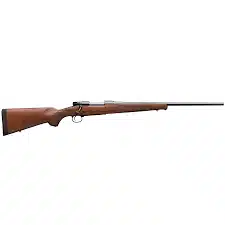
The Winchester Model 70 Featherweight has carried the title “The Rifleman’s Rifle” for decades – and in 30-06 Springfield, it remains one of the most complete traditional hunting rifles in production. Built around controlled-round feeding and a three-position safety, it’s a rifle designed for hunters who prioritize reliability and heritage over raw precision metrics. At $899–$1,199 street price, it competes in a crowded mid-tier market, but few rivals carry the same combination of walnut aesthetics, field-proven mechanics, and American hunting legacy.
| Specification | Details |
|---|---|
| Barrel Length | 22″ |
| Barrel Twist | 1:10 |
| Barrel Contour | Sporter |
| Weight | 6.5 lbs |
| Trigger | M.O.A. Trigger System, adjustable 3–5 lbs, factory ~3.5 lbs |
| Magazine | Hinged floorplate internal, 5 rounds |
| MSRP | $999–$1,400 |
| Street Price | $899–$1,199 |
| Stock | Grade I American walnut, satin finish |
| Threaded Barrel | No – standard Featherweight |
| Action | 2-lug CRF, Mauser extractor, 90-degree bolt lift, three-position safety |
| Finish | Blued or satin stainless |
| Scope Base | Pre-drilled for standard bases |
Quick Verdict – Is It Worth the Price?
✓ Best for: Traditional deer and elk hunters who want a lifetime CRF walnut rifle
✓ Price: $899–$1,199 street
✓ Key strength: Three-position safety with Mauser-style controlled-round feeding
✗ Not ideal for: Precision long-range hunters or shooters wanting a detachable magazine
Real-World Performance on the Range and Field
The Winchester Model 70 Featherweight 30-06 Springfield delivers honest, practical accuracy from its 22″ cold hammer-forged barrel with a 1:10 twist. With Winchester 150gr Power-Max Bonded – essentially the factory-matched load – expect 0.6–0.9 MOA groups from a properly broken-in walnut stock, pushing around 2,920 fps and generating solid terminal performance on deer-sized game out to 400 yards. Federal 165gr Trophy Bonded runs a similar accuracy window at roughly 2,800 fps, making it a capable elk load with appropriate shot placement. The M.O.A. trigger breaks at approximately 3.5 lbs from the factory – heavier than a Tikka but clean enough for field shooting without adjustment. One honest caveat: the walnut stock is sensitive to humidity and temperature swings, which can open groups slightly during extended range sessions or wet field conditions. Pillar or glass bedding resolves this if precision is a priority, but for most hunting applications inside 300 yards, the Featherweight performs exactly as advertised – reliably, consistently, and without drama.
Applications & Use Cases – What It’s Built For
The Winchester Model 70 Featherweight 30-06 Springfield was designed as a general-purpose American hunting rifle, and it executes that role with few equals. For whitetail deer hunting – whether from a stand in the Midwest or stalking hardwood ridges in the East – the 30-06 with 150gr loads delivers flat trajectories and clean kills inside 300 yards, and the 6.5 lb weight makes it easy to carry all day without fatigue. For elk hunting in the Mountain West, the same rifle loaded with 180gr Federal Trophy Bonded at 2,700 fps provides the penetration and retained energy needed for larger-bodied animals at moderate ranges – the three-position safety is particularly valuable here, allowing hunters to carry a chambered round with the bolt locked during long approaches. The Featherweight is less suited to open-country long-range hunting where shots regularly exceed 400 yards; at that point, a heavier-barreled rifle with a better trigger and higher-magnification optic compatibility becomes more relevant. It also works as a capable black bear and hog rifle where the CRF extractor’s reliability under rapid follow-up shot pressure is a genuine advantage. For a hunter who wants one rifle to cover most North American big game scenarios, the Featherweight 30-06 is a rational, time-tested answer.
Ergonomics & Handling – How It Feels to Carry
At 6.5 lbs unscoped, the Winchester Model 70 Featherweight 30-06 Springfield sits in a practical middle ground – light enough for all-day carry without the punishing recoil of an ultralight mountain rifle in 30-06. The Grade I walnut stock has a classic American profile with a straight comb and modest pistol grip; it fits most shooters naturally but won’t suit everyone without adjustment, as there’s no length-of-pull customization on the standard model. The 90-degree bolt lift is the most frequently cited ergonomic limitation – it’s slower and requires more wrist movement than the 60-degree lifts on Tikka or Browning alternatives, which matters during quick follow-up shots. The three-position safety is genuinely excellent in the field: position one fires, position two locks the bolt while keeping the rifle safe, and position three is full safe – a system that gives hunters real options during a stalk that most competitors simply don’t offer.
Aftermarket & Upgrade Path – Room to Grow
The Winchester Model 70 Featherweight 30-06 Springfield sits on a proprietary action that has a dedicated but smaller aftermarket compared to the Remington 700 footprint. Trigger upgrades are available – Timney makes a direct-fit replacement that drops pull weight below 2.5 lbs for hunters who want a crisper break. Stock upgrades are the most impactful modification: Bell & Carlson and McMillan both offer Model 70 long-action stocks that eliminate the walnut’s humidity sensitivity and improve accuracy consistency. Pillar bedding the factory stock is a cost-effective middle ground at roughly $100–150 from a competent gunsmith. Scope mounting is straightforward using standard Talley or Leupold bases designed for the Model 70. The standard Featherweight does not come threaded, so suppressor users need to either rechamber the barrel or step up to the Extreme Weather or other threaded variants. The platform rewards modest investment well – a bedded stock and quality scope mount will extract the rifle’s full accuracy potential without major expense.
Pros & Cons – The Honest Breakdown
Strengths:
✓ Three-position safety – unique and genuinely useful in the field for loaded carry
✓ Mauser-style CRF extractor – most reliable feeding system in production bolt-actions
✓ 0.6–0.9 MOA accuracy with quality loads – sufficient for all hunting applications
✓ 6.5 lbs – among the lightest CRF walnut rifles currently in production
✓ Grade I American walnut – classic aesthetics that hold resale value well
✓ M.O.A. trigger adjustable 3–5 lbs – usable from the box, improvable with aftermarket
✓ 5-round internal magazine – adequate capacity for hunting with a clean, snag-free profile
✓ Cold hammer-forged barrel – consistent bore quality and long service life
Limitations:
✗ 90-degree bolt lift – slower cycling than Tikka T3x or Browning X-Bolt alternatives
✗ Trigger minimum 3 lbs – heavier floor than Savage AccuTrigger or Tikka factory trigger
✗ Walnut stock humidity sensitivity – can affect accuracy without bedding
✗ No threaded barrel on standard Featherweight – suppressor users need a different variant
✗ No AICS detachable magazine option – internal floorplate only on this model
✗ Proprietary action – smaller aftermarket than Remington 700 platform
Competitors & Alternatives Worth Considering
| Feature | Model 70 Featherweight | Ruger Hawkeye Hunter | Tikka T3x Lite | Bergara B-14 Timber |
|---|---|---|---|---|
| Price | $899–$1,199 | $949–$1,049 | $875–$1,050 | $1,100–$1,300 |
| Weight | 6.5 lbs | 7.0 lbs | 6.0 lbs | 7.2 lbs |
| Trigger | ~3.5 lbs | ~3.5 lbs | ~2.0 lbs | ~3.0 lbs |
| Magazine | Internal floorplate | Internal floorplate | Detachable | AICS detachable |
| Feeding | CRF | CRF | Push feed | Push feed |
The Ruger Hawkeye Hunter 30-06 Springfield is the closest direct competitor – also CRF, also walnut and stainless, and typically $50–150 cheaper – making it the natural alternative for hunters who want Mauser-style reliability without the Winchester premium. The Tikka T3x Lite 30-06 Springfield undercuts both on trigger quality and weight at a similar price point, but it’s push-feed and lacks the three-position safety, which matters to hunters who prioritize those features. The Bergara B-14 Timber 30-06 Springfield costs $100–300 more and offers AICS magazine compatibility and a Remington 700 aftermarket footprint – a better platform for precision-focused hunters who want upgrade flexibility. None of the competitors match the Model 70’s combination of CRF, three-position safety, and walnut aesthetics in a single package at this price.
Who Should Buy This Rifle – and Who Shouldn’t
The Winchester Model 70 Featherweight 30-06 Springfield is ideal for the traditional American hunter who wants a reliable, field-ready bolt-action they can carry for decades and eventually hand down – the CRF extractor, three-position safety, and walnut stock are features that reward hunters who understand and value them. It’s also a strong choice for elk and deer hunters who operate in varied weather conditions and want a proven mechanical system over cutting-edge ergonomics. Look elsewhere if you’re a precision long-range hunter who needs a sub-2-lb trigger and AICS magazine compatibility – the Bergara B-14 Timber 30-06 Springfield or Tikka T3x Lite 30-06 Springfield will serve you better at a similar or lower price point.
Frequently Asked Questions About the Model 70
Q: Is the Model 70 Featherweight accurate enough for elk hunting?
A: Yes. At 0.6–0.9 MOA with quality loads and 180gr bullets generating 2,700 fps from the 22″ barrel, it’s fully capable on elk inside 350 yards.
Q: Can I thread the barrel on the standard Featherweight?
A: Not from the factory – the standard Featherweight is unthreaded. Winchester’s Extreme Weather and other variants come threaded; a gunsmith can thread the existing barrel for roughly $100–150.
Q: How does the three-position safety work?
A: Position one fires, position two locks the bolt with the rifle on safe (allowing safe unloading), and position three is full safe with bolt operable – a genuinely versatile field system.
Q: Is the walnut stock a problem in wet conditions?
A: It can be. Humidity causes minor stock movement that may open groups slightly. Pillar bedding or a synthetic stock swap resolves this for precision use.
Q: How does the M.O.A. trigger compare to competitors?
A: Factory break at ~3.5 lbs is heavier than Tikka’s ~2.0 lbs but clean and consistent. Timney aftermarket replacement drops it below 2.5 lbs if needed.
Q: What’s the effective range for deer with this rifle?
A: With 150gr loads at 2,920 fps, the 30-06 retains sufficient energy for ethical deer kills to 450–500 yards – though practical field accuracy limits most hunters to 300 yards.
Final Verdict – A Classic That Still Delivers
The Winchester Model 70 Featherweight 30-06 Springfield isn’t the lightest, doesn’t have the best trigger, and won’t win a precision benchrest competition – but it remains the most complete traditional hunting bolt-action in American production, combining CRF reliability, a genuinely useful three-position safety, and Grade I walnut in a 6.5 lb package that handles real hunting conditions with confidence. For hunters who want a rifle built to last a lifetime and carry the weight of American hunting heritage, the Featherweight earns its price and its reputation.
The Winchester Model 70 Featherweight in 30-06 Springfield is a rifle that rewards hunters who understand what they’re buying – not the latest precision platform, but a proven, field-hardened tool with mechanical advantages that matter when conditions get difficult. At $899–$1,199, it sits at a fair price for what it delivers: controlled-round feeding, a three-position safety, honest sub-MOA accuracy, and a walnut stock that looks as good on a rack as it performs in the field. Buy it for the right reasons, and it won’t disappoint.