 Firearms Republic
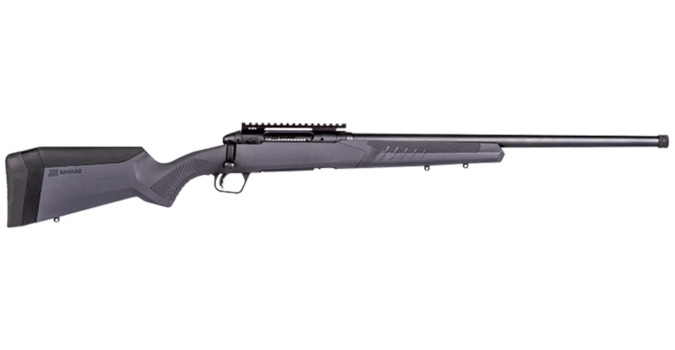
The Savage 110 Prairie Hunter arrived in .224 Valkyrie as one of the few purpose-built factory bolt guns for a cartridge that was mostly an AR-15 story. With a heavy 22″ barrel, adjustable AccuFit stock, and a factory 20-MOA rail, Savage built this rifle for shooters who wanted long-range varmint and steel performance without building a custom rig. Street prices hovered around $700 before discontinuation, and used examples still show up regularly.
| Specification | Details |
|---|---|
| Barrel Length | 22″ |
| Barrel Twist | 1:7 |
| Barrel Contour | Heavy carbon-steel |
| Weight | 7.8 lbs |
| Trigger | AccuTrigger, user-adjustable |
| Magazine | Detachable box, 3-round |
| MSRP | $849 |
| Street Price | $650–$750 |
| Stock | AccuFit synthetic, adjustable cheek/LOP |
| Threaded Barrel | Yes – 1/2×28 |
| Action | Savage 110, 90-degree bolt lift |
| Finish | Matte black |
| Scope Base | Factory 20-MOA rail |
Quick Verdict
✓ Best for: Prairie dog shooters and long-range steel enthusiasts wanting a dedicated bolt-action platform
✓ Price: $650–$750 used
✓ Key strength: Heavy barrel plus AccuTrigger for repeatable bench accuracy
✗ Not ideal for: Hikers or backcountry hunters needing a lightweight carry rifle
This is a discontinued model, not a failed one – Savage simply narrowed its Valkyrie offerings as demand shifted. The strongest reason to buy used is the combination of factory 20-MOA rail and adjustable stock at a price competitors rarely matched. The clearest reason to pass is the three-round magazine capacity, which some shooters find limiting for volume varmint work.
Real-World Performance
Independent testing from Shooting Times on a 22″ Savage 110 Prairie Hunter 224 Valkyrie recorded velocities that varied meaningfully by bullet weight and construction. Federal’s 90-grain SMK load averaged 2,750 fps, while 90-grain Fusion ran slightly faster at 2,832 fps. Lighter bullets showed the expected velocity gains – Berger’s 80.5-grain load reached 3,002 fps, and Barnes’ 78-grain TSX clocked 2,919 fps. These are results from that specific test rifle and lot of ammunition, not guaranteed factory performance across all barrels. The same test noted some feeding hesitation with thin-jacketed 90-grain bullets in the detachable magazine, an observation worth noting for buyers planning to run match-grade projectiles. At typical prairie dog and steel distances of 300–600 yards, this rifle delivers consistent enough accuracy for field use, though no published test claims sub-half-MOA performance. Shooters should treat these numbers as a baseline for load development rather than a promise.
Applications & Use Cases
Prairie dog and varmint shooting: This is the rifle’s home turf. The heavy barrel resists heat buildup during extended strings, and the 1:7 twist stabilizes heavier match bullets well suited to longer shots on small targets. Verdict: excellent fit for its intended role.
Long-range steel competition: The 20-MOA rail and adjustable stock make it easy to build a stable position, and the AccuTrigger helps with precise breaks at distance. The three-round magazine slows down rapid-fire stages compared to AR-platform competitors. Verdict: workable but not optimized for speed-focused matches.
Bench load development: Handloaders benefit from the heavy contour barrel’s stability and the rifle’s factory rail for mounting high-magnification optics. This is arguably where the rifle shines brightest for enthusiasts chasing specific bullet-and-powder combinations. Verdict: strong choice for methodical range work.
Predator hunting: With appropriate controlled-expansion loads – not the 90-grain SMK match bullet – this rifle can serve coyote and fox hunters who want flat trajectories and minimal pelt damage. Bullet selection matters enormously here, and shooters need to match construction to the application rather than assuming any .224 load works universally. Verdict: capable with correct ammunition choice, but not a one-load-fits-all setup.
Ergonomics & Handling
At 7.8 lbs bare, the Savage 110 Prairie Hunter 224 Valkyrie carries noticeable heft that translates into stability from a bench or bipod but becomes tiring on long walking hunts. The AccuFit stock’s adjustable comb and length of pull let shooters dial in a proper cheek weld for high-mounted optics, which matters given the factory 20-MOA rail’s intended use with long-range glass. The 90-degree bolt throw is traditional Savage 110 territory – smooth but not the shorter-throw feel some tactical shooters prefer. Loading the three-round detachable magazine is straightforward, though its low capacity means more frequent reloads during high-volume varmint sessions compared to AR-15 alternatives. Overall, this rifle handles best as a supported precision tool rather than a quick-handling field gun, and shooters should plan their use case accordingly.
Aftermarket & Upgrade Path
Savage’s barrel-nut system remains one of the platform’s biggest ownership advantages, allowing gunsmiths to swap barrels or adjust headspace without the complexity some competitors require. The AccuTrigger is already adjustable from the factory, reducing the need for aftermarket trigger work that other budget bolt guns often demand. Stock and chassis compatibility within the Savage 110 short-action footprint opens doors to aftermarket chassis systems for shooters wanting a more modular platform. The real ownership concern is magazine sourcing – this rifle uses a proprietary Savage-pattern detachable box magazine, not an AR-15 6.8 SPC magazine, and buyers should verify magazine availability before purchase rather than assuming easy substitutes exist. For used buyers, a practical inspection checklist should include bore and throat wear from the 1:7 twist barrel, extractor condition, muzzle thread integrity at 1/2×28, and confirmation that included magazines function reliably with intended ammunition.
Pros & Cons
Strengths:
✓ Heavy 22″ barrel with 1:7 twist stabilizes bullets up to 90 grains
✓ Factory 20-MOA rail eliminates need for aftermarket base purchase
✓ AccuTrigger breaks cleanly and adjusts without gunsmith tools
✓ AccuFit stock allows cheek and length-of-pull customization
✓ Threaded 1/2×28 muzzle ready for a suppressor (see our suppressor buyer’s guide) or brake
✓ Savage barrel-nut system simplifies future gunsmithing work
✓ Strong used-market value compared to boutique competitors
Limitations:
✗ Three-round magazine capacity limits volume shooting sessions
✗ 7.8 lbs bare weight makes it heavy for hiking hunts
✗ Discontinued status means no factory replacement parts pipeline
✗ Thin-jacketed 90-grain bullets showed feeding hesitation in testing
✗ Proprietary magazine limits aftermarket capacity options
✗ 90-degree bolt lift feels slower than short-throw competitors
✗ Limited factory ammunition selection compared to mainstream calibers
Competitors & Alternatives
| Feature | Savage 110 Prairie Hunter | CZ 600 Alpha | Mossberg MVP Precision | MPA 224BA |
|---|---|---|---|---|
| Price | $700 | $900 | $1,050 | $2,200 |
| Weight | 7.8 lbs | 7.1 lbs | 8.6 lbs | 9.5 lbs |
| Trigger | 2.5–6 lbs adj. | 3 lbs | 3.5 lbs | 2 lbs |
| Magazine | 3-round detachable | 5-round detachable | AR-15 magazine | AICS-pattern |
| Accuracy | Field-tested, no claim | Manufacturer claim | Manufacturer claim | Manufacturer claim |
The CZ 600 Alpha 224 Valkyrie offers a lighter package and larger magazine capacity, but at a higher price point and with less established used-market availability in this caliber. The Mossberg MVP Precision 224 Valkyrie uses AR-15 magazines, giving it a practical edge in capacity and reload speed, though it weighs nearly a pound more than the Savage. For shooters wanting a true chassis-based precision platform, the MPA 224BA 224 Valkyrie delivers superior triggers and magazine compatibility but at more than triple the Savage’s typical street price, making it a different market segment entirely.
Who Should Buy This
Ideal for prairie dog shooters and long-range steel competitors who want a dedicated bolt-action Valkyrie without paying chassis-rifle prices: the heavy barrel and adjustable stock deliver real bench stability. Handloaders developing precise loads will appreciate the factory rail and AccuTrigger’s clean break for consistent testing. Look elsewhere if magazine capacity matters more than barrel stability – the Mossberg MVP Precision 224 Valkyrie and its AR-15 magazine compatibility solve that problem directly. Backcountry hunters prioritizing low weight should also consider lighter-weight alternatives rather than accepting this rifle’s nearly 8-lb bare weight for extended carries.
Frequently Asked Questions
Q: Is the Savage 110 Prairie Hunter discontinued?
A: Yes, as of July 2026 it’s discontinued, though used examples remain findable through dealers and private sales.
Q: What magazine does it use?
A: A proprietary Savage-pattern detachable three-round box magazine, not an AR-15 6.8 SPC magazine.
Q: Is the muzzle threaded 1/2×28?
A: Yes, confirmed 1/2×28 threading, not 5/8×24.
Q: Can its 1:7 barrel stabilize 90-grain bullets?
A: Yes, testing confirmed stable flight with 90-grain SMK and Fusion loads at that twist rate.
Q: How fast was factory ammunition in independent tests?
A: Shooting Times recorded 2,750–3,002 fps depending on bullet weight, from 78 to 90 grains.
Q: What should a used buyer inspect?
A: Bore condition, extractor function, muzzle threads, magazine availability, and confirmation the barrel twist matches intended bullet weights.
Final Verdict
The Savage 110 Prairie Hunter 224 Valkyrie remains a sensible used purchase for shooters wanting a dedicated bolt-action platform for prairie dogs, steel, or bench load work. Its value in 2026 comes from used-market pricing and straightforward Savage-pattern support rather than rarity or collectability. Buyers needing high-volume magazine capacity or ultralight carry weight should look toward AR-platform alternatives instead.
The Savage 110 Prairie Hunter proved that a mainstream manufacturer could build a serious factory bolt gun around a cartridge many assumed belonged only to ARs. While discontinued, its combination of heavy barrel, adjustable stock, and factory rail still holds real value for patient buyers willing to shop the used market and verify magazine availability before committing.
Compare Before You Buy
Factory .224 Valkyrie rifles are rare, so most buyers cross-shop other .224 bolt guns: Savage 110 Core Predator .22 ARC, Ruger American Gen II Predator .22 ARC, Howa 1500 Mini Action .22 ARC, Savage 110 Ultralite Predator .22 ARC and Ruger American Gen II Prairie .22 ARC.
For more background, read our .223 Remington Caliber Guide, .22 ARC for Hunting: What Game, What Distance, What Bullet and Best Budget Hunting Rifles Under 0.