 Firearms Republic
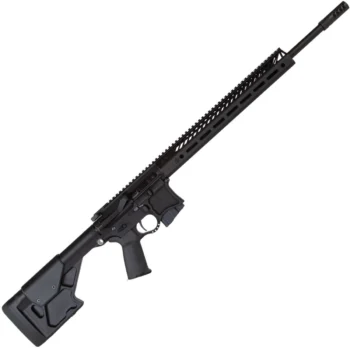
The Seekins Precision VKR is the premium way to own a .224 Valkyrie AR. It uses Seekins’ own billet aluminum receivers, a match-grade 5R stainless barrel in 1:7 twist, and an adjustable gas block, and it launched in two lengths: the VKR18 at $1,659 and the VKR20 at $1,995. The VKR20 weighs 8.8 lbs. It is a very nicely made rifle with one unusual note attached: Seekins itself said its testing found 90-grain Valkyrie ammunition “less than satisfactory.” Here is what that means and who the rifle suits.
| Spec | VKR20 (launch configuration) | VKR18 |
|---|---|---|
| Caliber | .224 Valkyrie | .224 Valkyrie |
| Barrel | 20″ match-grade 5R, 1:7 twist | 18″ 416-5R stainless, ½-28 threaded |
| Gas system | Rifle length, melonited gas tube, adjustable low-profile block | Adjustable gas block |
| Upper / lower | iRMT-3 upper, SP223 ambidextrous billet lower | Skeletonized NX15 billet upper |
| Handguard | 15″ SP3R-V3 M-LOK, free float | Lightweight free-float handguard |
| Trigger | Timney Targa | Standard Seekins configuration |
| Stock | Seekins ProComp 10x | Magpul ACS-L collapsible (per retailer listing) |
| Muzzle device | Seekins ATC brake | Threaded ½-28 |
| Weight | 8.80 lbs | Not published in the sources I could verify |
| Launch MSRP | $1,995 | $1,659 |
| Retail listings, Nov 2026 | $1,899.99 (VKR listing, marked out of stock) | $1,479.99 (18″ listing) |
Quick Verdict
✓ Best for: shooters who want a high-end, well-finished Valkyrie and will pair it with the right ammunition
✓ Key strength: billet receivers, 5R barrel and a Timney trigger on the VKR20 at a price under many custom builds
✗ Not ideal for: budget shooters, or anyone who only wants to run 90-grain match ammo without experimentingThe build quality is the draw. The 90-grain caveat is real and worth reading before you spend close to $2,000, and availability is patchy, so check stock first.
The Ammunition Caveat
When Seekins announced its Valkyrie line, it added a note: the company tested a number of ammunition and bullet designs that performed well, but it found the 90-grain ammo “less than satisfactory,” and said future loads might meet its standards. That is an unusual thing for a manufacturer to publish, and it matters because the 90-grain Sierra MatchKing is the load most people buy a Valkyrie to shoot. Seekins did not name a specific load in the coverage I found, so I cannot tell you which one failed or how.
What it means in practice: do not assume the VKR will shoot the 90-grain load into half an inch just because the barrel is match grade. Buy a few boxes of different loads, including lighter bullets, and test at 100 and 300 yards before you commit to one. It is the same advice that applies to any long-range rifle, but here the manufacturer has told you to follow it.
What You Get for the Money
Seekins builds its own receivers from 7075-T6 billet rather than forging them, which is why the NX15 upper is skeletonized and the SP223 lower has an ambidextrous design with generous controls. On a standard AR-15 you would pay extra for each of those details. Add the SP3R-V3 handguard, which is flat on the bottom for stable bag and bipod contact, the adjustable gas block for tuning with suppressors, and a melonited rifle-length gas tube, and the VKR20 reads like a custom build sold as a complete rifle.
The Timney Targa is a good single-stage trigger rather than a two-stage match unit, and the ProComp 10x stock is a proper adjustable precision stock with a cheek riser and recoil pad. The later VKR listings I found at Sportsman’s Warehouse show a revised configuration: a NOXs handguard, a NEST flash hider, an MOE+ pistol grip, a Magpul ACS-L stock and a black armor-coated barrel, with 20+1 magazines. That is a lighter, more general-purpose rifle than the launch VKR20, so read the listing carefully and confirm which build you are buying.
Ballistics: Where the VKR Goes Subsonic
Federal’s 90-grain SMK load is rated at 2,700 fps from a 24-inch test barrel. Real rifles with shorter barrels run slower. GunsAmerica measured about 2,533 fps from an 18-inch Valkyrie and 2,628 fps from a 20-inch, and American Rifleman measured 2,565 fps from an 18-inch Savage MSR15. Those are the numbers that apply to the VKR18 and VKR20, not Federal’s 2,700. I did not find a chronograph test of the Seekins rifles themselves, so use these as close proxies. Using a solver that reproduces Federal’s published table, the 90-grain bullet (G1 BC .563) behaves like this at sea level in standard air:
| Barrel class | Muzzle velocity | Velocity at 1,000 yd | Velocity at 1,300 yd | Goes subsonic at (approx.) |
|---|---|---|---|---|
| 18″ (VKR18) | 2,533 fps | 1,262 fps | 1,064 fps | 1,205 yd |
| 18″ (best case) | 2,565 fps | 1,280 fps | 1,074 fps | 1,225 yd |
| 20″ (VKR20) | 2,628 fps | 1,315 fps | 1,094 fps | 1,265 yd |
Sea-level speed of sound is about 1,116 fps, so the VKR18 bullet is already subsonic by 1,300 yards, which means the often-quoted “supersonic past 1,300 yards” claim does not apply to it. The VKR20 gets to roughly 1,265 yards. Altitude helps: at 5,000 feet, the same loads stay supersonic to about 1,430 yards (18-inch) and 1,500 yards (20-inch). In cold air they transition sooner. For most shooters the point is simple: both rifles remain supersonic through 1,000 yards, which is what matters for stable, predictable bullet flight on steel.
Real-World Use
The VKR is built for the range first. It has the weight (8.8 lbs for the VKR20) to absorb recoil and the stock adjustment to keep your cheek weld consistent, and the adjustable gas block makes it a good match for a suppressor, which is worth a look at our suppressor buyer’s guide if you are considering one. For hunting, it fits the same niche as other Valkyrie rifles: varmints and coyotes are ideal, and a Valkyrie with a bullet designed to expand can work on small game and hogs at moderate range. It is not a replacement for the larger AR-15 deer calibers, and it is not the one-rifle solution for mixed game.
For a suppressed hunting rig, the lighter VKR18 is the better choice, and our suppressed hunting setups guide covers what else to consider. If you compare it to the more affordable .223 Remington or .22-250, the Valkyrie’s advantage is semi-auto speed with better wind resistance beyond 600 yards, but at much higher ammo prices.
Availability and Price Reality
This is where the VKR gets complicated. The 18-inch Seekins .224 Valkyrie barrel I found at OpticsPlanet is listed as discontinued, and Sportsman’s Warehouse shows its VKR listing as out of stock in its .224 Valkyrie AR-15 category. Wholesale Hunter shows listings for the VK18 and VKR20 under Seekins part numbers, with no price visible. A $1,659 launch price for the 18-inch has become $1,479.99 on one retailer’s page, and the 20-inch moved from $1,995 to $1,899.99. Retail pricing and stock change often, so confirm directly with Seekins or a dealer. If you cannot find a complete rifle, the Seekins .224 Valkyrie barrels and uppers were also offered separately.
Upgrade Path
There is little to fix. The most useful additions are an optic matched to your range (a 4-16x for 600 yards, a 5-25x for 1,000), a bipod, and a muzzle device or suppressor. If you want to experiment with different ammunition, as Seekins implicitly suggests, a chronograph is worth more than any hardware upgrade. For budget-conscious shooters, our best AR-15 builds guide shows what you can assemble for less, and our .22 ARC AR-15 build guide covers a modern alternative with similar goals.
Pros and Cons
✓ Billet receivers and 5R barrel, a build quality step above typical factory ARs
✓ Adjustable gas block and melonited gas tube for suppressed use
✓ Timney Targa trigger and ProComp 10x stock on the VKR20
✓ Lighter VKR18 option for carrying
✓ 20+1 capacity on later configurations
✗ Seekins itself flagged 90-grain ammo as unsatisfactory in its testing
✗ Premium pricing, close to $2,000 at launch for the VKR20
✗ Limited, inconsistent availability and some discontinued parts
✗ Several configurations exist, so specs differ by listing
✗ Not a deer-class hunting rifle
How It Compares
| Rifle | Barrel / twist | Weight | Price (verify) |
|---|---|---|---|
| Seekins VKR20 | 20″ / 1:7 | 8.8 lbs | $1,995 launch, $1,899.99 listing |
| Seekins VKR18 | 18″ / 1:7 | Not verified | $1,659 launch, $1,479.99 listing |
| CMMG Mk4 DTR2 | 24″ / 1:7 | 9.2 lbs | $1,457.99 listing |
| Stag 15 Valkyrie | 18″ / 1:7 | 8.1 lbs | $1,179.99 to $1,282.99 listings, often sold out |
| Bear Creek Arsenal BC-15 | 20″ / 1:7 | 8.0 lbs | from about $405 |
The VKR costs about four times what a BCA BC-15 does for the same caliber and twist. What you are paying for is machining, finish, ergonomics and trigger, not extra velocity, so be honest about whether you will notice those differences at the range. If you want a compact, premium AR in a different small caliber, Seekins also makes a DMR in .22 ARC.
Who Should Buy It
Buy the VKR if you appreciate precision-machined AR parts, want a Valkyrie that already has the right gas system for a suppressor, and are willing to find the load it likes. Skip it if you are new to the platform and want the simplest path, in which case our best rifles for new shooters is a better starting point, or if you are weighing AR sizes, in which case see AR-15 vs AR-10. Anyone choosing between small-bore long-range cartridges should also read .22 ARC vs 6.5 Grendel and our 6.5 Grendel and 6mm ARC guides before settling on the Valkyrie.
Frequently Asked Questions
How much does the Seekins VKR .224 Valkyrie cost?
At launch the VKR18 was $1,659 and the VKR20 was $1,995. Recent retailer listings showed $1,479.99 for an 18-inch VKR and $1,899.99 for another VKR listing, but the Sportsman’s Warehouse category page marked them out of stock. Confirm price and availability with Seekins or a dealer.
What did Seekins say about 90-grain Valkyrie ammo?
When it announced the line, Seekins said it tested several ammunition and bullet designs that performed well but found the 90-grain ammo less than satisfactory. It did not identify a specific load in the coverage I found, so test several loads yourself.
How much does the VKR20 weigh?
Seekins lists the launch VKR20 at 8.80 pounds. Weight for the VKR18 was not published in the sources I could verify, and later configurations with different handguards and stocks may differ.
How far is the VKR supersonic?
With Federal’s 90-grain SMK at around 2,533 fps from an 18-inch barrel, the bullet goes subsonic at roughly 1,205 yards at sea level in standard air. At about 2,628 fps from a 20-inch barrel, it is roughly 1,265 yards. Higher altitude extends this and cold air shortens it.
Is the Seekins VKR a good suppressor host?
The adjustable low-profile gas block and melonited rifle-length gas tube are designed to let you tune gas flow, which helps with suppressed use. The barrel is threaded ½-28.
Is the Seekins VKR good for deer hunting?
The .224 Valkyrie is a small-bore cartridge and many states have minimum caliber or energy requirements for deer. The VKR is better suited to varmints, coyotes and range shooting. Check your state regulations.
Final Verdict
The Seekins VKR is a beautifully built Valkyrie for shooters who value machining and a tuned gas system, and the VKR20 in particular reads like a custom rifle at a factory price. It also comes with the manufacturer’s own warning about 90-grain ammunition and an uncertain supply chain. If you find one at a fair price and plan to test loads, it is a premium option. If you want the best value, the cheaper rifles in this series do the same job.
Compare Before You Buy
Compare the VKR with the other .224 Valkyrie rifles in this series, and see our .22 ARC hunting guide if game use matters more to you than range reach.
Prices and specifications were checked in November 2026 against Seekins launch coverage and major retailers. They change often, so verify with your dealer before you buy.