 Maksym Kovaliov
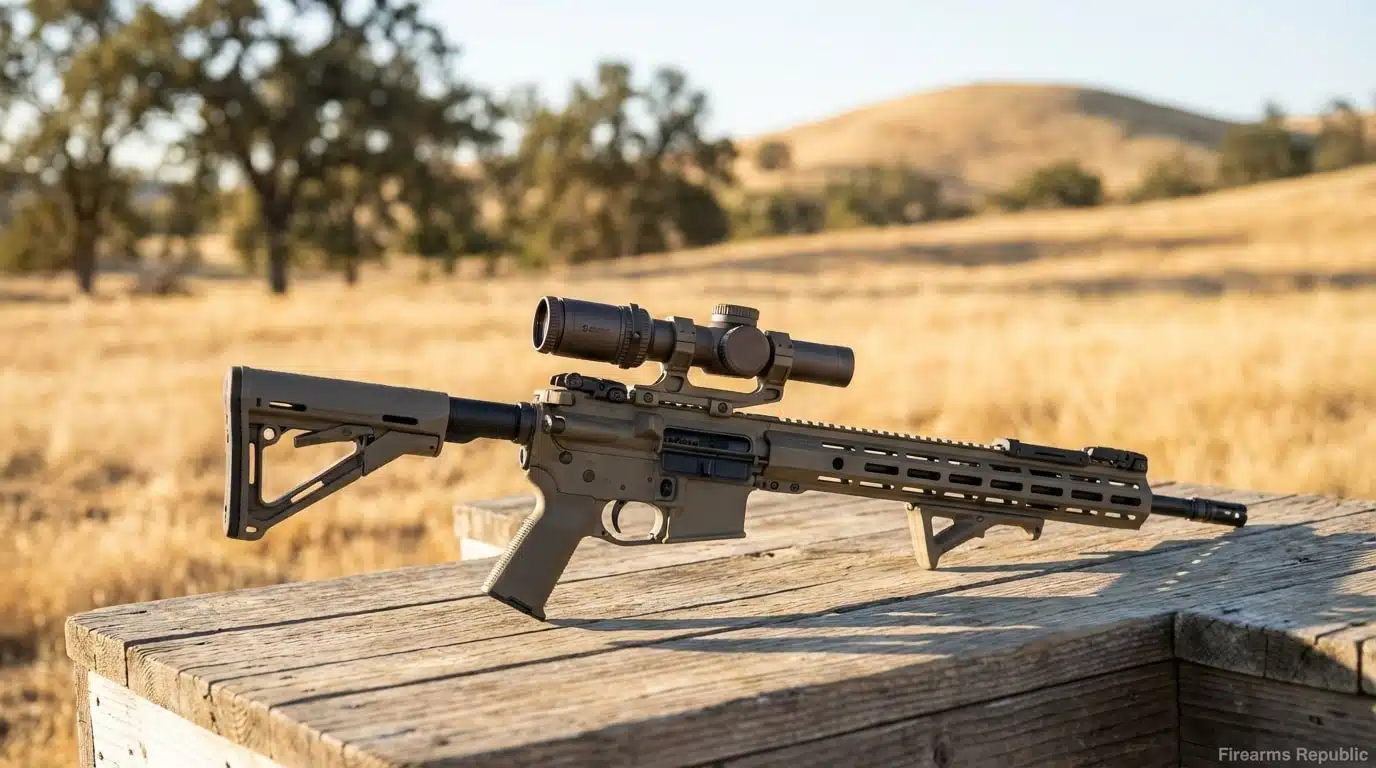
Building an AR-15 is one of the most rewarding projects in the shooting sports – you end up with a rifle configured exactly for your use case, you understand every component, and you typically save $100–$300 versus buying a complete factory rifle with comparable parts. The caveat is that the AR-15 parts market is enormous, the quality range is vast, and the gap between a $50 barrel and a $350 barrel is not obvious from the outside. This guide cuts through the noise with complete, field-tested parts combinations at three realistic price tiers: under $1,000, under $1,500, and under $2,000. Each build is configured for a specific primary use case, includes an optic recommendation, and explains why each component was chosen rather than just listing part numbers.
Before You Build: What Goes Into an AR-15
An AR-15 consists of a lower receiver, lower parts kit (LPK), stock, upper receiver, barrel, bolt carrier group (BCG), charging handle, handguard, and muzzle device. Understanding which components most affect performance – and which are interchangeable commodities – determines where to spend and where to save.
Where quality matters most:
Barrel – The single most important accuracy component. Barrel steel (4150 chrome moly vs. 416 stainless), rifling method (button vs. hammer-forged vs. cut), chrome lining, and twist rate all directly affect accuracy, durability, and longevity. Don’t cheap out on the barrel. A $150–$350 barrel from a reputable manufacturer (Ballistic Advantage, Faxon, BCM, Daniel Defense) is a permanent quality investment. A $50 Chinese import barrel is not.
Bolt Carrier Group (BCG) – The heart of the operating system. Quality BCGs use properly heat-treated Carpenter 158 steel (bolt) and 8620 steel (carrier), with MPI (magnetic particle inspection) and HPT (high-pressure testing) certification. These quality markers are not marketing – they’re the difference between a BCG that lasts 20,000 rounds and one that fails at 5,000. Budget $100–$180 for a quality BCG.
Trigger – The mil-spec trigger in most budget lowers and complete rifles is functional but heavy (6–8 lbs) with significant take-up. A drop-in trigger ($60–$240) is the single upgrade that most improves the shooting experience and accuracy. For precision use, it’s nearly mandatory.
Where you can save:
Lower receiver – An Anderson Manufacturing stripped lower ($60) and a BCM lower are functionally identical for most purposes. The lower receiver contains no moving parts that affect accuracy; it’s an aluminum housing. Spend more for aesthetics or brand loyalty if you want, but don’t convince yourself that a more expensive lower shoots better.
Upper receiver – Same logic. An Aero Precision upper ($80–$110) is dimensionally equivalent to a BCM upper ($150+). Quality matters in forging consistency and port location; both manufacturers meet that standard.
Handguard – Function first. A free-float M-LOK handguard from Aero Precision, Midwest Industries, or BCM in the $80–$150 range provides the rigidity, heat management, and mounting surface that matters. A $300 handguard with the same construction and materials doesn’t improve accuracy or reliability.
Gas system note: All three builds below use mid-length gas systems on 16″ barrels unless noted. Carbine-length gas on a 16″ barrel is the legacy mil-spec choice – it runs reliably but generates more bolt velocity, more recoil, and more wear than mid-length. The few dollars of extra barrel cost for mid-length is worth it on any new build.
Build 1: The Under-$1,000 General-Purpose AR-15
Primary use case: All-around defensive/hunting rifle – home defense, deer hunting in states that allow AR-15 calibers, and recreational range use. This build prioritizes reliability and accuracy over premium fit and finish.
Target weight: 6.8 lbs bare, 7.5–8.0 lbs with red dot and loaded magazine.
Parts List
Lower Receiver Anderson Manufacturing AM-15 Stripped Lower – $60–$75 Solid forging, mil-spec dimensions, no frills. Functionally equivalent to receivers costing three times as much. Anderson has produced millions of lowers without the QC issues that plague budget imports.
Lower Parts Kit BCM (Bravo Company) LPK without trigger/hammer – $55–$65 BCM’s LPK uses quality springs, anti-walk pins, and a mil-spec enhanced trigger guard. Excludes the trigger and hammer because those get replaced with a drop-in. Buying an LPK without trigger/hammer costs slightly less and avoids paying for components you’ll discard.
Trigger Geissele SSA (Super Semi-Automatic) – $165–$180 The SSA is Geissele’s most affordable two-stage trigger and the most recommended first trigger upgrade in the AR-15 community. First stage: ~2.5 lbs of take-up with a distinct wall. Second stage: ~1.5 lbs crisp break. Total: ~4 lbs. It’s the trigger used by military special operations units on contract rifles. At $165, it’s the most cost-effective quality upgrade in the entire build.
Budget alternative: Rise Armament RA-140 ($60–$80) is a single-stage at 3.5 lbs that outperforms the mil-spec trigger considerably. Not as good as the Geissele but a real improvement for half the cost.
Stock and Buffer System Magpul MOE Carbine Stock + Mil-Spec Buffer Tube + standard buffer and spring – $55–$75 total The Magpul MOE is the standard for reliability, durability, and fit. Six-position adjustable, solid lockup with no rattle. The mil-spec buffer tube and standard carbine buffer work correctly with a mid-length gas system on a 16″ barrel. Upgrade to an H2 buffer ($20) if the rifle runs too fast (brass landing in your face) or has reliability issues with lightweight ammunition.
Upper Receiver Aero Precision M4E1 Threaded Upper – $90–$110 The M4E1’s integrated trigger guard and upper/handguard interface are cleaner than standard uppers. The threaded barrel nut interface integrates with Aero’s own Enhanced handguard for a tool-free install. Quality forging, consistent port location, no issues.
Barrel Ballistic Advantage 16″ Modern Series Mid-Length 5.56 NATO, 1:8 twist – $180–$210 Ballistic Advantage produces the best barrels in the $150–$250 price range. The 16″ Modern Series is 4150 chrome moly with a QPQ (Melonite) finish – not chrome-lined, but the QPQ treatment provides comparable corrosion resistance and slightly better accuracy than chrome-lined steel. 1:8 twist stabilizes bullets from 55gr to 77gr. Mid-length gas. The Modern Series is a step above the Performance Series in rifling quality without reaching premium tier pricing.
Handguard Aero Precision ATLAS R-ONE 15″ M-LOK – $110–$130 The ATLAS R-ONE threads directly onto the Aero M4E1 upper without a proprietary barrel nut – a significant tool-free installation advantage. At 8.6 oz, it’s one of the lightest quality aluminum M-LOK handguards available. 15″ length provides good forward grip placement for most shooters without adding excessive weight.
Bolt Carrier Group BCM (Bravo Company) Full-Auto BCG, 5.56 – $130–$150 BCM’s BCG is the benchmark for quality at a non-premium price. Carpenter 158 bolt, properly staked gas key, chrome-lined carrier interior, HPT/MPI marked. The “Full-Auto” designation means the carrier key screws are staked rather than just torqued – relevant for long-term reliability under sustained fire.
Charging Handle BCM Gunfighter Mod 4 (Medium) – $50–$65 The standard mil-spec charging handle is functional but the small latch requires a specific grip technique under stress. The BCM Gunfighter’s larger ambidextrous latch allows natural operation with either hand. The Mod 4 (medium) is the most versatile configuration for general use.
Muzzle Device BCM A2X Flash Hider – $25–$35 The A2-profile flash hider is the mil-spec standard for a reason – it’s effective at reducing visible flash signature and doesn’t add significant weight or complexity. For a general-purpose build where suppressor use isn’t planned, the A2 is the right muzzle device. If you want to add a suppressor later, replace with a SilencerCo ASR or Dead Air KeyMo-compatible device ($50–$80) that accepts quick-detach suppressors.
Total Build Cost (Parts Only): $920–$1,045
Optic Recommendation
Vortex Crossfire Red Dot ($150) or Primary Arms SLx MD-25 ($200) For a general-purpose defensive/hunting AR-15, a red dot is the practical choice – fast target acquisition at close range, simple operation under stress, and adequate for any shot inside 200 yards. The Vortex Crossfire and Primary Arms SLx MD-25 are both quality red dots at entry-level prices. Add $30–$50 for a quality mount (Arisaka or Vortex Sport Cantilever).
Total system with red dot: $1,100–$1,275
Build 2: The Under-$1,500 Hunting and Competition AR-15
Primary use case: Deer hunting, 3-Gun competition, and precision target shooting to 400 yards. This build prioritizes accuracy and ergonomics over pure economy, with a stainless match barrel and a quality LPVO for versatile optic capability.
Target weight: 7.2 lbs bare, 8.5–9.0 lbs with LPVO and loaded magazine.
Parts List
Lower Receiver Aero Precision M4E1 Lower – $90–$110 The Aero M4E1 lower’s flared mag well speeds reloads in competition, and its integrated trigger guard eliminates a separate component. Dimensionally mil-spec, quality forging. The step up from Anderson is cosmetic and ergonomic rather than functional, but this build’s use case justifies the improvement.
Lower Parts Kit Geissele Super Dynamic Enhanced (SD-E) LPK – $80–$95 Geissele’s enhanced LPK includes quality springs and anti-walk pins. Excludes trigger/hammer because the build uses a drop-in.
Trigger Geissele SD-C (Super Dynamic Combat) – $185–$200 The SD-C is Geissele’s two-stage flat-bow trigger – a 2-lb take-up followed by a 1.5-lb break for a 3.5-lb total pull. The flat bow provides a more consistent trigger press for precision shooting than the curved SSA bow, and the total pull weight is appropriate for competition and hunting. For a build that sees both 3-Gun time pressure and 300-yard deer shots, the SD-C hits the right balance.
Stock Magpul PRS Lite – $115–$135 The PRS Lite provides adjustable LOP and comb height – the precision shooting stock adjustments that allow consistent cheek weld and eye relief across shooting positions. For 3-Gun competition where position transitions are frequent and hunters who want consistent long-range precision, the PRS Lite’s adjustability is directly worth the premium over a fixed-LOP stock. Weight is 20 oz – heavier than a carbine stock, appropriate for a precision-oriented build.
Upper Receiver Aero Precision M4E1 Threaded Upper – $90–$110 Same as Build 1. The M4E1 family’s consistent dimensions and ATLAS handguard compatibility make it the natural pairing choice across Aero components.
Barrel Faxon Firearms 16″ GUNNER Profile 5.56 NATO, 1:8 twist, stainless steel – $220–$260 The Faxon GUNNER profile is a lightweight contoured barrel that’s thicker under the handguard (for heat management and rigidity) and lighter at the muzzle end. 416R stainless steel without chrome lining produces better inherent accuracy than chrome-lined 4150 CM – the smoother bore surface is more consistent, and stainless is more responsive to shooting technique. The GUNNER profile splits the difference between a pencil barrel (light but heats fast) and a government/HBAR profile (heavy but slower to heat). For mixed hunting and competition use, it’s the right barrel profile. 1:8 twist handles the full 5.56 bullet weight range.
Handguard Aero Precision ATLAS R-ONE 15″ M-LOK – $110–$130 Same as Build 1. The integrated Aero upper/handguard system eliminates barrel nut tools and provides a rigid, lightweight free-float platform.
Bolt Carrier Group Toolcraft Nickel Boron BCG, 5.56 – $120–$145 Toolcraft manufactures BCGs for several major AR brands. The nickel boron coating provides easier cleaning than standard phosphate finish and maintains the Carpenter 158 bolt and 8620 carrier steel specifications. HPT/MPI marked. For a competition rifle that sees high round counts, easier cleaning matters.
Charging Handle Radian Raptor Ambidextrous – $80–$95 The Radian Raptor is the benchmark ambidextrous charging handle. Both sides of the latch deploy simultaneously, making it the fastest and most natural-feeling charging handle for competition use and for any shooter who wants truly ambidextrous operation. At $80–$95, it’s a meaningful improvement over the BCM Gunfighter for competition-priority builds.
Muzzle Device SilencerCo ASR Flash Hider – $50–$65 The ASR flash hider is suppressor-ready out of the box, accepting SilencerCo’s Omega 36M and Omega 300 suppressors via quick-detach. For a build that might see a suppressor in the future, spending $50 now on a compatible muzzle device avoids a second trip to the gunsmith and keeps options open. Functional as a standalone flash hider if the suppressor never materializes.
Total Build Cost (Parts Only): $1,140–$1,345
Optic Recommendation
Primary Arms SLx 1-6×24 ACSS ($300) or Vortex Strike Eagle 1-8×24 ($320) A low-power variable optic (LPVO) in 1-6x or 1-8x is the right optic for a hunting and competition AR-15. At 1x it functions as a red dot for close-range speed; at 6–8x it provides the magnification for 300-yard deer shots or precision competition steel. The Primary Arms SLx ACSS reticle is specifically designed for fast target acquisition at 1x and precise holdovers at higher magnification. The Vortex Strike Eagle offers a simpler reticle if the ACSS’s complexity isn’t desired. Add a 30mm mount ($50–$80) for appropriate height-over-bore.
Total system with LPVO: $1,490–$1,745
Build 3: The Under-$2,000 Precision and Long-Range AR-15
Primary use case: Precision target shooting to 600 yards, PRS Gas Gun competition, and dedicated long-range hunting. This build prioritizes sub-MOA accuracy, the best available trigger, and a quality optic that matches the rifle’s mechanical capability.
Target weight: 8.5 lbs bare, 10.5–11.5 lbs with optic and loaded magazine.
Parts List
Lower Receiver Aero Precision M4E1 Enhanced Lower – $110–$130 The Enhanced M4E1 lower includes an integrated triggerguard, bolt catch relief cut, and improved ergonomics over standard. For a precision build, the additional fit and finish is appropriate at the price.
Lower Parts Kit Geissele Super Dynamic Enhanced (SD-E) LPK – $80–$95 Same as Build 2.
Trigger Geissele Super Tricon (or TriggerTech Adaptable AR) – $220–$260 The Geissele Super Tricon ($240) is a two-stage precision trigger with a 1.5-lb first stage and 1-lb second stage – among the lightest and most consistent AR triggers available in a mil-spec housing. The TriggerTech Adaptable AR ($220–$250) provides an adjustable single-stage from 1.5 to 4 lbs using TriggerTech’s frictionless release technology. Either choice represents the top tier of drop-in AR trigger performance for precision work. For shooters coming from bolt-gun precision backgrounds, the TriggerTech’s light, crisp single-stage may feel more natural; for those who prefer the safety of a distinct two-stage, the Super Tricon is the reference standard.
Stock Magpul PRS Gen3 – $200–$230 The PRS Gen3 is the benchmark precision AR stock – fully adjustable LOP and comb height, ARCA rail underneath for precision shooting rest work, rubber butt pad for consistent shoulder placement. At 26 oz it’s the heaviest stock on any of these builds, appropriate for a precision platform where stability and repeatability matter more than overall system weight.
Upper Receiver Aero Precision M4E1 Threaded Upper – $90–$110 Same as Builds 1 and 2. Consistent platform choice.
Barrel BCM (Bravo Company) 18″ Government Profile 5.56 NATO, 1:8 twist, chrome-lined – $280–$320 For a precision build, an 18″ barrel extracts maximum velocity from 5.56 and .223 ammunition without the weight and length of a 20″ government barrel. BCM’s government profile with chrome lining provides the durability for high-volume practice (chrome-lined barrels last 20,000–30,000+ rounds versus 10,000–15,000 for non-chrome stainless) while maintaining sub-MOA accuracy with quality match ammunition. The chrome lining sacrifices a small amount of theoretical accuracy ceiling compared to premium stainless barrels, but BCM’s hammer-forging and consistent rifling produce accuracy that exceeds most shooters’ technique.
Premium alternative: Criterion 18″ Hybrid profile stainless ($350–$400) – a premium barrel that shoots notably tighter groups with quality match ammunition. The right choice for competition-focused builders who will also push the optic and technique to their limits.
Handguard BCM MCMR 15″ M-LOK – $140–$165 BCM’s MCMR (Modular Combat Modular Rail) provides a rigid, well-finished free-float platform with quality barrel nut engagement and excellent M-LOK slot placement for bipod attachment. The 15″ length positions a bipod forward for a stable prone shooting position. BCM’s handguards are used on military contract rifles – the MCMR has the pedigree and the fit to match the BCM barrel on this build.
Bolt Carrier Group BCM Full-Auto BCG with enhanced Nickel Boron – $155–$175 BCM’s nickel boron-coated BCG adds easier field cleaning to the platform’s core quality specifications. For a precision build that will accumulate significant round counts in practice sessions, the maintenance advantage is worth the $20 premium over standard phosphate.
Charging Handle Radian Raptor Ambidextrous – $80–$95 Same as Build 2. The Raptor’s ambidextrous operation and fast latch deployment are appropriate for precision competition use.
Muzzle Device Surefire SOCOM 3-Prong Flash Hider or SilencerCo ASR Flash Hider – $60–$90 Both are suppressor-compatible via their respective QD systems. For a precision build where suppressor use is likely (hearing protection during sustained range sessions), suppressor-ready muzzle device investment is justified. If the build will never be suppressed, an A2-profile flash hider ($25) works equally well.
Bipod Atlas BT10 LPVO Bipod – $220–$250 The Atlas BT10 is the precision shooting standard – independent leg adjustment, ARCA/Picatinny rail compatibility, positive pan/cant control. For a PRS-oriented build or any precision AR-15 used from prone, the Atlas provides noticeably better position control than the Harris S-BRM. Not strictly a lower parts component but essential for this build’s use case.
Total Build Cost (Parts Only): $1,635–$1,875
Optic Recommendation
Vortex Viper PST Gen II 5-25×50 ($750) or Primary Arms Platinum 4-14×44 ($500) A high-magnification FFP scope with exposed turrets and 0.1 MRAD clicks is required for this build’s precision use case. The Vortex Viper PST Gen II 5-25×50 is the benchmark value long-range optic – FFP, reliable zero return, quality glass, and the magnification range to work from 100 to 1,000 yards. The Primary Arms Platinum 4-14×44 ACSS ($500) is a more affordable entry to the FFP/exposed-turret category for precision use to 800 yards. Add a quality 34mm or 30mm mount ($80–$150 for Aero Ultralight, Warne XSKEL, or Spuhr) for appropriate height and rigidity.
Total system with Vortex Viper PST Gen II: $2,465–$2,875
Note: To stay strictly under $2,000 total including optic, use the Primary Arms Platinum 4-14×44 ($500) on the Build 3 parts list reduced to approximately $1,700 in components, for a total of approximately $2,200. The $2,000 threshold applies to the rifle build alone; a precision build with a competition-quality optic inevitably exceeds it. Build 3 represents the “under $2,000 in rifle parts” tier with the understanding that appropriate precision optics add cost.
Complete Build Comparison
| Component | Build 1 (Under $1,000) | Build 2 (Under $1,500) | Build 3 (Under $2,000) |
|---|---|---|---|
| Lower | Anderson AM-15 | Aero M4E1 | Aero M4E1 Enhanced |
| Trigger | Geissele SSA | Geissele SD-C | Geissele Super Tricon / TriggerTech |
| Stock | Magpul MOE | Magpul PRS Lite | Magpul PRS Gen3 |
| Barrel | BA 16″ 5.56 QPQ | Faxon 16″ SS GUNNER | BCM 18″ Chrome |
| Handguard | Aero ATLAS R-ONE | Aero ATLAS R-ONE | BCM MCMR 15″ |
| BCG | BCM FA Phosphate | Toolcraft NiB | BCM FA NiB |
| Charging Handle | BCM Gunfighter | Radian Raptor | Radian Raptor |
| Muzzle Device | BCM A2X | SilencerCo ASR | Surefire/SilencerCo ASR |
| Parts Cost | $920–$1,045 | $1,140–$1,345 | $1,635–$1,875 |
| Optic (recommended) | Red dot $150–$200 | LPVO $300–$320 | FFP 5-25x $500–$750 |
| Total System | $1,100–$1,275 | $1,490–$1,745 | $2,200–$2,700 |
| Primary Use | Defense/hunting | Hunting/competition | Precision/PRS |
Caliber Variants: Beyond 5.56
All three builds above are configured for 5.56 NATO/.223 Remington. For hunters or specialty applications, upper assembly swaps change the caliber without touching the lower.
.300 Blackout upper for suppressed hog hunting: Swap the 5.56 upper for a dedicated .300 Blackout upper assembly (barrel, BCG, handguard, charging handle – $400–$700 complete). The lower receiver, trigger, stock, and buffer system remain the same. Subsonic .300 BLK through a suppressor is the quietest practical centerfire hunting combination available. See our .300 Blackout Caliber Guide for the full suppressed ballistics picture and our Night Hunting Rifles & Optics Guide for complete suppressed hog setups.
6.5 Grendel upper for deer hunting: A 6.5 Grendel upper with a 20″ barrel (Ballistic Advantage 20″ 6.5 Grendel, $250–$300; dedicated 6.5 Grendel BCG, $130–$160; complete assembly $400–$600) transforms a 5.56 lower into a legitimate deer and hog rifle generating 1,800 ft-lbs of muzzle energy. Legal for deer in most states, significant improvement over .223 on game. See our AR-15 Caliber Selection Guide for the full caliber comparison.
.350 Legend upper for straight-wall states: Hunters in Ohio, Indiana, and Michigan who need a straight-wall cartridge can run a .350 Legend upper on any of these lower builds. PSA and Ballistic Advantage offer complete .350 Legend upper assemblies for $350–$500. Terminal performance is comparable to .30-30 Winchester, legal in straight-wall states.
Tools Required to Build
An AR-15 home build requires a modest tool investment. For first-time builders, budget $100–$150 for tools:
Essential tools:
- Armorer’s block ($30–$50) – holds the lower during pin installation
- Roll pin punch set ($20–$35) – specific sizes for AR-15 pins
- Polymer mallet ($10–$15) – driving pins without damaging receivers
- Torque wrench ($25–$60) – for barrel nut torque (30–80 ft-lbs range)
- Castle nut wrench ($15–$25) – for buffer tube installation
- Front sight tool ($20–$30) if using a fixed front sight
For the upper assembly specifically: barrel nut torque and alignment are the most critical steps. The barrel nut must be torqued to spec (torque spec varies by handguard manufacturer – always check the handguard’s instruction sheet) and the gas tube must align with the gas key on the BCG. Both are simple with proper tools; both are problematic without them.
Several quality YouTube channels (Brownells TV, InRangeTV) have comprehensive AR-15 assembly videos. The first build takes 3–4 hours; subsequent builds take 1–2 hours.
Pros and Cons of Building vs. Buying
Advantages of building: ✓ Configure exactly for your use case – no compromises on any component ✓ Typically $100–$300 less than a comparable complete factory rifle ✓ Deep understanding of the platform improves maintenance and troubleshooting ✓ Can upgrade individual components over time without replacing the whole rifle ✓ Customization of aesthetics (color, profile, length) without aftermarket modification
Advantages of buying complete: ✓ Simpler – one transaction, arrives ready to shoot ✓ Factory warranty covers defects in complete rifles; built rifles are owner responsibility ✓ No tool investment required ✓ Easier for first-time AR-15 owners who want to shoot first, learn later ✓ Complete rifles from BCM, Daniel Defense, and Aero Precision EPC often match or exceed build-equivalent quality at competitive prices
For first-time AR-15 buyers who primarily want to hunt or defend their home and have no interest in the building process, a complete rifle from Ruger, BCM, or Aero Precision in the $700–$1,200 range is the right answer. For buyers who want the best components for their specific use case and enjoy the process, building produces a better result per dollar in the $1,000–$2,000 range.
Frequently Asked Questions
Q: Is it legal to build your own AR-15?
A: Yes, in most states. Federal law allows individuals to build a firearm for personal use without a license, provided they are legally permitted to own a firearm and do not manufacture it with intent to sell. The receiver must be serialized if it will ever be transferred or sold. Several states (California, New York, New Jersey, Massachusetts, Connecticut, Hawaii, and others) have additional restrictions on AR-15 features – verify your state’s current assault weapon laws before building. Always consult current federal and state regulations; laws change.
Q: What’s the difference between mil-spec and commercial buffer tubes?
A: Mil-spec buffer tubes have a 1.148″ outer diameter; commercial tubes are slightly larger at 1.170″. Most quality stocks (Magpul MOE, PRS, CTR) are available in both specifications, but you must match the tube to the stock – a mil-spec stock on a commercial tube doesn’t fit correctly. Mil-spec is the quality standard; use mil-spec buffer tubes and stocks throughout. All three builds above specify mil-spec.
Q: How important is 1:7 vs. 1:8 vs. 1:9 twist rate?
A: 1:8 twist is the right general-purpose choice for all three builds. It stabilizes bullets from 55gr to 80gr, covering the full practical 5.56/.223 bullet weight range. 1:7 twist handles the heaviest military projectiles (77–80gr) and suppressed applications but can over-spin lighter varmint bullets at high velocity. 1:9 stabilizes lighter bullets well but is marginal for 77gr match bullets. 1:8 covers the broadest range without compromise and is the correct choice for a build that might see multiple ammunition types.
Q: Can I use these builds for hunting?
A: Yes, where AR-15 platform hunting is legal. Verify your state’s regulations on semi-automatic rifle hunting – most states allow it for deer, hog, and predator hunting, but some states (Colorado, Illinois, Virginia) restrict or prohibit semi-automatic rifle hunting for certain species. For deer specifically, ensure your caliber meets minimum energy requirements; standard 5.56 is legal in most AR-15 deer-hunting states but 6.5 Grendel, .350 Legend, or .300 Blackout supersonic may be better terminal performers. See our Best Deer Hunting AR-15 Calibers guide for state-specific caliber guidance.
Q: What’s the most important first upgrade on a budget AR-15?
A: The trigger. A mil-spec trigger group in a budget complete rifle runs 6–8 lbs with significant take-up and reset travel. A Geissele SSA ($165) or Rise Armament RA-140 ($65–$80) drops directly into any standard lower and transforms the shooting experience. Nothing else in the $65–$200 range improves a complete rifle’s practical performance as immediately and dramatically as a quality trigger. See our Best Triggers for AR-15 / AR-10 guide for the full trigger comparison.
Q: Should I buy a complete lower or build from a stripped lower?
A: For first-time builders, a complete lower from a reputable manufacturer (Aero Precision, Palmetto State Armory, BCM) for $180–$320 is the simpler path – it arrives with all LPK components installed and a stock attached. Building from a stripped lower saves $50–$80 but requires an armorer’s block, punch set, and the patience to install small pins and springs correctly the first time. Both options produce the same result; the stripped lower build is the learning experience, the complete lower is the convenience path. Either works correctly when quality components are used.