
 Firearms Republic
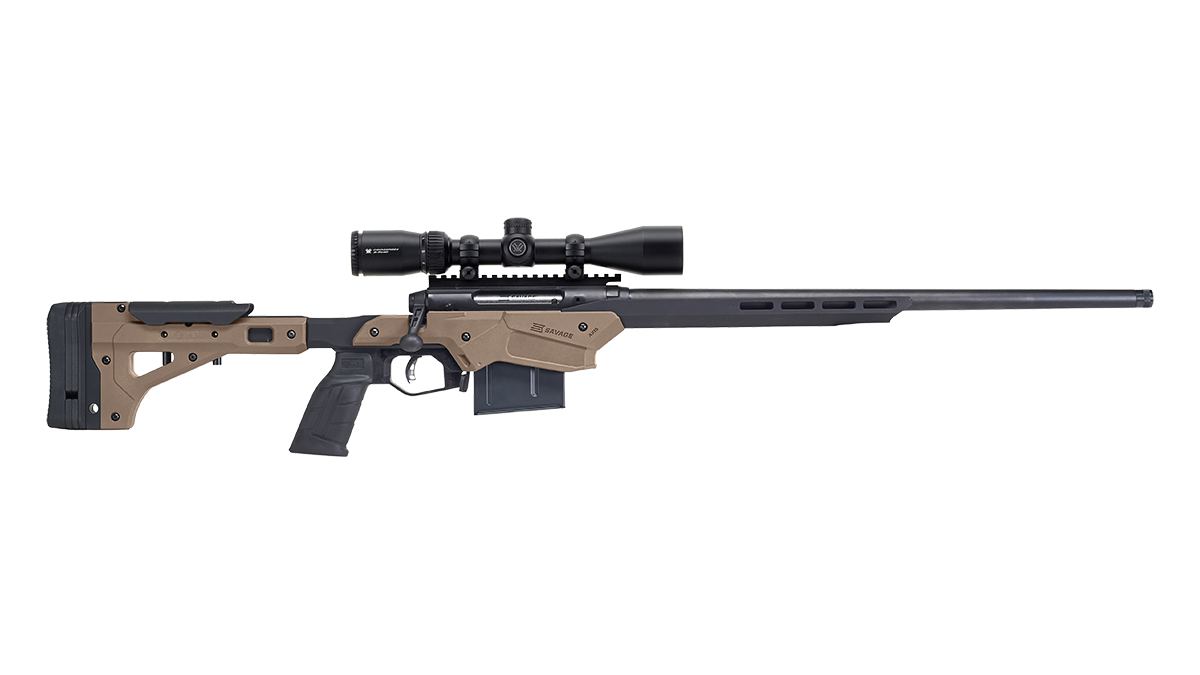
The Savage Axis II Precision in 6.5 Creedmoor represents something uncommon in the budget rifle market – a factory chassis rifle under $650. Savage paired their entry-level Axis action with an MDT aluminum chassis, heavy 22″ barrel, and their AccuTrigger to create what’s essentially the cheapest path to a precision rifle setup. The question isn’t whether it’s a good value on paper – it obviously is – but whether the budget Axis action and adequate barrel quality can deliver enough performance to justify choosing this over saving for a Bergara or Tikka.
Quick Verdict – Budget Chassis Done Right
✓ Best for: Entry-level PRS shooters and budget precision practice (400-800 yards)
✓ Price: $599-$649 street (MSRP $699)
✓ Key strength: MDT aluminum chassis with AccuTrigger at budget price point
✗ Not ideal for: Hunting applications (9.1 lbs too heavy) or competitive shooters prioritizing smoothness
The Axis II Precision delivers chassis rifle features without custom build costs, but the rough Axis action and adequate barrel quality mean you’re trading refinement for affordability. It’s the cheapest way to get adjustable ergonomics and AICS magazines in a factory rifle.
Real-World Performance – Range & Accuracy
The 22″ heavy profile barrel with 1:8 twist handles 140-147gr bullets well, delivering around 2,700 fps with 140gr ELD-M and 2,620 fps with 147gr loads. Factory match ammunition from Federal and Hornady produces 0.8-1.2 MOA groups consistently – not match-grade but adequate for learning fundamentals and club-level competition. The heavy contour maintains this accuracy through 15-20 round strings without significant heat-induced stringing, which matters for PRS stages. Cold bore consistency is good, and the included 20 MOA Picatinny rail provides sufficient elevation for reaching 800-1,000 yards with quality glass.
Handloaders can tighten groups to 0.6-1.0 MOA with load development, though the button-rifled budget barrel won’t compete with premium cut-rifled options. At 600 yards, expect 5-7 inch groups with good ammunition and fundamentals – entirely workable for steel practice and entry-level competition. The threaded 5/8×24 muzzle accepts suppressors and brakes without additional gunsmithing. Barrel life runs 3,000-4,000 rounds before accuracy degradation, which gives most recreational shooters 3-5 years of service.
Applications & Use Cases – Best Fit
Entry-level PRS club matches: This rifle’s primary mission. The MDT chassis provides adjustable length of pull and comb height, the 9.1-pound weight helps manage recoil, and the AICS 10-round magazine fits most match requirements. Accuracy is adequate for club-level competition where targets run 1-2 MOA. The rough bolt operation slows manipulation compared to smoother actions, but you’re learning fundamentals, not winning Nationals. Budget shooters can compete for under $1,300 total with decent optics.
Long-range steel practice (400-800 yards): Excellent application. The heavy barrel and stable chassis make consistent hits easier, and the adjustable ergonomics help maintain proper position during extended range sessions. At 600 yards, this setup reliably connects on 10-inch steel with quality ammunition. The weight becomes an advantage here – less movement between shots and better recoil management for spotting impacts.
Budget precision training: Ideal for learning fundamentals without expensive equipment investment. The AccuTrigger teaches proper trigger control, the chassis introduces adjustability concepts, and AICS magazines familiarize shooters with precision rifle magazine systems. When you outgrow it, upgrade to a Bergara or Tikka and keep this as a loaner or backup.
Hunting applications: Completely inappropriate. At 9.1 pounds bare plus optics and bipod, you’re carrying 12+ pounds in the field. The chassis width snags brush and makes awkward rifle handling. Any traditional-stocked 6.5 Creedmoor serves hunters better – this rifle exists for range and competition use only.
Ergonomics & Handling – Weight Trade-offs
The MDT LSS chassis transforms ergonomics compared to synthetic-stocked budget rifles, offering three length-of-pull positions and adjustable comb height via spacers. The aluminum construction provides solid hand placement and better recoil management than polymer stocks. Grip angle suits precision shooting from positions, though some shooters find the vertical grip angle less comfortable than traditional stocks. The forend’s M-LOK slots accept accessories, and the wide fore-end provides stable bag contact for positional shooting.
However, that chassis adds roughly two pounds versus synthetic stocks, pushing total weight to 9.1 pounds before optics. With a Vortex Diamondback Tactical scope, rings, bipod, and loaded magazine, you’re carrying 12.4 pounds – manageable for range work but prohibitive for hunting. The Axis action’s rough bolt operation requires more effort than Tikka or Bergara actions, with heavier lift and gritty feel. The AccuTrigger breaks cleanly at factory 2.5 pounds, adjustable down to 1.5 pounds – easily the best trigger in this price category and competitive with rifles costing $300-400 more. Magazine changes with AICS-pattern magazines are straightforward, and the 10-round capacity suits most applications.
Aftermarket & Upgrade Path – What’s Next
The Savage Axis platform presents limited aftermarket compared to Remington 700 or Savage 110 footprints. Prefit barrel manufacturers largely ignore the Axis due to its proprietary barrel nut system, meaning barrel replacement at 3,000-4,000 rounds requires gunsmith work or upgrading to a different rifle entirely. Trigger upgrades are unnecessary since the AccuTrigger already delivers excellent performance – save that money. Chassis upgrades offer the most practical path: the included MDT LSS chassis can be upgraded to the full-featured LSS-XL for around $200, adding more adjustability and accessory mounting.
The realistic upgrade path focuses on accessories rather than rifle components. Budget $400-700 for decent precision glass like Vortex Diamondback Tactical or Athlon Argos BTR, $100-300 for a quality bipod (Harris or Atlas), and perhaps $150-200 for additional AICS magazines and a muzzle brake. Total investment reaches $1,250-1,500 for a complete competition-ready setup. Beyond accessories, the Axis action’s limitations suggest shooting the factory barrel through its useful life, then upgrading to a Bergara B-14 or Tikka T3x if you’re committed to precision shooting rather than investing heavily in this platform.
Pros & Cons – The Complete Picture
Strengths:
✓ MDT aluminum chassis included at $600 price point ($350-400 value)
✓ AccuTrigger adjustable 1.5-6 lbs, factory ~2.5 lbs (best trigger under $700)
✓ AICS 10-round magazine compatibility with one magazine included
✓ Heavy 22″ barrel maintains sub-1.2 MOA through 15-round strings
✓ Factory threaded 5/8×24 muzzle for suppressors/brakes
✓ 20 MOA Picatinny rail included (no extra cost)
✓ Adjustable LOP and comb height (chassis features at budget price)
✓ Sub-MOA accuracy achievable with handloads (0.6-1.0 MOA)
Limitations:
✗ Axis action significantly rougher than Savage 110, much rougher than Tikka/Bergara
✗ 9.1 lbs prohibitive for hunting (chassis adds ~2 lbs vs synthetic stock)
✗ Factory accuracy adequate not exceptional (0.8-1.2 MOA typical with match ammo)
✗ Limited prefit barrel availability (proprietary Axis barrel nut system)
✗ Budget MDT LSS chassis, not full-featured LSS-XL (fewer adjustments)
✗ Button-rifled budget barrel, not cut-rifled precision grade
✗ Lower resale value than Tikka/Bergara/premium brands
✗ Heavier bolt lift and gritty operation slows manipulation
Competitors & Alternatives – Value Context
| Feature | Axis II Precision | Ruger American Predator | Savage 110 Tactical | Mossberg MVP Precision |
|---|---|---|---|---|
| Price | $599-$649 | $649 | $899 | $749 |
| Weight | 9.1 lbs | 6.8 lbs | 8.9 lbs | 10 lbs |
| Trigger | 2.5 lbs | 3-5 lbs adj | 2.5 lbs | 3-7 lbs adj |
| Magazine | AICS 10rd | AICS 10rd | AICS 10rd | AR-15 |
| Accuracy | 0.8-1.2 MOA | 0.8-1.5 MOA | 0.7-1.0 MOA | 1.0-1.5 MOA |
The Ruger American Predator costs similar money but weighs 2.3 pounds less with traditional synthetic stock, making it vastly superior for hunting while sacrificing the chassis adjustability and heavy barrel that precision shooters want. Choose Ruger if hunting matters; choose Savage if range/competition is primary. The Savage 110 Tactical costs $250-300 more but delivers a noticeably smoother action and slightly better accuracy – worth considering if budget allows, but the Axis provides 80% of the capability for 65% of the cost.
The Mossberg MVP Precision uses AR-15 magazines instead of AICS, which are cheaper and more available but less purpose-built for precision work. It costs $100 more than the Axis with a heavier overall package and inferior trigger. Unless you’re committed to AR magazine compatibility, the Axis makes more sense. For hunters considering this category, ignore all chassis rifles and buy a Thompson Center Compass for $399 or Ruger American – the weight penalty isn’t worth it for field use.
Who Should Buy This – Target Shooter
This rifle suits budget-conscious precision shooters entering long-range shooting or club-level PRS competition who want chassis features without custom build costs. First-time precision rifle buyers get adjustability, decent accuracy, and AICS compatibility for learning fundamentals without $1,500+ investment. Range shooters practicing at 400-800 yards benefit from the heavy barrel and stable platform, where weight becomes advantage rather than liability.
Look elsewhere if hunting is your primary application – any traditional-stocked 6.5 Creedmoor serves better. Competitive shooters prioritizing smoothest action operation should save for Bergara B-14 HMR or Tikka T3x TAC A1, which cost more but deliver noticeably refined bolt manipulation. Those planning extensive upgrades should consider platforms with better aftermarket support like Remington 700 footprint rifles. If you’re unsure whether precision shooting is for you, this represents low-cost entry; if you’re committed long-term, spending $300-500 more on better foundation makes sense.
Frequently Asked Questions – Common Concerns
Q: How does the Axis action compare to Savage 110?
A: Noticeably rougher with gritty bolt operation and heavier lift. The Axis is a budget-simplified version prioritizing cost over smoothness. Functional and reliable but lacks refinement.
Q: Is 9.1 pounds too heavy for hunting?
A: Yes, for most hunting applications. Add optics, bipod, and ammunition, and you’re carrying 12+ pounds. The chassis width also snags brush. Hunt with traditional-stocked rifles.
Q: Can I replace the barrel when it wears out?
A: Difficult. Savage Axis uses proprietary barrel nut different from Savage 110. Few manufacturers make prefits. Plan to shoot factory barrel through its 3,000-4,000 round life, then upgrade entire rifle.
Q: What accuracy should I expect?
A: 0.8-1.2 MOA with quality factory match ammunition (Federal GMM, Hornady Match). Handloads can achieve 0.6-1.0 MOA with development. Not match-grade but adequate for learning and club competition.
Q: Is the AccuTrigger worth it in a budget rifle?
A: Absolutely. It’s the same AccuTrigger found in $900+ Savage rifles. Factory 2.5-pound pull is excellent, adjustable down to 1.5 pounds. Best trigger in the budget category by significant margin.
Q: What’s total cost for competition-ready setup?
A: Budget $600 rifle + $500 optic (Vortex Diamondback Tactical) + $150 bipod + $50 extra magazine = $1,300 complete. Add $100 for muzzle brake if desired.
Final Verdict – Entry-Level Precision Value
The Savage Axis II Precision delivers chassis rifle capability at half the typical cost, making it the obvious choice for budget-conscious precision shooters. The rough action and adequate accuracy mean you’re trading refinement for affordability, but at $600, it’s the cheapest functional path to adjustable ergonomics and AICS magazines.
For entry-level precision shooting and club PRS competition, the Savage Axis II Precision provides legitimate value despite its compromises. The MDT chassis and AccuTrigger at this price point are unprecedented, and accuracy proves adequate for learning fundamentals and competing locally. Hunters should ignore this rifle entirely – the 9+ pound weight makes no sense in the field. Serious competitors will eventually outgrow the rough Axis action and want smoother operation, but as a first precision rifle or budget practice gun, it accomplishes the mission. This rifle exists to get shooters into chassis-based precision shooting without four-figure investment, and it succeeds at that specific goal.