 Maksym Kovaliov
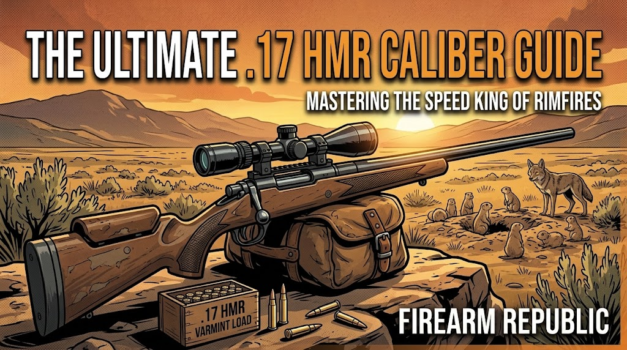
The .17 HMR is the cartridge that quietly solved a problem rimfire shooters had accepted as permanent: the .22 LR’s effective ceiling of roughly 100 yards. Introduced by Hornady in 2002 in collaboration with Marlin and Ruger, the .17 Hornady Magnum Rimfire fires a 17gr bullet at 2,550 fps – nearly double the velocity of a standard .22 LR load – with a ballistic coefficient high enough to maintain that speed advantage meaningfully past 200 yards. The result is a rimfire cartridge that shoots dramatically flatter, drifts substantially less in wind, and extends the practical small game and varmint range of a rimfire platform to 150–200 yards with a confidence the .22 LR cannot provide at those distances. At $0.25–$0.45 per round for standard loads and $0.50–$0.70 per round for premium match offerings, it sits at a meaningful premium over .22 LR bulk ammo but costs a fraction of any centerfire varmint cartridge. For dedicated varmint hunters, precision rimfire shooters who want reach beyond 100 yards, and anyone who has consistently been frustrated by the .22 LR’s wind sensitivity past 75 yards, the .17 HMR represents a genuine and well-executed solution. This guide covers the complete picture: ballistics, real-world performance, honest comparisons, ammunition selection, and where the cartridge excels and falls short.
What Is the .17 HMR?
The .17 HMR is a rimfire cartridge based on the .22 WMR (.22 Magnum) case necked down to accept a .172 caliber (17mm) bullet. The design philosophy was straightforward: take the largest practical rimfire case available, neck it to the smallest practical bullet diameter, and load a high-BC projectile to maximize velocity and extend effective range. The result is a cartridge with a .286″ bullet diameter, .286″ neck, and an overall case length of 1.058″ – identical to the .22 WMR case dimensions except for the necked-down mouth.
The key to the .17 HMR’s performance advantage over the .22 LR is not raw velocity alone – it is the combination of high velocity and a bullet design optimized for BC. The standard 17gr V-MAX bullet achieves a BC of approximately .125 G1, which is low by centerfire standards but exceptional for a bullet this size and weight. More practically, the V-MAX’s polymer tip initiates reliable fragmentation on small game at the velocities the .17 HMR produces, making it both accurate and effectively lethal on varmints at distances where the .22 LR struggles.
Because the .17 HMR is based on the .22 WMR case, rifles chambered for .22 WMR can sometimes be converted to .17 HMR with a barrel swap – though this requires a factory re-barrel rather than a simple field swap, and the bolt face dimensions must be compatible. The .17 HMR cannot be fired in a .22 LR or standard .22 WMR chamber, and attempting to do so is dangerous. Like all rimfire cartridges, the .17 HMR cannot be reloaded.
Ballistics: The Numbers That Matter
The .17 HMR’s ballistic profile is defined by velocity and flat trajectory. From a standard 18–22″ rifle barrel, the 17gr V-MAX exits at approximately 2,550 fps. The 20gr XTP runs slightly slower at 2,375 fps but carries more energy and penetrates more consistently – relevant for larger varmints. These figures translate into a trajectory dramatically flatter than any .22 LR load, with wind performance that makes field shooting past 100 yards genuinely manageable.
| Load | MV (fps) | 100 yd Velocity | 100 yd Energy | 150 yd Drop (100 yd zero) | 10 mph Wind @ 150 yd |
|---|---|---|---|---|---|
| 17gr V-MAX | 2,550 | 1,901 | 136 ft-lbs | -3.7″ | 3.8″ |
| 17gr Hornady HP | 2,550 | 1,880 | 133 ft-lbs | -3.8″ | 3.9″ |
| 20gr XTP | 2,375 | 1,776 | 140 ft-lbs | -4.6″ | 4.3″ |
| 20gr Gamepoint | 2,375 | 1,745 | 135 ft-lbs | -4.7″ | 4.5″ |
| 17gr CCI TNT | 2,525 | 1,876 | 133 ft-lbs | -3.9″ | 4.0″ |
The comparison to .22 LR at these distances is stark. A 40gr .22 LR high-velocity load zeroed at 50 yards drops approximately 8–10 inches at 150 yards and drifts 7–9 inches in a 10 mph crosswind. The 17gr V-MAX drops 3.7 inches and drifts 3.8 inches at the same distance – roughly half the drop and less than half the wind drift. For a shooter trying to hit a squirrel’s head at 125 yards or a prairie dog at 175 yards, those differences are the margin between a clean hit and a miss.
Energy at 100 yards runs 130–140 ft-lbs depending on load – compared to 75–92 ft-lbs for .22 LR. That improvement in retained energy is relevant for reliable small game kills at extended distances, where the .22 LR’s energy at 100+ yards becomes marginal. The .17 HMR’s 136 ft-lbs at 100 yards is sufficient for clean kills on squirrels, rabbits, and prairie dogs with proper shot placement, with slightly more margin than the .22 LR provides at the same range.
The effective ceiling for the .17 HMR is approximately 200 yards for varmints in calm conditions. Past 200 yards, velocity has dropped to 1,400–1,500 fps, energy falls below 80 ft-lbs, wind drift compounds significantly, and the small 17gr bullet becomes sensitive to mirage and minor atmospheric variations that affect point of impact unpredictably. Treating 200 yards as the practical ceiling – and 150 yards as the consistent ethical hunting range – is the honest assessment.
.17 HMR vs. The Competition
.17 HMR vs. .22 LR
The .22 LR wins on cost ($0.06–$0.15/round vs. $0.25–$0.45/round), platform variety, ammo availability, suppressed quietness, and total versatility. The .17 HMR wins clearly on effective range, wind resistance, and trajectory flatness past 75 yards. For hunters and shooters whose primary activity occurs inside 75 yards, the .22 LR’s cost advantage is compelling and the .17 HMR’s performance edge is largely wasted. For dedicated small game hunters who regularly face 100–175 yard shots, or varmint hunters working prairie dog towns where animals may be 100–200 yards away, the .17 HMR’s range extension is genuinely valuable. Most serious rimfire owners end up owning one of each, using the .22 LR for close-range work and volume practice and the .17 HMR for hunting sessions where reach matters. Full picture in our .22 LR Caliber Guide.
.17 HMR vs. .22 WMR
The .22 WMR fires 40–50gr bullets at 1,800–2,000 fps, delivering more energy and better wind resistance than the .22 LR but trailing the .17 HMR in trajectory flatness. At 100 yards, a 40gr .22 WMR drops approximately 1 inch more than a 17gr .17 HMR with the same zero and drifts 1.5–2 inches more in a 10 mph wind. Past 150 yards the gap widens further. The .22 WMR compensates with better terminal performance on medium small game – a 40gr expanding bullet hits harder and penetrates more deeply than a 17gr fragmenting projectile, which matters on rabbits and larger animals where the .17 HMR can sometimes fail to exit cleanly. For pure varmint work at 100–175 yards, the .17 HMR is the better choice. For small game hunters who also want the option to take larger rabbits or use the rifle in light brush where fragments can lose energy, the .22 WMR is a legitimate alternative.
.17 HMR vs. .17 WSM
The .17 Winchester Super Magnum is a newer and more powerful .17 rimfire cartridge, pushing 20gr bullets to 3,000 fps vs. the .17 HMR’s 2,375 fps with the same weight bullet. The .17 WSM extends effective range to approximately 250–300 yards and handles wind meaningfully better at distance. The trade-offs are sharply higher ammo cost ($0.60–$1.00/round), narrower rifle selection, and louder report. For dedicated varmint hunters who need 250-yard capability and are willing to pay the ammo premium, the .17 WSM is the better tool. For most rimfire hunters whose shots stay inside 175–200 yards, the .17 HMR’s lower cost and broader platform selection make it the more practical choice.
.17 HMR vs. .22-250 Remington
At some point the varmint hunting caliber comparison shifts from rimfire to centerfire. The .22-250 pushes 50–55gr bullets to 3,600–3,800 fps, extending effective varmint range to 400+ yards with dramatically more energy and terminal performance. For serious prairie dog hunters running multiple-shot days at 200–350 yards, the .22-250 and similar centerfire varmint cartridges are clearly superior tools. The .17 HMR’s argument is cost and simplicity: a .17 HMR session costs roughly $15–$20 per 50 rounds vs. $40–$60 per 50 for premium centerfire varmint ammo. For hunters whose varmint shooting stays inside 200 yards and who value lower cost over maximum range, the .17 HMR remains relevant. Our Varmint Hunting Rifles Guide covers the full varmint caliber range.
Factory Ammunition: What to Buy
The .17 HMR ammunition market is smaller than .22 LR but meaningfully broader than many specialty centerfire cartridges. Hornady, CCI, Federal, Remington, and Winchester all load for it, and availability at major sporting goods retailers is generally reliable. Rural hardware store availability is less consistent than .22 LR but better than most premium rimfire options.
Standard 17gr V-MAX loads:
Hornady 17gr V-MAX ($0.30–$0.40/round, various pack sizes) is the reference load – the original and still the benchmark. Consistent velocities, reliable fragmentation on varmints, and the polymer tip that defines the V-MAX series make it the default choice for hunting applications. CCI 17gr V-MAX is loaded with the same Hornady projectile and performs essentially identically – worth buying whichever is cheaper at time of purchase.
20gr options for hunting:
The 20gr loads trade velocity for mass, and the practical result is better terminal performance on larger varmints and small game where the 17gr bullet can produce insufficient penetration. Hornady 20gr XTP ($0.35–$0.45/round) is the primary 20gr hunting load – the XTP bullet is designed for controlled expansion rather than fragmentation, giving better penetration on rabbits and larger animals. CCI 20gr Gamepoint uses a soft point design that performs similarly. For hunters who use the .17 HMR on game larger than prairie dogs or squirrels, the 20gr options are the better choice.
Precision and match loads:
The .17 HMR does not have a dedicated match ammunition segment comparable to the .22 LR’s Eley Tenex and Lapua X-ACT offerings. The cartridge’s inherent design – high velocity and varmint-oriented bullet construction – does not lend itself to the sub-quarter-MOA precision that serious .22 LR bench rest competition demands. The most accurate factory loads for general precision use are typically standard Hornady V-MAX runs that happen to produce tighter groups in a given rifle. Testing multiple lots and identifying a consistent supply is the practical approach.
A critical note on lot consistency:
The .17 HMR is more sensitive to lot-to-lot velocity variation than the .22 LR. Because the cartridge operates at higher velocity and with less margin for variation at its effective range ceiling, a velocity shift of 50–75 fps between ammo lots can produce a 0.5–1 inch point of impact change at 150 yards. Serious hunters and precision rimfire shooters should buy in bulk when they find a lot that performs well in their rifle and verify zero when switching to a new lot.
| Load | Type | Price | Best For |
|---|---|---|---|
| Hornady 17gr V-MAX | Standard Hunting | $0.35/rd | Prairie dogs, squirrels, varmints |
| CCI 17gr V-MAX | Standard Hunting | $0.33/rd | Same as Hornady V-MAX |
| Hornady 20gr XTP | Hunting (controlled expansion) | $0.42/rd | Rabbits, larger varmints |
| CCI 20gr Gamepoint SP | Hunting (soft point) | $0.40/rd | Small game, larger varmints |
| Federal 17gr V-MAX | Standard Hunting | $0.36/rd | General purpose |
| Winchester 17gr Varmint HV | Hunting | $0.38/rd | General purpose |
Best Applications for the .17 HMR
Prairie Dog and Varmint Hunting
This is the .17 HMR’s home application and where it performs most convincingly. Prairie dog towns present shots from 50 to 200 yards in open terrain where wind is almost always present. The .17 HMR’s trajectory and wind performance let hunters hold close to the crosshairs out to 150 yards in moderate wind – a 5 mph wind produces only 1.3 inches of drift at 100 yards and 3.8 inches at 150 yards, which is manageable for a shooter who reads wind before the shot. The V-MAX bullet’s fragmentation on impact is both humanely lethal on prairie dogs and minimizes ricochet risk on flat open terrain where bullet scatter matters. Shot volume in prairie dog hunting can be high – 50–100 rounds in a session is common – and the .17 HMR’s per-round cost, while higher than .22 LR, remains modest enough to sustain that volume comfortably. Our Varmint Hunting Rifles Guide covers dedicated varmint setups in detail.
Squirrel and Small Game Hunting
At the classic small game distances of 50–125 yards, the .17 HMR has an accuracy and trajectory advantage over the .22 LR that experienced squirrel hunters notice and appreciate. Head shots on squirrels at 75–100 yards are consistently achievable with a well-zeroed .17 HMR rifle and quality ammo in calm to moderate conditions, whereas the .22 LR at those distances requires more precise range estimation and better wind reading to achieve the same result. The trade-off is terminal performance on body shots – the 17gr V-MAX fragments dramatically on impact, which can damage more meat than a .22 LR solid or subsonic if a body shot is unavoidable. For squirrel hunters who prioritize head shots for clean kills and want the confidence of a flatter-shooting platform at modest extra cost, the .17 HMR is a genuine upgrade from the .22 LR. See our Small Game Hunting Rifles guide for the full small game context.
Coyote and Predator Hunting at Close to Moderate Range
The .17 HMR is a capable coyote cartridge inside 125 yards, but it sits right at the edge of practical capability for animals this size. A 17gr bullet at 1,800 fps impact velocity – what you get at 100 yards – produces 122 ft-lbs of energy and, with the V-MAX’s fragmentation, causes lethal wound channels on coyotes. The limitation is that fragmentation, which is the V-MAX’s strength on small varmints, can prevent adequate penetration on coyotes at longer ranges where impact velocity has dropped further. The 20gr XTP is a better choice for coyote use – controlled expansion rather than fragmentation provides more reliable penetration at the impact velocities the .17 HMR produces at 75–125 yards. Past 125 yards on coyotes, the .22-250, .223, or .17 WSM are more appropriate tools. Our Coyote Hunting Rifles guide covers the full predator hunting cartridge landscape.
Pest Control on Properties and Homesteads
For farm and homestead pest control – rats, squirrels, rabbits raiding gardens, starlings, and similar nuisances – the .17 HMR offers the .22 LR’s clean operation with extended reach and better accuracy at modest extra cost. The faster velocity and flatter trajectory make snap shots at 50–100 yards more reliable than with the .22 LR, and the V-MAX’s fragmentation reduces overpenetration risk on soft targets. The louder report compared to a suppressed .22 LR is the primary trade-off for this application: the .17 HMR cannot be effectively suppressed below hearing-safe levels with supersonic loads, whereas a suppressed subsonic .22 LR is genuinely quiet. For pest control where noise discipline matters, the .22 LR wins. For properties where the extended range of the .17 HMR is useful and noise is not a primary concern, it is a practical pest management tool.
Precision Rimfire Training and Competition – Extended Range
Within the NRL22 and similar precision rimfire competition formats, the .17 HMR occupies a useful position for shooters who want to extend their practice range beyond the 100-yard standard. An NRL22-style course shot at 150 yards with a .17 HMR requires more precise wind reading and range estimation than the same course at 100 yards with a .22 LR, which transfers directly to the skill development relevant for centerfire long-range practice. The .17 HMR is not eligible in standard NRL22 and CMP rimfire divisions that specify .22 LR, but informal training setups and some regional matches accept it. For shooters building wind-reading and holdover skills before advancing to centerfire precision work, the .17 HMR at 150–200 yards is a genuinely useful training tool at rimfire cost.
Rifles Chambered in .17 HMR
The .17 HMR rifle market is smaller than the .22 LR’s but broader than most specialty rimfire cartridges. Most major manufacturers produce at least one model, and the primary platforms are bolt-action – the cartridge’s precision orientation and higher operating pressure make bolt guns the most natural fit.
Bolt-action hunting rifles:
The Savage B.Mag ($350–$400) was purpose-designed for .17 HMR and .17 WSM and remains one of the cleanest factory offerings for the cartridge – an AccuTrigger-equipped bolt gun with a heavy barrel that produces excellent accuracy. The Ruger American Rimfire ($350–$420) in .17 HMR delivers the same solid Ruger quality that makes the standard Ruger American a benchmark, in a rimfire-scaled platform. The CZ 457 ($500–$600) in .17 HMR is the premium production option – the CZ455’s replacement brings excellent factory accuracy and a trigger adjustable to under 2 lbs. Marlin XT-17 ($250–$300) is an affordable entry point that performs adequately for casual varmint hunting.
Lever-action:
The Henry Varmint Express in .17 HMR ($600–$700) is a tube-fed lever-action that provides a fast follow-up shot option in an unusual configuration for this cartridge. It’s fun to shoot and capable at varmint distances, though the ergonomics of rapid second shots are not as quick as a semi-auto for multi-target varmint sessions.
Semi-automatic:
Very few semi-auto rifles are chambered in .17 HMR, and those that exist have historically had reliability issues. The higher operating pressure and smaller case dimensions of the .17 HMR create cycling challenges that the .22 LR’s lower pressure does not present. Savage 93R17 BTV produces a bolt-action version that the market generally prefers. If semi-auto capability is important for your application, the .17 HMR is not the best choice – stick to bolt-action platforms for reliable function.
Precision and heavy barrel options:
For shooters who want maximum accuracy from the cartridge, heavy barrel bolt-action options perform meaningfully better than sporter-weight barrels by reducing heat-related velocity variation during multi-shot sessions and minimizing barrel movement under recoil. The CZ 457 Varmint ($600–$650) and Savage B.Mag Heavy Barrel ($400–$450) are the primary production options. Custom barrel installations on CZ 455/457 and Ruger American platforms are also available from aftermarket barrel makers for shooters who want to optimize a specific platform.
Suppressor Use with the .17 HMR
The .17 HMR can be used with a suppressor, but the practical result is less dramatic than with a suppressed .22 LR subsonic setup. Because the .17 HMR is an inherently supersonic cartridge – its entire performance case rests on high velocity – there is no subsonic loading option. A suppressor on a .17 HMR reduces the muzzle blast and mechanical action noise meaningfully but cannot eliminate the supersonic crack of a 2,550 fps projectile. The result is a significant reduction in report – from roughly 140 dB unsuppressed to approximately 120–125 dB suppressed – which is still above the hearing-safe threshold but meaningfully quieter for bystanders and reduces the shooter’s hearing fatigue over a long session.
Thread pitch on most .17 HMR barrels is 1/2×28, the same as AR-15 barrels and many .22 LR platforms. A quality rimfire or multiuse suppressor that handles .17 caliber – the SilencerCo Sparrow, Gemtech GM-22, and Dead Air Mask HD all accommodate .17 HMR – works for both .22 LR and .17 HMR duty. The cleaning schedule is the same as for .22 LR suppressors: disassemble and clean every 500 rounds with lead ammo to prevent carbon and lead buildup from permanently fouling the baffles. See our Suppressor Buyer’s Guide for full suppressor selection guidance.
Who Should Choose the .17 HMR?
The .17 HMR is your cartridge if:
You hunt prairie dogs, squirrels, or similar varmints at 75–175 yards and are consistently frustrated by the .22 LR’s wind drift and drop at those distances. You want to extend your rimfire effective range without stepping up to the cost and complexity of centerfire varmint cartridges. You want a dedicated small game and varmint rifle that performs confidently at hunting distances where the .22 LR requires precise range estimation and wind compensation to be consistent. You already own a .22 LR and want a complementary rimfire platform for longer work while keeping the .22 LR for close-range and suppressed applications.
Look elsewhere if:
You primarily shoot inside 75 yards – at those distances the .22 LR’s lower cost and greater versatility make the .17 HMR’s performance advantage irrelevant. You want a suppressed-first platform for quiet pest control or training – the .22 LR with subsonic ammo is dramatically quieter than any .17 HMR setup. You hunt game larger than coyotes – the .17 HMR is not an appropriate cartridge for deer-sized or larger animals under any circumstances. You want a high-volume practice cartridge for building fundamentals cheaply – the .22 LR at half the cost is the right tool for that job. You are a new shooter who needs one rimfire rifle to start – the .22 LR’s versatility, lower cost, and broader platform selection make it the correct first choice.
Frequently Asked Questions
Q: What is the maximum effective range of the .17 HMR for hunting?
A: The practical ceiling is 150–175 yards for varmints like prairie dogs and squirrels in conditions with less than 10 mph wind, and closer to 100–125 yards for animals larger than squirrels where energy and penetration margins become more critical. At 200 yards, wind drift and energy drop make consistent ethical kills on small game difficult enough that most hunters draw the line there. In calm conditions with a skilled shooter, some extend to 200 yards on prairie dogs – but this is the outer edge, not the comfortable operating range.
Q: Can I shoot .22 LR ammo in a .17 HMR rifle?
A: No – absolutely not. The .17 HMR and .22 LR are completely different cartridges with different case dimensions, bullet diameters, and operating pressures. Attempting to fire .22 LR in a .17 HMR chamber is dangerous and will damage the rifle. The cartridges share no compatibility. Similarly, .22 WMR ammo should not be fired in a .17 HMR chamber even though both are based on the same case – the bullet diameter difference is critical.
Q: Why is the .17 HMR more accurate than .22 LR at distance?
A: Two primary reasons. First, the higher velocity produces a flatter trajectory, which means small errors in range estimation produce smaller point-of-impact deviations. Second, the faster bullet spends less time in flight and therefore has less time to be deflected by wind. A bullet that travels to 100 yards in 0.12 seconds (roughly the .17 HMR’s flight time) is exposed to wind influence for less time than one that takes 0.15 seconds (roughly a .22 LR high-velocity load). The combination of better BC and higher velocity makes the .17 HMR inherently easier to shoot accurately at 100–175 yards than any .22 LR load.
Q: Is the .17 HMR louder than .22 LR?
A: Yes, noticeably so. A standard .17 HMR load produces approximately 135–140 dB at the shooter’s ear compared to 130–135 dB for a .22 LR high-velocity load – a modest difference in decibels that sounds more significant in the field. More practically, the .17 HMR cannot be quieted to hearing-safe levels with a suppressor the way a subsonic .22 LR can, because all .17 HMR loads are supersonic and produce a ballistic crack that a suppressor cannot eliminate. For hunting in areas where shot noise is a concern or for shooters prioritizing a quiet experience, the .22 LR with a suppressor is a fundamentally quieter option.
Q: Does the .17 HMR work in cold weather?
A: Rimfire cartridges generally are more temperature-sensitive than centerfire cartridges because the primer compound distributed in the rim is more susceptible to cold-induced ignition failures than a centrally-seated primer cup. The .17 HMR, like the .22 LR, can produce slightly higher misfire rates in extreme cold below 0°F, though modern production ammo from quality manufacturers (Hornady, CCI, Federal) performs reliably down to approximately 0°F in most cases. More practically relevant is the velocity variation between cold and warm conditions: expect 50–75 fps lower velocity in cold temperatures compared to standard 70°F conditions, which shifts point of impact slightly at distance. Re-confirm zero when shooting in temperature conditions significantly different from when the rifle was originally zeroed.
Q: What scope magnification is best for a .17 HMR rifle?
A: For hunting at 50–150 yards, a 3–9x scope provides sufficient magnification for target identification and precise shot placement on small game. For precision work extending to 175–200 yards, a 4–12x or 6–18x scope with a fine crosshair or target dot reticle provides better aiming precision on small targets. Variable-power scopes with a side-focus parallax adjustment are strongly recommended – the .17 HMR’s accuracy potential is only fully realized when parallax is eliminated at the shooting distance, which standard scopes with fixed parallax cannot provide reliably across the 50–175 yard range. Quality rimfire scopes from Vortex, Leupold, and Hawke in the $150–$400 range are popular practical choices.