 Maksym Kovaliov
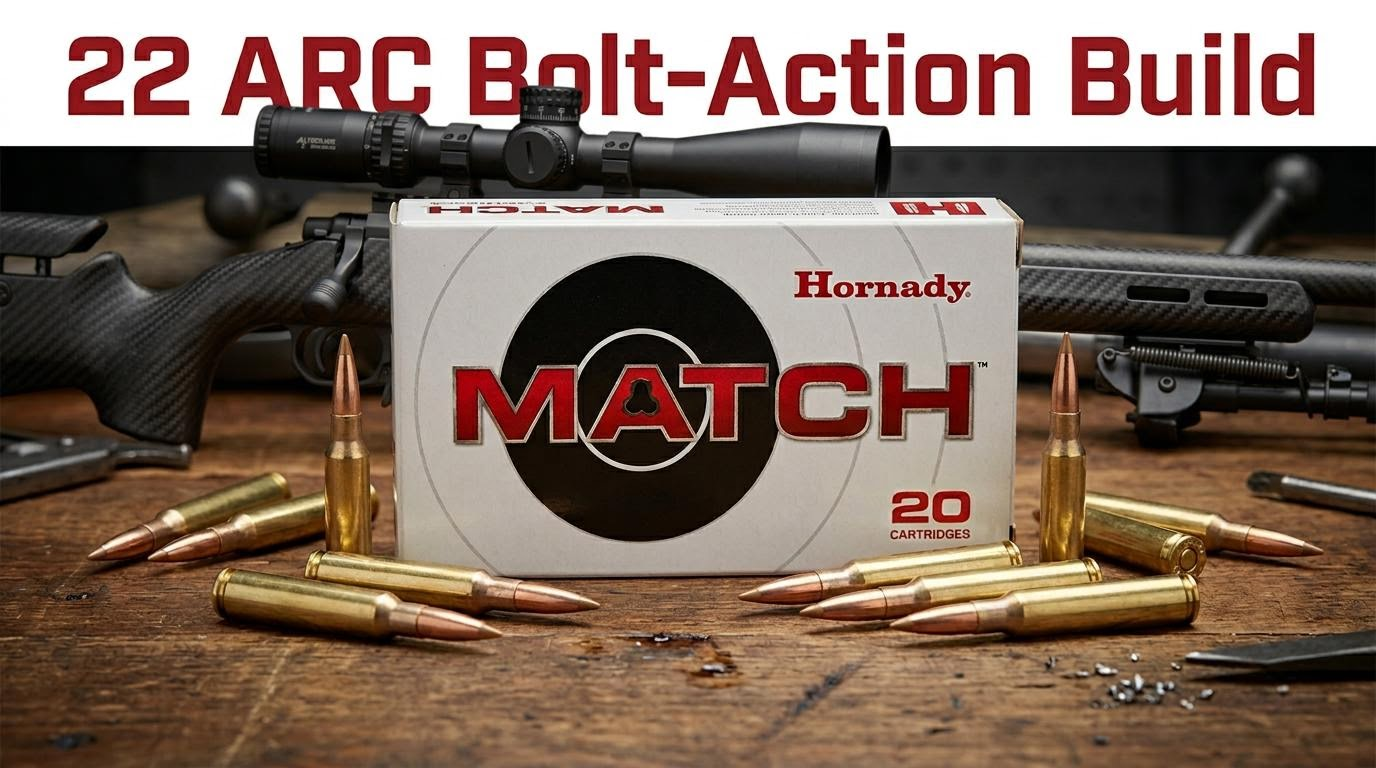
Most conversations about .22 ARC start and end with the AR-15 – and that makes sense, because that’s the platform the cartridge was engineered around. But treating .22 ARC as AR-15-only leaves serious performance on the table. In a bolt-action rifle, the same cartridge runs at 60,000–62,000 PSI instead of the AR’s 52,000 PSI ceiling, which translates to 200+ fps of additional velocity with the same bullet. That’s not a rounding error – it’s the difference between a 450-yard hunting cartridge and a 600-yard one.
The catch is that bolt-action .22 ARC builds come with a genuine decision point that trips up a lot of first-time builders: mini-action vs short-action. The .22 ARC case is short – it’s based on the 6.5 Grendel, which was itself designed to fit inside an AR-15 magazine. That compact geometry is a perfect match for mini-action receivers, but it’s an awkward fit in a standard short-action. Neither is broken, but one is clearly optimized. This guide breaks down both options, explains what matters in each component choice, and gives you a clear path to a finished rifle.
Why Bolt-Action .22 ARC Is Worth Building
Before getting into receiver choices, it’s worth understanding what a bolt-action actually unlocks with this cartridge – because the performance difference versus an AR-15 is more meaningful than most shooters expect.
Factory .22 ARC ammunition is loaded to 52,000 PSI to ensure safe function across all gas-operated platforms. That’s a conservative pressure ceiling that leaves velocity on the table. In a bolt-action, that ceiling rises to 60,000–62,000 PSI – the same working pressure range as .308 Winchester, 6.5 Creedmoor, and most other short-action hunting cartridges. With a quality handload using a powder like Varget or CFE223, an 80gr ELD-X from a bolt-action .22 ARC exits an 18″ barrel at approximately 3,050–3,100 fps. From an AR-15 running factory ammunition, that same bullet leaves at roughly 2,700–2,800 fps.
That velocity gain matters for two reasons. First, the 2,000 fps threshold – the generally accepted minimum impact velocity for reliable expansion of hunting bullets – extends from approximately 450 yards (factory AR-15 loads) to approximately 600 yards (bolt-action handloads). Second, the higher velocity translates to better wind drift numbers and a flatter trajectory at the ranges where .22 ARC’s high-BC bullets are doing their best work.
The bolt-action also benefits the precision side of the equation. No gas system variability, no carrier timing sensitivity, no port pressure concerns – just a simple, repeatable mechanical lockup that lets the cartridge’s inherent accuracy potential show through. If you’re shooting .22 ARC for PRS-style precision or extended-range hunting, bolt-action is the right tool.
The Core Issue: Why Receiver Size Matters With .22 ARC
To understand why mini-action vs short-action is a real decision, you need to understand what “action size” means in practice.
A bolt-action receiver is dimensionally matched to a specific range of cartridge lengths. The receiver’s magazine box, bolt stroke length, and feed geometry are all designed around a maximum overall cartridge length (COAL). Short-action receivers – the standard platform for cartridges like .308 Winchester, .243 Winchester, and 6.5 Creedmoor – are built around a maximum COAL of approximately 2.800″. A mini-action receiver is built around a shorter maximum COAL, typically around 2.260″–2.350″.
The .22 ARC loaded to standard COAL sits at approximately 2.260″. That’s well within mini-action territory. In a short-action receiver, a .22 ARC cartridge is feeding from a magazine into a bolt that travels significantly farther than the cartridge requires. The round is seated and chambered fine – the rifle functions – but the bolt stroke is longer than necessary, the magazine geometry requires an adapter or special insert to position rounds correctly, and the whole system feels loose and imprecise compared to a properly sized action.
Mini-action receivers eliminate all of that mismatch. The bolt stroke is exactly as long as it needs to be, the magazine wells are dimensioned for the cartridge, and the feeding geometry is clean and consistent.
Mini-Action: The Right Tool for the Job
A mini-action receiver is purpose-built for cartridges in the .22 ARC / 6.5 Grendel length class. The bolt stroke is short, the receiver is compact, and the whole package is noticeably lighter and more maneuverable than a short-action equivalent.
Q Mini Fix
The Q Mini Fix is the most visible mini-action platform in the current .22 ARC ecosystem, and for good reason. Q (formerly known as Q LLC) designed this receiver specifically for compact, high-performance cartridges in the Grendel case head family. The Mini Fix ships as a complete chassis-style rifle with folding stock, suppressors-ready barrel threading, and a clean, modernist profile. It’s not a traditional build-it-yourself component – it’s a complete system that happens to run .22 ARC beautifully.
The Mini Fix in .22 ARC with an 18″ barrel weighs approximately 6.5 lbs before optic. The folding stock brings it to a compact carry length for backcountry use. Factory MSRP runs approximately $2,000–$2,200 depending on configuration, which puts it in mid-premium territory. This is not a budget build – but if you want a complete, out-of-box bolt-action .22 ARC that’s properly sized, it’s the most polished option currently available.
Other Mini-Action Options
Beyond the Q Mini Fix, the mini-action receiver market for .22 ARC is still developing. Several custom action makers have produced or announced mini-action receivers compatible with the Grendel bolt head, but availability changes frequently. When evaluating any mini-action receiver for .22 ARC, confirm three things explicitly: bolt face diameter (.440″ / Grendel Type II), magazine compatibility (most use a modified AICS format or proprietary insert), and headspace gauges are available in .22 ARC specifically.
The Ruger American Gen 2 in compact configurations has been discussed as a potential platform, though chambering availability and barrel specifications should be verified at time of purchase. The market here is moving – check current manufacturer offerings.
Mini-Action Build Components
If you’re building around a mini-action receiver rather than purchasing a complete rifle, here’s what you need:
Receiver: Mini-action, .440″ (Grendel Type II) bolt face. Confirm headspace spec is .22 ARC, not 6.5 Grendel – they use the same bolt face but different headspace dimensions.
Barrel: 1:7 twist, .22 ARC chamber – non-negotiable on both counts. Recommended lengths: 16″ for a compact hunting/field build, 18″ for the best balance of velocity and maneuverability, 20″ for maximum velocity in a bench or precision role. Barrel makers currently offering .22 ARC chamberings include Criterion, Bartlein, and Wilson Combat, though availability shifts – verify current stock.
Stock/Chassis: Mini-action receivers typically pair with custom chassis or lightweight stocks. MDT and KRG offer chassis options for various mini-action footprints. Verify compatibility with your specific receiver.
Magazines: For bolt-action mini-action builds, MDT makes AICS-format magazines specifically designed for .22 ARC / Grendel-length cartridges. Standard .308-length AICS magazines will not feed correctly – the cartridges sit too low in the magazine box and feeding is unreliable.
Trigger: Any trigger compatible with your specific receiver’s footprint. Timney, TriggerTech, and Jewell all offer options in the 1.5–3.0 lb range suitable for precision work. For hunting use, 2.5–3.5 lbs is the practical range.
Estimated build cost (mini-action, excluding receiver): $700–$1,200 depending on barrel, stock, and trigger choices.
Short-Action: The Practical Compromise
A short-action receiver works with .22 ARC. Rifles built on short-action platforms chamber and fire .22 ARC without mechanical problems. But understanding the compromises involved helps you decide whether those compromises matter for your intended use.
What Works Fine
The bolt face, chamber, and feeding mechanics function correctly. A short-action receiver with a .440″ Grendel Type II bolt head, a .22 ARC barrel, and properly configured magazines will shoot the cartridge accurately and reliably. The higher pressure ceiling (60,000–62,000 PSI) still applies – a short-action .22 ARC still outperforms a factory AR-15 load by 200+ fps with handloads.
Short-action receivers have a massive ecosystem advantage. Custom receivers from Defiance, Bighorn, Curtis, and dozens of other makers are available off the shelf. Chassis systems, stocks, and aftermarket components are abundant. If you already own a short-action receiver with a Grendel-compatible bolt, converting to .22 ARC may require only a barrel swap and magazine change.
The Real Compromises
Bolt stroke length: A short-action bolt travels approximately 2.800″ to accommodate full-length short-action cartridges. A .22 ARC cartridge is approximately 2.260″ long. Every time you cycle the bolt, you’re moving it about half an inch more than the cartridge geometry requires. On a bench, this is irrelevant. In the field on a quick follow-up shot, it’s a noticeable ergonomic inefficiency.
Magazine geometry: Standard AICS magazines designed for .308-length cartridges position rounds using feed lips and follower geometry calibrated for 2.800″ COAL. A .22 ARC round in that magazine will feed, but it’s relying on the follower pushing a shorter cartridge forward and up into the feed path in a way the magazine wasn’t specifically designed for. Purpose-built Grendel/ARC AICS magazines from MDT address this – use them, not standard .308 AICS mags.
Weight and length: Short-action receivers are heavier and longer than mini-action equivalents. For a precision bench or range rifle where you’re not carrying it far, this doesn’t matter. For a backcountry hunting build where you’re packing it 8 miles in, every ounce is relevant and a mini-action will save you meaningful weight.
Short-Action Build Components
Receiver: Any short-action receiver with a .440″ (Grendel Type II) bolt face. Many precision custom action makers offer this option. Confirm explicitly – most short-action receivers default to .473″ (.308) bolt face and the Grendel/.22 ARC bolt head must be specified at order.
Barrel: Same requirements as mini-action: 1:7 twist, .22 ARC chamber, your preferred length. Short-action builds often run 20–24″ barrels because the longer action accepts longer barrels proportionally – though 18–20″ is the practical sweet spot for .22 ARC ballistics.
Magazines: MDT AICS magazines in Grendel/ARC configuration. Do not use standard .308 AICS magazines. Do not use standard 6.5 Creedmoor AICS magazines. The cartridge is shorter than both and feeding will be unreliable.
Stock/Chassis: Full short-action compatibility – the widest possible selection of aftermarket stocks and chassis is available here. MDT HNT26, KRG Bravo, McMillan A5, Manners T4A – any short-action chassis works. This is the main practical advantage of the short-action platform.
Trigger: Same options as mini-action. Wider compatibility due to the larger receiver ecosystem.
Estimated build cost (short-action, excluding receiver): $800–$1,400 depending on components.
Side-by-Side Comparison
| Feature | Mini-Action | Short-Action |
|---|---|---|
| Bolt stroke | Optimized for .22 ARC COAL | ~0.5″ excess travel |
| Weight | Lighter (6–7 lbs complete) | Heavier (7–9 lbs complete) |
| Magazine compatibility | MDT ARC/Grendel specific | MDT ARC/Grendel AICS required |
| Aftermarket options | Limited, growing | Extensive |
| Receiver availability | Limited (Q Mini Fix, select custom) | Wide selection |
| Cost to build | Higher (limited competition) | Lower (broad market) |
| Best use | Field, hunting, backcountry | Bench, range, precision |
| Feeding reliability | Optimized | Good with correct magazines |
| Suppressor compatibility | Excellent (compact OAL) | Good |
Pressure, Velocity, and What the Numbers Mean
Both mini-action and short-action bolt rifles allow .22 ARC to run at full bolt-action pressure – the receiver type doesn’t affect the pressure ceiling, only the geometry. What matters is that both platforms unlock handloading to 60,000–62,000 PSI, which is where .22 ARC’s performance gap over AR-15 factory loads fully materializes.
Reference velocities with an 18″ barrel and handloads at bolt-action pressure:
- 80gr ELD-X: approximately 3,000–3,080 fps – holds 2,000 fps impact velocity to approximately 580–600 yards
- 88gr ELD-M: approximately 2,900–2,950 fps – holds supersonic past 1,000 yards, with excellent stability from a 1:7 barrel
- 71gr Copper Rose (monolithic): approximately 3,150–3,200 fps – requires 1:7 twist for stable flight; notably shorter than lead-core equivalents but gyroscopically demanding
The powder selection matters for temperature stability. Varget and CFE223 both show excellent temperature insensitivity in .22 ARC – important if you’re taking this rifle from a cold morning elk camp to a hot afternoon range session. H4350, while excellent in larger cartridges, is a poor fit for .22 ARC’s smaller case volume. Stick with medium-burn-rate powders designed for the cartridge’s capacity.
Headspacing: The Step You Cannot Skip
Regardless of which receiver platform you choose, headspacing a .22 ARC bolt-action is non-negotiable. Unlike an AR-15 where the barrel extension and bolt are relatively standardized, bolt-action builds involve fitting a specific barrel to a specific bolt, and the resulting headspace must be verified before firing.
Purchase a .22 ARC headspace gauge set – a Go gauge and No-Go gauge, specifically for .22 ARC (not 6.5 Grendel). These run $40–$70 from Clymer, Manson, or Forster. The Go gauge must close fully; the No-Go gauge must not close. If you’re sending your barreled action to a gunsmith for final fitting, specify .22 ARC headspace explicitly and ask them to confirm with gauges.
This step takes five minutes and prevents catastrophic case head separation on the first firing. There’s no reason to skip it.
Suppressor Compatibility
Both platforms run well with a suppressor. The 1/2×28 thread pitch on most .22 ARC barrels accepts standard .224-caliber suppressors directly. A quality .30-caliber suppressor also works – the larger bore accommodates .224 projectiles safely and adds more volume for sound reduction.
The mini-action platform has a dimensional advantage for suppressed use: the shorter overall action length means a suppressed mini-action rifle can be more compact than a suppressed short-action equivalent. If you’re pairing this build with a 7–8″ suppressor can and want to keep total package length manageable, the mini-action’s shorter receiver contributes meaningfully.
Gas system timing is irrelevant here – bolt-action rifles don’t have gas system sensitivity to suppressor backpressure. You can mount and dismount a suppressor on a bolt-action .22 ARC without any concern about tuning or adjustable gas blocks.
Who Should Build Which Platform
Choose mini-action if: You’re building a dedicated .22 ARC rifle – not converting an existing platform – and you want the cleanest possible fit between cartridge and receiver. You’re hunting backcountry or mountain terrain where every ounce counts. You want the most compact possible bolt-action package. You’re building around the Q Mini Fix complete rifle system. You prioritize optimized ergonomics over the broadest parts availability.
Choose short-action if: You already own a short-action receiver with a Grendel Type II bolt face and want to add a .22 ARC barrel with minimal additional investment. You’re building a precision bench or range rifle where weight and compactness aren’t priorities. You want the widest possible selection of stocks, chassis, and aftermarket components. You’re building in a market where mini-action receivers aren’t currently available or are on extended backorder.
The short-action is not a wrong choice – it’s a practical choice that works well and offers significantly more flexibility in component sourcing. The mini-action is the right choice – the one that reflects how the cartridge was designed to be used in a bolt platform. If you’re starting from scratch and building specifically for .22 ARC, mini-action is worth the extra effort to source.
FAQ
Q: Can I convert my existing 6.5 Grendel bolt-action to .22 ARC?
A: Potentially yes, depending on your action. The bolt face is identical – both use the .440″ Grendel Type II diameter. If your 6.5 Grendel bolt-action uses a standard AICS-style magazine and has a replaceable barrel, a barrel swap to a .22 ARC chamber (1:7 twist) is straightforward. You’ll also need .22 ARC-specific magazines since the cartridge dimensions differ from 6.5 Grendel. Always verify headspace with .22 ARC gauges after the barrel swap – don’t use 6.5 Grendel gauges.
Q: Why does bolt-action .22 ARC get 200+ fps more than AR-15 factory loads?
A: Factory .22 ARC ammunition is pressure-limited to 52,000 PSI for safe function in gas-operated AR-15 platforms. Bolt-action rifles have no gas system cycling to manage, so the same cartridge can be handloaded safely to 60,000–62,000 PSI. That additional pressure drives the same bullet faster. This isn’t unique to .22 ARC – many cartridges show similar velocity gains in bolt vs semi-auto platforms.
Q: Do I need to handload to get bolt-action performance, or will factory ammunition work?
A: Factory ammunition works fine in a bolt-action .22 ARC – you just won’t get the full velocity advantage. You’ll still get better accuracy characteristics than from an AR-15 (no gas system variability) but the velocity numbers will be the same as the factory AR-15 data. To realize the 3,000+ fps performance that justifies the bolt-action build for hunting use, handloading to bolt-action pressures is necessary.
Q: What’s the practical difference between 450-yard and 600-yard effective hunting range?
A: It comes down to the 2,000 fps impact velocity threshold for reliable bullet expansion. Factory .22 ARC from an AR-15 drops below 2,000 fps at approximately 450 yards with an 80gr bullet. A bolt-action handload at 3,080 fps holds 2,000 fps to approximately 600 yards. That 150-yard extension is meaningful in western hunting environments where shots at 400–500 yards are common and a target might be just beyond factory load range.
Q: Are .22 ARC bolt-action rifles legal for deer hunting?
A: It varies significantly by state. Many states have minimum caliber or minimum bullet diameter restrictions for deer hunting – common thresholds are .22 caliber (which .22 ARC meets at .224″) or .23 caliber (which .22 ARC does not meet). Some states regulate by minimum energy rather than caliber. Always verify current regulations for your specific state before hunting season. A guide covering this state-by-state is on the way at firearmsrepublic.com.
Q: Is mini-action the same as “compact action” or “short-short action”?
A: The terminology isn’t fully standardized across manufacturers, which creates confusion. “Mini-action,” “compact action,” and “short-short action” all generally refer to receivers sized for cartridges shorter than standard short-action COAL (2.800″). For .22 ARC specifically, look for receivers specifying a maximum COAL of approximately 2.260″–2.350″, a .440″ Grendel-type bolt face, and explicit .22 ARC compatibility. When in doubt, contact the manufacturer directly with your cartridge specs.