
 Firearms Republic
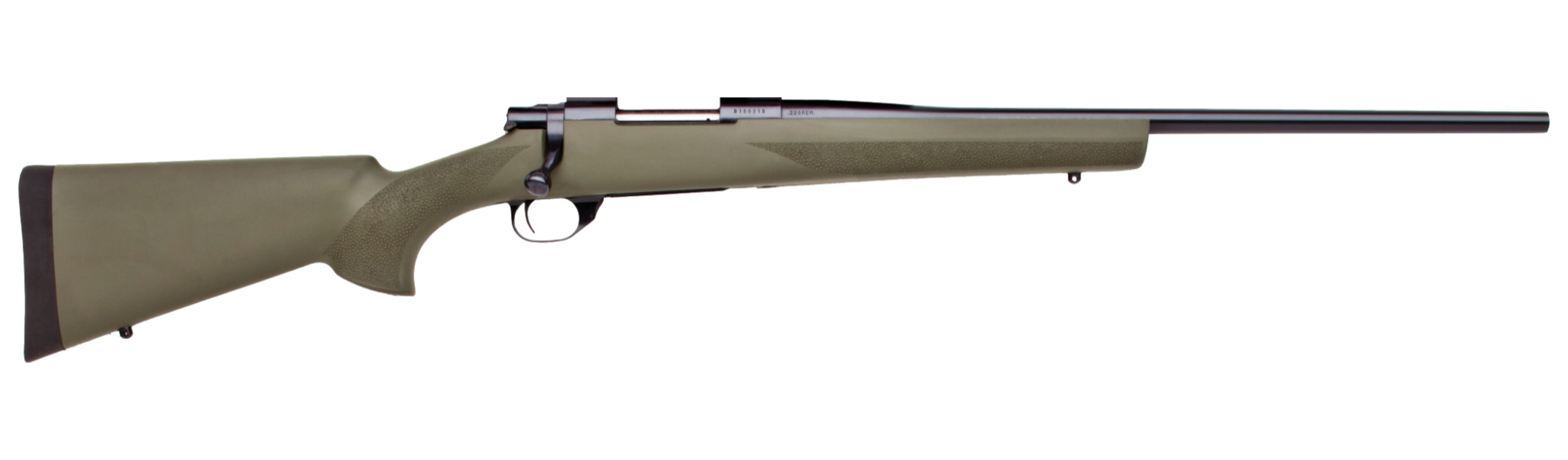
The Howa 1500 Heavy Barrel in .308 Winchester occupies a unique niche in the budget precision market – it’s essentially a Remington 700 footprint rifle with Japanese manufacturing quality at $600-650 street price. The heavy #6 contour barrel and 8.9-lb weight make this more of a range/precision platform than a hunting rifle, but that’s exactly the point. With a smooth two-stage trigger, sub-MOA accuracy guarantee, and full access to the massive Rem 700 aftermarket, it’s positioned as a barreled action that happens to come with a functional stock rather than a complete hunting rifle.
Quick Verdict
✓ Best for: Budget precision shooters wanting Rem 700 aftermarket access without custom rifle prices
✓ Price: $599-649 street (often found under $600 on sale)
✓ Key strength: Japanese manufacturing quality with Remington 700 footprint compatibility at budget pricing
✗ Not ideal for: Mountain hunters or anyone carrying rifles more than a mile (8.9 lbs bare rifle, 11+ lbs scoped)
Real-World Performance
The 22-inch heavy barrel delivers typical .308 velocities – 2,750 fps with 150gr loads, 2,650 fps with 168gr match bullets, and 2,550 fps with 175gr Federal Gold Medal Match. The 1:10 twist stabilizes bullets up to 180 grains reliably but struggles with modern heavy projectiles beyond 185 grains, which limits extreme long-range applications but covers 95% of practical .308 use. Factory match ammunition produces 0.6-0.9 MOA groups consistently, with Federal GMM 168gr and Hornady ELD-M being particularly accurate. The heavy barrel’s real advantage shows during extended range sessions – I’ve fired 25-round strings without accuracy degradation, where lighter barrels start opening groups after 10-15 rounds as they heat up. At 600 yards, 4-6 inch groups are achievable with proper fundamentals and quality ammunition. The HACT two-stage trigger breaks cleanly at approximately 3.5 pounds from the factory, with a distinct take-up stage followed by a crisp wall – better than most budget rifles but not quite Tikka smooth. Cold bore accuracy is excellent, with first-round impacts consistently matching subsequent shots. Practical effective range extends to 800-1,000 yards for precision work and 400-500 yards for ethical hunting on deer-sized game.
Applications & Use Cases
Range and Target Shooting: This is where the heavy barrel shines. The weight provides a stable shooting platform from prone or bench, and the barrel manages heat during extended strings without losing accuracy. The sub-MOA guarantee means you’re chasing fundamentals, not rifle limitations. At 100-600 yards, it’s more than capable for practice and informal competition. Verdict: Excellent choice for this role.
Stand or Blind Hunting: The 8.9-lb weight is a non-issue when you’re sitting, and the accuracy is overkill for most hunting scenarios but provides confidence for longer ethical shots. The heavy barrel maintains zero through temperature swings better than sporter barrels. Works well for whitetail from elevated stands or prairie hunting from vehicles. Verdict: Perfectly adequate, though you’re paying for precision you may not need.
Entry-Level Long-Range Precision: The Rem 700 footprint means you can start with the factory setup and gradually upgrade trigger, stock, and eventually barrel as skills develop. The hinged floorplate limits speed in competition scenarios, but for learning fundamentals at 600-1,000 yards, it’s a solid foundation. Many shooters use this as a barreled action for custom builds. Verdict: Strong value proposition for this application.
Mountain or Backcountry Hunting: At 8.9 lbs bare (11+ lbs scoped), this rifle becomes exhausting on hikes exceeding three miles. The front-heavy balance from the #6 contour makes offhand shooting awkward. You’ll curse the weight by mile five of a Colorado elk hunt. Verdict: Wrong tool for this job – choose a sporter barrel or different platform entirely.
Ergonomics & Handling
The Hogue overmolded synthetic stock provides adequate grip in wet conditions and absorbs recoil decently, but it’s clearly a budget component – the comb height works for low-mounted scopes but isn’t adjustable, and the forend is narrow for precision shooting from bags. The rifle balances forward of the magazine due to the heavy barrel, which aids steady holds from supported positions but makes quick offhand shots feel muzzle-heavy. The bolt cycles smoothly with minimal play, often compared favorably to rifles costing twice as much – the Japanese manufacturing quality shows here. The three-position safety allows bolt operation with the trigger locked, which is safer for unloading in hunting scenarios. Loading through the hinged floorplate is straightforward but slower than detachable magazines, requiring you to press rounds down against spring tension. At 8.9 pounds, recoil is mild – approximately 17-18 ft-lbs with standard .308 loads – making this comfortable for extended range sessions. Carrying the rifle on a sling for extended periods reveals the weight penalty, with shoulder fatigue noticeable after an hour of walking. The length of pull measures approximately 13.5 inches, which fits average-sized shooters but isn’t adjustable without stock replacement.
Aftermarket & Upgrade Path
The Remington 700 footprint is the Howa’s killer feature – any trigger, stock, chassis, scope base, or bottom metal designed for the 700 drops right in. Popular upgrades include TriggerTech Diamond triggers ($250), KRG Bravo chassis ($450), or MDT systems for serious precision work. Many shooters purchase the barreled action alone for $400-500 and immediately install it in their preferred chassis, creating a semi-custom rifle for under $1,000. If you want detachable AICS magazines, Hawkins or PTG bottom metal kits run around $300. The factory barrel is legitimately good for 5,000+ rounds, but when it’s worn, Remington 700 prefits from Criterion or Shilen install easily. This upgradeability separates the Howa from competitors like the Ruger American (proprietary action) or Tikka (limited aftermarket). The practical path for most shooters: shoot the factory setup for a year, upgrade the trigger if desired, then consider a chassis when the Hogue stock feels limiting. Total investment of $600 rifle + $250 trigger + $450 chassis creates a $1,300 setup competitive with $2,000+ factory precision rifles.
Pros & Cons
Strengths:
✓ Sub-MOA accuracy guarantee with premium ammunition (0.6-0.9 MOA typical)
✓ Remington 700 footprint provides massive aftermarket compatibility
✓ Smooth bolt operation rivals rifles costing $300-400 more
✓ Heavy barrel maintains accuracy through 20+ round strings
✓ HACT two-stage trigger better than most budget factory triggers (3.5 lbs)
✓ Japanese manufacturing quality control excellent for price point
✓ Available as barreled action for $400-500 (ideal DIY platform)
✓ Three-position safety allows safe unloading with trigger locked
Limitations:
✗ Heavy at 8.9 lbs bare rifle (11+ lbs scoped) – exhausting for mountain hunting
✗ Hinged floorplate only (no detachable magazines without $300 conversion)
✗ 1:10 twist limits bullet selection to 180gr maximum (no modern heavy bullets)
✗ Hogue stock functional but basic (narrow forend, non-adjustable comb)
✗ Front-heavy balance from #6 barrel contour (awkward for offhand shooting)
✗ Blued finish option rusts more easily than stainless or Cerakote
✗ No AICS magazine compatibility without aftermarket bottom metal
✗ Overkill weight for typical hunting scenarios (3+ lbs heavier than needed)
Competitors & Alternatives
| Feature | Howa 1500 HB 308 Win | Ruger American 308 Win | Savage 110 308 Win | Tikka T3x Lite 308 Win |
|---|---|---|---|---|
| Price | $625 | $649 | $699 | $875 |
| Weight | 8.9 lbs | 6.3 lbs | 8.5 lbs | 6.2 lbs |
| Trigger | 3.5 lbs | 3.5 lbs | 2.5 lbs | 2.0 lbs |
| Magazine | Hinged | AICS | Internal | Internal |
| Accuracy | 0.7 MOA | 0.9 MOA | 0.8 MOA | 0.6 MOA |
The Ruger American costs similar but weighs 2.6 pounds less and accepts AICS magazines – better for hunting, but the action isn’t as smooth and aftermarket support is limited. The Savage 110 offers the excellent AccuTrigger and similar accuracy, but the Howa’s bolt is noticeably smoother. Both are excellent; choose based on whether you prefer Savage’s barrel nut system or Howa’s Rem 700 compatibility. The Tikka T3x Lite is the smoothest action in this comparison with the best factory trigger, but costs $200-250 more and has limited aftermarket – if you’re planning upgrades, the Howa provides better value. Worth noting: the Weatherby Vanguard is a rebadged Howa 1500, so if you find a Vanguard cheaper, it’s the same rifle with different branding.
Who Should Buy This
This rifle makes sense for budget precision shooters who want Remington 700 aftermarket access without spending $1,500+ on a Bergara or custom build. It’s ideal for range work from 100-800 yards where weight aids stability and the heavy barrel manages heat during long strings. DIY builders should consider the barreled action option at $400-500, then install it directly into their preferred chassis. Hunters shooting from fixed positions like blinds or stands will appreciate the accuracy, though the weight is overkill for most hunting. Look elsewhere if you’re planning mountain hunts (Tikka T3x Lite is 2.7 pounds lighter) or need detachable magazines for competition (Ruger American has AICS compatibility). If you want a smooth bolt action with upgrade potential and don’t mind the weight, this delivers excellent value at $600-650.
Frequently Asked Questions
Q: How does the Howa 1500 compare to the Weatherby Vanguard?
A: They’re the same rifle – Weatherby rebrands the Howa 1500 action. Buy whichever is cheaper or has the stock/finish you prefer.
Q: Can I use heavy .308 bullets like 185-220 grain projectiles?
A: The 1:10 twist stabilizes up to 180 grains reliably but struggles beyond that. Stick with 168-178 grain bullets for best results.
Q: Is the factory trigger good enough or should I upgrade immediately?
A: The HACT two-stage trigger at 3.5 pounds is adequate for hunting and range work. Upgrade to TriggerTech ($250) only if pursuing serious precision shooting.
Q: How much does a complete setup weigh with scope and accessories?
A: Bare rifle is 8.9 lbs. Add scope (1.5 lbs), rings/base (0.3 lbs), and ammunition (0.3 lbs) for approximately 11 pounds total – manageable for range, heavy for hunting.
Q: Can I convert the hinged floorplate to accept AICS magazines?
A: Yes, with aftermarket bottom metal from Hawkins or PTG ($300). This adds cost but enables detachable magazine use.
Q: What’s the expected barrel life before accuracy degrades?
A: The cold hammer-forged barrel typically delivers 5,000-8,000 rounds before noticeable accuracy loss. Replacement prefits cost $350-400.
Final Verdict
Ratings:
Hunting: 3/5 (accurate but heavy for field use)
Long-Range: 4.5/5 (excellent accuracy and heat management for the price)
Competition: 3.5/5 (hinged floorplate limiting, but capable with upgrades)
Value: 5/5 (Rem 700 compatibility and Japanese quality at budget pricing)
The Howa 1500 Heavy Barrel delivers on its promise – genuine sub-MOA accuracy with Remington 700 aftermarket compatibility at a price point where most rifles make significant compromises. The weight limits hunting applications, but for range precision, entry-level long-range shooting, or as a barreled action foundation for custom builds, it’s arguably the best value under $700. If you need lightweight portability, look elsewhere. If you want an accurate, upgradeable platform that won’t embarrass you at 600 yards, this is exactly what $625 should buy.