
 Firearms Republic
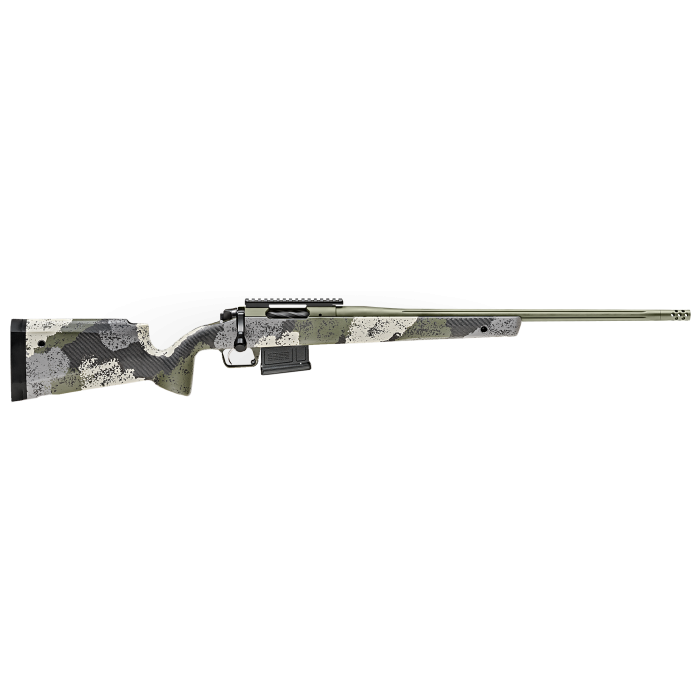
The Springfield Waypoint represents Springfield Armory’s first venture into precision bolt-action hunting rifles, and they’ve entered strong with a 6.5 Creedmoor platform built around premium components. With an AG Composites carbon fiber stock, factory TriggerTech trigger, and fluted barrel wrapped in Burnt Bronze Cerakote, this rifle targets mountain hunters who want lightweight performance without crossing into the $2,500+ ultralight territory. At $1,550 street price, it undercuts Christensen and Fierce by nearly $1,000 while delivering similar features – though Springfield’s lack of bolt-gun heritage raises questions about long-term reputation in a crowded field.
Quick Verdict
✓ Best for: Mountain hunters wanting premium features under $1,600
✓ Price: $1,550 street (MSRP $1,699)
✓ Key strength: TriggerTech trigger + AG Composites carbon stock at competitive price
✗ Not ideal for: Budget hunters ($300 premium over Weatherby 307) or ultralight seekers (Christensen 1 lb lighter)
Real-World Performance
The 22-inch fluted barrel with 1:8 twist stabilizes everything from 120gr to 147gr bullets, delivering 2,700 fps with 140gr ELD-M and 2,620 fps with 147gr ELD-M – standard velocities for 6.5 Creedmoor from this barrel length. Accuracy runs 0.5 to 0.8 MOA with quality factory match ammo, tightening to 0.4-0.6 MOA with handloads tuned to the rifle. The Sub-MOA guarantee holds through testing, with cold bore consistency excellent and string accuracy maintaining sub-MOA through 8-10 rounds before the medium-taper barrel starts showing heat effects. At 800 yards, 143gr ELD-X hits with 1,000 ft-lbs energy and 10-12 inches of wind drift in a 10 mph crosswind – comfortable performance for mountain game at distance.
The 60-degree bolt throw cycles smoothly with minimal effort, noticeably faster than traditional 90-degree actions when working from prone or tight positions. The Sako-style extractor handles extraction reliably, and the spiral-fluted bolt sheds debris better than smooth bolts in dusty conditions. The TriggerTech trigger breaks cleanly at 3 lbs from the factory with zero creep and minimal overtravel – exceptional for a production hunting rifle and eliminating the immediate need for aftermarket upgrades. Recoil with the included muzzle brake is mild, around 8-9 ft-lbs felt, though most hunters will remove the brake for noise considerations or thread on a suppressor using the 5/8×24 threads.
Applications & Use Cases
Mountain Elk Hunting: At 6.5 lbs bare and 8.3 lbs with a Leupold VX-5HD 3-15x scope and loaded magazine, this rifle hits the sweet spot for high-country hunts where every pound matters above 10,000 feet. The carbon fiber stock doesn’t add bulk, and the balance point sits just forward of the magazine well for comfortable carry over the shoulder or in hand. The 6.5 Creedmoor provides adequate energy for elk-sized game to 400 yards with proper shot placement, though it’s not a magnum powerhouse. Accuracy supports ethical shots to 600+ yards when conditions allow. The lightweight barrel heats after 5-6 shots, but hunting scenarios rarely demand rapid strings.
Long-Range Antelope and Mule Deer: This is where the Waypoint excels – flat-shooting 6.5 Creedmoor paired with sub-MOA accuracy for prairie and canyon hunting where shots stretch past 400 yards. The 143gr ELD-X drops 44 inches at 500 yards with a 200-yard zero, manageable holdovers with a quality scope. The rigid carbon stock provides a stable shooting platform from prone or off a pack, and the vertical grip angle suits precision shooting better than traditional hunting stocks. Wind calls matter more than elevation at distance, and the relatively low recoil allows spotting impacts through the scope. For this application, the rifle punches well above its weight class.
Suppressed Backcountry Hunting: The factory-threaded barrel and included brake make suppressor mounting straightforward – remove the brake, thread on your can, and you’re running. With a lightweight titanium suppressor like a TBAC Ultra 7, total weight climbs to 9.1 lbs, still manageable for mountain work. The carbon stock doesn’t telegraph suppressor heat like aluminum-bedded synthetic stocks, and the 22-inch barrel provides sufficient velocity while keeping overall length reasonable with a 7-inch can attached. The smooth action and light trigger support precision shooting without the hearing protection concerns of braked or bare-muzzle hunting.
Ergonomics & Handling
The AG Composites carbon fiber stock feels rigid in hand with zero flex when torquing against a barricade or pack – this is a $600-800 stock from a premium American manufacturer, not an entry-level composite. The vertical grip with modest palm swell suits precision shooting, though traditional hunters may find it less natural than classic grip angles. Length of pull measures 13.5 inches, appropriate for most shooters but not adjustable without adding spacers or cutting. The comb height positions your eye correctly with medium-height rings, and the carbon shell stays comfortable against the cheek in cold weather unlike bare aluminum chassis systems.
Balance sits slightly forward of the magazine well, making the rifle feel lighter than 6.5 lbs when carrying but slightly muzzle-heavy when shooting offhand – a reasonable trade for a hunting rifle prioritizing prone and supported positions. The bolt cycles smoothly with the 60-degree throw requiring less hand movement than 90-degree actions, and the fluted bolt handle provides positive grip even with gloves. The AICS-compatible magazine seats positively with an audible click and drops free cleanly when released. The safety is a traditional two-position design – simple and reliable, though not as convenient as three-position safeties for loading and unloading.
Aftermarket & Upgrade Path
The Remington 700 footprint action opens substantial aftermarket compatibility for triggers, stocks, bottom metal, and scope bases – though the factory TriggerTech trigger and AG Composites stock are already premium components that don’t demand immediate replacement. If you want adjustability, swapping to a chassis like an XLR Element or MDT ESS runs $400-600, though you’ll sacrifice the lightweight carbon stock that defines this rifle. Scope base options are abundant with the 700 footprint, and quality 20 MOA rails from Nightforce, Hawkins, or Area 419 cost $75-150 for long-range work.
The barrel uses standard threading for easy replacement when you reach the 3,000-5,000 round barrel life typical of 6.5 Creedmoor, and prefit barrels from Criterion, Proof, or Bartlein install with headspace gauges and action wrench for $350-800 depending on contour and material. The action itself doesn’t need work – the spiral-fluted bolt and Sako extractor function reliably, and blueprinting offers minimal benefit on a modern production action. The realistic upgrade path involves glass and suppressor rather than action components, making this rifle a “buy and shoot” platform rather than a project gun requiring immediate investment.
Pros & Cons
Strengths:
✓ TriggerTech trigger breaks at 3 lbs with zero creep – $200+ value included
✓ AG Composites carbon fiber stock rigid and lightweight – same quality custom builders use
✓ Sub-MOA accuracy with quality ammo – 0.5-0.8 MOA typical, 0.4-0.6 MOA with handloads
✓ 60-degree bolt throw faster than traditional actions – noticeable advantage from prone
✓ Factory threaded 5/8×24 with brake included – suppressor-ready out of box
✓ Remington 700 footprint – extensive aftermarket compatibility
✓ Burnt Bronze Cerakote distinctive and durable – holds up to pack wear
✓ Made in USA with quality components – Springfield assembled in Massachusetts
Limitations:
✗ 6.5 lbs competitive but not ultralight – Christensen Ridgeline 1 lb lighter at $2,400
✗ Springfield’s first bolt rifle – limited track record vs established manufacturers
✗ Steel barrel not carbon – weight savings from stock and fluting only
✗ Fixed 13.5″ LOP – no adjustment without modification
✗ $300 premium over Weatherby 307 – similar weight, lower price
✗ 5-round magazine capacity – adequate but not high
✗ Medium-taper barrel heats after 8-10 rounds – not designed for volume shooting
✗ Resale value uncertain – new model without established market
Competitors & Alternatives
| Feature | Springfield Waypoint | Christensen Ridgeline FFT | Weatherby 307 Alpine CT | Bergara B-14 Ridge |
|---|---|---|---|---|
| Price | $1,550 | $2,400 | $1,199 | $1,050 |
| Weight | 6.5 lbs | 5.5 lbs | 6.3 lbs | 7.3 lbs |
| Trigger | 3 lbs TriggerTech | 2.5-3.5 lbs | 3-4 lbs | 3.5 lbs |
| Magazine | AICS 5rd | AICS 3rd | Internal 3+1 | AICS 5rd |
| Accuracy | 0.5-0.8 MOA | 0.5 MOA | 0.8-1.0 MOA | 0.5-0.7 MOA |
The Christensen Ridgeline FFT at $2,400 delivers a full pound less weight with a carbon-wrapped barrel and more refined fit and finish – if budget allows, it’s the superior mountain rifle. The Springfield offers 80% of the performance for 65% of the cost, making it the value play for hunters who need lightweight but can’t justify $2,400. The Weatherby 307 Alpine CT at $1,199 weighs nearly identical to the Springfield but costs $300 less – you’re paying that premium for the TriggerTech trigger and AG Composites stock, which matters if you value those components. The Bergara B-14 Ridge at $1,050 shoots tighter groups and costs $500 less but carries an extra pound – choose Bergara for accuracy and value, Springfield for weight savings and trigger quality.
Who Should Buy This
Ideal for mountain hunters who’ve outgrown budget rifles but can’t stomach $2,500+ for Christensen or Fierce – the Springfield delivers premium components at a mid-tier price point that makes sense for serious hunters shooting 50-100 rounds per year. Shooters who value factory-ready performance will appreciate the TriggerTech trigger and carbon stock requiring zero immediate upgrades. Suppressor users benefit from the threaded barrel and quality brake, and the 700 footprint ensures long-term parts availability.
Look elsewhere if you’re budget-focused and weight isn’t critical – the Weatherby 307 or Bergara B-14 Ridge deliver similar accuracy for $300-500 less with minimal weight penalty. Ultralight seekers chasing every ounce should spend the extra $900 for Christensen’s carbon barrel and lighter configuration. Competition shooters need heavier, more stable platforms, and volume shooters will heat the medium-taper barrel quickly.
Frequently Asked Questions
Q: How does the Springfield action compare to Remington 700?
A: Similar footprint with 60-degree bolt throw vs 90-degree – smoother cycling, same aftermarket compatibility. Spiral-fluted bolt and Sako extractor are upgrades over standard 700.
Q: Is 6.5 lbs too light for recoil management?
A: With the brake, recoil is mild at 8-9 ft-lbs felt. Remove the brake and recoil jumps to 14-15 ft-lbs – manageable for experienced shooters but noticeable for recoil-sensitive shooters.
Q: Can I adjust the TriggerTech trigger lighter?
A: Yes, adjustable from 2.5-5 lbs. Factory 3 lbs setting is excellent for hunting – going lighter risks accidental discharge in field conditions.
Q: What’s barrel life expectancy?
A: 3,000-5,000 rounds typical for 6.5 Creedmoor – adequate for hunters shooting 50-100 rounds annually. Replacement barrels available as prefits.
Q: Does the carbon stock handle suppressor heat?
A: Yes, carbon fiber insulates better than aluminum-bedded synthetics – no heat transfer issues with lightweight titanium suppressors during normal hunting use.
Q: Is Springfield’s warranty transferable?
A: Limited lifetime warranty covers original owner only – factor this into resale value considerations on a new model.
Final Verdict
The Springfield Waypoint delivers premium components at a competitive price, undercutting carbon-stocked competitors by $900+ while maintaining quality that matters in the field. It’s not the lightest or cheapest option, but it occupies a practical sweet spot for hunters who want performance without crossing into boutique pricing – assuming Springfield’s bolt-gun reputation develops positively over time.
The Springfield Waypoint succeeds as a first-generation bolt rifle by focusing on proven components rather than reinventing the platform – the AG Composites stock and TriggerTech trigger are legitimate premium features that justify the $1,550 price for weight-conscious hunters. It’s not groundbreaking, but it’s competent and well-executed, offering mountain hunters a legitimate alternative to established lightweight rifles without demanding $2,500+ investment. The lack of track record remains the primary concern, but the quality of execution suggests Springfield did their homework before entering the precision bolt-gun market.