
 Firearms Republic
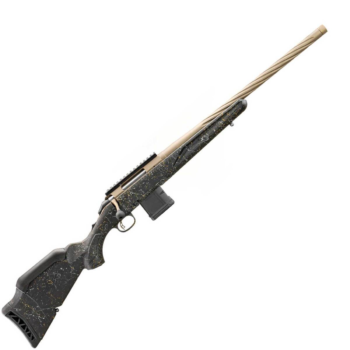
The Ruger American Gen II Prairie arrives as the heavy-hitter of Ruger’s 22 ARC bolt-action lineup – a bull barrel variant purpose-built for shooters who burn through ammunition in extended prairie dog sessions rather than taking single careful shots at game. At $699–769 street price, it costs $70 more than the Predator variant and trades 100 fps of muzzle velocity for genuine thermal stability across long strings. Whether that trade-off makes sense depends entirely on how you shoot.
| Specification | Details |
|---|---|
| Barrel Length | 20″ |
| Barrel Twist | 1:7 |
| Barrel Contour | Bull (heavy), spiral fluted, cold hammer forged |
| Weight | 7.5 lbs |
| Trigger | Ruger Marksman Adjustable, 3–5 lbs (factory ~3.5 lbs) |
| Magazine | AR-style PMAG compatible (Grendel pattern), 10 rounds |
| MSRP | $799 |
| Street Price | $699–$769 |
| Stock | Black synthetic with gray/bronze splatter, adjustable LOP and comb |
| Threaded Barrel | Yes – 5/8×24 |
| Action | 3-lug, 70-degree bolt lift, push-feed |
| Finish | Smoked Bronze Cerakote on barrel and receiver |
| Scope Base | Integrated Picatinny rail |
Quick Verdict
✓ Best for: Prairie dog and varmint shooters firing extended strings at one setup
✓ Price: $699–$769 street
✓ Key strength: Bull barrel thermal stability keeps groups consistent across 50–100 round sessions
✗ Not ideal for: Hunters who carry long distances or prioritize maximum muzzle velocity
Real-World Performance
The Ruger American Gen II Prairie 22 ARC delivers honest precision from its 20″ bull barrel – expect 0.4–0.5 MOA with Hornady 88gr ELD-M at roughly 2,950 fps, and 0.4–0.6 MOA with 75gr ELD-M at around 3,150 fps. The 1:7 twist handles the full 22 ARC projectile range cleanly, from 62gr ELD-VT varmint bullets at approximately 3,300 fps up through the heavier 88gr match-style loads. The real story isn’t peak accuracy on a cold barrel – it’s what happens after round 15 or 20 in a session. Where a medium-profile barrel starts showing velocity standard deviation creep and minor group opening after sustained strings, the bull contour here maintains tighter shot-to-shot consistency. You’re giving up roughly 100 fps compared to the Predator’s 22″ medium barrel, which matters less than you’d think at 22 ARC’s already-efficient case capacity. For prairie dog work at 200–350 yards, that velocity difference is negligible – the thermal stability is the actual performance advantage you’re paying for.
Applications & Use Cases
Prairie dog and ground squirrel shooting is where the Ruger American Gen II Prairie 22 ARC earns its name. All-day sessions firing 100+ rounds over six hours are exactly the scenario this rifle was designed for – the bull barrel absorbs heat that would cause a medium-profile barrel to shift zero and open groups noticeably by mid-session. If you’re set up on a dog town and running through strings of 10–15 shots without waiting for cool-down, this is the right tool.
Bench varmint shooting benefits from the heavier bull profile in a second way – the additional mass at the muzzle end dampens minor positional inconsistencies on a rest, making it easier to shoot consistent groups during wind-call evaluation sequences where you need to fire multiple shots quickly. The 7.5 lb weight that becomes a liability on a long carry becomes an asset on a bipod or bench.
Suppressor use is a natural fit here. The 5/8×24 threaded muzzle and bull barrel contour combine well – the extra barrel mass helps manage the additional back-pressure and heat that suppressed shooting generates, and the bull profile provides a stable platform for heavier suppressor cans without the muzzle-heavy feel you’d get on a lighter sporter barrel.
General deer or predator hunting is possible but not the Prairie’s strength. At 7.5 lbs before glass, it’s the heaviest Gen II 22 ARC variant, and the velocity penalty versus the Predator is a real consideration for hunters taking single shots at game rather than running extended strings.
Ergonomics & Handling
The Ruger American Gen II Prairie 22 ARC uses the same adjustable stock platform as the rest of the Gen II lineup – spacer-based LOP adjustment and a comb that can be raised for higher optic mounting. The black/bronze splatter finish looks sharp in open-country settings and holds up to field use without the maintenance concerns of a blued finish. The 70-degree bolt lift cycles smoothly and clears most low-mounted optics without issue. Balance point sits noticeably forward of the action due to the bull barrel, which works in your favor on a bench or bipod but makes the rifle feel front-heavy when carried at the balance point for extended periods. The 40.75″ overall length is manageable, and the 10-round PMAG-compatible magazine drops free cleanly and reloads fast – a genuine advantage during rapid prairie dog sessions where fumbling with proprietary magazines costs you shots.
Aftermarket & Upgrade Path
The Ruger American Gen II Prairie 22 ARC benefits from a straightforward upgrade path. The Ruger Marksman trigger adjusts down to approximately 2.5–3 lbs with a screwdriver at no cost – do this before spending money elsewhere. For shooters who want a more consistent break, the TriggerTech Ruger American drop-in runs around $130 and is the most impactful paid upgrade. Optics selection matters here – the bull barrel’s stability advantage is wasted under mediocre glass, so a Vortex Viper PST Gen II 5–25×50 around $900 is a reasonable pairing for serious varmint work. For field use, a Harris 6–9″ BRMS bipod at $90 covers most prairie dog setups; the Atlas BT10-NC at $240 is worth it for shooters who run the rifle hard on a bench. Magazines are standard Magpul PMAG 10-round AR-pattern – $14 each, widely available, no compatibility headaches.
Pros & Cons
Strengths:
✓ Bull barrel maintains 0.4–0.5 MOA consistency across extended strings – medium barrels can’t match this
✓ Spiral fluting reduces the bull barrel weight penalty without sacrificing thermal mass
✓ Smoked Bronze Cerakote is the most premium-looking finish in the Gen II 22 ARC lineup
✓ PMAG-compatible magazine – $14 replacements, no proprietary sourcing issues
✓ Adjustable LOP and comb accommodate different shooter builds and optic heights
✓ 5/8×24 threaded muzzle with factory radial brake – suppressor-ready out of the box
✓ 1:7 twist handles full 22 ARC projectile range from 62gr to 88gr
✓ Integrated Picatinny rail – no additional base purchase required
Limitations:
✗ 7.5 lbs is the heaviest Gen II 22 ARC variant – 0.8 lbs more than the Predator
✗ 20″ bull barrel loses approximately 100 fps versus Predator’s 22″ medium barrel
✗ $70–$80 premium over the Predator for bull barrel advantage – trade-off is questionable for hunters
✗ Factory trigger at 3.5 lbs is adequate but not exceptional – adjustment or replacement recommended
✗ Bull barrel still heats during extreme sessions (150+ rounds); it manages heat better, it doesn’t eliminate it
✗ Forward-heavy balance makes extended carries less comfortable than lighter variants
Competitors & Alternatives
| Feature | Prairie 22 ARC | Predator 22 ARC | Savage 110 Core Tactical 22 ARC | Howa 1500 Mini 22 ARC |
|---|---|---|---|---|
| Price | $699–$769 | $629–$689 | $799–$849 | $799–$849 |
| Weight | 7.5 lbs | 6.7 lbs | ~8.5 lbs | ~7.8 lbs |
| Barrel | 20″ bull | 22″ medium | 20″ heavy | 20″ heavy |
| Trigger | 3–5 lbs adj. | 3–5 lbs adj. | AccuTrigger 1.5–6 lbs | HACT 2-stage |
| Accuracy | 0.4–0.5 MOA | 0.5–0.7 MOA | 0.5–0.7 MOA | 0.5–0.7 MOA |
The Ruger American Gen II Predator 22 ARC is the most direct comparison – it costs $70 less, weighs 0.8 lbs less, and adds roughly 100 fps from its 22″ medium barrel. For hunters taking deliberate single shots, the Predator wins on almost every practical metric. The Prairie’s bull barrel advantage only becomes meaningful when you’re firing sustained strings, which is a specific use case. The Savage 110 Core Tactical 22 ARC matches the Prairie’s price range and offers the AccuTrigger adjustable down to 1.5 lbs – a genuine trigger advantage – but runs heavier overall. The Howa 1500 Mini Action 22 ARC brings a quality HACT two-stage trigger but lacks the PMAG compatibility that makes the Ruger’s magazine situation so simple.
Who Should Buy This
The Ruger American Gen II Prairie 22 ARC is the right choice for prairie dog and ground squirrel hunters who regularly fire 50–100 rounds per setup and have experienced the frustration of a medium-profile barrel walking zero mid-session. It’s also well-suited to bench varmint shooters who run multiple-shot strings for wind evaluation and want the most premium-looking Ruger Gen II 22 ARC available. Look elsewhere if you’re a hunter who covers ground on foot – the 7.5 lb weight and forward-heavy balance are real carrying penalties, and the Ruger American Gen II Predator 22 ARC at $70 less serves that role better with more velocity and less weight.
Frequently Asked Questions
Q: How much velocity does the 20″ bull barrel give up versus the Predator’s 22″ medium?
A: Approximately 100 fps – roughly 2,950 fps versus 3,050 fps with Hornady 88gr ELD-M.
Q: Does the bull barrel actually stay cooler during prairie dog sessions?
A: It manages heat better than a medium profile – groups stay consistent longer – but it still heats during 150+ round days.
Q: Is the PMAG compatibility genuine or does it require modification?
A: Genuine – standard Magpul 10-round AR-pattern PMAGs (Grendel pattern) feed reliably without modification.
Q: Can the trigger be adjusted without a gunsmith?
A: Yes – the Ruger Marksman trigger adjusts to approximately 2.5–3 lbs with a screwdriver using the factory adjustment screw.
Q: What suppressor thread pitch does the Prairie use?
A: 5/8×24 – standard for .224 caliber suppressors and widely compatible.
Q: Is the Smoked Bronze Cerakote durable enough for field use?
A: Yes – Cerakote is more corrosion and abrasion resistant than standard bluing, requiring minimal maintenance in field conditions.
Final Verdict
The Ruger American Gen II Prairie 22 ARC is a purpose-specific tool that does its job well – if that job is extended varmint sessions where barrel heat management matters more than maximum velocity or light carry weight. At $699–769, the $70 premium over the Predator buys genuine bull barrel consistency across long strings, not just aesthetics. If you’re burning through 100 rounds on a dog town, this is the right Ruger Gen II 22 ARC to own.
The Prairie sits at an honest crossroads in the Gen II 22 ARC lineup – heavier and slightly slower than the Predator, but meaningfully more consistent when the round count climbs. For the shooter it’s designed for, that trade-off is straightforward. For everyone else, the Predator saves weight, adds velocity, and costs less. Know your use case before you buy.