 Maksym Kovaliov
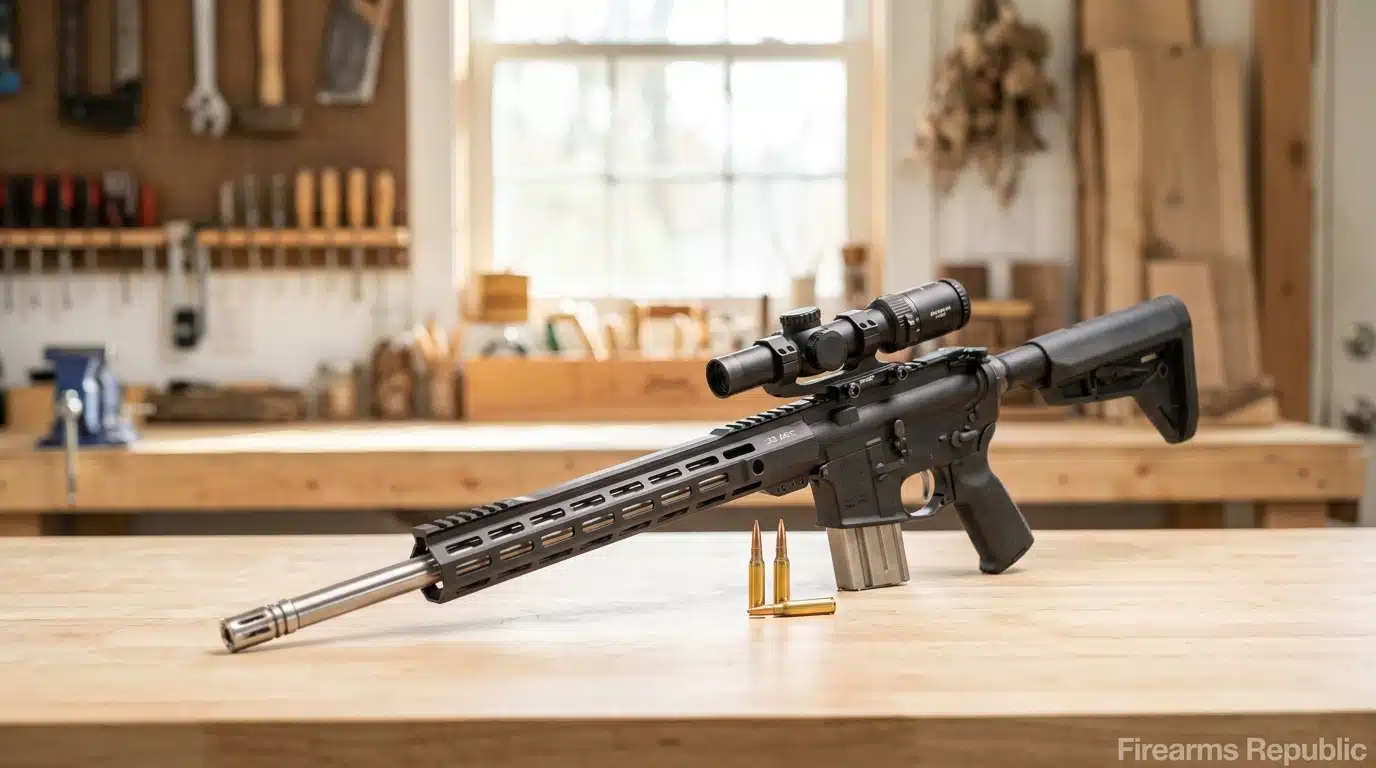
The .22 ARC is one of the most technically interesting cartridges to hit the AR-15 platform in years – a 22-caliber round engineered from the ground up for the intermediate gas system, pushing high-BC bullets at velocities that outrun .223 at distance while staying inside standard AR-15 dimensions. Hornady introduced it in 2022, and it’s been slowly earning a dedicated following among precision AR-15 shooters who want more reach without moving to an AR-10.
But building one isn’t plug-and-play. The .22 ARC shares a case head diameter with the 6.5 Grendel, which means it needs a Type II bolt – and that single detail trips up more first-time builders than anything else. Get that wrong and you’ll either have extraction problems or, in a worst case, a dangerous situation.
This guide walks through every part you need, what’s compatible, what you must swap out, and where builders consistently make mistakes. Whether you’re starting from scratch or converting an existing upper, here’s exactly what you need to build a reliable, accurate .22 ARC rifle.
What Is .22 ARC and Why Build One?
Before diving into parts, it’s worth understanding what .22 ARC actually is and why it exists as a platform.
The .22 ARC (Advanced Rifle Cartridge) was developed by Hornady in partnership with Barrett – the same engineering team that gave us 6mm ARC. The case is essentially the same as 6.5 Grendel: same case head, same rim, same overall dimensions – just necked down to .224 caliber. That means it fires standard .224 bullets (the same diameter as .223/5.56) but with a much longer, heavier, higher-BC projectile than a typical .223 load can seat and stabilize.
The result is a cartridge that launches 80-90gr .224 bullets at 2,500-2,700 fps from a 16″ barrel. For context, .223 from a 16″ tube typically maxes out at 77gr bullets for reliability, and those require a fast 1:7 or 1:8 twist. The .22 ARC’s larger case allows longer, heavier projectiles to be seated without intruding into powder space – bullets that retain energy and resist wind deflection out past 800 yards in a way .223 simply can’t match.
If you’re shooting PRS in an AR-15 division, varmint hunting at extended ranges, or just want the most capable .224-caliber cartridge on an intermediate-size platform, the .22 ARC makes a compelling case. The trade-off is cost – factory ammunition runs $1.50-$2.00 per round, and component availability is still building. It rewards reloaders significantly.
The Core Compatibility Rules
Before getting into the parts list, understand these three rules. They govern every purchasing decision in a .22 ARC build:
Rule 1: Your lower is fine as-is. Any standard AR-15 lower receiver, lower parts kit, stock, and pistol grip works without modification. The .22 ARC runs through a standard AR-15 lower.
Rule 2: Your upper needs to be purpose-built or converted. A standard .223/5.56 upper receiver is mechanically compatible, but the barrel, bolt, and magazines must all be .22 ARC specific. You can’t mix a .22 ARC barrel with a .223 bolt – the bolt face diameter is completely different.
Rule 3: The bolt face is the same as 6.5 Grendel Type II – not 5.56 and not standard Grendel. This is the single most important compatibility fact in the entire build. More on this below.
Complete Parts List: What You Need
Lower Receiver Assembly
Lower Receiver Any stripped or completed mil-spec AR-15 lower works. There’s nothing .22 ARC-specific here. If you already own a lower, use it. If you’re buying new, Aero Precision M4E1, Palmetto State Armory, or Anderson are reliable budget options at $60-$100 for a stripped lower.
Lower Parts Kit Standard AR-15 LPK – no changes needed. A basic mil-spec LPK runs $35-$60. Geissele’s LPK is excellent at $75 if you want upgraded springs. The .22 ARC’s bolt thrust is manageable for standard components.
Stock or Brace Standard mil-spec carbine buffer tube and any AR-15 stock. The buffer weight matters more than most builders expect – more on that in the gas system section below. Start with a mil-spec carbine buffer (3.0 oz) and H1 or H2 heavy buffer (3.8 oz / 4.6 oz) on hand. A Magpul MOE or CTR stock runs $30-$60 and works perfectly.
Trigger Any AR-15 trigger works mechanically. For a precision-oriented .22 ARC build, a quality single-stage trigger is worth the investment – Geissele SSA or SSA-E at $170-$200, or a LaRue MBT-2S at $85 if budget matters. Factory mil-spec triggers are functional but will limit what the cartridge can do at distance.
Estimated lower cost: $200-$400 depending on components chosen
Upper Receiver
A standard AR-15 upper receiver (direct impingement, standard bolt carrier group compatible) works without modification. The .22 ARC does not require a large-frame or non-standard upper.
Options:
- Aero Precision M4E1 – $85, excellent fit and finish, forward assist, dust cover
- Palmetto State Armory Classic – $60, budget-friendly, works fine
- Anderson Manufacturing – $50, bare-bones, reliable
If you’re building a dedicated precision upper, consider matching your upper to your lower for a tighter fit. Aero’s M4E1 matched set is $140 and eliminates any wobble between upper and lower.
One important note: the upper needs to be headspaced to your specific barrel. Headspace is set during barrel installation, not by the upper itself – but you need a Go/No-Go gauge for .22 ARC (not 5.56) to verify. If you’re sending this to a gunsmith for assembly, specify .22 ARC headspacing explicitly.
The Barrel – Most Critical Component
The barrel defines what your .22 ARC build can do, and there are fewer options here than for 5.56 or 6mm ARC. The market is still maturing.
Required specs:
- Caliber: .22 ARC (not .223, not 5.56, not .22-250 – the chamber dimensions are unique)
- Twist rate: 1:7 twist – this is mandatory. The .22 ARC is designed around heavy, long .224 bullets (80-90gr). A 1:8 will stabilize 77gr bullets marginally but will underperform with the heavy loads the cartridge is designed for. A 1:9 or slower will not work. Don’t compromise on this.
- Profile: Match your intended use – government/pencil profile for lighter builds, medium or heavy contour for precision/bench work
- Extension: Standard AR-15 barrel extension (not Grendel, not large-frame)
- Gas system length: Mid-length for 16-18″ barrels. Carbine-length creates excess pressure and reliability issues with this cartridge
Recommended lengths:
- 16″ – Most versatile. Legal for rifles, handles suppressor-length systems well, gives you 2,500-2,600 fps with 88gr ELD-M. Best all-around choice.
- 18″ – Gains roughly 75-100 fps over 16″, meaningful for long-range precision work. Preferred for PRS-style builds. Balance between velocity and maneuverability.
- 20″ – Maximum velocity (~2,700+ fps with 88gr), best for pure bench or F-class work. Heavy and long; not practical for field use.
Barrel options currently available:
- Bartlein blanked and chambered – Custom shop, ~$350-$500, excellent quality, long lead times
- Wilson Combat – Has offered .22 ARC barrels at $280-$350, mid-tier quality
- Criterion Barrels – $250-$300, button-rifled, solid performance
- Ballistic Advantage – Has introduced .22 ARC offerings at $200-$260, accessible price point
The market is thinner than 6.5 Grendel or 6mm ARC right now. Check current availability – new makers are entering the space as the cartridge gains adoption.
The Bolt Carrier Group – Where Most Builds Go Wrong
This is the most frequently misunderstood part of a .22 ARC build, and getting it wrong has real consequences.
The .22 ARC uses a 6.5 Grendel Type II bolt face.
Not 5.56. Not standard Grendel (Type I). The Type II designation refers to a specific bolt face geometry and extractor design. The case head of the .22 ARC measures .441″ – the same as 6.5 Grendel. A 5.56 bolt face measures .378″. You cannot substitute one for the other.
The “Type II” distinction matters because early Grendel bolts (Type I, associated with Bill Alexander’s original design) used a slightly different geometry. Some Type I bolts will physically function with .22 ARC but with degraded reliability. Buy Type II explicitly labeled.
Compatible bolt carrier groups:
- Geissele BCG (6.5 Grendel Type II) – $175, the most trusted option. Properly labeled, excellent quality control, well-documented .22 ARC compatibility.
- DuraMag BCG – $120-$140, reliable mid-tier option, properly headspaced for Type II diameter
- Faxon Firearms BCG (Grendel Type II) – $160, good quality, available through major distributors
- JP Enterprises – $250+, premium tier, excellent for precision builds
What to avoid: Generic “Grendel bolt” listings that don’t specify Type II. Some budget BCGs are mislabeled or ambiguous about which specification they meet. When in doubt, contact the manufacturer directly and ask: “Is this bolt compatible with .22 ARC?” The answer should be yes, and they should be able to tell you why (Type II bolt face).
The carrier body itself is standard AR-15 dimensions – same as 5.56, same as 6.5 Grendel. Only the bolt head needs to be the Grendel Type II diameter.
Always headspace your bolt to your specific barrel. Buy a .22 ARC Go/No-Go gauge set (~$40-$60) and verify before firing. This is not optional.
Magazines
Standard AR-15 .223/5.56 magazines will not work reliably with .22 ARC. The .22 ARC cartridge’s larger case body requires wider magazine feed lips and a different follower angle.
Required: Magazines designed for 6.5 Grendel or specifically labeled .22 ARC compatible
Compatible options:
- Geissele Super 42 Grendel magazines – $25-$35 each, designed for the Grendel case head, reliable with .22 ARC
- DuraMag Grendel magazines – $20-$30, polymer construction, reliable feed geometry
- ASC (American Shooting Components) Grendel mags – $20-$28, long track record with Grendel-family cartridges
- Brownells Grendel magazines – $22-$30, house-brand version of a known design
Capacity: Most Grendel-compatible magazines are available in 10, 17, and 26-round configurations. The 17-round is the most practical balance of capacity and profile for a standard AR-15 lower.
One more note: Some PMAG-style magazines marketed as “multi-caliber” will not reliably feed .22 ARC. Test with dummy rounds before heading to the range, and buy from sources that specifically list Grendel/ARC compatibility.
Gas System
The .22 ARC operates at a maximum average pressure of approximately 52,000 PSI – similar to 6.5 Grendel and slightly higher than standard 5.56. The gas system must be properly tuned for reliable function.
Gas tube length: For a 16″ barrel, use a mid-length gas system (gas port approximately 9″ from the barrel extension). Carbine-length gas systems (7″) on a 16″ barrel create excessive dwell time and over-gas the action, leading to case head separation over time and battering of the BCG. Mid-length is the correct choice.
For 18″ barrels, mid-length is still appropriate. For 20″ barrels, rifle-length gas (12″) is correct.
Gas block: A standard .750″ diameter gas block fits most .22 ARC barrel profiles. Verify your barrel’s gas block seat diameter before ordering – some heavier contour barrels use .936″ or other diameters.
If you want tuning flexibility, an adjustable gas block ($60-$120 from companies like Superlative Arms, SLR Rifleworks, or Odin Works) lets you dial down the gas for suppressor use or match different ammunition pressures without changing springs or buffers.
Buffer weight: Start with an H (heavy, 3.8 oz) buffer in your carbine tube. If you’re seeing ejection issues or brass being thrown too far forward, move to an H2 (4.6 oz). The .22 ARC does not need a specialty buffer system in most configurations. A JP Silent Captured Spring ($90) simplifies the tuning process if you want to refine function.
Handguard
No restrictions here – any free-floating AR-15 handguard that fits your barrel nut standard works. M-LOK is the current standard for accessory mounting. For a precision build, free-floating is strongly preferred over a drop-in design; it eliminates any contact between the handguard and barrel that could affect point of impact when pressure is applied.
Recommended options by use:
- Hunting/field use: Midwest Industries 15″ M-LOK, $90-$110 – lightweight, solid, no-frills
- Precision/PRS: Geissele MK series or a Faxon M-LOK handguard, $150-$200 – excellent concentricity and rigidity
- Budget build: Aero Precision ATLAS R-ONE, $110, good quality for the price
Muzzle Device
Standard 1/2×28 thread pitch (same as .223/5.56). Any AR-15 muzzle device threads straight on. For a precision-oriented build, a quality muzzle brake or linear compensator is worthwhile – recoil is already mild with .22 ARC, but a brake helps track impacts during follow-up shots.
If suppressor use is a primary goal, a direct-thread or QD-compatible suppressor adapter ($80-$150) from your suppressor manufacturer is the cleanest solution.
The .22 ARC is well-suited to suppressed shooting – moderate pressure and good bullet selection make it quiet with a quality 30-caliber can.
Complete Build Cost Estimates
| Component | Budget Build | Mid-Tier Build | Precision Build |
|---|---|---|---|
| Lower receiver | $65 | $85 | $100 |
| Lower parts kit | $40 | $60 | $75 |
| Stock + buffer | $45 | $75 | $120 |
| Trigger | $35 (mil-spec) | $85 (LaRue) | $200 (Geissele) |
| Upper receiver | $60 | $85 | $100 |
| Barrel (16″, 1:7) | $220 | $300 | $450 |
| BCG (Type II) | $120 | $160 | $250 |
| Gas block + tube | $30 | $60 (adj.) | $100 (adj.) |
| Handguard | $90 | $130 | $180 |
| Muzzle device | $30 | $60 | $100 |
| Magazines (3x) | $65 | $80 | $90 |
| Total (approx.) | ~$800 | ~$1,180 | ~$1,765 |
These are component costs only – add $80-$150 for professional assembly and headspace verification if you’re not doing it yourself, plus a .22 ARC Go/No-Go gauge set (~$50) if you are.
Common Build Mistakes – And How to Avoid Them
Mistake 1: Using a 5.56 bolt or unlabeled “Grendel” bolt The most common error. A 5.56 bolt will not chamber .22 ARC. A Type I Grendel bolt may chamber rounds but will have extraction issues. Always verify Type II and contact the manufacturer if the listing is ambiguous.
Mistake 2: Running a carbine-length gas system on a 16″ barrel Results in over-gassing – excessive bolt carrier velocity, case head separation, and premature wear. Use mid-length for 16-18″ barrels.
Mistake 3: Using a 1:8 twist barrel Will not reliably stabilize 85-90gr bullets, which is where the .22 ARC’s advantage lives. At 1:8 you’re leaving most of the cartridge’s capability on the table. Use 1:7.
Mistake 4: Skipping headspace verification Even when you buy from reputable sources, always verify headspace with a .22 ARC-specific gauge set before firing. Barrel-to-bolt fit varies, and a Go/No-Go check takes five minutes.
Mistake 5: Using .223/5.56 magazines They may load, but they won’t feed reliably. The case body diameter of .22 ARC requires proper Grendel-compatible magazines. Don’t guess – test with dummy rounds or buy purpose-appropriate mags from the start.
Mistake 6: Under-investing in the barrel The .22 ARC is a precision cartridge. A cheap barrel will waste everything the cartridge offers. Don’t cut corners here – it’s the most performance-defining single component in the build.
Ammo and Reloading Considerations
Factory .22 ARC ammunition is currently limited – Hornady is the primary producer, offering the 88gr ELD-M ($1.75-$2.00/round) as the flagship load. A few other manufacturers are beginning to load it, but selection is thin compared to mature cartridges.
The 88gr ELD-M is the round the cartridge was designed around. At 2,550 fps from a 16″ barrel, it produces a G7 BC of approximately .250, which competes directly with heavier 6.5mm and 6mm loads at extended ranges. Wind drift at 600 yards with a 10mph full-value wind is roughly 14 inches – noticeably better than a 77gr .223 load (approximately 22 inches in the same conditions).
If you reload, the .22 ARC becomes dramatically more economical and capable. Brass is formed from 6.5 Grendel brass (simple neck sizing), and component availability for .224 bullets is excellent – Sierra MatchKing, Hornady ELD-M, Berger Hybrids all provide high-BC options in 80-90gr weights. Reloading data is still developing, so work up loads carefully from published minimums.
Who Should Build a .22 ARC?
This is a build that rewards shooters with specific goals. It’s not the most practical choice for everyone.
Build a .22 ARC if you: Shoot precision gas-gun matches where .22 caliber divisions exist, want maximum long-range performance from an intermediate-size platform, primarily reload and want to extract full value from heavy .224 bullets, or are building a dedicated varmint/predator rifle for 400-800 yard shots.
Look elsewhere if you: Want the cheapest possible per-round cost (stick with .223), need widely available factory ammunition at any small-town gun shop (6.5 Grendel or 6mm ARC have better availability currently), or are building a general-purpose carbine where precision past 400 yards isn’t a priority.
The .22 ARC is a specialist’s cartridge. Built correctly – with the right twist, the right bolt, and quality components – it delivers precision AR-15 performance that genuinely challenges purpose-built bolt guns at intermediate ranges.
FAQ
Q: Can I convert my existing .223/5.56 AR-15 upper to .22 ARC?
A: Partially. Your upper receiver can be reused, but you’ll need a new barrel chambered in .22 ARC (1:7 twist), a new 6.5 Grendel Type II bolt carrier group, and Grendel-compatible magazines. The upper receiver itself requires no modification. Plan on spending $400-$700 on the conversion components, depending on barrel and BCG quality.
Q: Will .223 or 5.56 ammunition fire in a .22 ARC chamber?
A: No – and you should never attempt to fire them. The .22 ARC chamber is longer and has different dimensions than .223 Rem or 5.56 NATO. Attempting to fire .223 in a .22 ARC chamber may result in case head separation, gas leaks, and potential injury. The cartridges are not interchangeable in either direction.
Q: Is the 6.5 Grendel Type II bolt actually the same as what .22 ARC needs?
A: Yes – the bolt face diameter is identical (.441″). A bolt marketed as “6.5 Grendel Type II” is dimensionally correct for .22 ARC. Verify the “Type II” designation specifically, not just “Grendel.” Some manufacturers now label their bolts as “Grendel/ARC compatible” which is helpful, but Type II specification is the underlying standard.
Q: What’s the effective range of a .22 ARC build with an 88gr ELD-M?
A: With a quality 16-18″ barrel, consistent hits on a 10″ target at 800 yards are achievable in calm conditions with a skilled shooter. Practically speaking, it’s a strong 600-700 yard hunting cartridge for varmints and medium game where regulations permit, and a competitive 1,000-yard cartridge in PRS-style gas-gun divisions with proper reading of conditions.
Q: How does .22 ARC recoil compare to 5.56 or 6.5 Grendel?
A: Recoil is mild – slightly more than 5.56 due to heavier bullets and higher pressure, but noticeably less than 6.5 Grendel or 6mm ARC. Most shooters describe it as comfortable for extended range sessions. The larger case generates slightly more bolt thrust than 5.56, which is why gas system tuning matters, but it’s not harsh to shoot.
Q: Are there complete .22 ARC uppers available, or do I need to build from parts?
A: A small number of manufacturers are offering complete .22 ARC uppers, though selection is limited compared to mature calibers. Wilson Combat and a few custom shops have offered them. Building from quality components gives you more control over specifications and is currently the most reliable path to a verified, headspaced upper.