 Maksym Kovaliov
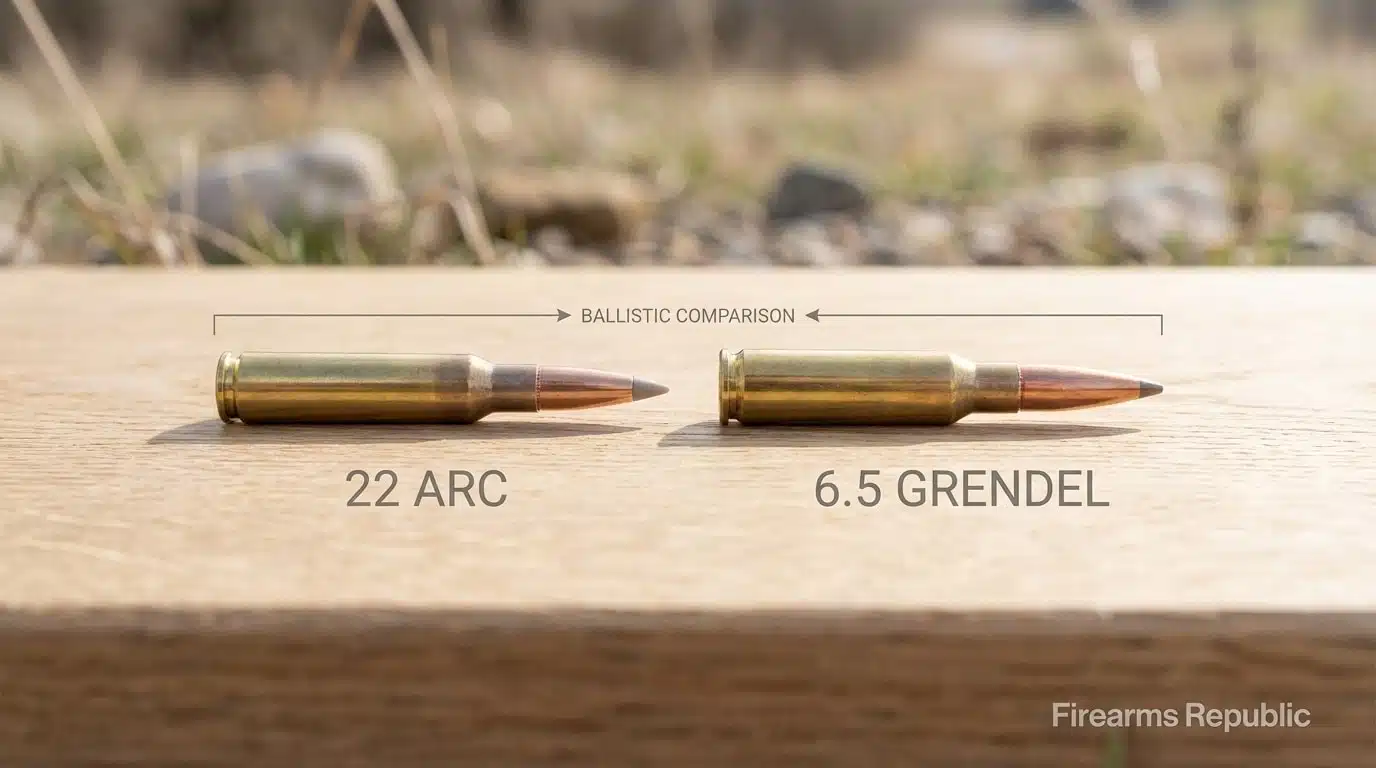
If you’re shopping for a precision AR-15 build and doing your research, you’ll quickly notice that .22 ARC and 6.5 Grendel share the same bolt face. Both use a .440″ Grendel Type II bolt head. Both run from Grendel-compatible magazines. Both drop into a standard AR-15 lower without modification. On paper, they look like close cousins – a barrel swap apart from each other.
They’re not close cousins. They’re built around fundamentally different design philosophies, optimized for different distances, and best suited to different shooters. The shared bolt face is a manufacturing convenience, not a statement of equivalence. Understanding exactly what’s similar and what’s different between these two cartridges is the foundation of making the right platform decision – whether you’re building an AR-15, planning a bolt-action, or trying to decide if converting your existing Grendel to .22 ARC makes sense.
What They Actually Share
The overlap between .22 ARC and 6.5 Grendel is real and practically useful, so it’s worth mapping out precisely before getting into the differences.
Bolt face diameter: Both cartridges use a .440″ bolt face – the 6.5 Grendel Type II specification. A bolt carrier group labeled “6.5 Grendel Type II” is dimensionally correct for .22 ARC. This is the single most important compatibility fact in a .22 ARC AR-15 build, and it means that shooters converting from Grendel to .22 ARC can reuse their existing BCG.
Case head dimensions: The .22 ARC case is formed from 6.5 Grendel brass – same rim diameter, same case head, same overall geometry at the base. The difference is in the neck: .22 ARC is necked down to .224 caliber, Grendel stays at .264 caliber.
Magazine compatibility: Most Grendel-format magazines – Geissele, DuraMag, ASC – feed .22 ARC reliably. The case body dimensions are close enough that the same feed geometry works for both. This is a meaningful practical advantage for anyone running both calibers or converting between them.
AR-15 lower compatibility: Both cartridges run through a standard AR-15 lower receiver without modification. Same lower parts kit, same stock, same pistol grip, same trigger. The entire lower assembly is interchangeable.
Barrel thread pitch: Both use standard AR-15 barrel specifications – same barrel extension, same thread pattern, same gas block diameter on most configurations. Swapping between a Grendel upper and a .22 ARC upper on the same lower is a two-minute operation.
That’s the full extent of the commonality. Everything downstream of the bolt face – the bullet, the ballistics, the effective range, the use case, the terminal performance – is different.
Where They Diverge: The Bullet Diameter Question
The core difference between .22 ARC and 6.5 Grendel is bullet diameter, and that difference shapes everything else.
6.5 Grendel fires .264 caliber bullets – the same diameter as 6.5 Creedmoor, 6.5 PRC, and the entire family of modern 6.5mm precision cartridges. The heaviest practical loads run 123–130gr, with the 123gr Scenar and 130gr Berger Hybrid being the most common precision choices. These are heavier, wider bullets that carry more energy at moderate distances and create larger wound channels on impact. The 6.5mm bullet diameter has a well-established reputation for terminal performance on medium to large game at practical hunting distances.
.22 ARC fires .224 caliber bullets – the same diameter as .223 Remington and 5.56 NATO, but in a much heavier projectile range. The design loads run 80–88gr, with the 88gr ELD-M being the flagship precision option. These are long, narrow, high-BC bullets that shed velocity slowly, resist wind efficiently, and stay supersonic at extreme distances – but they’re starting with less frontal area and less energy than a 6.5mm projectile at equivalent velocities.
The practical implication: Grendel hits harder at 400 yards. .22 ARC reaches farther past 600 yards. They’re optimized for different ends of the distance spectrum.
Ballistics: Where Each Cartridge Lives
Understanding where each cartridge performs best requires looking at velocity retention, energy at distance, and wind drift together – not just muzzle velocity.
6.5 Grendel with 123gr Scenar from a 24″ barrel: approximately 2,580 fps at the muzzle. At 500 yards, it retains roughly 1,750 fps and approximately 835 ft-lbs of energy. The G7 BC of the 123gr Scenar runs approximately .257, which is good but not exceptional for a long-range projectile.
.22 ARC with 88gr ELD-M from a 16″ AR-15 barrel: approximately 2,750 fps at the muzzle (factory load). At 500 yards, it retains roughly 1,980 fps and approximately 765 ft-lbs of energy. The G7 BC of the 88gr ELD-M runs approximately .259 – nearly identical to the Grendel’s 123gr Scenar, in a smaller package.
At 500 yards, the Grendel delivers more energy. At 800 yards, the .22 ARC’s superior velocity retention – due to the heavier-for-caliber bullet design – starts to close that gap significantly. Beyond 800 yards, the .22 ARC holds supersonic velocity longer, making it the more capable extreme-range cartridge.
| Metric | 6.5 Grendel (123gr) | .22 ARC (88gr) |
|---|---|---|
| Bullet diameter | .264″ | .224″ |
| Muzzle velocity (16″ AR) | ~2,580 fps | ~2,750 fps |
| Energy at 400 yards | ~1,050 ft-lbs | ~875 ft-lbs |
| Energy at 600 yards | ~830 ft-lbs | ~760 ft-lbs |
| Supersonic limit (AR) | ~900 yards | ~1,000+ yards |
| Optimal effective range | 100–500 yards | 400–1,000+ yards |
| Wind drift at 500 yds (10mph) | ~10.5″ | ~9.2″ |
| Recommended twist | 1:8 | 1:7 (mandatory) |
The crossover point – where .22 ARC’s superior BC and velocity retention offsets Grendel’s heavier bullet – is approximately 600–700 yards depending on load selection and atmospheric conditions. Inside that distance, Grendel’s energy advantage is real. Outside it, .22 ARC increasingly dominates.
Terminal Performance: Energy vs. Placement
This is where the philosophical divide between these cartridges is sharpest, and where honest evaluation matters most.
6.5 Grendel generates approximately 1,200–1,400 ft-lbs at the muzzle with 123gr loads – enough energy for ethical shots on medium game at distances up to 400–450 yards from a 16″ AR-15 barrel. The .264″ bullet diameter creates a larger initial wound channel than .224″, and the heavier bullet penetrates more reliably through heavy bone and muscle. For hunting wild hogs, whitetail deer, or black bear at practical AR-15 distances – inside 400 yards – Grendel’s terminal performance is straightforwardly better than .22 ARC. It hits harder, penetrates deeper, and requires less precision of shot placement to achieve reliable ethical kills. The hog hunting rifle guide covers why energy at close-to-moderate distances matters for tough, adrenaline-charged animals like hogs specifically.
.22 ARC generates approximately 1,330 ft-lbs at the muzzle with 88gr loads – more than Grendel, counterintuitively, due to higher velocity. But the .224″ bullet creates a smaller initial wound channel, and reliable expansion requires impact velocity above approximately 2,000 fps. From a factory AR-15 load, that threshold is reached at approximately 450 yards with an 80gr hunting bullet. The cartridge’s advantage is long-range precision: its high BC and flat trajectory make accurate bullet placement easier at distance, and accurate placement matters more than raw energy in thin-skinned medium game.
The practical summary: for hunting inside 400 yards where you want reliable terminal performance independent of shot angle and placement, Grendel is the better choice. For hunting at 400–600+ yards where the flat trajectory and wind resistance of a high-BC .224 bullet enables more precise shot placement, .22 ARC in a bolt-action configuration is the better choice.
AR-15 Platform: Converting Between Them
Because the bolt face is identical, converting an AR-15 between 6.5 Grendel and .22 ARC is one of the more accessible caliber conversions available. What changes, what stays, and what are the gotchas?
What stays the same:
- Lower receiver, lower parts kit, stock, pistol grip, buffer, buffer spring
- Upper receiver (the receiver itself is compatible)
- BCG – a 6.5 Grendel Type II BCG works for both cartridges
What must change:
- Barrel – a .22 ARC barrel is chambered and rifled for .224 bullets with 1:7 twist. A Grendel barrel chambers .264 bullets with 1:8 twist. These are not interchangeable.
- Magazines – while Grendel mags feed .22 ARC, it’s worth verifying with your specific magazine that feeding is reliable with .22 ARC’s slightly different case dimensions. Test with dummy rounds before relying on them in the field.
- Headspace – after any barrel swap, verify headspace with caliber-specific gauges. A .22 ARC Go/No-Go gauge set is different from a 6.5 Grendel set. Don’t skip this step.
What does not need to change but often gets replaced anyway:
- Handguard – if you’re rebuilding the upper, you may change it for aesthetic or mounting reasons, but the handguard is mechanically compatible between calibers
- Muzzle device – both use standard AR-15 1/2×28 thread pitch on most configurations
The cost of a Grendel-to-.22 ARC conversion is primarily the barrel – $220–$450 depending on maker – plus headspace gauges (~$50). If your existing Grendel BCG is properly labeled Type II and in good condition, it stays. Total conversion cost: approximately $270–$500. Full conversion details are in the .22 ARC AR-15 build guide.
Bolt-Action: How They Compare as Rifle Platforms
Both cartridges work in bolt-action rifles, though their optimal platforms differ.
6.5 Grendel in a bolt-action is a capable short-to-medium range precision cartridge. The same 123gr Scenar that works well in an AR-15 reaches approximately 2,580 fps from a 24″ bolt-action barrel – modest by short-action standards but adequate for hunting and 500-yard precision work. Grendel bolt-action builds use the same .440″ Grendel Type II bolt face as the AR-15 version. The mini-action platform suits it well, for the same geometric reasons as .22 ARC. Grendel in a bolt gun doesn’t gain the dramatic pressure-floor benefit that .22 ARC does – the Grendel SAAMI pressure limit of 52,000 PSI applies in bolt guns too, unlike .22 ARC which can be handloaded to 62,000 PSI in bolt-action platforms.
.22 ARC in a bolt-action is covered in depth in the bolt-action .22 ARC build guide. The key point for this comparison: the .22 ARC’s pressure ceiling in a bolt gun (62,000 PSI) versus the Grendel’s ceiling in any platform (52,000 PSI) means the .22 ARC bolt-action genuinely outperforms a Grendel bolt-action at long range. An .22 ARC bolt handload at 3,080 fps with an 88gr ELD-M versus a Grendel bolt load at 2,620 fps with a 123gr Scenar produces meaningfully different 800-yard performance – the ARC arrives supersonic with more velocity retained; the Grendel is approaching the transonic zone.
For long-range bolt-action work specifically, .22 ARC is the more capable cartridge. For moderate-distance bolt-action hunting where energy at 300–400 yards matters more than 800-yard velocity retention, Grendel’s heavier bullet has merit.
Ammunition Availability and Cost
This is a practical consideration that deserves honest treatment.
6.5 Grendel has been a SAAMI-standardized cartridge since 2012 and has reasonable factory ammunition availability. Hornady, Federal, Wolf, and several other manufacturers load it. Cost runs approximately $1.20–$1.80 per round for quality factory loads. It’s not as easy to find as .223 or 6.5 Creedmoor – you won’t pick it up at a Walmart – but any major online retailer stocks it and specialty shops typically carry it.
.22 ARC is newer (introduced 2022) and factory ammunition selection is currently limited primarily to Hornady’s 88gr ELD-M load at approximately $1.75–$2.00 per round. Availability is improving as the cartridge matures but remains thinner than Grendel at most retailers. Both cartridges reward handloading for precision use – component .224 bullets in 80–88gr weights are widely available, and Grendel brass is plentiful from multiple manufacturers including Lapua, which produces some of the best brass available.
For a shooter who primarily uses factory ammunition and can’t or won’t handload, Grendel currently has the edge in practical ammo availability. For a handloader focused on precision performance, both cartridges are well-supported at the component level.
Use Case Summary: Who Should Choose Which
Choose 6.5 Grendel if:
- You’re hunting medium to large game – hogs, whitetail, black bear – at AR-15 practical distances inside 400 yards, where the .264″ bullet diameter and heavier projectile energy deliver more reliable terminal performance independent of shot angle
- You want maximum energy on target at 300–500 yards from a semi-automatic platform
- Factory ammunition availability matters and you’re not committed to handloading
- You’re building a general-purpose defensive or tactical AR-15 that also hunts – the Grendel’s heavier bullet is better suited to that dual role than .22 ARC
- You’re reading more about home defense rifle options and want the most capable intermediate cartridge for barrier penetration and energy transfer
Choose .22 ARC if:
- You’re prioritizing long-range precision past 500 yards – varmint hunting at extended range, PRS gas-gun competition, or precision practice at 600–1,000 yards
- You want the highest BC .224 bullets the AR-15 platform can stabilize, and you understand that requires a 1:7 twist barrel
- You’re planning a bolt-action build and want to extract maximum performance from the Grendel-family case head, including the 62,000 PSI handload ceiling
- You hunt in open western terrain where shots beyond 400 yards are realistic and a flat, wind-resistant trajectory matters more than bullet diameter
- You’re already shooting .223 or 6.5 Grendel and want to step up to a dedicated long-range precision platform without moving to an AR-10
FAQ
Q: Can I use my 6.5 Grendel BCG in a .22 ARC build without any modification?
A: Yes, provided your Grendel BCG is the Type II specification. The bolt face diameter is .440″ for both cartridges. Confirm “Type II” is explicitly stated on the BCG – some older or budget Grendel BCGs are Type I, which uses slightly different extractor geometry and may have reliability issues with .22 ARC. A properly labeled Type II BCG transfers directly to a .22 ARC build with no modification.
Q: Which cartridge is better for deer hunting?
A: It depends on distance and terrain. For whitetail inside 300 yards – the majority of whitetail shots across most of the country – Grendel’s .264″ bullet and heavier energy delivery is the more reliable choice, particularly for angled shots through shoulder bone. For open-country mule deer or pronghorn where shots at 400–500+ yards are realistic, .22 ARC in a bolt-action configuration with a quality expanding bullet is capable and accurate. Note that many states restrict deer hunting to minimum calibers above .224″ – check your state’s regulations before building a hunting rifle in either .22 caliber. The whitetail hunting rifles guide covers caliber selection for deer in more detail.
Q: Is .22 ARC just a necked-down 6.5 Grendel?
A: Functionally yes – the .22 ARC case is formed by necking the 6.5 Grendel down to .224 caliber. The case dimensions are essentially identical below the neck. Practically, this means Grendel brass can be formed into .22 ARC brass by running it through a .22 ARC sizing die, which is useful for handloaders. However, Hornady produces purpose-made .22 ARC brass with neck thickness and annealing optimized for the smaller caliber, which is the better starting point for precision handloads.
Q: Which has better barrel life?
A: 6.5 Grendel, meaningfully so. The Grendel’s .264″ bore is larger relative to its case capacity, which creates less overbore erosion at the throat. Grendel barrels typically last 5,000–8,000 rounds before accuracy falls off significantly. .22 ARC barrels, with a smaller bore driving faster gas velocity through the throat, typically see accuracy degradation around 3,000–4,000 rounds in AR-15 applications. For a high-volume shooter, the Grendel’s barrel longevity advantage is a real cost-of-ownership consideration.
Q: Do the same magazines work for both cartridges?
A: Most Grendel-format magazines – Geissele, DuraMag, ASC – feed both cartridges reliably. The case body dimensions are close enough that standard Grendel magazine geometry works for .22 ARC. That said, always test with dummy rounds before field use, as feed lip geometry varies between manufacturers and some Grendel mags are tighter than others. Dedicated .22 ARC magazines from Geissele or DuraMag are the safest choice for a dedicated .22 ARC build.
Q: If I’m interested in PRS gas-gun competition, which should I build?
A: .22 ARC, clearly. PRS gas-gun divisions typically shoot at distances where .22 ARC’s high-BC 88gr ELD-M has a meaningful advantage over Grendel’s 123gr options. The extended supersonic range, flatter trajectory past 600 yards, and superior wind resistance of the .22 ARC’s high-BC .224 bullets are exactly what PRS gas-gun competition rewards. The PRS gas-gun competition guide covers platform requirements and caliber selection for that specific use case.