
 Firearms Republic
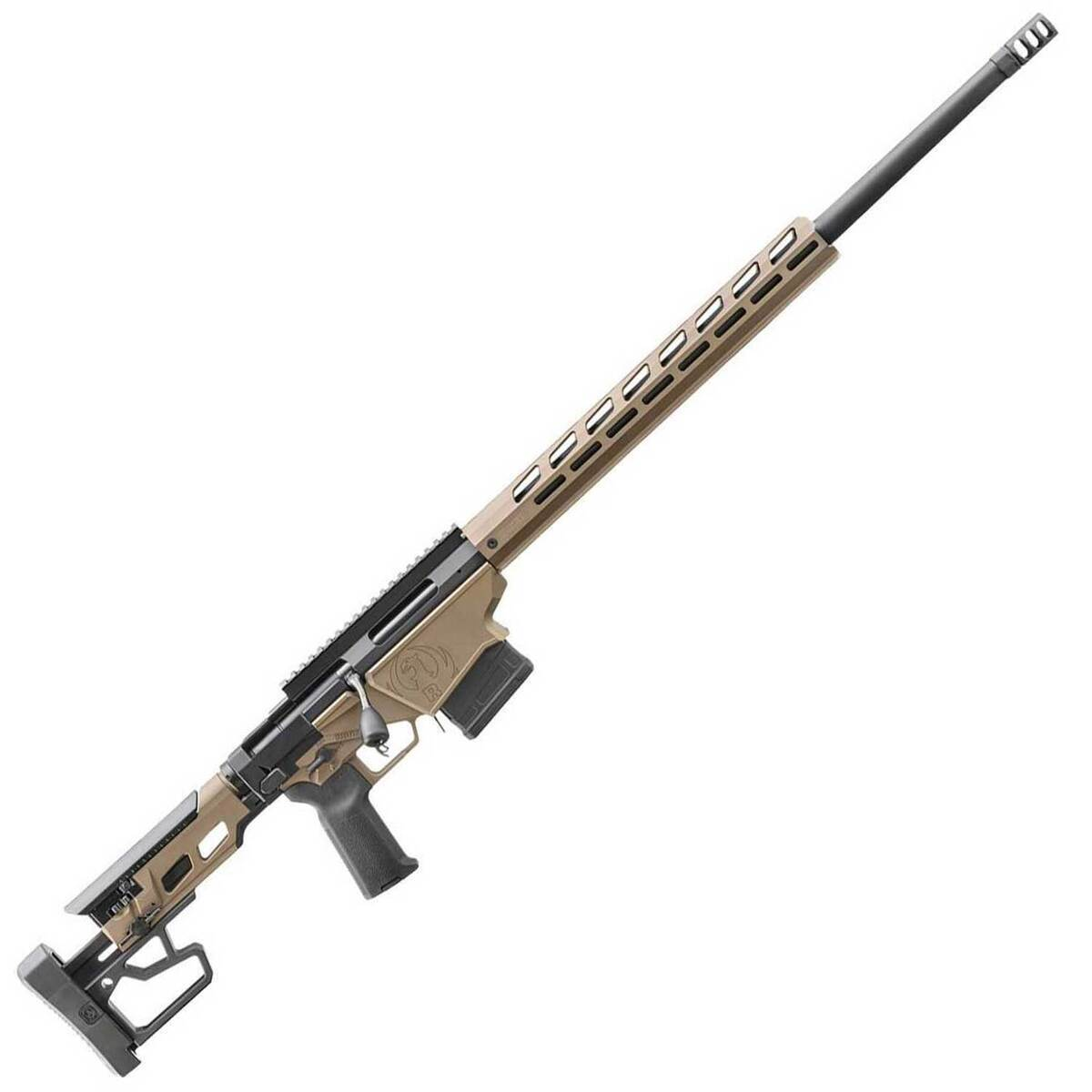
The Ruger Precision Rifle in 6.5 Creedmoor launched the accessible chassis rifle market when it debuted, bringing full-featured adjustability to shooters who couldn’t justify $3,000+ custom builds. With a folding aluminum chassis, AR-style controls, AICS magazine compatibility, and a heavy 24″ barrel, it’s purpose-built for PRS competition and long-range precision shooting. At $1,400-1,600 street price, it sits in the sweet spot between budget bolt guns and semi-custom rigs, though recent price increases have compressed its value advantage.
Quick Verdict
✓ Best for: PRS/NRL competition shooters on budget, long-range precision from barricades and positional shooting
✓ Price: $1,400-1,600 street (MSRP $1,799)
✓ Key strength: Full aluminum chassis with folding stock, complete adjustability, and AICS ecosystem for under $1,600
✗ Not ideal for: Hunting (10.7 lbs bare, 13+ lbs scoped), budget accuracy seekers (Bergara HMR $300 less, more accurate)
Real-World Performance
The 24″ cold hammer-forged barrel with 1:8 twist stabilizes everything from 120gr to 147gr bullets, delivering 2,750 fps with 140gr ELD-M and 2,650 fps with 147gr ELD-M. Factory match ammunition produces 0.7-1.0 MOA groups consistently – adequate for club-level PRS but not exceptional compared to the Bergara B-14 HMR’s typical 0.4-0.5 MOA performance. The heavy contour barrel handles 30+ round strings without accuracy degradation, maintaining zero through heat that would walk lighter profiles. Cold bore shots track reliably within 0.3 MOA of group center. Handloaders can tighten groups to 0.5-0.8 MOA with optimized loads, though the factory barrel isn’t match-grade and shows its limitations beyond 800 yards where vertical dispersion increases.
The three-lug 70-degree bolt cycles faster than traditional 90-degree actions but lacks the Tikka’s buttery smoothness – it’s functional rather than refined. Dual claw extractors handle dirty chambers reliably, and the oversized bolt handle operates easily with gloves. The included muzzle brake reduces 6.5 Creedmoor recoil to negligible levels, keeping you on target through 20-round stages. Effective range extends past 1,200 yards with proper wind calls, though most shooters see best results inside 1,000 yards where the factory barrel’s accuracy holds.
Applications & Use Cases
PRS/NRL Competition: This is the RPR’s primary mission and where it shines. The chassis provides stable platforms from barricades, M-LOK slots accept accessories like barricade stops and weights, and the adjustable stock accommodates various body positions. At 10.7 lbs bare (13 lbs scoped), it’s heavy enough for recoil management without crossing into impractical territory. Factory accuracy is adequate for club matches where most targets are 1.5-2 MOA, though serious competitors upgrade triggers and barrels. The folding stock simplifies transport to matches. Verdict: Excellent entry point, competitive with upgrades.
Long-Range Steel Shooting: Hammering steel from 600-1,200 yards is where the heavy barrel and stable chassis justify their weight. The platform’s rigidity eliminates stock flex that plagues budget hunting rifles, and the 20 MOA rail optimizes scope elevation for distance work. Shooting 30-round sessions at 800 yards, the barrel maintains accuracy while lighter profiles walk. The chassis width provides bag stability, though it’s awkward from prone without a rear bag. Verdict: Very capable for recreational long-range.
Tactical/LEO Training: The AR-style controls (safety, grip, magazine release) transfer muscle memory from patrol rifles, and the folding stock fits vehicle storage. Heavy weight aids recoil management for rapid follow-ups, though the 13-lb total weight fatigues shooters during extended field exercises. Verdict: Functional but heavy for tactical movement.
Hunting: Completely impractical. At 13+ lbs scoped, it’s exhausting beyond 2-3 miles, and the 27″ folded length barely fits backpacks. The chassis width snags vegetation and creates awkward shooting positions in field scenarios. Save 3-4 lbs and $400 with a Bergara B-14 HMR or traditional hunting rifle. Verdict: Wrong tool entirely.
Ergonomics & Handling
The fully adjustable chassis accommodates shooters from 5’4″ to 6’4″ through 12-15″ length-of-pull adjustment, 1″ comb height range, and five cant positions. The AR-15 grip accepts aftermarket options (Magpul K2, BCM Gunfighter), and the 45-degree safety falls naturally under the thumb for AR shooters. The folding mechanism locks solidly with no wobble, reducing overall length to 27″ for transport. Balance skews barrel-heavy – the 24″ heavy contour dominates weight distribution, requiring rear bag support for extended shooting sessions.
The Ruger Marksman Adjustable trigger ships around 3.5 lbs with noticeable creep and a mushy break – acceptable for field shooting but inadequate for precision competition. Most shooters upgrade to TriggerTech Special ($250) immediately. Magazine changes are intuitive with the ambidextrous paddle release, and AICS magazines drop free reliably. The bolt’s 70-degree throw requires wrist rotation but cycles faster than 90-degree actions, though it binds slightly when run aggressively compared to custom actions. At 10.7 lbs bare, the rifle sits stable on barricades but fatigues during positional transitions in long matches.
Aftermarket & Upgrade Path
The RPR uses a proprietary action rather than Remington 700 footprint, limiting barrel and trigger options compared to custom builds. However, the platform still offers meaningful upgrades. TriggerTech Special triggers ($250) are the most common first modification, transforming the mushy factory unit into a crisp 2-lb break suitable for competition. At 3,000-5,000 rounds when the factory barrel is shot out, prefit barrels from Criterion ($450) or Proof Research carbon ($850) install with barrel nut wrenches – simpler than shouldered barrels requiring gunsmithing.
The AR-15 grip compatibility opens Magpul, BCM, and Hogue options for hand fit preferences. M-LOK slots accept bipods, barricade stops, weights for balance tuning, and rails for accessories. The chassis accepts AICS magazines from Magpul ($30-40), MDT ($50-80), and Accurate Mag ($120+) in 10-20 round capacities. Bolt handle upgrades ($50-100) increase purchase surface for gloved operation. Scope choice matters enormously – budget $1,500+ for Vortex Razor HD Gen II or Nightforce ATACR to match the rifle’s capability. Total investment for a competitive PRS rifle runs $3,000-4,000 with glass and upgrades.
Pros & Cons
Strengths:
✓ Full aluminum chassis with 12-15″ LOP, 1″ comb height, 5-position cant adjustment
✓ Folding stock reduces length to 27″ for compact storage and transport
✓ AR-style controls (safety, grip, magazine release) leverage existing muscle memory
✓ AICS magazine ecosystem – use proven Magpul, MDT, Accurate Mag options
✓ M-LOK slots on fore-end for bipods, barricade stops, weights, accessories
✓ Heavy 24″ barrel handles 30+ round strings without accuracy loss
✓ Muzzle brake included reduces 6.5 Creedmoor recoil to minimal levels
✓ 20 MOA Picatinny rail optimized for long-range elevation
Limitations:
✗ Heavy at 10.7 lbs bare, 13+ lbs scoped – prohibitive for hunting or field carry
✗ Factory trigger adequate but not competitive – 3.5 lbs with creep, common first upgrade
✗ Factory accuracy 0.7-1.0 MOA – good not great compared to Bergara’s 0.4-0.5 MOA
✗ Proprietary action limits barrel/trigger aftermarket versus Rem 700 footprint
✗ Chassis adds cost for features hunters don’t need – paying for adjustability
✗ Barrel-heavy balance requires rear bag support, fatigues in positional shooting
✗ Price creep from original $1,399 MSRP to $1,799 compresses value advantage
✗ Chassis width (3.5″) awkward from prone, snags vegetation, wider than traditional stocks
Competitors & Alternatives
| Feature | RPR 6.5 CM | Bergara B-14 HMR | Savage 110 Elite | Tikka T3x TAC A1 |
|---|---|---|---|---|
| Price | $1,500 | $1,150 | $1,400 | $1,999 |
| Weight | 10.7 lbs | 9.5 lbs | 12.6 lbs | 10.9 lbs |
| Trigger | 3.5 lbs | 2.5 lbs | 2.5 lbs | 2.0 lbs |
| Magazine | AICS | AICS | AICS | AICS |
| Accuracy | 0.8 MOA | 0.5 MOA | 0.7 MOA | 0.6 MOA |
The Bergara B-14 HMR at $1,150 delivers noticeably better accuracy (0.4-0.5 MOA typical) with a superior factory trigger, but lacks the folding chassis and full adjustability – choose Bergara for pure accuracy value, RPR for features and adjustability. The Savage 110 Elite Precision matches the RPR’s $1,400 price point with a heavier MDT chassis and AccuTrigger, but weighs 12.6 lbs and doesn’t fold – similar capabilities, choose based on weight preference and chassis style. The Tikka T3x TAC A1 at $1,999 offers a buttery-smooth 60-degree bolt, better factory trigger, and more refined overall package, but costs $500 more – if budget allows, the Tikka is objectively superior.
The Christensen MPR at $1,800 uses a carbon fiber barrel to save 1.5 lbs, appealing if weight matters, though accuracy isn’t meaningfully better. For pure competition on budget, the RPR remains the most popular choice – you’ll see more RPRs at club PRS matches than any other rifle because it delivers complete functionality under $1,600.
Who Should Buy This
Ideal for PRS/NRL competitors entering the sport who need a complete package under $1,600 – the RPR delivers chassis adjustability, folding stock, and competition features without custom build costs. Long-range precision shooters wanting a stable platform for 600-1,200 yard steel sessions benefit from the heavy barrel and rigid chassis. Tactical shooters and LEO/military personnel appreciate AR-style controls and folding capability for vehicle storage.
Look elsewhere if hunting is your primary use – the 13+ lb scoped weight is prohibitive for field carry, and traditional stocks like the Bergara B-14 Ridge save $400 and 4 lbs. Budget-focused accuracy seekers should choose the Bergara HMR at $1,150 with superior 0.5 MOA factory accuracy. Shooters wanting the smoothest action and best factory trigger should stretch to the Tikka T3x TAC A1 at $1,999.
Frequently Asked Questions
Q: How accurate is the RPR with factory ammunition?
A: Expect 0.7-1.0 MOA with quality match ammo like Hornady ELD-M or Federal Gold Medal. Handloads can tighten groups to 0.5-0.8 MOA. It’s adequate for competition but not exceptional – Bergara and Tikka shoot tighter groups from the factory.
Q: What’s the first upgrade I should make?
A: TriggerTech Special trigger ($250). The factory Ruger Marksman trigger at 3.5 lbs with creep is the weakest link. A crisp 2-lb trigger transforms the rifle’s precision capability immediately.
Q: Can I use this rifle for hunting?
A: Technically yes, practically no. At 10.7 lbs bare (13+ lbs scoped), it’s exhausting beyond short walks. The chassis width snags vegetation and creates awkward field positions. Buy a Bergara B-14 Ridge or traditional hunting rifle instead.
Q: How does barrel life compare to other 6.5 Creedmoor rifles?
A: Expect 3,000-5,000 rounds before accuracy degrades noticeably. The cold hammer-forged barrel is durable. When accuracy opens up, Criterion prefits cost $450 or Proof carbon barrels run $850.
Q: Is the RPR better than a Bergara B-14 HMR?
A: Different missions. Bergara shoots more accurately (0.5 vs 0.8 MOA) and costs $300 less, but lacks folding stock and full chassis adjustability. Choose Bergara for accuracy/value, RPR for competition features.
Q: What scope should I mount on the RPR?
A: Budget $1,500+ for Vortex Razor HD Gen II 4.5-27x or Nightforce ATACR 5-25x. The rifle’s capability demands quality glass with reliable tracking and sufficient magnification for 1,000+ yard shooting.
Final Verdict
Competition: 4/5 – Purpose-built for PRS with features that matter, adequate accuracy for club matches, competitive with upgrades
Long-Range Steel: 4.5/5 – Heavy barrel and stable chassis excel at recreational precision shooting inside 1,200 yards
Hunting: 1/5 – Prohibitively heavy at 13+ lbs scoped, chassis width impractical for field use
Value: 3.5/5 – Complete package under $1,600 but price increases compressed advantage; Bergara HMR offers better accuracy for less
Bottom line: The RPR remains the most popular entry-level competition rifle because it delivers complete chassis functionality and adjustability under $1,600 – just understand you’re paying for features, not ultimate accuracy. For pure precision on budget, the Bergara HMR shoots tighter groups for $300 less.
The Ruger Precision Rifle established the accessible chassis rifle category and still delivers the most complete feature set under $1,600 – folding stock, full adjustability, AR-style controls, and AICS compatibility make it purpose-built for PRS competition. Factory accuracy at 0.7-1.0 MOA is adequate rather than exceptional, and the 13+ lb scoped weight eliminates hunting applications entirely. The proprietary action limits some aftermarket options compared to Remington 700 footprints, though meaningful upgrades exist. Price increases from the original $1,399 MSRP to $1,799 have compressed its value advantage, with the Bergara B-14 HMR now offering superior accuracy for $300 less. Still, walk any club PRS match and you’ll see more RPRs than any competitor – it remains the default choice for shooters entering precision competition who need a complete platform without custom build costs. Buy it for positional competition shooting and long-range steel, skip it entirely for hunting or if pure accuracy matters more than adjustability.