 Maksym Kovaliov
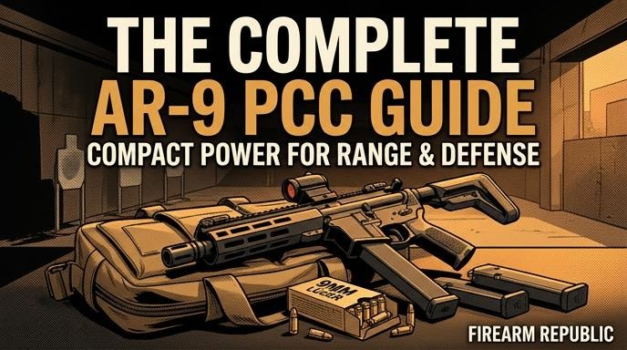
Pistol Caliber Carbines on the AR Chassis
The pistol caliber carbine isn’t a new idea – law enforcement and military units have carried submachine guns chambered in 9mm and .45 ACP for over a century. What’s new is the packaging: a growing segment of manufacturers now builds PCCs on the AR-15 chassis, giving shooters a platform that handles like a familiar AR-15, accepts standard AR accessories, and runs pistol-caliber ammunition. The result is a rifle-length platform that’s cheaper to shoot than centerfire rifle calibers, quieter with a suppressor, and dominant in USPSA Pistol Caliber Carbine competition.
The AR-9 – shorthand for any AR-pattern PCC chambered in 9mm – is the most popular configuration by a wide margin. But the platform extends to .45 ACP, .40 S&W, 10mm Auto, and a handful of other handgun cartridges. This guide covers the full PCC landscape: how these rifles work, what makes them different from standard AR-15s, which magazine systems matter, the best production rifles, and where the platform genuinely excels and where it doesn’t.
History of the PCC
Military Origins: The Submachine Gun Era
Pistol caliber long guns predate the AR platform by decades. The Thompson submachine gun (.45 ACP) entered service in the 1920s and became an icon of both organized crime and WWII infantry use. The MP40 (9mm) served German forces throughout WWII. The Israeli Uzi (9mm), the HK MP5 (9mm), and the Beretta M12 defined the submachine gun era from the 1950s through the 1980s – compact, controllable, running pistol ammunition for simplified logistics.
The MP5 in particular became the gold standard for law enforcement and counterterrorism units globally. Its roller-delayed blowback action delivered exceptional accuracy for a 9mm subgun, and its widespread adoption by FBI HRT, GSG-9, SAS, and similar units gave it unmatched credibility.
The Civilian Market: 1980s–2000s
Civilian semi-automatic versions of submachine guns existed in the U.S. throughout this period – semi-auto MP5 clones, Uzi carbines, Beretta CX4 Storm – but the category was niche. Magazine restrictions post-1994 AWB dampened enthusiasm, and the guns themselves required learning a new platform with limited parts compatibility.
The real shift came when manufacturers figured out how to build PCCs on the AR-15 lower receiver. A 9mm AR uses the same lower as a standard AR-15 – same controls, same stock interface, same trigger group – with a modified upper that accepts a 9mm barrel and a magazine well adapter or dedicated lower that accepts pistol magazines. Shooters who already owned AR-15s could transition to a PCC with no relearning curve.
The USPSA/PCC Explosion: 2016–Present
USPSA (United States Practical Shooting Association) added a dedicated Pistol Caliber Carbine division in 2016. The division grew faster than any other in USPSA history. By 2020, PCC was the second-largest division in USPSA by participation, behind only Production.
The competitive pressure drove rapid development. Manufacturers optimized trigger systems for USPSA’s speed-focused stages. Delayed blowback systems reduced felt recoil. Lightweight builds under 5 lbs became standard. The CMMG Banshee, JP Enterprises GMR-15, and Angstadt Arms UDP-9 defined what a competition-ready PCC looks like. Today the AR-9 is a fully mature competition platform with a deep aftermarket and established best practices.
How AR-9 PCCs Work
Blowback vs. Delayed Blowback
Standard AR-15s use a rotating bolt and gas-operated action. Most AR-9 PCCs use a fundamentally different operating principle: blowback.
Simple (Direct) Blowback: The bolt is not locked to the barrel. When the cartridge fires, case pressure pushes the case rearward, which pushes the bolt rearward against the recoil spring. There is no locking mechanism – the bolt mass and spring tension are the only things holding the bolt closed long enough for pressure to drop to safe levels. This works for low-pressure pistol cartridges but produces a sharp, snappy recoil impulse because the bolt mass required is heavy (roughly 14–16 oz vs. 8–10 oz for a 5.56 BCG).
Delayed Blowback: A mechanical delay – roller delay (CMMG’s Radial Delayed Blowback), gas delay, or lever delay – slows the bolt’s rearward travel slightly. This allows pressure to drop more before extraction, permitting a lighter bolt and producing a smoother, softer recoil impulse. CMMG’s Radial Delayed Blowback system is the most common delayed design in modern AR-9s and is considered the best-shooting system currently available.
The Last Round Bold Hold Problem
Standard AR-15 BCGs lock back on an empty magazine via the bolt catch. Many simple blowback AR-9s do not lock open after the last round – the bolt simply closes on an empty chamber. This slows competition reloads and makes it harder to confirm an empty rifle visually.
Quality AR-9s address this with a modified bolt catch designed to engage on empty magazines. Verify that any PCC you’re considering offers last-round bolt hold-open (LRBHO) before purchasing – it matters for both competition and defensive use.
Magazine Feed Angle
Standard AR-15 magazines feed at approximately 5 degrees from vertical. 9mm cartridges are significantly shorter and fatter than 5.56 rounds, requiring a different magazine geometry. AR-9 PCCs use one of several approaches:
- Dedicated AR-9 lower with proprietary magazine well – optimized geometry, typically the most reliable
- Glock magazine adapter – magazine well accepts standard Glock pistol magazines, offering exceptional aftermarket depth
- Colt SMG pattern – older standard used by Colt, LWRC, and some others; runs modified single-stack magazines
- SIG MPX pattern – proprietary magazines, limited crossover
The Glock magazine pattern has become the most popular for new builds and purchases because Glock magazines are available everywhere, in every capacity, at low cost, and the platform compatibility question is settled by owning a common Glock magazine.
Calibers for the AR-9 / PCC Platform
9mm Luger (9×19mm) – The Dominant Choice
9mm is the right caliber for 90% of PCC buyers. It’s the cheapest centerfire pistol round on the market, available everywhere, produces the least recoil of any centerfire PCC option, and has the best factory ammunition selection for both training and defensive use.
9mm PCC ballistics from a 16″ barrel:
| Load | Muzzle Velocity (16″ bbl) | Muzzle Energy | vs. Pistol (4″ bbl) |
|---|---|---|---|
| 115gr FMJ | 1,450 fps | 537 ft-lbs | +250 fps |
| 124gr JHP (defensive) | 1,350 fps | 502 ft-lbs | +200 fps |
| 147gr subsonic | 1,020 fps | 340 ft-lbs | +50 fps |
| 147gr +P | 1,150 fps | 432 ft-lbs | +150 fps |
The 16″ barrel adds meaningful velocity over a pistol barrel – roughly 150–250 fps depending on load – improving terminal performance and extending effective range. A 9mm PCC with quality 124gr defensive loads is a legitimate home defense option inside 100 yards.
.45 ACP
The heavy bullet crowd’s choice. .45 ACP in a PCC offers a larger diameter projectile (0.452″ vs 0.355″ for 9mm) and subsonic performance from standard loads – no need for special subsonic ammunition for quiet suppressed shooting. Recoil is heavier than 9mm. Magazine options are more limited. For most shooters, 9mm is the better choice; .45 ACP makes sense if you’re specifically building a dedicated suppressor host or prefer heavy slow bullets philosophically.
.40 S&W
.40 S&W occupies an awkward middle ground – more recoil than 9mm, similar terminal performance to modern 9mm defensive loads, less magazine capacity, and dwindling factory ammunition support. Law enforcement is moving away from .40 S&W broadly. Difficult to recommend for new builds unless you have a specific reason (existing .40 magazines, surplus ammo).
10mm Auto
The niche choice for hunters and outdoorsmen who want pistol-caliber long gun performance with genuine stopping power. A 16″ barrel running 180gr 10mm at 1,600 fps produces 1,024 ft-lbs of energy – approaching .357 Magnum rifle territory and significantly more than any standard 9mm load. Glock 10mm magazines work with Glock-compatible lowers. CMMG and a few others offer 10mm PCCs. Recoil is substantial. For hunting small-to-medium hogs and defensive carry in bear country, this is the most capable PCC option.
Caliber Comparison
| Caliber | Velocity (16″ bbl) | Energy | Recoil | Ammo Cost | Best For |
|---|---|---|---|---|---|
| 9mm 124gr | 1,350 fps | 502 ft-lbs | Mild | $0.20–$0.40/rd | Competition, training, defense |
| .45 ACP 230gr | 1,000 fps | 511 ft-lbs | Moderate | $0.35–$0.60/rd | Suppressed, traditional preference |
| .40 S&W 165gr | 1,250 fps | 572 ft-lbs | Snappy | $0.35–$0.55/rd | Diminishing use case |
| 10mm 180gr | 1,600 fps | 1,024 ft-lbs | Heavy | $0.50–$0.90/rd | Hunting, max performance |
Magazine Systems: What You Need to Know
The magazine system is the most important platform decision for an AR-9 purchase. Once you commit to a magazine pattern, you’re locked into that ecosystem for the life of the lower receiver.
Glock Pattern (Recommended for Most Buyers)
Glock-compatible lowers accept standard Glock Gen 3 or Gen 5 9mm magazines. This matters because:
- Glock magazines are available at every gun store and online retailer
- Standard capacity (17-round), extended (33-round), and flush-fit (10-round) options all exist
- If you own a Glock pistol, your magazines are interoperable
- Magpul PMAG GL9 ($15) offers high-quality 9mm Glock-pattern magazines at budget prices
Recommended Glock-pattern AR-9s: CMMG Banshee 100/200, PSA PX-9, Foxtrot Mike Products FM-9, Angstadt Arms UDP-9
Colt SMG Pattern
The original AR-9 magazine standard, used by Colt’s 9mm AR and adopted by LWRC, Bravo Company, and others. Colt SMG magazines are single-stack and generally limited to 20 or 32 rounds. Less convenient than Glock pattern for most buyers. Relevant if you’re specifically building a Colt-pattern gun or want the pattern used by the military/law enforcement community.
Who uses Colt SMG pattern: LWRC SMG-45, BCM (older models), Colt 9mm AR
SIG MPX / Proprietary Patterns
Some manufacturers use proprietary magazine systems optimized for their specific geometry. SIG’s MPX is the most notable – it uses proprietary magazines that are not interchangeable with any other platform. The MPX is excellent but creates a closed ecosystem. Buy it if the rifle’s merits justify the proprietary commitment.
Magazine Capacity by Application
| Application | Recommended Capacity |
|---|---|
| USPSA PCC (competition) | 30–33 rounds (division maximum is 30+1) |
| Home defense | 17–20 rounds |
| Training | 17–33 rounds |
| States with capacity restrictions | 10 rounds |
| Suppressed backyard shooting | 17 rounds |
Best AR-9 / PCC Rifles: Production Models
Premium Tier ($1,500+)
JP Enterprises GMR-15 The competition standard. JP’s GMR-15 is purpose-built for USPSA PCC and is the rifle that defines what competitive PCC performance looks like. Features JP’s Silent Captured Spring system (dramatically reduces felt recoil and bolt bounce), JP’s trigger (one of the best factory AR triggers available), and tight-tolerance machining throughout. The GMR-15 runs Glock magazines and locks back on empty. At $2,000–$2,200, it’s expensive – but it’s the rifle serious USPSA competitors buy when they’re done experimenting.
Foxtrot Mike Products FM-9B (Enhanced) FM-9 has built a strong reputation for competition-ready AR-9s at a price point below JP. The FM-9B features a radial-delayed blowback system (softer recoil than simple blowback), LRBHO, and Glock magazine compatibility. At $1,400–$1,600, it’s a significant step below JP pricing while delivering most of the competition performance. Popular with USPSA shooters who want a serious platform without the JP price tag.
SIG Sauer MPX Competition SIG’s MPX is the non-AR-pattern PCC that dominates USPSA alongside the AR-9. Proprietary operating system (short-stroke piston), ambidextrous controls, and exceptional factory trigger. The Competition version adds a longer barrel and Magpul MBUS Pro sights. At $1,800–$2,000, it competes directly with the JP GMR-15. Its proprietary magazine system is the main drawback. If you’re committed to the MPX ecosystem, it’s one of the two best production PCCs on the market.
CMMG Banshee 300 Mk9 CMMG’s Radial Delayed Blowback system is the smoothest-shooting blowback action in production. The Banshee 300 series comes with a 5″ or 8″ barrel in pistol configuration and a 16″ barrel in carbine configuration. The Mk9 variant uses Glock magazines and is available in 9mm, .45 ACP, and 10mm. At $1,400–$1,600, it’s the best choice for a dedicated suppressor host – the delayed blowback reduces gas to the shooter’s face dramatically versus simple blowback designs, and CMMG’s side-charging upper makes suppressed operation cleaner.
Mid-Range ($700–$1,500)
Angstadt Arms UDP-9 Angstadt builds one of the cleanest mid-range AR-9s available. Glock magazine compatible, LRBHO standard, side-folding stock option, and quality machining throughout. At $1,100–$1,300, the UDP-9 occupies the gap between budget AR-9s and JP-tier competition rifles. A strong choice for the shooter who wants quality without full competition pricing.
PSA PX-9 Gen 3 Palmetto State Armory’s PX-9 Gen 3 represents a significant improvement over earlier PSA PCC offerings. Glock magazine compatible, radial delayed blowback system (borrowed from CMMG’s design concept), LRBHO, and PSA’s consistently low pricing at $600–$800. Accuracy and reliability are solid for the price point. The best budget AR-9 currently in production and a genuine competitor to rifles at twice the price.
KelTec Sub-2000 Gen 3 Not an AR-pattern rifle – the Sub-2000 is KelTec’s unique folding PCC design – but worth including here because it addresses a specific need: an ultra-portable PCC that folds in half for pack or bag carry. Glock or Beretta magazine compatible depending on version. At $500–$600, it’s inexpensive, lightweight (4.25 lbs), and folds to fit in a backpack. The Gen 3 addressed earlier reliability complaints significantly. Not a competition rifle, but a compelling suppressor host and go-bag gun.
Beretta CX4 Storm One of the original civilian PCCs, the CX4 Storm uses Beretta pistol magazines (92 series for 9mm, Px4 for .45 ACP). Not an AR-pattern design – it has a conventional operating system and aesthetic – but it’s reliable, accurate, and comfortable to shoot. At $700–$800, it’s a good choice for the shooter who wants a non-AR-looking PCC or wants to share magazines with a Beretta pistol.
Ruger PC Carbine Ruger’s entry runs either Ruger Security-9 magazines or Glock-pattern magazines depending on the included adapter. At $600–$700, it’s reliable, accurate (threaded barrel standard), and takes down for storage without tools. Not optimized for competition – the trigger is adequate but not exceptional – but an excellent general-purpose home defense and range PCC.
Budget Tier ($400–$700)
Anderson Manufacturing AR-9 Anderson builds the lowest-cost functional AR-9 on the market at $400–$500. Basic blowback system, Glock magazine compatible, no LRBHO on some configurations. As with their AR-15s – a functional platform for upgrade, not a finished product.
DPMS 9mm AR DPMS’s 9mm offering runs Colt SMG magazines, which limits aftermarket options. At $550–$650, it’s reliable enough but the magazine compatibility makes it harder to recommend versus Glock-pattern alternatives at similar prices.
Model Comparison
| Model | Price | System | Magazines | LRBHO | Weight | Best For |
|---|---|---|---|---|---|---|
| JP GMR-15 | $2,100 | Blowback | Glock | ✓ | 5.9 lbs | USPSA competition |
| SIG MPX Competition | $1,900 | Piston | Proprietary | ✓ | 6.8 lbs | Competition / duty |
| CMMG Banshee 300 Mk9 | $1,500 | Radial delayed | Glock | ✓ | 5.8 lbs | Suppressed, hunting |
| FM-9B Enhanced | $1,500 | Radial delayed | Glock | ✓ | 6.2 lbs | Competition value |
| Angstadt UDP-9 | $1,200 | Blowback | Glock | ✓ | 5.7 lbs | Quality mid-range |
| PSA PX-9 Gen 3 | $700 | Radial delayed | Glock | ✓ | 6.0 lbs | Best budget |
| Ruger PC Carbine | $650 | Blowback | Glock/Ruger | ✓ | 6.1 lbs | General purpose |
| KelTec Sub-2000 Gen 3 | $550 | Blowback | Glock | ✗ | 4.3 lbs | Portable / go-bag |
AR-9 in USPSA / PCC Competition
USPSA’s Pistol Caliber Carbine division is the primary competitive home for the AR-9. Understanding the division rules shapes what to buy and how to configure it.
USPSA PCC Division Rules (Key Points)
- Caliber: Must be a pistol caliber (9mm is standard; .45 ACP and .40 S&W also legal)
- Barrel: No minimum length; all configurations legal
- Optics: Any optic allowed
- Magazine capacity: No limit (most competitors use 33-round Glock magazines)
- Compensators: Legal
- Trigger: No minimum pull weight specified for PCC (unlike Open or Limited divisions)
- Starting position: Rifle at low ready, finger off trigger
What Wins in USPSA PCC
PCC stages reward speed and accuracy at 7–50 yard targets. The optimal configuration differs from 3-Gun or precision shooting:
- Short sight radius or red dot – 1x red dot (Trijicon MRO, Aimpoint T2) is the competition standard. Magnified optics slow transitions at close range.
- Compensator / muzzle brake – Significant advantage on PCC. The comp keeps the dot on target during rapid fire and in follow-through.
- Light trigger – JP’s trigger, Elftmann SE, or CMC flat-faced 3.5 lb triggers are standard. Every millisecond of trigger pull matters at PCC speeds.
- Glock 33-round magazines – Maximum capacity for the longest stages.
- Sling – Strong-hand transition during magazine changes; single-point or two-point depending on preference.
Typical competitive PCC build:
- JP GMR-15 or CMMG Banshee (delayed blowback for softer recoil)
- Aimpoint T2 or Trijicon MRO on a Unity Tactical FAST mount (co-witness height)
- Compensator (SJC Titan, SureFire ProComp 556, or OEM if competition legal)
- Glock 33-round PMAG GL9 magazines × 4–6
- Total build: $2,500–$3,500 fully kitted
AR-9 for Home Defense
The PCC has become a serious consideration for home defense alongside pistols and shotguns. Here’s the honest assessment:
Advantages Over Pistols
- Longer sight radius – More accurate at distance with less training
- More forgiving under stress – Stock improves stability and reduces the effect of adrenaline-induced fine motor skill degradation
- Higher velocity – 150–250 fps over a pistol barrel improves terminal performance
- Capacity – 17–33 rounds vs. 15–17 for full-size pistols
Advantages Over Centerfire Rifle (AR-15)
- Less over-penetration risk – 9mm hollow points penetrate fewer walls than 5.56 or .308 in most conditions (counterintuitive but supported by testing)
- Quieter – 9mm produces significantly less muzzle blast than rifle calibers; with a suppressor, a subsonic 9mm PCC is among the quietest firearms available
- Less recoil – Easier for all household members to use effectively
Limitations
- Shorter effective range – 9mm energy drops below reliable expansion threshold past 100–150 yards for most loads
- Less terminal performance than rifle – Quality 5.56 defensive loads significantly outperform 9mm on barrier penetration and wound channel
- Size – Even a 16″ PCC is harder to maneuver in tight spaces than a pistol, though shorter barrels address this
The verdict: A 9mm PCC is a legitimate home defense tool, particularly for households where recoil management is a concern or where suppressor use is planned. It’s not the maximum-performance option – that remains a quality AR-15 in 5.56 with defensive ammunition – but it’s a practical choice with real advantages in specific contexts.
Suppressed PCC: The Best Suppressor Host on the Market
The AR-9 in 9mm subsonic is arguably the best suppressor host available to civilian shooters. Here’s why:
Standard 147gr subsonic 9mm exits the muzzle below the speed of sound – no sonic crack. With a suppressor, the only sound is the mechanical action (bolt cycling) and a reduced muzzle report. The result is genuinely hearing-safe shooting without hearing protection in most cases – a level of quiet that even suppressed centerfire rifle calibers cannot match.
Setup for maximum suppression:
- 16″ barrel (or longer – more dwell time = more complete combustion before suppressor)
- 147gr subsonic ammunition (Hornady Subsonic, Federal Suppressor, SIG Sauer Subsonic)
- Quality 9mm suppressor (SilencerCo Omega 9K, Dead Air Wolfman, Gemtech ONE)
- Adjustable gas block recommended for delayed blowback designs with suppressor
Suppressor note: A suppressor requires a $200 NFA tax stamp and an ATF Form 4 with a wait time currently averaging 6–10 months. Plan the purchase accordingly.
AR-9 vs. Dedicated Subgun Designs
The AR-9 isn’t the only PCC option. Several dedicated designs compete with it:
| Platform | Type | Magazine | Price | Notes |
|---|---|---|---|---|
| AR-9 (Glock-mag) | AR-pattern | Glock | $600–$2,200 | Most versatile, best aftermarket |
| SIG MPX | Dedicated PCC | Proprietary | $1,500–$2,000 | Excellent, but closed ecosystem |
| CZ Scorpion EVO 3 | Dedicated PCC | Scorpion | $900–$1,200 | Excellent trigger, compact |
| B&T APC9 | Dedicated PCC | Glock/B&T | $2,500+ | Professional-grade, expensive |
| Ruger PC Carbine | Dedicated PCC | Glock/Ruger | $600–$700 | Takedown, general purpose |
| KelTec Sub-2000 | Folding PCC | Glock | $500–$600 | Ultra-portable |
The AR-9’s key advantage over dedicated subguns is the shared platform with AR-15s: same controls, same trigger group compatibility, same stock and grip options, same optic mounting standards. If you already own and train with an AR-15, the AR-9 requires no relearning.
Pros and Cons
✓ Advantages
- Cheap to shoot – 9mm at $0.20–$0.35/round means significantly more trigger time per dollar vs. 5.56 or .308
- Suppressor-optimal – Subsonic 9mm is the quietest hearing-safe shooting available
- USPSA PCC dominance – Deep competitive platform with established best practices and significant participation
- Shared manual of arms with AR-15 – No relearning for existing AR shooters
- Excellent home defense option – Particularly suppressed or for shooters managing recoil
- Glock magazine ecosystem – For Glock-compatible lowers, the magazine market is enormous and cheap
- Lower recoil than rifle calibers – Faster follow-up shots, easier for smaller-framed shooters
✗ Disadvantages
- Limited effective range – 9mm energy drops past 100–150 yards; not a 300-yard rifle
- Not a hunting rifle – 9mm is marginal on deer-sized game; only 10mm approaches hunting viability
- Heavier bolt than rifle-caliber AR — Simple blowback requires heavy bolt; adds weight where you don’t want it
- Last-round bolt hold-open – Not standard on all designs; verify before purchasing
- Less terminal performance than centerfire rifle – 5.56 with quality defensive loads outperforms 9mm for defensive purposes
- Magwell adapter reliability – Some Glock-adapter designs are less reliable than dedicated AR-9 lowers; buy quality or avoid adapters
- NFA considerations for short barrels – Sub-16″ PCCs require SBR paperwork or must be built as pistols
Frequently Asked Questions
Q: What’s the difference between an AR-9 and a standard AR-15?
A: The most fundamental difference is the operating system and caliber. A standard AR-15 uses a gas-operated rotating bolt system chambered in 5.56/. 223 or similar rifle calibers. An AR-9 uses a blowback or delayed blowback system (no gas operation in most designs) chambered in pistol calibers – primarily 9mm. The lower receivers are compatible between platforms in many cases (though a dedicated AR-9 lower with a Glock magazine well is better than an adapter), but the upper receivers, BCGs, barrels, and magazines are completely different. Controls, stocks, grips, and trigger groups transfer between platforms – the core reason AR-9s are popular with existing AR-15 owners.
Q: Is an AR-9 / PCC good for home defense?
A: Yes – with appropriate expectations. A 9mm PCC with quality hollow point ammunition (Hornady Critical Defense, Federal HST, Speer Gold Dot) is a legitimate defensive tool inside 75–100 yards. The longer barrel increases velocity compared to a pistol, and the stock makes accurate shooting significantly easier under stress. The primary advantages are lower recoil than rifle calibers and, suppressed, extremely low noise levels. The limitation is that 9mm is less effective than .223/5.56 on barriers and at distance. For most home defense scenarios – which occur at under 20 yards – the 9mm PCC is entirely adequate. If maximum terminal performance is the priority, an AR-15 in 5.56 with quality 77gr OTM or 62gr bonded loads is the stronger choice.
Q: Do AR-9 rifles take Glock magazines?
A: It depends on the specific rifle. Glock-compatible AR-9s use a magazine well designed around Glock pistol magazines – these rifles accept standard Glock 9mm magazines including the 17-round standard, 33-round extended, and Magpul PMAG GL9. Not all AR-9s are Glock-compatible – some use Colt SMG pattern magazines, SIG MPX magazines, or other proprietary standards. Confirm magazine compatibility before purchasing. For new buyers, Glock-pattern compatibility is the recommended choice due to magazine availability and affordability.
Q: Can I use my AR-9 for competition?
A: Yes – USPSA has a dedicated Pistol Caliber Carbine division, and it’s one of the fastest-growing competitive shooting divisions in the country. 9mm is the dominant caliber. The division allows optics, compensators, and extended magazines, making it one of the most equipment-forward and technically interesting divisions to compete in. Entry-level competitive PCCs start around $700–$800 (PSA PX-9, Ruger PC Carbine); serious competition setups run $2,000–$3,500 fully equipped. Check your local USPSA club for match schedules – PCC stages are designed to be approachable for new competitors.
Q: Is a 9mm PCC better suppressed than a suppressed AR-15?
A: For overall suppressed experience, yes – significantly. Subsonic 9mm (147gr below 1,125 fps) produces no sonic crack, meaning the suppressor only has to address the muzzle blast rather than both blast and the sonic boom of a supersonic projectile. A suppressed 9mm PCC running subsonic loads is genuinely hearing-safe for most shooters without hearing protection. A suppressed AR-15 in 5.56 is much quieter than unsuppressed, but the supersonic bullet still produces a distinct crack at the muzzle. The exception is .300 Blackout in an AR-15 with 220gr subsonic loads – that matches the 9mm PCC for suppressed performance while offering larger-diameter, heavier projectiles. Both are excellent suppressor hosts; 9mm wins on ammunition cost.
Q: What’s the best first AR-9 to buy?
A: For most buyers, the PSA PX-9 Gen 3 ($650–$750) or Ruger PC Carbine ($650) are the right starting points. Both offer Glock magazine compatibility, last-round bolt hold-open, and reliable operation at an accessible price. The PSA PX-9 Gen 3’s radial delayed blowback system gives it a softer recoil impulse than the Ruger’s simple blowback – a meaningful difference for extended range sessions. If competition is the goal and budget allows, go directly to the CMMG Banshee 300 Mk9 ($1,500) or JP GMR-15 ($2,100) — the entry-level options will need to be replaced anyway once you’re serious about USPSA.
Related Guides
- AR-15 Platform Guide – The rifle-caliber cousin, full breakdown
- AR-10 Platform Guide – Full-power .308/6.5 CM semi-auto
- AR Rimfire Platform Guide – .22 LR training on the AR chassis
- .300 Blackout Caliber Guide – The suppressor specialist in rifle caliber
- Home Defense Rifle Guide – AR-15 vs PCC vs shotgun comparison
Related Application Guides
- USPSA / PCC Competition Guide
- Best Suppressor Hosts – Rifle Caliber and PCC
- Home Defense Firearm Guide