 Maksym Kovaliov
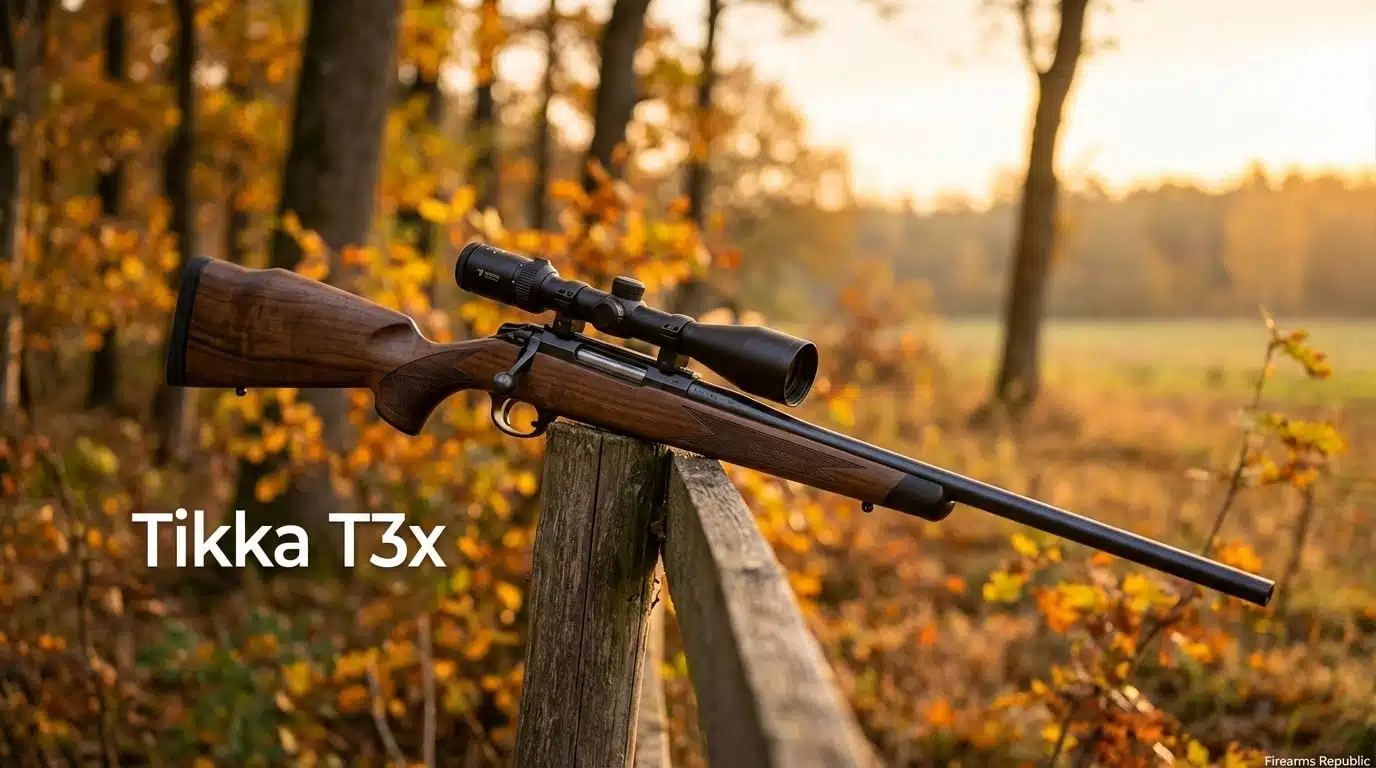
The Tikka T3x occupies a specific and well-earned position in the bolt-action rifle market: the best factory trigger available under $1,000, combined with production accuracy that competes with rifles at twice the price. Produced at the Sako factory in Riihimäki, Finland – one of the world’s most respected precision rifle manufacturing facilities – the T3x benefits from Finnish manufacturing standards that treat tolerances as design specifications rather than acceptable variations. The result is a rifle that shooters notice the moment they cycle the bolt: smoother than any domestic production rifle at its price, with a trigger that breaks at approximately 2 lbs with a cleanliness that most shooters have not felt outside a benchrest competition or a $300 aftermarket drop-in. Since replacing the original T3 in 2016, the T3x has become the default recommendation when a shooter asks for the best hunting rifle under $1,000 – a position it holds for reasons that are specific and defensible rather than based on brand reputation alone. This guide covers every T3x variant, which configurations serve which applications, how it compares to its primary competitors, and the honest limitations of a platform that gets more right than most.

The T3x Family: Every Significant Variant
Tikka T3x Lite – The Standard Recommendation
Price: $800–$875 | Weight: 6.1 lbs bare | Calibers: 6.5 CM, .308 Win, .30-06, 7mm-08, .243 Win, 6.5 PRC, 7mm Rem Mag, .300 Win Mag, and others
The T3x Lite is the flagship configuration in the T3x family for hunters – the one that earns the platform most of its recommendations. At 6.1 lbs bare, it is meaningfully lighter than most production hunting rifles at comparable prices and meaningfully heavier than dedicated carbon-construction mountain rifles. The textured synthetic stock in the Lite configuration handles wet field conditions well and maintains point of impact across temperature changes better than wood stocks.
The detachable single-stack magazine is the Lite’s signature practical feature: pre-loaded magazines can be swapped in the field without running rounds individually into the magazine well, and the magazine drops free on release without requiring manual removal. For hunters who carry a spare magazine loaded with different bullet weights – a hunting load and a range load, or a heavy elk load and a lighter deer load when hunting both – this is a functional advantage that most other hunting rifles at this price lack.
What makes it the trigger benchmark: The T3x trigger uses a two-stage design with a first stage that takes up slack at minimal resistance and a second stage that breaks at approximately 2 lbs with essentially no perceptible creep. This trigger is not simply acceptable for its price – it is genuinely excellent by any measure. The Savage AccuTrigger adjusts to 2.5 lbs minimum; the Ruger American adjusts to 3 lbs minimum. The T3x arrives from the factory at 2 lbs without user adjustment required.
Tikka T3x CTR – The Tactical Hunting Variant
Price: $1,050–$1,150 | Weight: 7.9 lbs bare | Calibers: 6.5 CM, .308 Win, 6.5 PRC
CTR stands for Compact Tactical Rifle. The CTR adds a threaded 20-inch barrel, adjustable cheek piece, Picatinny rail, and 10-round detachable magazine to the T3x platform – transforming the hunting rifle architecture into a platform suitable for precision competition, tactical training, and hunters who want a suppressor-ready tactical-style bolt gun at a price below most dedicated precision rifles.
The 10-round single-stack magazine is the CTR’s most distinctive feature. In 6.5 CM, it provides more rounds per load than any comparable bolt-action under $1,200 except the Ruger Precision Rifle. For PRS and NRL competitors who want competition-relevant magazine capacity without building a chassis rifle, the CTR is a production shortcut that works.
The 20-inch barrel in a CTR configured for suppressor use produces a 26–28-inch total length suppressed – practical for hunting and competition without the unwieldy length of a 24-inch barrel and can.
Honest limitation: The CTR’s stock is adjustable at the cheek but not at the length of pull – LOP is fixed at 13.75 inches. For shooters who need a shorter pull (youth, smaller-framed adults) or a longer pull (tall shooters with long arms), the fixed LOP is a genuine ergonomic limitation that the Ruger Precision Rifle and similar chassis rifles address with full adjustment.
Tikka T3x Hunter – The Traditional Configuration
Price: $800–$900 | Weight: 6.4–7.1 lbs (varies by stock configuration) | Calibers: Same range as Lite
The Hunter is the T3x Lite with a slightly heavier stock profile and – in some configurations – the option for walnut rather than synthetic. The functional difference from the Lite is modest; the aesthetic difference matters to hunters who want traditional wood stocks. Accuracy and trigger are identical to the Lite.
Tikka T3x Compact
Price: $800–$875 | Weight: 5.9 lbs | Stock: 12.5-inch LOP
The Compact reduces length of pull to 12.5 inches for youth hunters and smaller-framed adults. In this configuration, the T3x platform’s excellent trigger and action quality serve as the best factory youth hunting rifle available at any price. The trade-off vs. the Ruger American Compact and Mossberg Patriot Bantam is $250–$350 more in price; the gain is the T3x trigger experience and action smoothness that those rifles cannot match. For families investing in a rifle a youth hunter will use for years and potentially carry into adult hunting, the T3x Compact represents a lifetime purchase rather than a starter rifle.
Tikka T3x Varmint
Price: $950–$1,100 | Weight: 8.0–8.3 lbs bare | Calibers: .223 Rem, .22-250 Rem, 6.5 CM, .308 Win

The Varmint applies a heavy-contour 23.5-inch barrel to the T3x platform, producing the heat resistance needed for extended prairie dog sessions and the rigidity that contributes to consistent accuracy across many shots. At 8.0–8.3 lbs bare, it is a bench or bipod rifle rather than a field-carry platform. In .22-250 Rem, it delivers maximum velocity from the full-length barrel while maintaining point of impact through the heat that varmint shooting generates. Accuracy runs 0.5–0.7 MOA with quality ammo – the best production accuracy Tikka delivers outside the T3x TAC A1. See our Varmint Hunting Rifles Guide.
Tikka T3x TAC A1 – The Precision Platform
Price: $1,600–$1,800 | Weight: 11.3 lbs | Calibers: .308 Win, 6.5 CM, .260 Rem
The TAC A1 is a completely different product from the hunting T3x variants – a full chassis rifle built around the T3x action with an aluminum chassis, fully adjustable stock (cheek, LOP, and butt pad height), folding mechanism, and a 10-round magazine. It is Tikka’s direct answer to the Accuracy International AT and similar precision competition platforms at a significantly lower price.
At $1,600–$1,800, the TAC A1 competes with the Bergara HMR Pro, Ruger Precision Rifle, and custom precision builds. Its advantages are the T3x action’s tight tolerances and legendary bolt smoothness inside a precision chassis. The limitation is weight – 11.3 lbs is heavy even for a precision rifle, and competing platforms at similar prices offer comparable accuracy in lighter configurations.
T3x Accuracy: What to Expect
Tikka’s sub-MOA guarantee applies to every T3x rifle. In practice, the T3x Lite and T3x Hunter consistently deliver 0.6–0.9 MOA with quality factory ammo. The Varmint configuration reaches 0.5–0.7 MOA, and the TAC A1 in developed loads reaches 0.4–0.6 MOA.

The horizontal consistency advantage: The T3x action’s tight tolerances produce groups that are typically as wide as they are tall – a sign of consistent headspace, minimal firing pin fall variation, and barrel bedding that does not shift between shots. Most production rifles show more horizontal variation than vertical; the T3x’s tight manufacturing shows in horizontal consistency that suggests repeatable lock-up.
Ammo sensitivity: The T3x is less ammo-sensitive than the Ruger American or Savage Axis II because its tighter tolerances reduce the impact of ammo variation on group consistency. Premium factory loads (Federal Fusion, Hornady ELD-X, Federal Terminal Ascent) generally perform within 0.1–0.2 MOA of each other in T3x rifles, while the same ammunition spread can show 0.3–0.5 MOA differences in less precisely manufactured alternatives. This reduced sensitivity means hunters can rely on multiple quality ammo options rather than needing to find the one specific lot their rifle prefers.
The T3x Trigger: A Detailed Look
The T3x trigger is the single feature that most justifies the platform’s price premium over domestic competitors. Understanding how it works explains why it performs differently from adjustment-based competitors.
Construction: The T3x uses a two-stage trigger with a precise first-stage takup and a consistent second-stage break. The second stage breaks at approximately 2 lbs from the factory with no user adjustment required or available – it is set at the factory and is not field-adjustable.
The non-adjustable design: The absence of user adjustment is initially counter-intuitive – why wouldn’t Tikka make the trigger adjustable like Savage’s AccuTrigger? The answer is that the T3x trigger’s 2 lb break is already at the ideal hunting weight for most shooters, and the factory-set consistency means every T3x trigger pulls identically. Adjustable triggers require the user to optimize them and verify the adjustment is safe; non-adjustable triggers simply work as delivered.
Aftermarket options: For competition shooters who want a lighter, adjustable trigger, the Bix’n Andy TacSport ($320–$380) and Timney 661 ($130–$155) are drop-in replacements for the T3x that bring pull weight down to 8 oz–1.5 lbs. The T3x action’s compatibility with these aftermarket triggers is an important feature for competition builds, though most hunters find the factory trigger entirely adequate.
The T3x Bolt: Why Smoothness Matters
The T3x’s 60-degree bolt lift is one of its most frequently noticed features. Most production bolt-actions use a 90-degree bolt lift that requires lifting the bolt handle significantly away from the stock before the bolt can be drawn rearward. The T3x’s 60-degree lift reduces the handle travel required, allows faster cycling between shots, and – practically – does not interfere with scope ocular housings that many scopes mount relatively far forward on the receiver.
The bolt body itself is machined to tighter tolerances than domestic competitors at comparable pricing, which produces the smooth cycling that T3x users describe as significantly better than Savage and Ruger alternatives. This is not a subjective impression – the T3x’s bolt-to-receiver fit produces measurably less play and wobble than budget alternatives, which contributes to both the smooth cycling feel and the consistent lock-up that supports accuracy.

T3x vs. Primary Competitors
T3x Lite vs. Savage Axis II
Axis II advantages: $350–$425 lower price, AccuTrigger adjustable to 2.5 lbs (vs. T3x non-adjustable 2 lbs – the Axis II adjusts lighter), and the Savage barrel-nut system for aftermarket rebarreling.
T3x Lite advantages: Better trigger feel (cleaner break regardless of pull weight setting), smoother bolt action, more refined stock, 60-degree bolt lift, and detachable magazine with drop-free release.
Verdict: The Axis II is the better value for hunters who shoot 40–60 rounds per year and need a functional deer rifle. The T3x is worth the premium for hunters who shoot 200+ rounds annually in practice, compete in PRS or NRL events, or want a rifle whose handling quality they appreciate beyond pure accuracy performance. See our Savage 110 Series Guide.
T3x Lite vs. Bergara B-14 Hunter
B-14 advantages: Remington 700 bolt face compatibility for the deepest stock and chassis aftermarket, sub-MOA guarantee with factory ammo, and slightly stiffer barrel profile in comparable configurations.
T3x advantages: Superior trigger (2 lbs factory vs. B-14’s non-adjustable 3–3.5 lbs), lighter weight in the Lite configuration (6.1 lbs vs. B-14 Hunter’s 7.0–7.5 lbs), and 60-degree bolt lift.
Verdict: The B-14 Hunter is the better platform for stock and chassis customization through the Remington 700 aftermarket. The T3x Lite is the better out-of-the-box shooting experience – lighter, better trigger, smoother bolt. For hunters who buy a rifle and never modify it, the T3x wins. For hunters who plan to install chassis or custom stocks over time, the B-14’s Rem 700 compatibility is a meaningful advantage. See our Bergara B-14 Series Guide.
T3x Lite vs. Ruger American Gen II
American Gen II advantages: AICS-compatible detachable magazines, factory-threaded barrel, and $200–$250 lower price.
T3x advantages: Significantly better trigger (2 lbs vs. American’s 3–5 lbs adjustable), smoother bolt action, lighter weight (6.1 vs. 6.3–6.4 lbs), and more refined overall construction.

Verdict: The American Gen II offers modern platform features at lower cost. The T3x offers a better shooting experience at higher cost. For hunters on a strict budget, the American Gen II provides everything needed. For hunters who can reach $800, the T3x’s trigger and bolt quality are genuinely better in ways that matter for field accuracy. See our Ruger American Complete Guide.
T3x Specific Configurations by Application
For Deer and Whitetail Hunting
T3x Lite in 6.5 CM ($800–$875): The primary recommendation for deer hunters who can reach this price tier. Best factory trigger in class, 6.1 lbs for comfortable all-day field carries, and 6.5 CM’s versatility from food plots to western fields. See our Whitetail Deer Hunting Rifles guide and Bolt-Action Rifles for Deer guide.
For Elk and Western Hunting
T3x Lite in 6.5 PRC ($875–$950): The most capable elk-class T3x configuration that maintains the Lite’s weight advantage. 6.5 PRC in a 6.1 lb rifle is the lightest elk-capable setup in the T3x family without moving to custom carbon construction. A quality brake is recommended for sustained range practice. See our Elk Hunting Rifles Guide.
T3x Lite in 7mm Rem Mag ($875–$950): For hunters who want the most universally available magnum cartridge in a Tikka action. The 7mm Rem Mag’s universal availability at hunting outfitters worldwide makes it the practical choice for international and remote hunts. See our 7mm Rem Mag Caliber Guide.
For Precision Competition
T3x CTR in 6.5 CM ($1,050–$1,150) with Bix’n Andy TacSport trigger ($320–$380): The CTR’s threaded barrel, 10-round magazine, and adjustable cheek piece combined with the competition-grade Bix’n Andy trigger produce a production PRS competitor under $1,500.
For Varmint Hunting
T3x Varmint in .22-250 Rem ($950–$1,100): The heavy barrel and T3x’s tight action tolerances produce the most accurate factory varmint rifle in this price tier. For prairie dog and coyote hunters who want maximum precision from a production platform, this is the benchmark. See our Varmint Hunting Rifles Guide.

For Youth Hunters
T3x Compact in .243 Win ($800–$875): The best factory youth hunting rifle available at any price that is not a custom build. The 12.5-inch LOP fits youth hunters 10–14 years old, the 2 lb trigger enables clean shots that prevent the flinch development of heavier triggers, and the .243 Win’s minimal recoil makes practice sessions productive. See our Youth Hunting Rifles Guide.
Common Questions and Known Issues
Magazine Compatibility and AICS
The T3x Lite uses Tikka’s proprietary single-stack detachable magazine. It does not accept AICS-pattern magazines. For hunters who specifically need AICS compatibility – for use with chassis systems that require AICS feeding – the CTR or TAC A1 are the appropriate T3x variants, or the Ruger American Gen II and Bergara B-14 HMR are the better base platforms.
Aftermarket Stock Availability
The T3x’s action dimensions do not share the Remington 700’s footprint, which is the industry standard for aftermarket stocks and chassis. MDT and KRG produce T3x-specific chassis and stocks, and Tikka produces the modular stock system (T3x Modular) that allows length of pull adjustment on the standard stock. However, the available T3x aftermarket stock options are narrower than Remington 700-compatible alternatives. Hunters who plan extensive stock customization should consider the Bergara B-14 or a Remington 700-footprint action instead.
Cold Weather Performance
The T3x is manufactured for Finnish outdoor conditions – which routinely reach -30°C. Cold weather performance is excellent; the bolt cycles smoothly at temperatures that cause stiffness in rifles with more manufacturing tolerance, and the stock materials maintain dimensional stability across temperature extremes relevant to North American hunting. For hunters who pursue late-season whitetail in sub-zero conditions or mountain elk in early October snowstorms, the T3x’s Finnish design heritage is a genuine field advantage.
Frequently Asked Questions
Is the Tikka T3x worth the extra money over a Savage or Ruger?
For hunters who shoot 200+ rounds per year in practice and competition, yes. The T3x trigger and action quality produce a noticeably better shooting experience that builds confidence through practice and translates to better field performance. For hunters who shoot 50–80 rounds per year exclusively for hunting, the practical improvement in hunting outcomes over an Axis II or American Gen II is marginal. The trigger advantage is real; whether it is worth $300–$450 more depends entirely on how much you shoot.
What is the best Tikka T3x for deer hunting?
The T3x Lite in 6.5 CM for most deer hunters. It provides the platform’s best combination of light weight, excellent trigger, versatile cartridge, and hunting-appropriate features. For hunters in eastern timber who want .308 Win ammo universality, the T3x Lite in .308 Win is the alternative.
Can I put a suppressor on a Tikka T3x Lite?
The standard T3x Lite does not have a factory-threaded barrel. A gunsmith can thread the barrel at standard 5/8×24 for approximately $80–$120. The CTR configuration includes a factory-threaded 20-inch barrel. For hunters who know they want a suppressor before purchase, the CTR is the right choice; for those who are uncertain, the barrel threading cost is modest if added later.
How does the T3x compare to the Sako 85?
The Sako 85 is manufactured at the same Finnish facility as the Tikka T3x and shares the same general quality standards, but uses a more complex controlled-round-feed action design and typically costs $1,500–$2,000 – approximately twice the T3x Lite’s price. The Sako’s CRF action is preferred by guides and hunters who value dangerous game reliability; the T3x’s push-feed action is adequate for standard North American hunting. For most hunters, the T3x offers 90% of the Sako’s capability at 50% of the price.
Is the T3x modular stock worth buying?
The T3x Modular Stock System ($150–$200) adds adjustable comb height and multiple length of pull inserts to the standard synthetic stock. For hunters who find the standard LOP slightly short or who want the ability to adjust for heavy clothing in cold weather, it is a practical upgrade at a reasonable price. For hunters who find the standard configuration fits well, it is unnecessary.