 Maksym Kovaliov
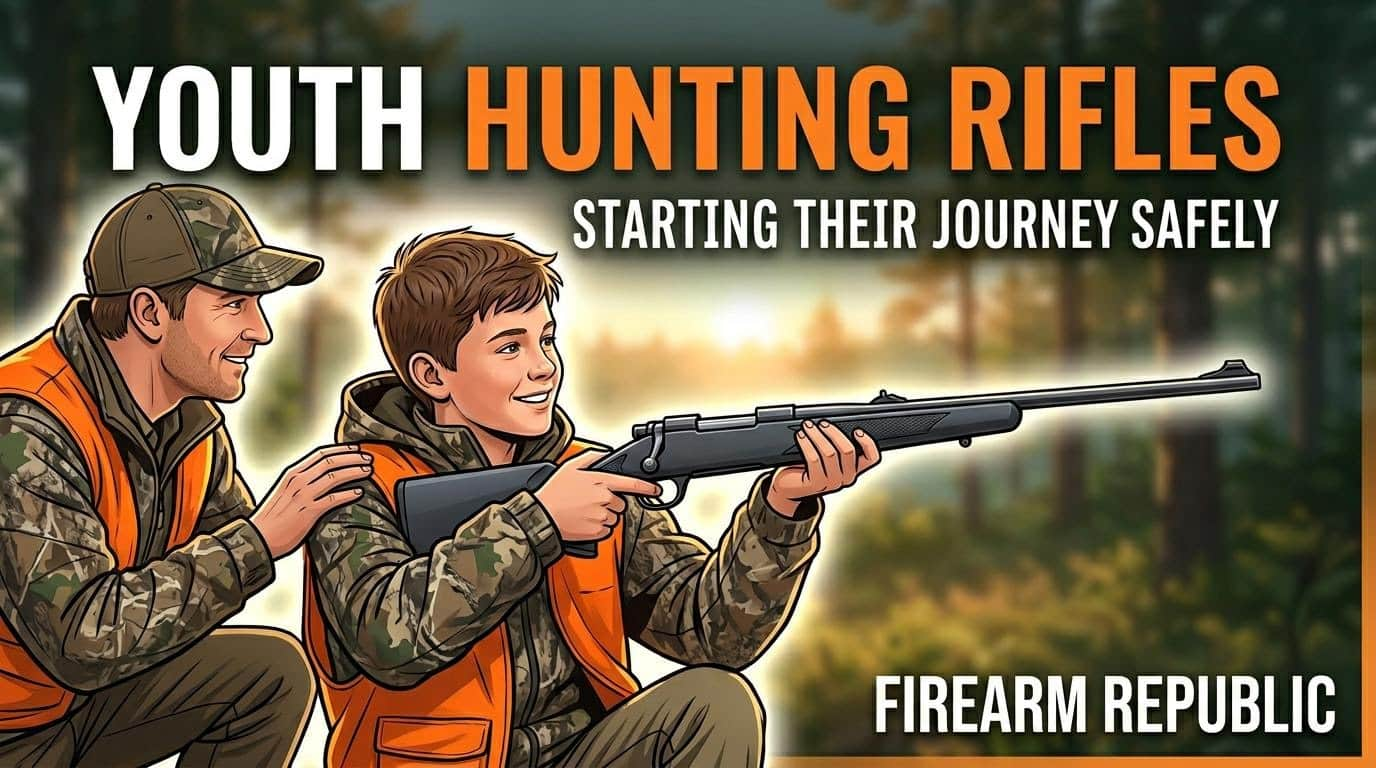
Buying a first hunting rifle for a young hunter is one of the more consequential gear decisions a parent or mentor makes. Get it wrong – too heavy, too long, too much recoil – and the experience is miserable enough to end a hunting relationship before it starts. A 10-year-old flinching away from a full-size .30-06 on the bench isn’t developing bad habits; they’re developing a fear of the rifle that no amount of coaching corrects easily. Get it right – a properly fitted rifle in a mild caliber that the young hunter can shoot confidently – and the fundamentals come quickly, the first deer goes down cleanly, and you’ve created a hunter who will be in the field for the next 60 years. This guide covers youth-specific rifles, caliber selection, fit considerations, and the transition to full-size rifles for hunters ages 8–16. The recommendations here prioritize fit, recoil management, and confidence-building over adult-optimized performance metrics.
Fit First: Why Youth Rifles Are Different
The single most important factor in a youth hunting rifle isn’t caliber or action type – it’s fit. A rifle with a 13.5″ length of pull (LOP) fits a 150-lb adult. A 10-year-old typically needs 11.5″–12.5″ LOP. When a young hunter shoots a rifle with too-long LOP, they crane their neck forward to reach the scope, pull the trigger with the first joint of their finger rather than the pad, and cant the rifle to reach the grip – all of which destroy shooting form and amplify felt recoil. A properly fitted rifle can be shot with consistent form, which means less recoil and better accuracy.
How to measure LOP for a youth shooter:
Have the young hunter hold the rifle in shooting position. Their trigger finger should reach the trigger naturally with the first pad of the finger (not the first joint, not deep in the trigger guard). Their cheek should rest comfortably on the stock with their eye aligned through the scope or sights without stretching forward. A simple field check: if the young hunter can comfortably hold the rifle at port arms (across the body at 45 degrees), the LOP is in the right range. If the butt drags on their forearm, it’s too long.
Most youth-specific rifles ship with 12″–12.5″ LOP. Some adult rifles with adjustable stocks (Ruger American Gen II, Savage 110 series) allow LOP adjustment from 12″ to 14″, making them viable as the young hunter grows rather than requiring a dedicated youth model that becomes obsolete in two years.
Stock height and cheek weld:
Youth hunters using a scoped rifle need adequate cheek weld height to align their eye with the scope’s center. Many youth-stock rifles have relatively low comb height designed for iron sights; when a scope is mounted, the young hunter ends up with their chin on the stock rather than their cheek, which causes inconsistent eye relief and amplifies felt recoil. A cheek riser ($20–$40, slip-on designs from Cabela’s or Amazon) solves this inexpensively without gunsmithing.
Caliber Selection for Youth Hunters
Caliber selection for youth hunters follows a simple hierarchy: start with the mildest caliber that is adequate for the game being hunted, not the most powerful caliber the young hunter can theoretically tolerate. Recoil management is the primary variable; terminal performance on deer-sized game is achievable across a wide range of mild calibers.
.243 Winchester – The Classic Youth Deer Caliber
The .243 Winchester is the traditional first deer rifle caliber for good reason. A 95gr Hornady SST at 3,025 fps generates 1,929 ft-lbs of muzzle energy – more than adequate for whitetail and mule deer inside 300 yards. Recoil in a 6.5-lb rifle runs approximately 9–10 ft-lbs, roughly 40% less than a comparable .308 Winchester. The flat trajectory (–7.5″ at 300 yards from a 200-yard zero) makes holdover intuitive for young hunters still developing their range estimation skills.
The .243’s one legitimate limitation is elk and large game – it’s marginal at best on mature bull elk and not recommended for that use. For the vast majority of youth hunters pursuing whitetail, mule deer, and pronghorn, this limitation is irrelevant. The .243 Winchester is available in more youth-specific rifle configurations than any other deer caliber. See our .243 Winchester Caliber Guide for full ballistic data.
7mm-08 Remington – The Best Youth Deer and Elk Caliber
The 7mm-08 is the most underrated youth hunting caliber available. A 140gr Hornady ELD-X at 2,800 fps generates 2,437 ft-lbs of muzzle energy – adequate for elk inside 250 yards with bonded bullets, and excellent for all deer-sized game to 400 yards. Recoil runs approximately 11–12 ft-lbs in a 6.5-lb rifle – mild enough for youth hunters and manageable for recoil-sensitive adults. The 7mm-08’s BC-to-recoil ratio is the best of any common hunting caliber: more downrange energy than .243, meaningfully less recoil than .308 or 6.5 Creedmoor.
For youth hunters in families that pursue elk alongside deer, the 7mm-08 is the right starting caliber – it covers both use cases without requiring a second rifle when the young hunter transitions to elk country. The ammunition ecosystem is strong: Hornady Precision Hunter 150gr ELD-X, Federal Premium 140gr Trophy Bonded Tip, and Nosler Partition 140gr are all available and provide excellent terminal performance. See our 7mm-08 Remington Caliber Guide for the full picture.
6.5 Creedmoor – The Modern Alternative
The 6.5 Creedmoor in a youth-fit rifle (12″–12.5″ LOP, 6–7 lbs) generates approximately 12–13 ft-lbs of recoil – comparable to 7mm-08 and manageable for most youth hunters 12 and older. The ballistic advantages of 6.5 CM over .243 and 7mm-08 at distance are meaningful for young hunters in open western country where shots past 250 yards are realistic. The ammunition selection is outstanding and includes purpose-built hunting loads at every price point.
The 6.5 CM is not the first choice for the youngest youth hunters (8–11) who are better served by .243’s lower recoil, but it’s an excellent option for teens 13 and older who are physically capable of handling moderate recoil and hunting country where longer shots are expected. A 13-year-old who starts on a 6.5 CM won’t need a caliber upgrade when they start hunting elk at 16. See our 6.5 Creedmoor Caliber Guide for the complete ballistic picture.
.22 LR – The Essential Starting Point
Before any young hunter fires a centerfire deer rifle, they should be proficient with a .22 LR. The fundamentals – trigger discipline, breathing, sight picture, follow-through – are identical across all rifle types, and the .22 LR allows thousands of repetitions at minimal cost and zero recoil. A young hunter who has fired 500 rounds of .22 LR from various positions before touching a deer rifle arrives at the centerfire range with mechanics already developed. One who picks up a .243 cold develops trigger habits under recoil pressure that are harder to unlearn.
The Ruger 10/22 ($300–$350) is the standard youth starting rifle – reliable, accurate, widely available in youth stock configurations, and with an enormous aftermarket. The Marlin Model 60 ($200–$250) is a reliable budget alternative. See our Small Game Hunting Rifles guide for more .22 options and the natural small game hunting progression that builds hunting skills before deer season.
Calibers to Avoid for Youth Hunters
.308 Winchester and .30-06 generate 16–20 ft-lbs of recoil in standard-weight rifles – more than is appropriate for most hunters under 14 and all hunters under 12. These calibers are fine for teens 15+ with proper stock fit and a muzzle brake, but they’re not starting calibers. A youth hunter who develops a flinch on .308 takes years to correct it; a youth hunter who develops confidence on .243 or 7mm-08 transitions to .308 without difficulty.
6.5 PRC, 7mm PRC, and magnums are inappropriate for youth hunters in any realistic scenario. The performance advantages of these cartridges don’t manifest at the distances youth hunters realistically shoot, and the recoil (22–28 ft-lbs) creates shooting problems rather than solving them.
The Rifles: Best Youth Hunting Platforms
Savage Axis II Youth Compact – Best Budget Youth Rifle
Price: $380–$430 street Weight: 6.0 lbs LOP: 12.5″ (youth compact configuration) Calibers: .243 Win, 7mm-08 Rem, .223 Rem, .308 Win Barrel: 20″, non-threaded Trigger: AccuTrigger, 2.5–6 lbs adjustable Accuracy: Sub-MOA guarantee
The Savage Axis II Youth Compact is the most practical value in youth hunting rifles. At $380–$430, it delivers the AccuTrigger – the best factory adjustable trigger in the sub-$500 market – in a 12.5″ LOP package that fits most hunters ages 10–14. The 20″ barrel keeps overall length compact without significantly sacrificing velocity in .243 or 7mm-08. At 6.0 lbs, it’s light enough that an 80-lb 10-year-old can carry it all day.
The AccuTrigger adjusted to 3 lbs is the youth rifle’s defining feature. A clean, light trigger break matters more for youth shooters developing technique than for experienced adult hunters with established mechanics. Poor triggers cause young hunters to slap or jerk; the AccuTrigger’s clean break at 3 lbs teaches correct technique from the first shot. Accuracy is sub-MOA with quality ammunition.
The limitation: the Axis II Youth Compact’s stock is basic synthetic with no adjustability. As the young hunter grows, LOP becomes too short within 2–3 years. The solution – an aftermarket stock or a more versatile adjustable-stock rifle – is worth considering if budget allows at the time of purchase.
Ruger American Compact – Best Value with Adjustable Stock
Price: $550–$620 street Weight: 6.25 lbs LOP: 12″–13.5″ adjustable Calibers: .243 Win, 7mm-08 Rem, 6.5 Creedmoor, .308 Win Barrel: 18″ threaded Trigger: Marksman Adjustable, 3–5 lbs Accuracy: Sub-MOA guarantee
The Ruger American Compact solves the youth rifle’s primary problem: obsolescence. The adjustable LOP from 12″ to 13.5″ means the rifle fits a 10-year-old today and a 14-year-old in four years without modification. The threaded 18″ barrel accepts a muzzle brake immediately if recoil management needs help, and a suppressor later when the young hunter is older and the NFA process is worth pursuing. The AICS-compatible magazine allows 10-round boxes if that’s ever relevant.
The Marksman trigger is the Ruger American’s consistent criticism – it adjusts from 3 to 5 lbs but lacks the clean break of the Savage AccuTrigger. For youth hunters, a heavier trigger is actually a safety argument as much as a performance argument; most youth hunting instructors prefer factory triggers set at 3.5–4 lbs rather than the lightest possible pull. Set at 3.5 lbs, the Marksman is workable. Accuracy is sub-MOA with quality loads. The adjustable stock’s longevity makes the $150–$200 premium over the Savage Axis II Youth a reasonable investment if the rifle will be used for 5–6 years rather than 2–3.
Tikka T3x Lite – Best Mid-Range Youth-to-Adult Transition Rifle
Price: $875–$950 street Weight: 6.1 lbs LOP: 14.25″ standard (requires aftermarket youth stock) Calibers: .243 Win, 7mm-08 Rem, 6.5 CM, .308 Win, and others Barrel: 22.4″ Trigger: Single-stage adjustable, ~2.5 lbs Accuracy: Sub-MOA (0.5–0.7 MOA typical)
The Tikka T3x Lite is not a youth-specific rifle – its 14.25″ LOP is too long for most hunters under 14 – but it belongs in this guide as the best transition platform for teens 14–16 who are ready for an adult rifle. The T3x Lite’s 6.1 lb weight, 2.5-lb factory trigger, and genuine sub-MOA accuracy in 7mm-08 or 6.5 CM make it the best value hunting rifle at the mid-range price for hunters who have outgrown youth-specific platforms.
For a 14-year-old who has developed good technique on a .243 or 7mm-08 youth rifle and is ready to step up, the T3x Lite in 7mm-08 or 6.5 CM is the rifle they’ll carry for the next 30 years. It fits adults, it’s accurate enough for any hunting application, and the caliber selection covers deer and elk without compromise. The investment at $875 makes more sense for a hunter who will use it for decades than the Ruger Compact at $575 that fits perfectly for four years and then needs replacing. See our Tikka T3x Complete Guide for the full platform analysis.
Mossberg Patriot Youth – Lightest Youth Option
Price: $380–$430 street Weight: 5.5 lbs LOP: 12″ standard Calibers: .243 Win, 7mm-08 Rem, .308 Win Barrel: 20″ Trigger: LBA adjustable, 2–7 lbs Accuracy: Sub-MOA guarantee
The Mossberg Patriot Youth is the lightest production youth hunting rifle available at this price point. At 5.5 lbs, it’s 0.5–0.75 lbs lighter than the Savage Axis II Youth Compact – a meaningful difference for an 80-lb hunter carrying a rifle across a mountain. The LBA trigger adjusts from 2 to 7 lbs; at 3.5 lbs it’s clean enough for hunting use. Accuracy is sub-MOA with quality loads. The spiral-fluted bolt is a practical feature that reduces drag in wet and dirty conditions.
The Patriot Youth’s limitation is its 12″ LOP, which fits hunters around ages 9–12 well but has less growth room than the Ruger American Compact’s adjustable stock. The aftermarket is thinner than Savage and Ruger platforms. For the youngest and smallest youth hunters where light weight is the priority, the Mossberg Patriot Youth is the right call. For hunters who expect to use the rifle for 4–5+ years, the Ruger’s adjustable stock is the better investment.
Browning X-Bolt Micro Midas – Best Premium Youth Rifle
Price: $900–$1,000 street Weight: 6.0 lbs LOP: 12.5″–13.5″ (3 spacers allow adjustment) Calibers: .243 Win, 7mm-08 Rem, 6.5 CM, .308 Win Barrel: 20″ free-floating Trigger: Feather Trigger, 3 lbs factory Accuracy: Sub-MOA guarantee
The Browning X-Bolt Micro Midas is the premium youth rifle for families willing to spend $900–$1,000. The LOP adjusts from 12.5″ to 13.5″ via removable spacers in the recoil pad – enough range to fit a 10-year-old today and a 14-year-old in four years. The Inflex recoil pad is the best production recoil management system available; in a 6.0-lb rifle shooting .243 or 7mm-08, perceived recoil is genuinely mild and confidence-building.
The four-lug rotary bolt provides reliable feeding and extraction. The free-floating 20″ barrel is accurate. The Feather Trigger at 3 lbs is clean and consistent. The X-Bolt Micro Midas is a quality rifle that happens to come in a youth configuration, not a simplified “youth version” of a quality rifle. If the budget reaches $900–$1,000, it’s the best complete youth package available. The Inflex recoil pad’s performance advantage over the Mossberg and Savage competitors is especially meaningful in this context – recoil management is the primary youth rifle consideration, and Browning’s pad is the best available.
Comparison: Youth Hunting Rifles
| Rifle | Price | Weight | LOP | Best Caliber | Trigger | Best For |
|---|---|---|---|---|---|---|
| Mossberg Patriot Youth | $400 | 5.5 lbs | 12″ fixed | .243 Win | LBA adj. | Youngest/smallest hunters |
| Savage Axis II Youth | $410 | 6.0 lbs | 12.5″ fixed | 7mm-08 / .243 | AccuTrigger | Best budget trigger |
| Ruger American Compact | $585 | 6.25 lbs | 12″–13.5″ adj. | 7mm-08 / 6.5 CM | Marksman adj. | Best grow-with-the-hunter value |
| Browning X-Bolt Micro Midas | $950 | 6.0 lbs | 12.5″–13.5″ adj. | 7mm-08 / .243 | Feather 3 lbs | Best premium youth rifle |
| Tikka T3x Lite | $900 | 6.1 lbs | 14.25″ | 7mm-08 / 6.5 CM | Excellent 2.5 lbs | Teen 14+ transition to adult |
Recoil Reduction Strategies
Even with the right caliber and properly fitted rifle, some youth hunters need additional recoil management help. Several practical options work before considering a muzzle brake:
Quality recoil pads are the first and easiest intervention. Most youth rifles ship with thin synthetic butt pads. Replacing with a Pachmayr Decelerator ($25–$35, slip-on) or Limbsaver slip-on ($30–$40) reduces felt recoil by 15–25% without gunsmithing. This is the first modification to make on any youth rifle, especially those not equipped with a quality factory pad.
Muzzle brakes reduce recoil by 30–50% by redirecting propellant gas to the sides as the bullet exits. A rifle with a threaded muzzle (the Ruger American Compact has one from the factory) can accept a brake for $50–$150. The trade-off: muzzle brakes dramatically increase muzzle blast – the concussive side-blast is significant and can be disorienting for young hunters and harmful to hearing. A brake should only be used with hearing protection, which is practical at the bench but less so in the field. For range practice with recoil-sensitive youth hunters, a brake on a threaded barrel is a useful tool. For field hunting, a quality recoil pad and appropriate caliber selection is the better approach.
Stock fit adjustment – specifically shortening the LOP – is often the most impactful intervention for youth hunters shooting a hand-me-down adult rifle. A gunsmith can cut the stock and refit a recoil pad for $60–$100. A rifle that fits correctly generates half the perceived recoil of the same rifle shot with poor stock fit.
Reduced-power loads are available in .243, 7mm-08, and 6.5 CM from Hornady and Federal. These loads sacrifice 200–300 fps of velocity to reduce recoil by 20–30% while retaining adequate deer-hunting performance inside 200 yards. For a first-year youth hunter who is still developing confidence, starting the season with reduced loads and transitioning to standard velocity loads as confidence builds is a sound approach.
Teaching Fundamentals: What to Practice Before Opening Day
The rifle is half the equation. The other half is building the shooting fundamentals that allow the young hunter to use it effectively under field conditions. A few specific practices that pay off in the field:
Dry fire before live fire. Every youth hunter should dry fire extensively before shooting live ammunition. Trigger control, breathing, and sight picture are all trainable without recoil or noise. Twenty minutes of dry-fire practice before the first range session produces dramatically better results than going straight to live fire. Snap caps ($15–$20) protect the firing pin and allow realistic dry-fire practice.
Bench work is for zeroing, not training. Most shooting range development happens from a bench, which teaches a position that doesn’t exist in the field. Once the rifle is zeroed and the young hunter is comfortable with the mechanics, transition to prone, sitting, and kneeling positions. A whitetail taken from a treestand is a shooting position the bench doesn’t simulate – kneeling, sitting against a tree, or shooting from a shooting stick.
Know the zero. A youth hunter should know exactly where their rifle hits at 50, 100, and 150 yards. Most first deer shots are inside 150 yards; knowing “my rifle hits 1.5 inches high at 100 yards and dead-on at 150” gives the young hunter a specific aiming reference rather than guessing. Use paper targets at each distance before hunting season and write the results on a card kept in the rifle’s case.
Practice in field clothing. A youth hunter who practices at the range in a t-shirt then hunts in a heavy wool jacket with thick insulating layers finds their cheek weld, trigger reach, and LOP have all changed. At least one practice session per season should be in hunting clothes to confirm fit and zero.
The Transition to Full-Size Rifles
Most youth hunters are ready for full-size adult rifles between ages 14–16, depending on physical development and the caliber involved. The transition should be driven by fit and recoil tolerance, not age. A 15-year-old who is physically slight and has only hunted deer with a .243 is not automatically ready for a .308 – but a 14-year-old who has been shooting 7mm-08 confidently for two seasons and is approaching adult size can step directly to 6.5 Creedmoor or .308 without a meaningful adjustment period.
The cleanest transition path: youth hunter starts on .243 or 7mm-08 in a compact youth rifle, develops technique and confidence over 2–3 seasons, and at 14–16 transitions to the same caliber (7mm-08 or 6.5 CM) in an adult-length stock. The mechanical skills transfer completely; only the LOP and weight change. Transitioning to a new caliber simultaneously with a new stock length creates two variables and slows the adjustment.
For hunters whose first adult rifle will also serve as a one-rifle solution for elk and larger game, see our Best One-Rifle Solution for Hunting guide and our Elk Hunting Rifles Guide for caliber guidance at that transition point.
Pros and Cons of Youth-Specific Rifles
Strengths: ✓ Proper fit enables correct technique from the first shot ✓ Lighter weight reduces fatigue for smaller hunters on long carry days ✓ Shorter LOP prevents the compensating habits that develop with a too-long rifle ✓ Mild calibers (.243, 7mm-08) build confidence without developing flinch ✓ Youth models available in proven platforms with quality triggers (Savage, Ruger, Browning)
Limitations: ✗ Fixed-LOP youth stocks become too short within 2–3 years ✗ Shorter barrels (18–20″) sacrifice 100–200 fps versus full-length barrels ✗ Limited caliber selection versus full-size adult rifles ✗ Fewer aftermarket options for customization ✗ Some youth hunters outgrow the platform faster than the investment justifies
Frequently Asked Questions
Q: What age is appropriate for a child’s first hunting rifle?
A: Physical and emotional readiness matters more than age. Most youth hunters are ready for a first centerfire deer rifle between 10–13 years old, but a mature, focused 9-year-old who has demonstrated safe handling of a .22 LR is a better candidate than a distracted 12-year-old who hasn’t. Prerequisites that matter more than age: demonstrated safe gun handling habits, ability to follow instructions consistently in the field, sufficient strength to hold the rifle steadily for 15–20 seconds, and enough recoil tolerance to shoot the chosen caliber without flinching. Start with extensive .22 LR work and let the young hunter’s readiness determine the timeline.
Q: .243 Winchester or 7mm-08 for a first deer rifle?
A: .243 Winchester for the youngest hunters (ages 9–12) where recoil tolerance is the primary constraint, or for hunters who will primarily pursue deer and never need elk-adequate performance. 7mm-08 Remington for hunters 12 and older who are physically capable of handling slightly more recoil and may eventually hunt elk or larger game – the 7mm-08’s marginal additional recoil buys meaningful additional versatility. Both are excellent; the 7mm-08 is the better long-term choice for most youth hunters who will continue to develop as hunters across multiple species.
Q: Should I buy a dedicated youth rifle or a full-size rifle with an adjustable stock?
A: For hunters 10–13, a dedicated youth rifle (Savage Axis II Youth Compact, Mossberg Patriot Youth) fits better and costs less. For hunters 13–15 who are approaching adult size, a full-size rifle with an adjustable LOP (Ruger American Gen II, Savage 110 with adjustable stock) in a youth-appropriate caliber is the better investment – it fits today and fits in two years, and the hunter won’t feel “outgrown” by the equipment. For a 14-year-old, buying an adult Tikka T3x Lite in 7mm-08 that fits with a spacer adjustment is a 30-year investment. Buying a dedicated youth model for a 14-year-old is a 2-year investment.
Q: How do I reduce recoil for a young hunter?
A: In order of effectiveness: (1) choose the right caliber – .243 or 7mm-08 instead of .308; (2) ensure proper stock fit – LOP that allows natural trigger reach eliminates a major source of perceived recoil; (3) add a quality recoil pad (Pachmayr Decelerator, Limbsaver) to any rifle without a quality factory pad; (4) consider reduced-velocity loads for early-season practice; (5) add a muzzle brake to a threaded barrel if further recoil reduction is needed for bench practice, used with hearing protection. Most youth recoil problems are solved entirely by caliber selection and stock fit before any additional modifications are needed.
Q: Can a youth hunter use a suppressor?
A: Yes – a suppressor on a youth hunting rifle is actually one of the strongest use cases for the technology. Hearing protection that doesn’t require ear muffs (which young hunters frequently remove in the excitement of a shot opportunity) is genuinely valuable, and the recoil reduction from a suppressed subsonic load or even a supersonic hunting load with added suppressor mass is meaningful for recoil-sensitive hunters. The legal issue: an NFA item cannot be possessed by a minor without a parent or trustee present. The suppressor must be registered to an adult (or NFA trust with adult trustees), who must be present whenever the minor uses it. Our Suppressor Buyer’s Guide covers trust setup for family suppressor ownership.
Q: What’s the best first hunting experience for a youth hunter before deer season?
A: Small game hunting – squirrel, rabbit, or dove – is the best preparation for a youth hunter’s first deer season. The lower stakes (missing a squirrel is not the same as missing or wounding a deer), the faster shooting opportunities, and the skills built around game identification, ethical shots, and field dressing translate directly to deer hunting. A youth hunter who has taken 10 squirrels and cleaned them before deer season understands what a clean kill looks like, has developed field shooting positions, and has processed the emotional component of taking an animal before facing the pressure of a deer stand. See our Small Game Hunting Rifles guide for platform and caliber recommendations.