 Maksym Kovaliov
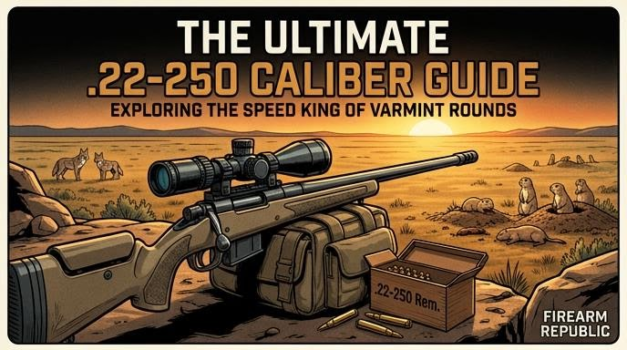


The .22-250 Remington is the cartridge that defined high-velocity varmint hunting in America for the second half of the 20th century – and still does. Pushing 40–55gr bullets to 3,700–4,000 fps from a bolt-action rifle, it was the fastest factory cartridge available for decades and produced explosive fragmentation on prairie dogs, groundhogs, and coyotes at distances that rimfire cartridges and slower centerfire alternatives could not approach. Commercially standardized by Remington in 1965 from a wildcat cartridge that had been developed in the 1930s, it has outlasted every serious competitor in the varmint bolt-action category. Today it competes with the .204 Ruger (faster but with worse bullet selection) and the .223 Remington (more affordable but slower) in the bolt-action varmint role, and it wins for a specific and defensible reason: at the 250–350 yard range where prairie dog and groundhog hunting regularly operates, no production factory cartridge combines the .22-250’s velocity, availability, and bullet weight range as effectively. At $0.65–$0.90 per round for standard varmint loads and $0.85–$1.20 per round for quality hunting ammo, it sits at a modest premium over .223 Rem that most dedicated varmint hunters accept without hesitation.

What Is the .22-250 Remington?
The .22-250 Remington traces its origins to a wildcat cartridge developed in the early 1930s by gunsmiths who wanted to push .22-caliber bullets faster than any cartridge of the era permitted. The approach was to neck down the .250 Savage case – a well-proportioned varmint-capable case with good powder capacity – to accept .224-caliber bullets. The resulting wildcat was known by several names before Remington standardized it commercially as the .22-250 Remington in 1965.
The case is based on the .250-3000 Savage with a 1.912″ case length and 2.350″ overall length, fitting comfortably in a short-action bolt rifle. At .473″ rim diameter, it shares the same bolt face as the .308 Winchester family, meaning any short-action bolt rifle designed for the .308 can be chambered for .22-250 with a barrel swap. Case capacity of approximately 43 grains of water gives it enough powder volume to achieve the velocity figures that define its performance without the pressure challenges that more compact .224-caliber cases produce at comparable velocities.
Maximum pressure sits at 65,000 PSI – above the .308 Win’s 62,000 PSI – which contributes to the cartridge’s slightly shorter barrel life relative to lower-pressure alternatives.
Ballistics: The Numbers That Matter
The .22-250 Remington’s ballistic profile is defined by velocity. At 3,700–4,000+ fps with 40–55gr bullets from a 24″ barrel, it produces the flattest factory rifle trajectory available in any common production varmint cartridge. From a standard 22″ hunting barrel, expect 3,550–3,750 fps depending on bullet weight and powder charge.
| Load | MV (24″, fps) | 300 yd Velocity | 300 yd Energy | 300 yd Drop (200 yd zero) | 15 mph Wind @ 300 yd |
|---|---|---|---|---|---|
| 40gr V-MAX | 4,150 | 2,685 | 641 ft-lbs | -5.1″ | 9.8″ |
| 50gr V-MAX | 3,850 | 2,621 | 763 ft-lbs | -5.8″ | 8.6″ |
| 55gr V-MAX | 3,750 | 2,603 | 828 ft-lbs | -6.1″ | 8.2″ |
| 55gr Ballistic Tip | 3,680 | 2,573 | 808 ft-lbs | -6.4″ | 8.4″ |
| 60gr V-MAX | 3,600 | 2,555 | 869 ft-lbs | -6.7″ | 7.7″ |
| 64gr SP (deer/coyote) | 3,400 | 2,467 | 865 ft-lbs | -7.4″ | 7.3″ |
The trajectory numbers tell the .22-250’s story clearly. At 300 yards with a 200-yard zero, the 55gr V-MAX drops only 6.1 inches – less than half the .223 Rem’s 11.8 inches at the same distance. This difference translates directly to field performance: a hunter who misjudges a prairie dog at 280 yards as 300 yards misses by 0.8 inches with the .22-250 where the same range estimation error misses by 2+ inches with .223 Rem.
Wind performance at 300 yards with 55gr V-MAX in a 15 mph crosswind: approximately 8.2 inches of drift. Comparable to the .223 Rem’s performance (8.5–9.0 inches with the same bullet), because wind drift is primarily a BC function and both cartridges use identical bullets. The .22-250’s wind advantage over .223 Rem is primarily the trajectory – less drop means less range estimation sensitivity, which indirectly reduces wind drift errors from misjudged distances.
.22-250 vs. The Competition
.22-250 vs. .223 Remington
The .223 Rem fires the same bullet range at 200–500 fps less velocity. At 200 yards, both cartridges handle prairie dogs effectively. At 250–350 yards – the range where the .22-250’s advantage is most practical – the .22-250’s flatter trajectory provides a meaningful margin for range estimation error. The .223 Rem’s advantages are dramatically lower per-round cost ($0.40–$0.60 vs. $0.65–$0.90), wider rifle availability, and the ability to practice high-volume at lower financial cost. For hunters whose shooting stays inside 250 yards, .223 Rem is the practical choice. For those who regularly engage 250–350 yard targets, the .22-250’s trajectory advantage earns its premium. See our .223 Remington Caliber Guide.
.22-250 vs. .204 Ruger
The .204 Ruger fires 32–40gr bullets at 4,000–4,225 fps – faster than the .22-250 with comparable bullet weights. It achieves a flatter trajectory and in calm conditions produces marginally better precision. The .22-250 counters with a substantially wider bullet weight range (40–64gr practical hunting range vs. .204’s 24–45gr), more rifle options, better factory ammo availability, and a reloading data depth that 20+ years of development beyond the .204 Ruger’s 2004 introduction produces. For hunters who want the absolute flattest-shooting varmint cartridge and reload, the .204 Ruger is a legitimate alternative. For the majority who want broader utility and wider support, the .22-250 is the more practical choice.
.22-250 vs. .243 Winchester with Varmint Loads
The .243 Win with 75–80gr varmint loads at 3,400–3,500 fps produces better wind performance than the .22-250 with 55gr at comparable distances because the heavier 6mm bullet’s better BC overcomes the velocity disadvantage. At 300 yards in a 15 mph wind, the .243 Win 75gr V-MAX drifts approximately 7.0 inches vs. the .22-250’s 8.2 inches with 55gr V-MAX. For hunters who want maximum wind resistance in a single platform, the .243 Win in a dual varmint-deer role makes sense. For dedicated varmint hunters who want maximum velocity and trajectory flatness, the .22-250 is the traditional choice. See our .243 Winchester Caliber Guide.
Factory Ammunition: What to Buy
The .22-250 factory ammo market is narrower than .223 Rem but adequately stocked at major retailers. Hornady, Federal, Remington, Winchester, and Nosler all load it in multiple configurations.
For prairie dogs and varmints (explosive fragmentation):
Hornady 40gr V-MAX ($0.70–$0.85/round) – Maximum velocity configuration at 4,150+ fps from a 24″ barrel. The extreme velocity and V-MAX fragmentation produces the most dramatic terminal results of any factory .22-250 load. Close-range (inside 175 yards) shots on prairie dogs are immediately lethal. The trade-off is meaningful barrel wear from extended 40gr sessions – the high-pressure/high-velocity combination with lighter bullets accelerates throat erosion faster than heavier loads.
Hornady 50gr V-MAX ($0.75–$0.90/round) – The most popular all-around .22-250 varmint load. Better BC than the 40gr provides improved wind performance at 250+ yards, and the slightly lower velocity (3,850 fps) reduces barrel heat and throat erosion compared to the 40gr. For hunters who run long prairie dog sessions, the 50gr represents a better balance between performance and barrel longevity than the extreme-velocity 40gr.
Hornady 55gr V-MAX ($0.75–$0.90/round) – The standard coyote load for .22-250 hunters. Better BC than lighter bullets, still produces explosive fragmentation at typical coyote distances (50–300 yards), and the slightly heavier weight provides marginally better wind resistance than the 50gr. For hunters who use the .22-250 for both prairie dogs and coyotes with the same load, the 55gr V-MAX is the recommended compromise.
For coyotes and predators (controlled terminal performance):
Hornady 60gr V-MAX ($0.80–$0.95/round) – For hunters who call coyotes and want maximum precision and controlled fragmentation. The 60gr at 3,600 fps produces reliable kills on coyotes to 300 yards with marginally better wind performance than the 55gr, and the slightly heavier construction is somewhat less prone to surface fragmentation that leaves animals hit but not recovered.
Winchester 64gr Power Point ($0.75–$0.90/round) – A soft-point load for hunters who want controlled expansion rather than fragmentation on coyotes and larger varmints. Less spectacular terminal result than V-MAX but better penetration on angled shots. The choice for hunters who sell pelts and want reduced pelt damage from explosive loads at close range.
For dual varmint-deer use:
Remington 55gr AccuTip-V ($0.80–$0.95/round) – For hunters who use the .22-250 in states where it is legal for deer (verify regulations) as well as varmints. The AccuTip-V’s controlled expansion provides more reliable penetration on medium game than pure varmint fragmentation loads.
| Load | Type | Price | Best Application |
|---|---|---|---|
| Hornady 40gr V-MAX | Varmint | $0.75/rd | Close-range prairie dogs |
| Hornady 50gr V-MAX | Varmint | $0.82/rd | All-around varmint work |
| Hornady 55gr V-MAX | Varmint/Predator | $0.82/rd | Coyote + prairie dogs |
| Hornady 60gr V-MAX | Predator | $0.88/rd | Dedicated coyote hunting |
| Winchester 64gr Power Point | Predator/Deer | $0.82/rd | Pelt preservation, deer |
| Remington 55gr AccuTip-V | Dual-purpose | $0.87/rd | Varmint + deer states |
Reloading the .22-250 Remington
The .22-250 is an excellent reloading cartridge with deep, well-developed load data from decades of use. Reloaders can push performance beyond factory maximums in the upper velocity range and achieve the load consistency that precision varmint shooting demands.
Brass: Remington factory brass is the standard – adequate for hunting and practice reloads at accessible pricing. Lapua .22-250 brass ($65–$75/100) is available and provides the consistency precision reloaders expect from the brand. Federal and Winchester brass are suitable alternatives. Case life is shorter than low-pressure cartridges due to the .22-250’s 65,000 PSI maximum – expect 4–7 firings with conservative sizing discipline vs. 8–12 from .308-family cartridges.
Powder: The .22-250’s case capacity works best with medium-burn-rate powders. Hodgdon Varget is the community standard for 50–60gr bullets – excellent temperature stability, consistent metering, and velocity-to-pressure ratios that push the 55gr V-MAX to 3,760–3,800 fps safely from a 24″ barrel with approximately 35–36gr. IMR 4064 is the classic alternative with comparable performance. Benchmark and H322 are preferred for lighter 35–45gr bullets at maximum velocity. For the 60–64gr class, H4895 and CFE 223 provide better velocity with larger bullets.
Bullets: The full range of .224-caliber varmint bullets is available for the .22-250. Hornady V-MAX in 40, 50, 55, and 60gr are the production standards. Sierra BlitzKing in 40, 50, and 55gr are the alternatives for reloaders who prefer Sierra. Berger 52gr and 55gr Flat Base Target bullets are used by precision varmint competition shooters. For the heaviest end, Hornady 60gr V-MAX and Sierra 63gr Semi-Spitzer provide the best BC available in this caliber range.
Twist rate considerations: Most .22-250 production rifles ship with 1:12 or 1:14 twist rate, optimized for 40–55gr bullets. This twist rate will not adequately stabilize bullets heavier than approximately 60gr. Some modern .22-250 rifles use a 1:10 twist that handles up to 75gr bullets for extended range work, but this is less common in production rifles. Verify your barrel’s twist rate before loading bullets at the heavy end of the caliber range.
Barrel heat in reloading practice: The .22-250’s high velocity generates significant barrel heat during extended shooting sessions. When developing loads, limit strings to 5 shots before allowing the barrel to cool to ambient temperature. Heat-induced pressure signs (flattened primers, sticky extraction) can appear earlier in a hot barrel than a cool one, leading to inaccurate pressure assessment during load development. Allow 5–10 minutes cooling time between development strings.
Best Applications for the .22-250 Remington
Prairie Dog Hunting
This is the .22-250’s defining application. On a productive prairie dog town in South Dakota, Wyoming, or Colorado, a session may involve 150–300 shots in a day at targets from 50 to 350 yards. The .22-250’s flat trajectory simplifies holdover across this range: zeroed at 200 yards, the 55gr V-MAX is approximately 2 inches high at 100, on at 200, and 6 inches low at 300. The holdover from any position from 100 to 275 yards requires less than 2 inches of adjustment – well within the precision most varmint hunters can execute from a bipod. See our Varmint Hunting Rifles Guide for full varmint hunting setup context.
Coyote and Predator Hunting
The .22-250 is the most widely used dedicated coyote cartridge among bolt-action hunters who call and shoot in open country. At 55–60gr loads, it produces reliable kills on coyotes to 300 yards with the trajectory that makes shot placement at variable distances more consistent. The trade-off vs. the .223 Rem is meaningful only at 200+ yards where the velocity and trajectory differences become practical. For hunters who routinely call coyotes to 100 yards or less, .223 Rem with lower cost provides equivalent effectiveness. See our Coyote Hunting Rifles guide.
Groundhog and Eastern Varmint Hunting
Groundhog (woodchuck) hunting in the agricultural East – Pennsylvania, Virginia, Ohio, New York – produces some of the longest-range varmint shots available outside the western plains. A groundhog at 300 yards in an eastern hay field presents a 2–3 inch vital zone that demands both accurate range estimation and a flat-shooting cartridge. The .22-250 with 50–55gr V-MAX handles this application at the limit of what most hunters can execute from supported field positions. For hunters who use the same rifle for fall deer hunting, the .22-250 in states that allow it for deer provides one platform for both applications.
Combination Varmint-Deer Rifle
In states where the .22-250 is legal for deer, the 64gr Power Point or 60gr controlled-expansion loads at 3,400–3,600 fps provide adequate terminal performance inside 200 yards on deer. The .22-250 is not ideal for deer – the bullet diameter and weight are at the lower bound of ethical margin – but in states where hunting varmints and deer with the same rifle from the same truck is the practical reality, it handles the dual role with appropriate bullet selection. Verify your state’s minimum caliber requirements for deer before using the .22-250 for that application.
Barrel Life: The Honest Assessment
The .22-250 has one of the shorter barrel lifetimes of any common hunting cartridge. At 65,000 PSI maximum pressure and the high-velocity/high-heat combination of regular varmint shooting sessions, most shooters report 1,500–2,500 rounds before accuracy begins to degrade. Sustained 40gr sessions at maximum velocity accelerate this toward the lower end; conservative 55–60gr loads at moderate pace extend it toward the higher end.
For hunters who shoot 50–150 rounds per prairie dog trip twice a year, barrel life translates to 5–15 years of useful service before replacement – not a practical concern for most hunting use. For competition varmint shooters who put 500+ rounds through the rifle annually at maximum velocity, budget for barrel replacement every 3–5 years.
Quality stainless steel barrels (Bartlein, Krieger, Criterion) in .22-250 run $300–$500 installed on Remington 700-footprint actions. The Savage barrel-nut system allows DIY barrel replacement with basic tools. See our Savage 110 Series Guide for Savage platform barrel replacement context.
Who Should Choose the .22-250 Remington?
The .22-250 is your cartridge if:
You are a dedicated prairie dog or groundhog hunter who regularly shoots at 200–350 yards and wants the flattest trajectory available in a bolt-action varmint cartridge with broad factory ammo support. You hunt coyotes primarily from open stands where shots reach 200–300 yards and want a bolt-action that handles both prairie dog and coyote seasons from the same platform. You already own a .22-250 and appreciate its performance – there is no compelling reason to switch to .204 Ruger or .243 Win for varmint work when the .22-250 serves the application well.
Look elsewhere if:
You primarily shoot inside 200 yards on prairie dogs or varmints and want maximum cost efficiency – the .223 Rem’s lower per-round cost enables more practice volume for equivalent hunting effectiveness at those distances. You want one rifle for varmints and deer that also handles 300-yard deer shots with ethical confidence – the .243 Win’s dual varmint-deer capability is meaningfully better at hunting distances where deer ethics require more than the .22-250’s bullet weight provides. You want the absolute flattest-shooting varmint cartridge available and are comfortable with a niche platform – the .204 Ruger achieves this at the cost of narrower ammo selection. You are a high-volume competition varmint shooter who values barrel life highly – the .22-250’s shorter barrel life vs. .223 Rem is a meaningful ongoing cost difference at 1,000+ rounds per year.
Frequently Asked Questions
Is the .22-250 good for deer hunting?
Where legal (verify state regulations – minimum caliber requirements often exclude it), it is capable inside 150 yards with quality 60–64gr expanding loads. The honest assessment: it is at the lower bound of ethical margin for deer due to bullet diameter and weight, requiring more precise shot placement than larger cartridges. For hunters who specifically want dual varmint-deer capability in one platform, the .243 Win handles the deer application more confidently with comparable varmint performance. The .22-250 as a deer cartridge should be a last resort or a state-specific regulatory choice, not a first recommendation.
What is the effective range of the .22-250 for prairie dogs?
In calm conditions with a quality load and a practiced shooter on a bipod: 350 yards is the consistent ceiling where the 55gr V-MAX maintains explosive fragmentation energy and the trajectory remains manageable. At 400 yards, velocity has dropped enough that fragmentation becomes less reliable and wind drift requires precise compensation that most hunters cannot consistently deliver from field positions. The practical effective range is 250–350 yards for most hunters in moderate wind conditions.
Does the .22-250 destroy pelts for coyote hunting?
At close range (inside 150 yards) with 40–55gr V-MAX loads, yes – explosive fragmentation produces significant exit wound damage. For fur hunters who want to preserve coyote pelts, the 60gr V-MAX or 64gr Winchester Power Point produces considerably less pelt damage than lighter frangible loads. Alternatively, a suppressed .300 BLK with 220gr subsonic loads provides the minimal pelt damage option for close-range coyote hunting. At 200+ yards where impact velocity has dropped, V-MAX fragmentation is more controlled and pelt damage is reduced.
What barrel length is best for the .22-250?
A 24″ barrel is the standard recommendation that maximizes the cartridge’s velocity potential – the .22-250 is a velocity-defined cartridge and the 24″ barrel extracts the full performance the case capacity enables. A 22″ barrel loses approximately 75–100 fps vs. a 24″ tube with minimal practical impact at varmint distances. A 26″ barrel adds approximately 50–75 fps over the 24″ with diminishing returns. For production varmint rifles where barrel weight is managed, 24″ is the correct specification.
How often do I need to clean the .22-250 after a prairie dog session?
Clean after every session of more than 50 rounds, and more frequently if shooting lead-core frangible bullets at close range that produce heavier fouling. After extended rapid-fire prairie dog strings, the bore accumulates copper fouling from the high-velocity bullet engraving and lead/core fouling from fragmented bullets that are caught in the muzzle blast. A dedicated copper solvent (Bore Tech Eliminator, Montana X-Treme Copper Killer) applied after each session and left to soak for 30–60 minutes removes fouling that standard solvent alone does not address. Fouling that accumulates between sessions shortens barrel life measurably.
Related Caliber Guides
- .223 Remington Caliber Guide
- .243 Winchester Caliber Guide
- .17 HMR Caliber Guide
- .22 LR Caliber Guide
- 6mm ARC Caliber Guide
- 6.5 Grendel Caliber Guide
- AR-15 Caliber Selection Guide
Related Application Guides
- Varmint Hunting Rifles Guide
- Coyote Hunting Rifles
- Small Game Hunting Rifles
- Whitetail Deer Hunting Rifles
- Hog Hunting Rifle Guide
Related Platform Guides
- Tikka T3x Complete Guide
- Savage 110 Series Guide
- Ruger American Complete Guide
- Remington 700 Platform Guide