 Maksym Kovaliov
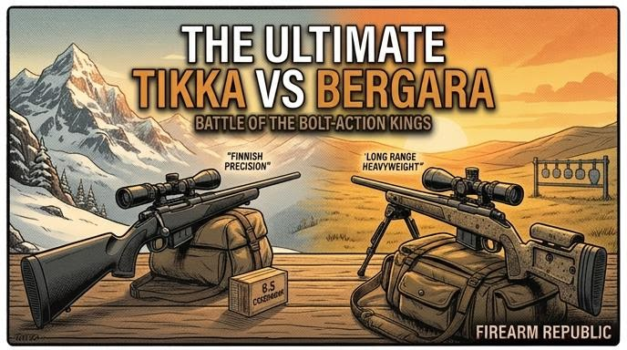
The mid-range bolt-action market has two rifles that consistently rise to the top of every recommendation thread, every gear guide, and every “what should I buy” conversation: the Tikka T3x and the Bergara B-14. Both are genuinely excellent. Both produce sub-MOA accuracy out of the box. Both are available in every relevant hunting and precision caliber. Both sell between $875 and $1,100 depending on configuration. And yet they’re meaningfully different rifles that suit different buyers, and buying the wrong one for your specific use case is a real mistake worth avoiding. This guide breaks down every relevant category head-to-head and tells you which rifle wins each one – and more importantly, which one wins for you.
The Rifles at a Glance
Tikka T3x ($875–$1,100 street depending on configuration) is manufactured by Sako in Finland and represents the mid-range tier of one of Finland’s most respected firearms manufacturers. The T3x family spans configurations from the ultralight T3x Lite (6.1 lbs) to the precision-oriented T3x TAC A1 (over 11 lbs in full chassis configuration), with the Lite, Hunter, and Varmint configurations being the most common among hunting buyers. The three-lug 70-degree bolt, adjustable single-stage trigger, and cold hammer-forged barrel are the platform’s defining technical features. See our Tikka T3x Complete Guide for the full platform breakdown.
Bergara B-14 ($950–$1,150 street depending on configuration) is manufactured in Spain by Bergara, a barrel manufacturer that expanded into complete rifles in 2013. The B-14 family includes the Hunter (traditional hunting stock), Ridge (fiberglass-reinforced stock), HMR (mini-chassis precision), Wilderness (rough-finish synthetic), and several other configurations. All B-14 models share a Remington 700-compatible action footprint – the single most important technical distinction between the T3x and B-14 platforms. See our Bergara B-14 Series Guide for the full breakdown.
Trigger: Tikka T3x Wins Narrowly
The Tikka T3x’s single-stage adjustable trigger is factory-set at approximately 2.5 lbs with a break quality that consistently surprises shooters expecting budget-tier performance. The break is clean, the reset is short, and overtravel is minimal. At 2.5 lbs, it rivals aftermarket triggers costing $150–$200 installed on competing platforms. This is not marketing language – experienced shooters who pull the T3x trigger for the first time consistently comment on how good it is relative to price expectations.
The Bergara Performance Trigger (BPT) factory-set at approximately 3 lbs is also good by production rifle standards. The break is clean, overtravel is minimal, and it adjusts to approximately 2.25 lbs with set screw access. When adjusted, the BPT approaches the T3x’s factory trigger quality. But the T3x arrives out of the box closer to optimal for most shooters, and the 0.5-lb difference between factory settings is perceptible in side-by-side comparison.
Where the distinction narrows: the B-14 accepts TriggerTech and Timney replacement triggers directly without modification, due to its Remington 700-compatible trigger pocket. A TriggerTech Primary ($130) in a B-14 is definitively better than the T3x’s factory trigger. The T3x does not accept Remington 700-pattern aftermarket triggers – Tikka-specific replacement options exist but are limited and expensive ($250–$450). For buyers who will shoot the rifle as delivered, the T3x wins this category. For buyers willing to invest $130 in a trigger upgrade, the B-14 with a TriggerTech ends up in a different league.
Winner: Tikka T3x (factory); Bergara B-14 (with $130 upgrade)
Accuracy: Bergara B-14 Wins
Both rifles carry sub-MOA accuracy guarantees and both generally deliver. But the Bergara B-14 consistently produces tighter groups in independent testing across multiple calibers and configurations.
The T3x Lite and T3x Hunter typically produce 0.5–0.8 MOA groups with quality match ammunition. The Bergara B-14 Hunter typically produces 0.4–0.6 MOA. The B-14 HMR, with its mini-chassis bedding block and heavier barrel profile, regularly produces 0.3–0.5 MOA – approaching custom rifle accuracy at a $1,100 production price.
The explanation lives in the barrel and bedding. Bergara is primarily a barrel manufacturer – the company built its reputation making barrels for other rifle producers before branching into complete rifles. The B-14’s barrel manufacturing quality is the foundation of the platform, and it shows in group sizes. The B-14 Hunter and Ridge models include a mini-chassis aluminum bedding block that provides more consistent barrel harmonics than a standard stock bedding surface. These aren’t marginal differences in controlled testing.
For hunters shooting at distances where 0.1–0.2 MOA differences between platforms are meaningful (300+ yards on pronghorn, 400-yard elk shots, precision target work), the Bergara’s accuracy advantage is real. For hunters taking shots inside 250 yards on deer, the practical difference is invisible – both rifles put bullets in the kill zone at any realistic whitetail distance.
Winner: Bergara B-14
Weight: Tikka T3x Wins Clearly
The T3x Lite at 6.1 lbs is one of the lightest production hunting rifles at any price. The T3x Hunter runs 6.6 lbs. The Bergara B-14 Hunter at 7.0 lbs and the B-14 Ridge at 7.7 lbs are meaningfully heavier.
In absolute numbers, the T3x Lite vs. B-14 Hunter difference is 0.9 lbs. Scoped with a compact 3-9×40 scope ($300–$400), the T3x Lite system runs 7.4–7.7 lbs; the B-14 Hunter system runs 8.5–8.8 lbs. That 1-lb difference compounding over a full western hunt – 8 miles per day at 9,000 feet for 5 days – is the difference between comfortable and grinding. For backcountry elk, mountain mule deer, and sheep hunters who cover serious miles, the T3x’s weight advantage is a meaningful practical consideration, not a specification-sheet detail.
For stand hunters, truck hunters, and bench shooters, the weight difference is irrelevant. But the buyers who are most likely comparing T3x vs. B-14 are often precisely the western and backcountry hunters for whom this matters most.
The Bergara B-14 Wilderness configuration is available in carbon-fiber-wrapped barrel versions that bring weight to 6.5–6.8 lbs – narrowing the gap significantly at a $1,300–$1,500 price point. But in the core comparison of standard configurations, the T3x wins weight by a clear margin.
Winner: Tikka T3x
Aftermarket and Platform Flexibility: Bergara B-14 Wins Clearly
This is the most significant category in the comparison and the primary reason the B-14 is the right choice for a specific type of buyer.
The Bergara B-14 is built on a Remington 700-compatible action footprint. This single fact opens the entire Remington 700 aftermarket ecosystem:
Stocks and chassis: MDT ESS, MDT ACC, KRG Bravo, Manners T4, McMillan A3, Bell & Carlson Medalist – every major precision rifle stock and chassis system fits the B-14 directly without adapters or modification. A B-14 Hunter purchased today can be placed into a $700 MDT chassis next year, turning a hunting rifle into a precision rifle platform without replacing the barreled action.
Triggers: TriggerTech Primary ($130), Timney Calvin Elite ($240), Jewell HVR ($260) – the full catalog of Remington 700-pattern triggers fits the B-14 directly. A $130 TriggerTech Primary in a B-14 is a fundamentally different trigger experience than either platform’s factory offering.
Scope bases and rings: Every Remington 700-pattern scope base, ring, and optic mount fits the B-14. The selection is wider than for any other production bolt-action platform.
The Tikka T3x uses a proprietary action footprint. Stock options are limited to Tikka-specific aftermarket products (MDT makes a T3x chassis, KRG makes a T3x stock) plus the existing factory stock options. Trigger options are Tikka-specific and expensive. The magazine is proprietary to Tikka.
For hunters who want a rifle that works perfectly as delivered and will never be modified, the Tikka’s limited aftermarket is irrelevant. For hunters who think of their rifle as a platform to develop – adding a chassis for long-range work, upgrading the trigger for competition, changing calibers – the B-14’s Remington 700 footprint is not a minor detail. It’s the reason to choose B-14 over T3x for buyers with any upgrade intent.
Winner: Bergara B-14 (not close)
Magazine System: Bergara B-14 Wins
The Bergara B-14 uses an AICS-compatible detachable box magazine (5 rounds standard). AICS compatibility means the rifle accepts the same aftermarket magazines used by virtually every precision rifle and chassis system on the market – 10-round AICS magazines from Accurate Mag, MDT, and others cost $25–$50 and drop directly into the B-14’s mag well.
The Tikka T3x uses a proprietary single-stack detachable magazine. Standard capacity is 3 rounds (short action); 6-round extended Tikka magazines are available at $60–$80 each. The proprietary interface means aftermarket AICS magazines do not fit without chassis conversion. For hunters who primarily hunt (where 3+1 rounds is entirely sufficient), this distinction is largely academic. For hunters who run the rifle in PRS competition or want 10-round capacity for hog hunting, the Bergara’s AICS compatibility is a practical advantage.
Winner: Bergara B-14
Bolt Feel and Cycling: Tikka T3x Wins
The Tikka T3x bolt is the benchmark for smooth cycling in production bolt-action rifles at any price. The three-lug design with a 70-degree throw cycles with a buttery smoothness that competing rifles in the $500–$1,500 price range rarely match. Experienced shooters who pick up a T3x for the first time consistently comment on the bolt feel. It’s not subtle – the T3x bolt feels like a significantly more expensive rifle than it costs.
The Bergara B-14’s two-lug bolt with a 90-degree throw is entirely serviceable – smooth enough for hunting use and reliable in field conditions. But next to the T3x bolt, it feels like what it is: a well-executed standard production bolt-action design. The 90-degree throw requires slightly more hand movement to cycle than the T3x’s 70-degree throw, which is a minor ergonomic consideration for rapid follow-up shots.
For hunters in thick timber who take fast follow-up shots on moving animals, the T3x’s faster bolt throw and smoother cycling are a practical advantage. For bench and long-range shooters who cycle the bolt deliberately between shots, the difference is cosmetic.
Winner: Tikka T3x
Weather Resistance and Field Durability
Both rifles are available in weather-resistant configurations, but the specific implementations differ.
The Tikka T3x’s synthetic stocks are well-sealed and weather-resistant in all configurations. The cold hammer-forged barrel and standard blued or stainless steel finishes hold up well in normal hunting conditions. The T3x’s design is tight and well-fitted, with minimal surface area for water and debris ingress. Tikka’s Finnish manufacturing heritage – the company operates in a country where outdoor equipment is routinely tested by genuinely harsh weather – produces a rifle that handles field conditions reliably.
The Bergara B-14 Wilderness configuration adds a rough Cerakote finish to the barrel and action for improved corrosion resistance beyond standard stainless steel. The fiberglass-reinforced stocks on the B-14 Ridge and Wilderness configurations are more rigid and less susceptible to moisture-induced changes than standard synthetic stocks. For wet-climate hunting (Pacific Northwest, coastal Alaska, rainy mountain hunts), the B-14 Wilderness configuration’s Cerakote finish has a practical advantage.
In standard configurations (B-14 Hunter vs. T3x Lite/Hunter), both rifles handle hunting-normal weather conditions reliably. Neither requires special care beyond basic maintenance.
Winner: Tie (B-14 Wilderness has edge in extreme wet conditions)
Value: Tikka T3x Wins at Entry Level
At the base configuration level, the Tikka T3x Lite ($875–$900) provides better trigger quality, lighter weight, and smoother bolt cycling than the Bergara B-14 Hunter ($950–$1,050) at a lower price. For a buyer who wants the best hunting rifle as delivered at the lowest possible price, the T3x Lite is the stronger value.
The value calculus shifts when upgrades are factored in. A B-14 Hunter with a TriggerTech Primary ($130) and in an AICS-compatible magazine configuration represents a platform worth $100–$150 more than the base B-14 price for a total system cost of $1,080–$1,180. That configured B-14 has a better trigger than the T3x, comparable or better accuracy, and full Remington 700 aftermarket flexibility – a stronger overall platform for a buyer willing to invest modestly in upgrades.
Winner: Tikka T3x (factory configuration, no upgrades)
Head-to-Head Comparison Table
| Category | Tikka T3x Lite/Hunter | Bergara B-14 Hunter | Winner |
|---|---|---|---|
| Price | $875–$950 | $950–$1,050 | Tikka T3x |
| Weight | 6.1–6.6 lbs | 7.0–7.7 lbs | Tikka T3x |
| Factory trigger | Excellent 2.5 lbs | Very good 3 lbs | Tikka T3x |
| Trigger (upgraded) | Limited options | TriggerTech drop-in | Bergara B-14 |
| Accuracy | 0.5–0.8 MOA | 0.4–0.6 MOA | Bergara B-14 |
| Magazine | Proprietary 3rd | AICS-compatible 5rd | Bergara B-14 |
| Aftermarket stocks | Tikka-specific only | Full Rem 700 ecosystem | Bergara B-14 |
| Bolt smoothness | Best in class | Standard production | Tikka T3x |
| Bolt throw | 70-degree | 90-degree | Tikka T3x |
| Platform flexibility | Limited | Extensive | Bergara B-14 |
| Caliber selection | Good | Excellent | Bergara B-14 |
Who Should Buy the Tikka T3x
The backcountry and western hunter: The T3x Lite in 6.5 Creedmoor or 7mm PRC at 6.1 lbs is the best sub-$1,000 hunting rifle for hunters who cover serious miles. The weight advantage over the B-14 Hunter compounds across a full backcountry hunt. Paired with a compact 3-9x scope, the system stays under 7.7 lbs – meaningfully lighter than any B-14 configuration at comparable price. For high-country elk, mountain mule deer, pronghorn across open basins, and any hunt where the rifle goes in a pack, the T3x Lite’s weight is the single most important variable.
The hunter who won’t modify: For a buyer who wants a complete, excellent hunting rifle at a fair price and has zero intention of adding a chassis, upgrading the trigger, or changing calibers, the T3x wins. The factory trigger is better, the bolt is smoother, the weight is lower, and the price is less. Nothing about the T3x’s limited aftermarket matters to a hunter who will mount a scope, zero it, and hunt for 20 years without modification.
The shooter who values feel over specifications: The T3x bolt and trigger have a tactile quality that is genuinely distinctive. For buyers who handle both rifles at a counter and find the T3x’s bolt and trigger more satisfying to operate – and many do – that preference is valid and points to a rifle they’ll shoot more and enjoy more. Equipment you enjoy using gets used more, and rifles that get shot more produce more accurate hunters.
The recoil-sensitive buyer in a lightweight configuration: In 6.5 Creedmoor or .308, the T3x Lite’s lighter weight produces slightly more felt recoil than the heavier B-14 Hunter. In 7mm PRC or .300 Win Mag, the recoil difference is meaningful. But in .243 Winchester or 7mm-08 for recoil-sensitive hunters, the T3x’s light weight is a pure advantage.
Who Should Buy the Bergara B-14
The platform builder: The buyer who wants a hunting rifle today that can become a precision rifle in two years is buying the B-14. A B-14 Hunter in 6.5 Creedmoor with a TriggerTech Primary ($130), eventually moved into an MDT HNT26 chassis ($500), with a Vortex Razor or Leupold Mark 5HD scope, is a legitimately competitive PRS rifle built incrementally on a $1,000 foundation. The T3x cannot execute this upgrade path – the proprietary footprint walls it off from the precision rifle ecosystem.
The precision and long-range shooter: The B-14 HMR configuration specifically – with its 24″ fluted heavy barrel, mini-chassis aluminum bedding block, and AICS magazine – is a purpose-built long-range precision platform that the T3x family doesn’t have a direct equivalent to below $1,300. At $1,100–$1,200, the B-14 HMR in 6.5 Creedmoor produces 0.3–0.5 MOA accuracy and accepts the same equipment as dedicated precision rifles. For hunters who also shoot long range recreationally or compete in PRS, the B-14 HMR is the right entry point. See our Long-Range Shooting Guide and PRS Competition Guide for the long-range context.
The elk and large game hunter who prioritizes energy margin: The B-14 in 7mm PRC or .300 Win Mag in a heavier configuration manages magnum recoil better than the lighter T3x. For hunters who chose .300 Win Mag for elk country and will shoot from a fixed position (stand, blind, or base camp setup), the B-14’s extra weight is working in their favor. See our Elk Hunting Caliber Comparison for caliber guidance.
The buyer with a $1,200+ budget: At the base configurations ($875–$1,050), the T3x wins on factory value. At $1,100–$1,200 with a TriggerTech trigger installed, the B-14 delivers a better overall package – precision-competitive accuracy, Rem 700 aftermarket, AICS magazine, and a trigger that matches or exceeds the T3x’s factory unit. For buyers with $1,100–$1,200 budgeted for the rifle alone, the B-14 with a trigger upgrade is the stronger total investment.
The Bottom Line
The honest answer: the Tikka T3x Lite is the better hunting rifle as delivered; the Bergara B-14 is the better rifle platform for buyers with any upgrade intent.
For a hunter who wants to spend $875–$950 on a rifle, mount a scope, and hunt for 20 years without another thought about the platform, the T3x Lite is the right choice. The factory trigger is better, the weight is lower, the bolt is smoother, and the price is less. It’s the better finished product.
For a hunter who thinks even vaguely about future upgrades – a chassis someday, a trigger replacement, a different caliber, long-range precision use – the B-14 is the right foundation. The Remington 700 ecosystem compatibility makes the B-14 a rifle that grows with the shooter’s interests in a way the T3x fundamentally cannot.
Most hunters buying in this price range are better served by the T3x. Most precision-oriented shooters and platform builders are better served by the B-14. The overlap in between – hunters who also shoot long range occasionally, who might eventually try PRS competition, who like having options – belongs in the B-14 camp.
Frequently Asked Questions
Q: Is the Tikka T3x or Bergara B-14 more accurate?
A: The Bergara B-14 is consistently more accurate in independent testing. The B-14 Hunter typically produces 0.4–0.6 MOA with quality match ammunition; the T3x Lite and Hunter typically produce 0.5–0.8 MOA. The B-14 HMR pushes to 0.3–0.5 MOA. For hunting use inside 300 yards, neither rifle’s accuracy limits performance. For precision shooting past 400 yards, the B-14’s edge is a real practical difference.
Q: Which has the better trigger – Tikka T3x or Bergara B-14?
A: The T3x has the better factory trigger – cleaner break at 2.5 lbs versus the B-14’s 3-lb factory setting. With a $130 TriggerTech Primary installed in the B-14 (which fits directly due to Rem 700 compatibility), the B-14 system has the better trigger. If you’re comparing factory-to-factory, T3x wins. If you’re willing to spend $130, B-14 with TriggerTech wins.
Q: Can I use Remington 700 stocks and accessories on the Tikka T3x?
A: No – the T3x uses a proprietary action footprint that is not compatible with Remington 700-pattern stocks, triggers, or chassis systems without specialized adapters. Tikka-specific aftermarket options exist (MDT makes a T3x chassis, KRG makes a T3x stock) but the selection is far narrower than the Rem 700 ecosystem. The Bergara B-14 accepts Remington 700-pattern components directly.
Q: Which is better for a western elk hunt?
A: The Tikka T3x Lite for hunters covering miles in backcountry – the weight advantage (6.1 lbs vs. 7.0 lbs) is meaningful over a full backcountry hunt. The Bergara B-14 for hunters doing a mix of vehicle-accessible and moderate terrain who want more energy margin in .300 Win Mag or 7mm PRC and the accuracy advantage for longer shots. See our Western Big Game Rifles guide and Elk Hunting Rifles Guide for the full western context.
Q: Is the Tikka T3x or Bergara B-14 better for PRS competition?
A: The Bergara B-14 – specifically the B-14 HMR configuration – is the right entry-level PRS platform. Its Rem 700 footprint, AICS magazine, heavy barrel, and mini-chassis bedding make it purpose-built for precision rifle use. With a TriggerTech Primary trigger, it’s competitive at club-level PRS matches without further modification. The T3x is not a natural PRS platform – its proprietary footprint limits chassis options and its standard configurations aren’t optimized for prone precision shooting. See our PRS Competition Guide for full competition context.
Q: Which rifle holds its value better?
A: Both hold value well in the used market. Tikka’s Finnish manufacturing reputation and the T3x’s consistent quality produce strong used prices – a used T3x Lite in good condition typically sells for 75–85% of new price. Bergara’s growing reputation in the precision rifle market supports similar resale values on B-14 models, particularly the HMR configuration. Neither rifle is a poor investment from a resale perspective. The T3x’s slightly lower entry price means the absolute dollar depreciation is lower on a T3x than a B-14 at comparable used prices.