
 Maksym Kovaliov
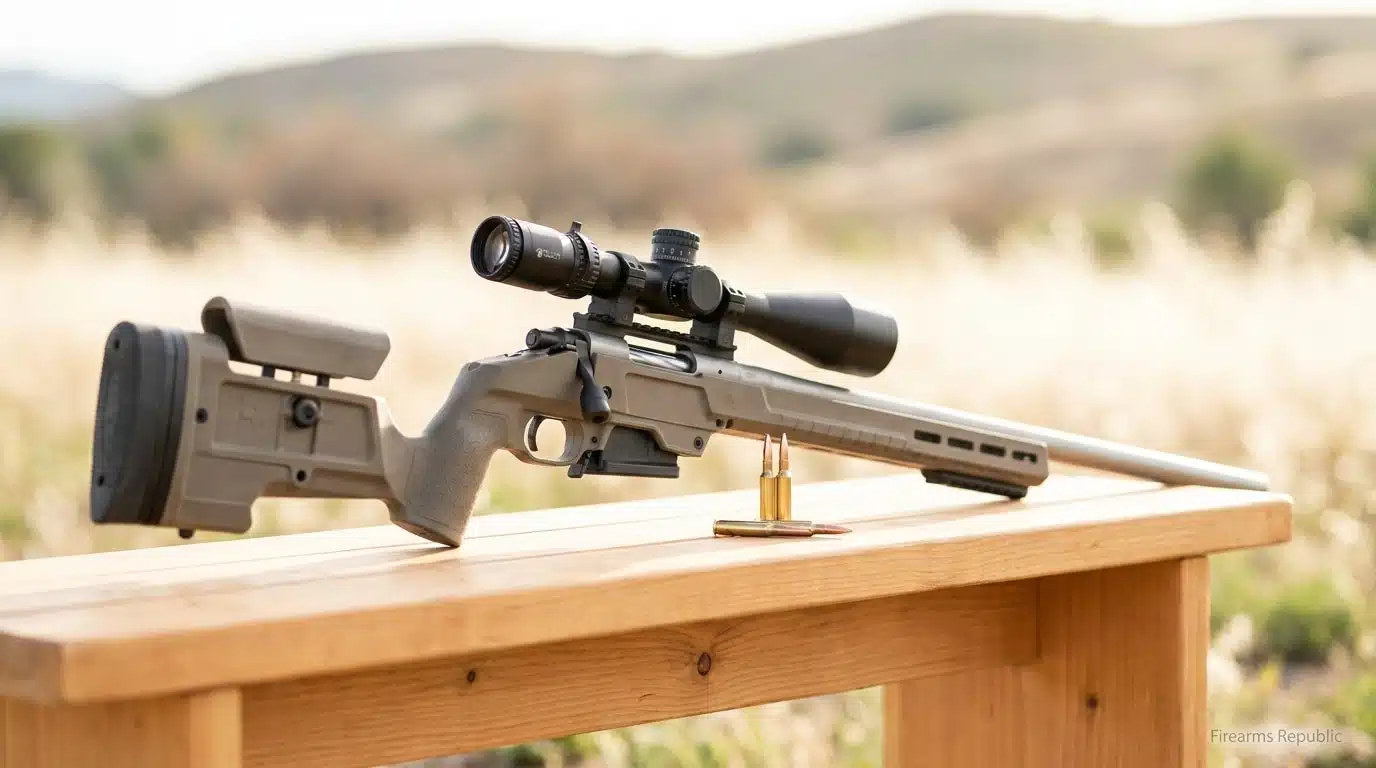
The .22 Creedmoor occupies an interesting position in the precision rifle world – it’s a cartridge that most shooters have heard of but few have actually built around. That’s partly because factory rifles chambered in .22 Creedmoor are scarce, partly because the cartridge sits in an awkward middle ground between the more accessible .22 ARC and the more established 6.5 Creedmoor, and partly because building one correctly requires understanding a few non-obvious decisions that can make or break the finished rifle.
The good news is that the platform side of a .22 Creedmoor build is straightforward. The cartridge runs on a standard .473″ short-action bolt face – the same diameter as .308 Winchester and 6.5 Creedmoor. That means you’re working with the largest, most mature bolt-action ecosystem in the precision rifle market. Custom receivers, aftermarket triggers, chassis systems, stocks – everything designed for short-action .308-family cartridges fits. The parts availability story is the best possible.
The performance story is equally compelling. With a properly spec’d barrel and handloads, a .22 Creedmoor launches an 88gr ELD-M at approximately 3,100–3,180 fps from an 18″ barrel – numbers that put it in genuine 1,000-yard precision territory while generating noticeably less recoil than 6.5 Creedmoor or .308. The trade-off is barrel life and a barrel twist situation that factory rifles frequently get wrong. This guide covers both.
What Makes .22 Creedmoor Different From Other .22 Builds
Before getting into components, it’s worth understanding what .22 Creedmoor actually is – because the name creates some confusion among shooters familiar with the broader Creedmoor family.
The .22 Creedmoor is a wildcat cartridge formed by necking down 6.5 Creedmoor brass to accept .224 caliber bullets. It is not a SAAMI-standardized cartridge, which has practical implications: there are no factory ammunition pressure limits constraining the load data, chamber dimensions vary slightly between barrel makers, and you will be handloading. There is no viable factory ammunition supply for .22 Creedmoor. This is not a cartridge you build and then buy ammo for at the local gun shop – it’s a handloader’s cartridge from the start.
What you get in return for that commitment is maximum .224 bullet performance from a short-action platform. The 6.5 Creedmoor parent case has significantly more powder capacity than the 6.5 Grendel-based .22 ARC – roughly 25% more by volume. That extra powder capacity drives heavier bullets faster, extending the range at which the rifle stays supersonic and maintains hunting-appropriate impact velocities.
The practical performance ceiling: an 88gr ELD-M at 3,100–3,180 fps holds supersonic past 1,200 yards in standard conditions, and keeps impact velocity above 2,000 fps – the threshold for reliable hunting bullet expansion – out to approximately 625–650 yards. That’s 25–50 yards beyond what a bolt-action .22 ARC achieves with handloads, and roughly 175–200 yards beyond factory .22 ARC from an AR-15.
That range extension is real. Whether it justifies the trade-offs – barrel life of 1,300–1,900 rounds, significant case consumption, and the full commitment to handloading – depends on what you’re building the rifle for.
The Barrel Twist Problem: Why 1:7, Not 1:8
This is the most common mistake in .22 Creedmoor builds, and it’s frequently made by experienced shooters who know their way around a rifle. Many factory barrels and custom barrel options for .22 Creedmoor are offered in 1:8 twist. Some barrel makers list 1:8 as the standard for .22 Creedmoor. It’s wrong – or at minimum, it’s a significant compromise.
The .22 Creedmoor’s entire performance rationale is built around heavy, long .224 bullets: 80gr, 85gr, 88gr projectiles with high ballistic coefficients that retain velocity and resist wind at distance. These are long bullets for their diameter. The 88gr ELD-M, for example, has a bearing surface and overall length that sits at the edge of what 1:8 can reliably stabilize, particularly at altitude, in cold temperatures, or at the transonic transition zone around 1,300 fps where bullet stability becomes critical.
At 1,000 yards, the performance difference between a well-stabilized 88gr bullet from a 1:7 barrel and a marginally-stabilized 88gr bullet from a 1:8 barrel isn’t academic – it’s visible in the vertical dispersion of your group. Field tests with both configurations consistently show the 1:8 barrel producing unexplained vertical stringing at distance, particularly in colder or denser air conditions.
Spec your barrel at 1:7 twist. Non-negotiable. If a barrel maker offers only 1:8 for .22 Creedmoor, look elsewhere or ask about a custom order. The 1:7 requirement does not compromise performance with lighter bullets – a 1:7 barrel stabilizes everything from 50gr varmint loads through 90gr match projectiles without issue.
Receiver: Standard Short-Action, .473″ Bolt Face
This is where the .22 Creedmoor build becomes significantly easier than a .22 ARC bolt-action project. The .473″ bolt face is the universal standard for short-action precision rifles. Every major custom receiver maker produces short-action receivers with this bolt face as the default option.
Premium custom receivers ($500–$1,200):
- Defiance Machine Deviant or Ruckus – excellent quality control, wide chassis compatibility, frequently stocked in short-action .473″
- Bighorn Arms TL3 or Origin – popular in PRS circles, extremely smooth bolt operation, trued receiver faces
- Curtis Axiom or Resistor – newer entry with strong reputation for tight tolerances
- Zermatt Arms RimX – if you want a lightweight option, though verify .22 Creedmoor-specific headspace availability
Mid-tier receivers ($250–$500):
- Howa 1500 barreled action – budget entry point, solid platform for a first .22 Creedmoor build, requires barrel replacement
- Remington 700-footprint receivers from various makers – enormous aftermarket compatibility for stocks and chassis
Important note on headspace: Because .22 Creedmoor is a wildcat cartridge, there is no universal SAAMI headspace standard. Chamber dimensions vary between barrel makers. Always verify with your specific barrel maker what headspace gauges to use – most will specify a Go/No-Go gauge set cut for their reamer dimensions. Don’t assume a gauge from one source fits a chamber from another.
Barrel: The Most Critical Investment
For a .22 Creedmoor build, the barrel is where you spend money without regret. The cartridge is inherently overbore – its case capacity relative to the .224 bore diameter creates significant heat and erosion at the throat with every shot. A quality barrel will last 1,300–1,900 rounds before accuracy falls off; a budget barrel may show signs of throat erosion by 800–1,000 rounds. The quality difference here has a direct impact on total cost of ownership.
Required specifications:
- Caliber: .22 Creedmoor (wildcat chamber – specify the reamer maker’s dimensions)
- Twist: 1:7 – see above, this is mandatory
- Contour: match your intended use – a medium Palma or Sendero for precision/bench work, a medium sporter for a field/hunting build
- Length: 20–24″ for maximum velocity utilization; 18″ is acceptable but leaves 100–150 fps on the table compared to 22″
Recommended barrel makers:
- Bartlein Barrels – $350–$500, hand-lapped, excellent for precision builds; specify .22 Creedmoor reamer dimensions explicitly
- Krieger Barrels – $400–$550, cut-rifled, premium quality; industry standard for high-volume competition shooters
- Proof Research – $600–$900, carbon fiber wrapped; significant weight savings for a hunting build, notably extends barrel life due to carbon heat dissipation
- Criterion Barrels – $250–$320, button-rifled, solid mid-tier quality; best value-to-performance ratio for a first .22 Creedmoor build
- Benchmark Barrels – $280–$350, excellent quality control, popular with precision shooters
Barrel contour guidance: A heavier contour (Sendero or heavy Palma) handles the .22 Creedmoor’s heat better than a sporter profile. The cartridge produces significant barrel warmth during extended range sessions, and a thin sporter barrel will walk point of impact as it heats. For a hunting rifle where you’re firing one or two shots, sporter is fine. For a precision or competition build, go heavier.
On carbon fiber barrels: The Proof Research carbon fiber option deserves specific mention for .22 Creedmoor because the carbon wrap genuinely helps manage the cartridge’s heat profile. Carbon fiber dissipates heat faster than steel, which reduces the point-of-impact shift between cold-bore and warm-bore shots. For a cartridge with already-compressed barrel life, anything that reduces heat at the throat is worthwhile. The $300–$400 premium over a comparable steel barrel is defensible here.
Magazine System: AICS Format and Its Advantages
This is where the .22 Creedmoor build has a significant practical edge over .22 ARC. The standard .473″ bolt face and short-action receiver length means the .22 Creedmoor feeds from standard AICS-format magazines designed for .308-length cartridges.
AICS magazines are available from multiple manufacturers, in multiple capacities, and at virtually every retailer that sells precision rifle components. Magpul PMAG AC, AI original AICS magazines, MDT AICS magazines, Accurate Mag – the options are extensive and prices are competitive. A quality AICS 5-round magazine runs $35–$60; 10-round versions run $50–$80.
The .22 Creedmoor’s COAL of approximately 2.800″ (loaded to standard short-action length) fits AICS magazines without modification. Rounds feed directly from a magazine designed for the same case head family. This is the smoothest possible feeding geometry for a bolt-action build and contrasts sharply with .22 ARC’s need for purpose-specific Grendel-format magazines.
Practical magazine recommendation: Start with Magpul PMAG AC in 5-round for hunting builds or 10-round for range/precision use. They’re reliable, widely available, and priced reasonably. If you’re running a chassis with AICS compatibility, any AICS-format magazine from the above list will function correctly.
Stock and Chassis Options
The short-action .473″ footprint opens the largest possible selection of stocks and chassis in the precision rifle market. Every major chassis system designed for short-action Remington 700-pattern or compatible receivers works directly.
Chassis systems for precision/competition builds:
- MDT HNT26 – $375, lightweight aluminum chassis designed for hunting applications; excellent balance of rigidity and weight savings
- MDT ESS – $280, versatile precision chassis, adjustable LOP and cheekpiece, excellent for range work
- KRG Bravo – $325, rigid aluminum chassis, folding stock option, widely used in PRS competition
- Kinetic Research Group X-Ray – $425, premium competition chassis, ARCA rail integration
Traditional stocks for hunting builds:
- McMillan A5 – $475–$575, fiberglass, adjustable, the standard for custom hunting builds
- Manners TF4A – $450–$550, carbon fiber reinforced, lighter than McMillan, excellent fit and finish
- Stocky’s Accustock – $200–$250, budget fiberglass option that works well for a first build
For a .22 Creedmoor precision build, a rigid chassis is the better choice over a traditional stock. The cartridge’s inherent accuracy potential is best realized in a platform that minimizes stock flex and maintains consistent bedding under recoil. A properly bedded traditional stock works – but a quality chassis requires no bedding and typically delivers more consistent results with less fitting work.
Trigger
Any short-action trigger designed for Remington 700-pattern or compatible receivers works here. For a precision build, the trigger is a meaningful accuracy multiplier – a crisp, consistent break is worth investing in.
Recommended options:
- TriggerTech Diamond – $250–$280, zero-creep roller-cam design, excellent for precision work, 1.5–3.5 lb range
- Geissele SSA (bolt-action version) – $195–$215, excellent quality control, popular for both hunting and precision
- Timney Calvin Elite – $220–$240, highly adjustable, reliable pull weight consistency
- Jewell HVR – $280–$350, ultra-light competition trigger for bench/F-class work, not ideal for hunting due to light pull
For hunting applications, set trigger pull at 2.5–3.5 lbs. For precision range work where there’s no concern about accidental discharge in field conditions, 1.5–2.5 lbs is appropriate.
Muzzle Device
Standard 5/8×24 thread pitch for .22 Creedmoor barrels. Any AR-10 or precision rifle muzzle brake threaded 5/8×24 fits directly.
For a precision or competition build, a quality muzzle brake is worthwhile. The .22 Creedmoor generates more recoil than .22 ARC due to larger powder charges and higher case pressure, though it’s still mild by centerfire rifle standards. A brake from Area 419, Terminator, or APA helps with spotting impacts and managing recoil during extended range sessions.
For hunting, a thread protector or simple linear compensator is the practical choice – it keeps the thread clean, adds minimal weight, and doesn’t create the lateral blast of an aggressive brake that’s unpleasant for hunting partners.
Suppressor compatibility is excellent. A .30-caliber suppressor (5/8×24 direct thread or QD mount) works across the .224 bore without issue and is particularly effective at moderating the .22 Creedmoor’s high-velocity report.
Complete Build Cost Estimates
| Component | Budget Build | Mid-Tier Build | Precision Build |
|---|---|---|---|
| Receiver | $200 (Howa) | $500 (Bighorn) | $900 (Defiance) |
| Barrel (22″, 1:7) | $280 (Criterion) | $420 (Bartlein) | $750 (Proof CF) |
| Stock/Chassis | $220 (Stocky’s) | $325 (KRG Bravo) | $475 (McMillan) |
| Trigger | $100 (Timney 510) | $215 (Geissele) | $270 (TriggerTech) |
| Magazines (3x) | $90 | $120 | $150 |
| Muzzle device | $35 | $80 | $150 |
| Headspace gauges | $50 | $50 | $50 |
| Total (approx.) | ~$975 | ~$1,710 | ~$2,745 |
These are component costs only. Add $100–$175 for gunsmith work (barrel installation, headspace verification, action truing if applicable). Most precision builders have actions trued – adding $150–$200 for a quality gunsmith to square the receiver face, lap the lugs, and true the bolt nose significantly improves consistency.
Reloading: Not Optional
This bears repeating clearly: you cannot build a .22 Creedmoor without committing to handloading. There is no factory ammunition. No major manufacturer loads .22 Creedmoor commercially. Before purchasing any components, verify you have access to reloading equipment or are prepared to acquire it.
The reloading process for .22 Creedmoor starts with 6.5 Creedmoor brass – form it by running it through a .22 Creedmoor full-length sizing die, which necks it down to .224. Quality brass from Hornady, Lapua, or Peterson is worth the investment given the cartridge’s barrel erosion rate – you want brass that survives multiple firings consistently.
Powder selection: slow-to-medium burn rate powders work best with the .22 Creedmoor’s case volume. H4350 is the most commonly cited starting point and delivers excellent results with 80–88gr bullets. StaBALL 6.5 offers better temperature stability than H4350 for hunters who take rifles from cold environments to warm ones. H1000 and Retumbo are used for maximum velocity loads with the heaviest bullets. Work up from published minimums regardless of source – chamber dimensions vary between .22 Creedmoor reamers.
Brass life is a known issue. The .22 Creedmoor’s operating pressure and overbore nature stress brass more than moderate-pressure cartridges. Expect 5–8 firings from Hornady brass before primer pockets loosen; Lapua brass typically yields 8–12 firings. Annealing after every 2–3 firings extends case life meaningfully.
Who Should Build a .22 Creedmoor
The .22 Creedmoor rewards a specific type of shooter. If you’re already a committed handloader who understands case preparation, enjoys the process of working up precision loads, and prioritizes maximum performance over convenience – this is an excellent cartridge. The performance ceiling is genuinely impressive: 88gr ELD-M at 3,100+ fps with sub-0.5 MOA accuracy from a quality barrel is achievable, and the recoil remains mild enough that you can read your own impacts without a spotter.
Build a .22 Creedmoor if you: Are an experienced handloader comfortable with wildcat cartridges, want the maximum performance ceiling available in a short-action .224 build, are building a dedicated precision or competition rifle where barrel replacement every 1,500 rounds is budgeted and expected, or want the broadest possible platform compatibility and parts availability in your bolt-action build.
Look elsewhere if you: Are new to handloading or prefer factory ammunition, want a rifle you can feed from a local gun shop, are building a general-purpose hunting rifle where long-term ease of use matters more than performance ceiling, or are cost-sensitive to barrel replacement frequency.
The .22 ARC in a bolt-action configuration delivers approximately 95% of the .22 Creedmoor’s ballistic performance with twice the barrel life, factory ammunition availability, and a simpler build process. For most shooters, the ARC bolt-action is the better practical choice. The .22 Creedmoor is for the shooter who wants every last fps and accepts the maintenance commitment that comes with it.
FAQ
Q: Is .22 Creedmoor a SAAMI-standardized cartridge?
A: No. .22 Creedmoor is a wildcat cartridge with no official SAAMI standardization. Chamber dimensions vary between barrel makers depending on which reamer they use. This means there is no factory ammunition, headspace gauges must be matched to your specific chamber reamer, and published load data should be treated as starting points rather than universal standards. Always work up loads carefully and verify headspace with gauges cut to your barrel maker’s reamer specifications.
Q: Can I use a standard 6.5 Creedmoor rifle and just swap the barrel?
A: Yes, with some caveats. If your 6.5 Creedmoor rifle uses a standard .473″ short-action bolt face and AICS-compatible magazine, a barrel swap to .22 Creedmoor is mechanically straightforward. You’ll need a barrel chambered in .22 Creedmoor (1:7 twist), proper headspace gauges for the new chamber, and to verify that your existing magazines feed .22 Creedmoor COAL correctly. The bolt face doesn’t change. Have a qualified gunsmith do the barrel installation and headspace verification.
Q: Why is barrel life so much shorter than .22 ARC?
A: The .22 Creedmoor is an overbore cartridge – it has significantly more case capacity relative to its bore diameter than .22 ARC. Burning a large powder charge through a small bore creates high temperatures at the throat, which accelerates erosion of the rifling at the bullet entry point. The .22 ARC uses roughly 25% less powder to achieve similar velocities, which means less heat and proportionally longer throat life. This is a fundamental trade-off of the .22 Creedmoor’s design – more powder capacity buys more velocity at the cost of barrel longevity.
Q: What’s the realistic accuracy potential of a quality .22 Creedmoor build?
A: A well-built .22 Creedmoor with a quality barrel, premium brass, and a refined handload is capable of consistent 0.3–0.5 MOA groups at 100 yards. At 1,000 yards, a 3–5 MOA wind call error matters far more than the rifle’s mechanical accuracy – but the cartridge and platform combination is capable of sub-1 MOA at 1,000 yards in calm conditions with a skilled shooter. The accuracy potential is genuinely excellent; the limiting factors are the shooter’s wind reading ability and the consistency of the handload.
Q: Will a 1:8 barrel work for .22 Creedmoor?
A: It will function, but it’s a significant compromise. A 1:8 barrel stabilizes 69–77gr bullets reliably but sits at the marginal edge for 80–88gr projectiles, particularly in cold weather or at altitude where air density increases gyroscopic stability requirements. At 1,000 yards, marginal stabilization produces vertical dispersion and unpredictable point-of-impact shifts. The entire performance rationale for .22 Creedmoor is based on heavy, high-BC bullets – specifying a 1:8 barrel undermines that rationale. Order 1:7.
Q: How does .22 Creedmoor compare to 6mm Creedmoor for a precision build?
A: The 6mm Creedmoor (.243 caliber) is the more established and more practical choice for most precision shooters. It has a broader selection of factory ammunition, wider bullet availability, similar recoil characteristics, and is a SAAMI-standardized cartridge. The .22 Creedmoor has a slight edge in wind drift due to the smaller bullet diameter and slightly higher BC of premium .224 bullets versus comparable 6mm projectiles, but the difference is modest at most practical ranges. If you’re considering both, 6mm Creedmoor is the more versatile build; .22 Creedmoor is the specialist’s choice for maximum .224 performance.