
 Firearms Republic
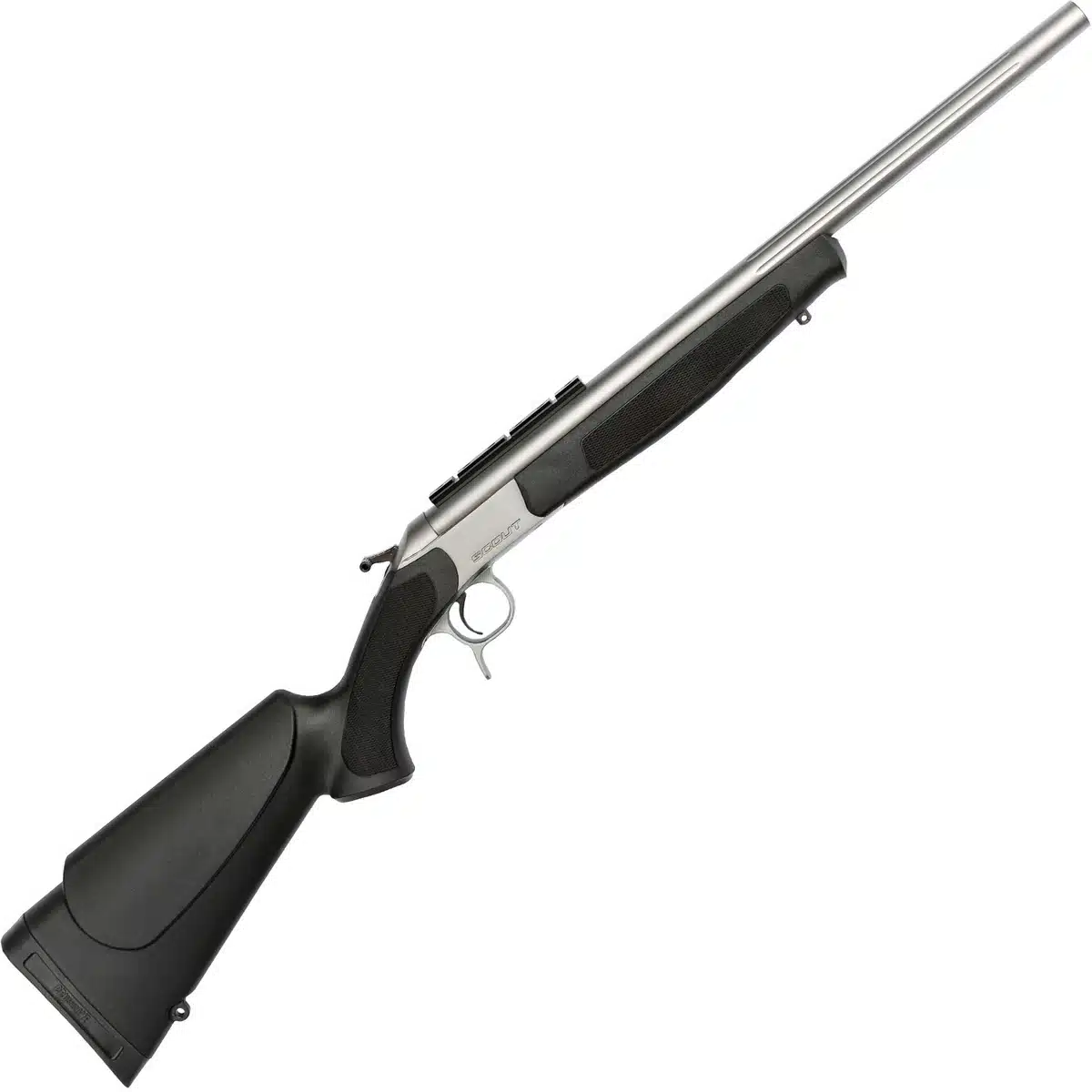
The .44 Remington Magnum is the most misunderstood cartridge in the CVA Scout lineup. Most shooters know the .44 Magnum as a revolver round – the cartridge Dirty Harry used, a handgun caliber that happens to come in rifle-length chambers. That reputation undersells what the cartridge does from a 22″ rifle barrel, and it undersells the Scout as a hunting platform in this caliber.
From a 22″ barrel, the .44 Magnum is not a handgun cartridge anymore. It’s a legitimate short-range rifle producing 1,800–2,100 ft-lbs of muzzle energy depending on the load – more than .44 Magnum pistol loads by 600–800 ft-lbs, and enough to handle deer, hogs, and black bear inside 150 yards with confidence. The CVA Scout in .44 Remington Magnum is a purpose-built brush gun in the tradition of the Marlin 1894, the Ruger Carbine, and the older Winchester 94 Trapper – rifles designed for close-range hunting in dense cover where shots come fast and don’t travel far.
This review covers what the .44 Magnum actually does from the Scout’s 22″ barrel, how it differs from lever-action .44 Magnum rifles, the best hunting applications, ideal ammo, and exactly who this specific configuration makes sense for.
The .44 Magnum in a Rifle Barrel: What Changes
The .44 Remington Magnum was introduced in 1955 as a revolver cartridge, jointly developed by Remington and Smith & Wesson. From a 6″ revolver barrel, standard 240gr loads produce approximately 1,250 fps and 830 ft-lbs. That’s meaningful pistol power but limited rifle-class performance.
From a 22″ rifle barrel, the same cartridge produces approximately 1,750–1,900 fps with 240gr bullets – 1,630–1,923 ft-lbs at the muzzle. The additional barrel length gives the slow-burning propellant charges more time to fully burn, extracting velocity that a short pistol barrel simply can’t develop.
The effect: a rifle-barreled .44 Magnum delivers roughly twice the muzzle energy of a handgun-barreled .44 Magnum. At 100 yards, retained energy from a 22″ barrel runs approximately 1,200–1,400 ft-lbs depending on the load – above the thresholds most hunters use for whitetail deer.
This is the key distinction. The Scout .44 Magnum is not a pistol-caliber carbine in the modern tactical sense. It’s a short-range hunting rifle that happens to use a pistol cartridge case. The operating principle is the same as the Marlin Model 1894 or the Winchester 94 Trapper – cartridges designed for handguns that prove substantially more capable from longer rifle barrels.
CVA Scout .44 Remington Magnum Specifications
Scout V2 (.44 Rem Mag):
- Barrel Length: 22″
- Barrel Twist: 1:38
- Barrel Material: 416 stainless steel, fluted
- Action: Break-action single-shot
- Weight: approximately 5.8 lbs
- Muzzle: Threaded 11/16×24 on most configurations (verify before ordering)
- Stock: Synthetic, ambidextrous, fixed LOP
2025 Scout (.44 Rem Mag):
- Same barrel specifications
- Adjustable LOP and comb height
- Picatinny rail standard
- Steel sling swivel studs
Street price: $375–$450 – notably the most affordable Scout configuration in the lineup.
Ballistic Performance from the 22″ Barrel
The velocity and energy gains from the 22″ barrel over pistol-length barrels are the entire case for this rifle. Here’s what the Scout actually produces:
| Load | Pistol (6″ bbl) | Scout 22″ bbl | Gain | 100 yd energy |
|---|---|---|---|---|
| Hornady 240gr XTP | 1,350 fps / 971 ft-lbs | 1,820 fps / 1,765 ft-lbs | +470 fps | ~1,280 ft-lbs |
| Federal 240gr Castcore HC | 1,350 fps / 971 ft-lbs | 1,760 fps / 1,650 ft-lbs | +410 fps | ~1,150 ft-lbs |
| Buffalo Bore 270gr HC | 1,375 fps / 1,133 ft-lbs | 1,900 fps / 2,165 ft-lbs | +525 fps | ~1,520 ft-lbs |
| Hornady 300gr XTP Mag | 1,150 fps / 881 ft-lbs | 1,600 fps / 1,706 ft-lbs | +450 fps | ~1,200 ft-lbs |
| Winchester 240gr Silvertip | 1,180 fps / 741 ft-lbs | 1,760 fps / 1,650 ft-lbs | +580 fps | ~1,150 ft-lbs |
The Buffalo Bore 270gr hard cast load is the standout: nearly 2,200 ft-lbs at the muzzle from a 22″ barrel. That’s more energy than standard .308 Winchester loads produce from a 16″ barrel. At 100 yards, the 270gr hard cast still carries ~1,520 ft-lbs – above what most hunters consider necessary for elk at close range.
The standard 240gr loads deliver approximately 1,150–1,280 ft-lbs at 100 yards. This is adequate for deer and large hogs inside 100 yards with well-placed shots. It is not a 200-yard deer cartridge. The trajectory is steep enough that holdover at 150+ yards becomes a practical problem without a specific range-compensating zero.
Trajectory Reality: Where the .44 Magnum Works
This is where honest writing matters most. The .44 Magnum from a 22″ barrel is a short-range hunting cartridge. Here are the real numbers:
Zeroed at 100 yards, 240gr Hornady XTP at 1,820 fps:
- 50 yards: +1.8″ above point of aim
- 100 yards: zero
- 125 yards: -2.3″ below point of aim
- 150 yards: -6.1″ below point of aim
- 175 yards: -12.4″ below point of aim
- 200 yards: -21.2″ below point of aim
At 150 yards, you’re holding 6″ high to hit point of aim. At 175 yards, you’re holding nearly a foot high. In a field shooting situation on a moving or partially obscured deer, this holdover becomes a significant source of error.
The honest effective hunting range for the Scout .44 Magnum on deer: 0–125 yards for most hunters without deliberate range compensation. Within that window, it’s an effective and clean-killing cartridge. Past 125 yards, the trajectory demands practice-built holdover skills that casual hunters typically don’t develop.
This is not a criticism of the cartridge – it’s a description of its intended use case. Brush hunting, stand hunting in timber, agriculture fields where shots are rarely beyond 75 yards, hunting in terrain where dense cover makes 100+ yard shots unusual. In these environments, the .44 Magnum Scout is perfectly appropriate.
Recoil: The Most Pleasant Heavy-Caliber Scout
Compared to the .45-70 and .450 Bushmaster configurations, the Scout .44 Magnum is the most comfortable heavy-caliber option to shoot.
Felt recoil from a 240gr load at 1,820 fps in a 6-lb rifle runs approximately 15–17 ft-lbs – comparable to a .308 Winchester in a similar-weight rifle, and significantly less than the .45-70 or .450 Bushmaster. With the heavier Buffalo Bore 270gr load, recoil climbs to approximately 20–22 ft-lbs, still well below the .450 Bushmaster’s 28–32 ft-lbs.
Most of the standard .44 Magnum factory loads don’t require a muzzle brake for comfortable shooting. The Scout .44 Magnum typically ships with a threaded muzzle rather than a KDF brake, which reflects the cartridge’s inherently manageable recoil. A thread protector is standard; adding a muzzle brake is optional for shooters who want to reduce recoil further for extended range sessions.
This recoil characteristic makes the Scout .44 Magnum one of the better options in the lineup for hunters who are recoil-averse but still want heavy-caliber brush-hunting performance. It’s more powerful than .308 at close range (larger diameter, heavier bullets) while generating similar or less felt recoil due to the lower chamber pressure and slower powder burning.
.44 Magnum vs .45-70 in the Scout
The natural comparison is the Scout .45-70, which produces more energy at every distance. Here’s where the .44 Magnum wins:
Ammo cost and availability: .44 Magnum ammunition is available at every sporting goods store, most Walmart locations, and any gun shop in the country. It’s also available in a wider range of bullet weights and styles than .45-70 at many retailers. The ammo ecosystem is deeper because the cartridge serves both rifle and pistol platforms.
Recoil: The Scout .44 Magnum is meaningfully more comfortable to shoot than the Scout .45-70, even with the .45-70’s muzzle brake. For hunters who want to practice regularly with their hunting rifle, the .44 Magnum allows more range sessions with less fatigue.
Platform availability: Hunters who own a .44 Magnum revolver can share ammunition between handgun and rifle – a traditional advantage of pistol-caliber carbines. For wilderness hunters or those who carry both a handgun and a rifle, ammunition commonality simplifies logistics.
Where .45-70 wins: Everything past 100 yards, everything involving hard bone penetration on large animals, and any situation where the maximum possible energy matters. The .45-70 is flatly more powerful at every distance. For hunters who want one hard-hitting Scout caliber for close-range elk, bear, and hogs, .45-70 is the more capable choice.
The .44 Magnum makes sense as a standalone caliber choice when: ammo cost and availability are primary concerns, the hunting application is strictly short-range deer and small-to-medium hog, or the hunter also carries a .44 Magnum handgun and values ammunition commonality.
Best Hunting Applications
Whitetail stand hunting in timber (shots inside 75 yards):
The classic .44 Magnum carbine application. A stand over a food plot, a creek crossing, or a trail junction where deer appear inside 50 yards is where this cartridge operates with authority and zero concern about trajectory. A 240gr Hornady XTP at 1,820 fps through a deer’s lungs at 60 yards is decisive. Load the Scout, hang it on the hook, let the deer come to you.
Hog hunting over feeders (shots inside 100 yards):
Large boars present a challenge for lighter calibers due to the shoulder shield. The .44 Magnum with a heavy hard-cast bullet – Federal 240gr Castcore or Buffalo Bore 270gr hard cast – penetrates the shield reliably from the 22″ barrel velocity. At 80 yards over a feeder, the Scout .44 Magnum is a practical hog gun.
Black bear over bait (shots inside 75 yards):
Most bear bait hunting happens inside 50–60 yards. The Buffalo Bore 270gr hard cast at 1,900 fps from the Scout’s 22″ barrel produces 2,165 ft-lbs at the muzzle – decisive performance on black bear of any size at bait range. The controlled, single-shot nature of the Scout platform encourages the deliberate shot selection that close-range bear hunting requires.
Supplemental whitetail rifle in straight-wall states:
In Ohio, Michigan, and Indiana, the .44 Magnum is legal during straight-wall restricted seasons. For hunters who want a second or backup rifle for these seasons at minimal cost – a platform to keep in the truck or use as a loaner – the Scout .44 Magnum at $375–$450 fills this role economically.
Pest control on agricultural land (inside 100 yards):
For farmers and landowners who need to dispatch coyotes, feral hogs, and other agricultural pests at close range, the Scout .44 Magnum is a practical, low-maintenance tool. The single-shot format’s simplicity suits occasional use, and the .44 Magnum’s terminal performance ensures clean kills on medium-to-large animals at typical agricultural shooting distances.
Ammunition Recommendations
For deer hunting (standard application):
Hornady 240gr XTP (Custom or Leverevolution) at approximately $28–$35/box. The XTP is Hornady’s premium jacketed hollowpoint, designed for controlled expansion at rifle velocities. From the Scout’s 22″ barrel, the XTP opens reliably at 1,820 fps and produces the wound channels hunters expect from a 240gr rifle bullet. Accurate, consistent, and widely available.
For hogs and bear (penetration priority):
Buffalo Bore 270gr hard cast at approximately $45–$55/box. The hard cast lead does not expand – it drives through regardless of what it encounters. At 1,900 fps from the Scout’s barrel, a 270gr hard cast through a boar’s shoulder destroys everything it contacts. This is the correct load for hunters who use the .44 Magnum as a dedicated hog or bear cartridge.
Federal 240gr Castcore hard cast – approximately $30–$38/box. More widely available than Buffalo Bore and only slightly less powerful. Good alternative when Buffalo Bore isn’t in stock.
For practice and range work:
Any standard factory 240gr FMJ or JSP load. The .44 Magnum’s deep production base means budget training ammo exists from Blazer, Federal American Eagle, and others at $22–$28/box. Practicing with a load close to your hunting load’s velocity (avoid very low-pressure target loads below 1,200 fps from pistols) ensures the rifle’s zero remains relevant.
What to avoid in the Scout:
Subsonic or reduced-power .44 Magnum loads designed for suppressed pistol use. These produce insufficient velocity from the Scout’s 22″ barrel to ensure reliable bullet expansion from jacketed hollowpoints, and the ballistic performance is far below what the cartridge is capable of. Use standard-pressure or +P .44 Magnum loads.
Optics Setup
Red dot for timber and stand hunting:
Inside 100 yards, a red dot is genuinely the most practical optic for the .44 Magnum Scout. Holosun 510C ($280), Vortex Sparc AR ($200), or Primary Arms Micro ($130) all work well. Fast target acquisition in a ground blind, forgiving of minor head position variations, and perfectly adequate for the cartridge’s effective range.
Low-power fixed scope for open-field hunting:
A fixed 2.5× or 4× scope covers the .44 Magnum’s full hunting range. Leupold FX-II 2.5×28 ($280) or Nikon ProStaff 3–9×40 dialed to 4× ($180) are practical choices. Avoid high magnification – 6× or more is unnecessary and counterproductive at the distances where .44 Magnum excels.
Scout scope option:
The .44 Magnum Scout’s long-range limitation is not optical – it’s ballistic. A scout-style scope (long eye relief, 2–4× magnification, forward-mounted) works well for a traditional brush-gun aesthetic and faster handling in cover. Leupold Scout 1.5–5×33 ($380) is the classic choice for this application.
CVA Scout .44 Mag vs Lever-Action .44 Mag
The natural competitor is a lever-action .44 Magnum carbine – Marlin 1894, Henry .44 Mag, or similar.
Lever-action advantages:
- Capacity (typically 9–10 rounds in a 20″ barrel lever-action)
- Follow-up shots immediately available
- Traditional aesthetics – the lever-action .44 Magnum carbine is a classic American rifle
- Some lever-actions (Henry, Marlin) in .44 Mag run $650–$900
CVA Scout .44 Mag advantages:
- Price: $375–$450 vs $650–$900 for a quality lever-action
- Stainless and synthetic construction – more weather-resistant than walnut/blued lever-actions
- Threaded barrel for suppressor use (most lever-actions do not ship threaded)
- Adjustable stock on 2025 Scout
- Slightly better accuracy potential from the single-shot fixed-barrel design
For hunters who want traditional aesthetics and capacity, the lever-action is the natural choice. For hunters who want maximum weather resistance, suppressor compatibility, and minimum cost in .44 Magnum, the Scout makes a compelling case.
Who Should Buy the CVA Scout .44 Remington Magnum
Buy it if:
You hunt in dense timber, brush, or conditions where shots are consistently inside 75–100 yards and trajectory management at distance is irrelevant. This is the .44 Magnum’s home territory and the Scout handles it perfectly.
You want a truck gun or backup rifle at the lowest possible price point in the Scout lineup. At $375–$450, the .44 Mag Scout is the most affordable configuration CVA offers, and it handles any deer or hog encounter at typical agricultural and timber distances.
You carry a .44 Magnum revolver and want ammunition commonality between handgun and rifle. Traditional dual-platform ammo sharing is a legitimate practical advantage in backcountry and remote hunting situations.
You want a suppressor host in a caliber with deep production base and widely available subsonic options. A threaded Scout .44 Mag with a suppressor and subsonic loads is an extremely quiet close-range hunting platform.
Look elsewhere if:
You want shots past 125 yards to be straightforward. The trajectory limits what the .44 Magnum can do at distance, and pretending otherwise leads to missed or wounded animals. The Scout .308 or 6.5 Creedmoor handles 200+ yard shots without the holdover calculations the .44 Magnum demands.
You want maximum straight-wall performance. The .450 Bushmaster at 2,686 ft-lbs muzzle energy outperforms even the hottest .44 Magnum loads significantly. See our CVA Scout .450 Bushmaster Review.
You hunt elk or large bear where the energy requirements demand the heaviest options. The .45-70 with +P loads or the .35 Whelen are more appropriate choices for large, dangerous game.
FAQ
Q: Is the .44 Magnum in the Scout more powerful than from a pistol?
A: Significantly. From a 6″ revolver, standard 240gr loads produce approximately 971 ft-lbs. From the Scout’s 22″ barrel, the same loads produce approximately 1,650–1,765 ft-lbs – roughly 70–80% more energy. The additional barrel length allows the propellant to fully combust, producing velocity gains of 400–550 fps over pistol-length barrels depending on the specific load.
Q: Can I use .44 Special ammunition in the CVA Scout .44 Mag?
A: Yes – .44 Magnum chambers accept .44 Special. However, .44 Special loads produce significantly less velocity and energy than .44 Magnum loads from a rifle barrel, and some .44 Special loads may not generate enough pressure to cycle reliably in all single-shot actions. For hunting, use .44 Magnum loads to get full performance from the Scout’s 22″ barrel.
Q: Is the Scout .44 Mag legal for deer in straight-wall states?
A: In most straight-wall states, yes – the .44 Remington Magnum meets the minimum caliber and case geometry requirements. Ohio requires .357″ minimum diameter; the .44 Mag at .429″ exceeds this. Michigan and Indiana have similar minimum caliber requirements that the .44 Mag satisfies. Always verify current season regulations for your specific state and county.
Q: How does the Scout .44 Magnum compare to the Scout .350 Legend for deer?
A: At 100 yards, the .44 Magnum delivers approximately 1,150–1,280 ft-lbs vs the .350 Legend’s approximately 1,350–1,500 ft-lbs from its 20″ barrel. The .350 Legend is actually slightly more powerful at 100 yards with standard loads, has flatter trajectory, and produces similar or lower recoil. The .44 Magnum’s advantages over .350 Legend are ammo availability (much deeper production base), suppressor compatibility, and the ability to use hard-cast loads for hog/bear penetration that .350 Legend doesn’t match. For pure deer hunting, .350 Legend is the better choice; for multi-application use including hogs and bear, the .44 Magnum has the edge.
Q: What is the twist rate on the Scout .44 Magnum barrel, and does it matter for bullet selection?
A: The Scout .44 Mag barrel runs approximately 1:38″ twist. This stabilizes standard 240–300gr cast and jacketed bullets well. For most factory hunting loads in the 240–270gr range, the twist rate is entirely appropriate. Very heavy cast bullets above 300gr may be slightly under-stabilized at lower velocities, but this is not a practical concern for standard hunting applications.
Related Guides
- CVA Scout Complete Guide
- CVA Scout .45-70 Government Review
- CVA Scout .450 Bushmaster Review
- CVA Scout for Elk, Hog & Heavy Game
- CVA Scout for Straight-Wall Deer Hunting States
- Hog Hunting Rifle Guide
- Suppressor Buyer’s Guide