
 Firearms Republic
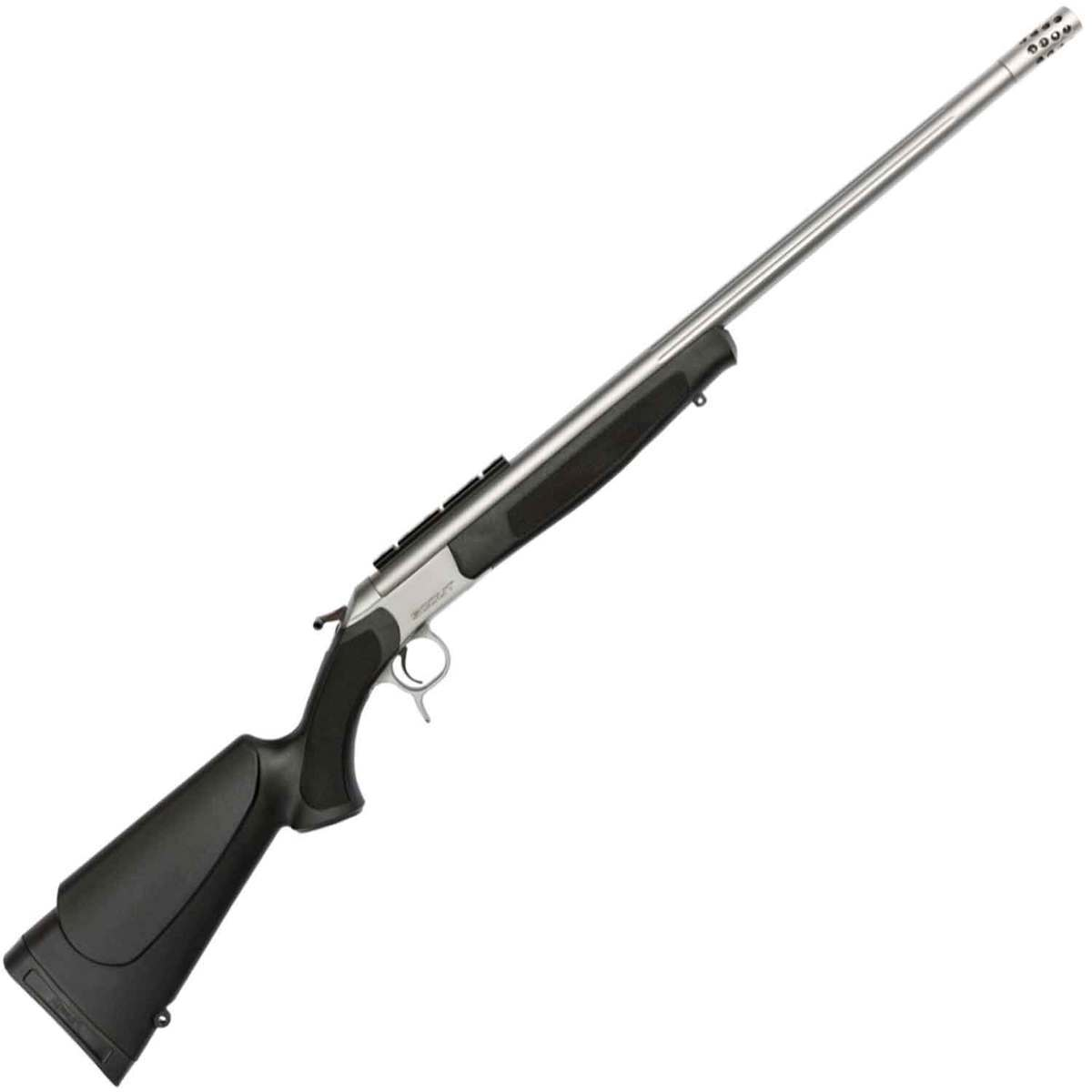
The Best Budget Big-Bore Single Shot?
The 45-70 Government is one of the oldest centerfire cartridges still in regular production, and it has no business being as useful as it is in 2025. Introduced in 1873 for the Springfield Model 1873 “Trapdoor” rifle, it was designed to knock down targets at distance with a slow, heavy lead bullet. Today, loaded with modern projectiles and powder, it knocks down bears, hogs, elk, and anything else that walks through North American woods at close range with authority.
The CVA Scout in .45-70 is the most searched configuration in the entire Scout lineup. That’s not an accident. It combines the simplicity of a break-action single-shot with one of the most capable short-range hunting cartridges available – in a package that costs $400–$475 and weighs under 6 lbs. No other production rifle puts .45-70 performance in a hunter’s hands at anywhere near this price.
This review covers the Scout .45-70 in full depth: how it actually performs, the real difference between the 22″ and 25″ barrel configurations, how the factory KDF muzzle brake changes the experience, what ammo to use and what to avoid, how Scout V2 compares to the 2025 Scout, and who this rifle actually makes sense for.
Why .45-70 in a Single-Shot Makes Sense
Before getting into the rifle itself, it’s worth addressing the obvious question: why would anyone want a single-shot in a hard-recoiling caliber like .45-70?
The answer is simple. The hunting applications where .45-70 excels are almost always single-shot situations anyway. You’re in a stand over a hog feeder at 60 yards. You’re sitting a bait pile in black bear country. You’re still-hunting elk in dense timber where a 150-yard shot is a long one. In these scenarios, you get one presented shot, you take it, and the game either drops or you reload. The second shot in a bolt-action .45-70 is a rarity in practice.
More practically: there is no production bolt-action .45-70 at any price. The .45-70 lives in lever-actions (Henry, Marlin), single-shots (CVA Scout, T/C Encore), and a handful of specialty falling-block or Sharps-pattern rifles. If you want .45-70 under $600, the Scout is essentially your only serious option.
The single-shot format also gives you a mechanical advantage with this cartridge specifically. Lever-action .45-70s are limited to lower-pressure loads because the tubular magazine requires flat-point bullets, and the 1895 Marlin and Henry lever guns have pressure limits that restrict the hottest commercial .45-70 loads. The CVA Scout has no such limitation – it handles full-pressure .45-70 loads including Garret Cartridges, Buffalo Bore, and Underwood Xtreme +P offerings that push a 325gr projectile to 2,100 fps. That’s a fundamentally different ballistic proposition than standard .45-70 lever-gun loads.
Scout V2 vs 2025 Scout in .45-70
Both generations are currently available, and the choice matters more in .45-70 than in lighter calibers because recoil management and optic mounting become real issues with this cartridge.
Scout V2 (.45-70):
- DuraSight Dead-On proprietary one-piece rail
- Fixed length of pull
- CrushZone recoil pad
- Available in 22″ and 25″ barrel lengths
- KDF muzzle brake standard on most configurations
- Street price: $375–$450
2025 Scout (.45-70):
- Standard Picatinny rail – accepts any rings
- Adjustable LOP via stock spacers
- Adjustable comb height
- Steel sling swivel studs
- 22″ barrel standard configuration
- Street price: $425–$495
The practical difference for a .45-70 hunter: the 2025 Scout’s Picatinny rail makes optic mounting significantly easier and more flexible. With the V2’s proprietary DuraSight system, you’re locked into specific ring options and getting proper eye relief with a scope becomes more of a project. The adjustable comb on the 2025 Scout also helps with proper cheek weld when running a scope – important in a hard-recoiling caliber where face contact on the stock matters for recoil management.
If you find a Scout V2 in .45-70 at $375 or less, that’s still an excellent rifle. At equal prices, take the 2025 Scout.
22″ vs 25″ Barrel: What the Numbers Actually Mean
The CVA Scout .45-70 is available in both 22″ and 25″ barrel configurations. The velocity difference is real and worth understanding.
With standard-pressure factory loads:
| Load | 22″ Barrel | 25″ Barrel | Difference |
|---|---|---|---|
| Hornady LEVERevolution 325gr FTX | ~1,850 fps | ~1,950 fps | +100 fps |
| Federal 300gr SP | ~1,780 fps | ~1,870 fps | +90 fps |
| Buffalo Bore 430gr HC | ~1,600 fps | ~1,680 fps | +80 fps |
| Underwood 325gr +P | ~2,000 fps | ~2,100 fps | +100 fps |
An extra 90–100 fps translates to roughly 50–75 ft-lbs of additional muzzle energy with most loads. In a cartridge that’s already delivering 2,200–3,000 ft-lbs at the muzzle depending on the load, this is a single-digit percentage improvement.
The practical verdict: For most .45-70 hunting applications inside 150 yards, the 22″ barrel is the right choice. The rifle is shorter, lighter, and easier to handle in a blind or dense cover. The 25″ barrel makes sense if you’re specifically running hot +P loads for bear and want to extract every fps the cartridge can deliver – or if you shoot from a bench enough that the extra velocity matters for zeroing at distance.
The 22″ barrel on the Scout runs approximately 45.5″ overall length, which is already longer than most hunters expect from a “compact” single-shot. The 25″ pushes that to 48.5″ – noticeable in a ground blind.
The KDF Muzzle Brake: Does It Work?
Yes. Meaningfully.
The CVA Scout .45-70 ships with a KDF (Kleinguenther’s) muzzle brake on most configurations. Without the brake, .45-70 from a 6-lb rifle is a genuine experience – Hornady’s 325gr LEVERevolution load produces approximately 35 ft-lbs of felt recoil in a 6-lb rifle, which is roughly equivalent to a 12-gauge slug gun. Manageable, but sharp.
With the KDF brake engaged, felt recoil drops to approximately 20–22 ft-lbs – comparable to a .30-06 in a standard sporter stock. The difference between one shot and multiple range sessions is real. Hunters who want to practice regularly with their .45-70 Scout should leave the brake on.
The brake adds about 2″ to overall length and is threaded on – you can remove it and run the threaded muzzle exposed or add a thread protector. A small number of hunters remove it for hunting where muzzle blast direction matters (hunting with a partner nearby, enclosed blinds). For general use, leave it on.
One note on the 2025 Scout vs V2 brake situation: some 2025 Scout .45-70 configurations ship with a ported barrel rather than a removable KDF brake. Verify what you’re buying. The removable KDF brake gives you more flexibility.
Ballistic Performance: What .45-70 Actually Does at Hunting Ranges
The .45-70 is a short-to-moderate range cartridge by modern standards. Understanding what it does at the distances where it’s actually used matters more than obsessing over 300-yard numbers that don’t apply to this cartridge’s use case.
At 100 yards (zeroed at 100):
- Hornady 325gr FTX LEVERevolution: ~1,850 fps, ~2,474 ft-lbs
- Buffalo Bore 430gr HC: ~1,600 fps, ~2,447 ft-lbs
- Underwood 325gr +P (from 22″ Scout): ~2,000 fps, ~2,888 ft-lbs
Any of these loads will reliably take deer, hog, elk, and black bear at 100 yards with a well-placed shot. The 325gr FTX is the best general hunting option – the polymer tip and flex bullet design gives it better expansion than traditional flat-nose lead bullets, and it’s designed to cycle through tubular magazines (which means it’ll feed cleanly in the Scout’s chamber as well).
At 150 yards (zeroed at 100):
- Hornady 325gr FTX: approximately -4.5″ drop, ~1,650 fps, ~1,965 ft-lbs
- At this velocity, terminal performance on deer and hog remains decisive
At 200 yards:
- Hornady 325gr FTX: approximately -17″ drop from 100-yard zero
- You’d need to hold significantly high or rezero for this distance
- Not a practical .45-70 hunting range from the Scout’s 22″ barrel
The honest .45-70 hunting envelope from a CVA Scout is 0–150 yards. Inside that window, it’s one of the most effective close-range hunting cartridges available. Past 175 yards, the trajectory becomes an exercise in holdover management that most hunters won’t bother with.
Best Ammo for the CVA Scout .45-70
Hornady LEVERevolution 325gr FTX – The go-to choice for most hunters. Purpose-designed for lever-actions but shoots well from single-shots, polymer tip improves BC over traditional flat-nose bullets, consistent accuracy across multiple Scout barrels. Street price around $42–$48/box.
Federal Premium 300gr Trophy Bonded Bear Claw – Trophy Bonded is one of the best controlled-expansion bullets available. Designed for large, dangerous game. If you’re specifically hunting brown bear or very large hogs where deep penetration matters above expansion, this is the load. About $55–$65/box.
Buffalo Bore 430gr HC (Hard Cast) – For hunters who want maximum penetration through heavy bone on bear or bison at close range. Hard cast lead does not expand – it drives straight through. At 1,600–1,700 fps from the Scout, a 430gr hard cast bullet produces enormous wound channels and penetrates farther than any expanding projectile. Significant recoil, but the brake helps. Around $50–$60/box.
Underwood Xtreme +P 325gr – The hottest production .45-70 load currently available. Pushes 325gr projectiles to ~2,050 fps from a 22″ Scout barrel. Not for rifles with tubular magazines – the Scout handles it fine. If you’re hunting large, dangerous game and want everything the cartridge can deliver, this is it. About $55–$65/box.
What to avoid: Standard-pressure loads designed for the original 1873 Trapdoor Springfield (typically 405gr lead at 1,330 fps). These are safe in the Scout but dramatically underperform what the platform is capable of. You’re leaving half the cartridge’s potential on the table.
Accuracy: Real-World Results
CVA Scout .45-70 accuracy is consistently better than most hunters expect from a $450 rifle chambered in a heavy thumper cartridge.
Typical factory ammo groups at 100 yards from a rested Scout:
- Hornady 325gr FTX: 0.8–1.2 MOA
- Federal 300gr Trophy Bonded: 0.9–1.3 MOA
- Buffalo Bore 430gr HC: 1.0–1.5 MOA
The wider groups with hard cast lead are expected – hard cast bullets have more dimensional variation than jacketed projectiles and are less consistent at velocity. For hunting purposes, 1.5 MOA at 100 yards in .45-70 is a 1.5″ group – plenty accurate for any shot on game inside 150 yards.
Shooters who hand load their .45-70 regularly achieve 0.6–0.8 MOA from the Scout with quality cast or jacketed bullets and optimized powder charges. The Bergara barrel is capable of this precision. The limiting factor is usually the ammunition, not the rifle.
One consistent finding across Scout owners: the rifle needs 3–5 fouling shots before groups tighten. The first shot from a clean cold bore tends to print slightly wider. In hunting applications, this means your practice session should end with the bore lightly fouled, and you shouldn’t clean it again before the hunt.
Optics for the CVA Scout .45-70
Scout .45-70 hunting typically happens inside 150 yards. Optic choice should reflect that reality.
Red dot sights – Genuinely excellent for .45-70 close-range hunting. A Vortex Sparc AR ($200), Holosun 510C ($280), or even a Primary Arms Micro ($130) gives you fast target acquisition in timber hunting scenarios. No magnification needed inside 80 yards, and a red dot is faster on moving targets than a scoped rifle.
Low-power variable optics (LPVO) – A 1–4×24 or 1–6×24 is the most versatile choice. Covers close-range timber hunting at 1× and gives enough magnification for 150-yard shots at 4–6×. Vortex Strike Eagle 1–6×24 ($280) or Leupold VX-Freedom 1.5–4×20 ($300) both work well on the Scout.
Fixed 2.5× or 4× scopes – Traditional hunting scopes for single-purpose hunters. A Leupold FX-II 4×33 ($350) is a classic pairing for a traditional big-bore hunting rifle. Simple, reliable, adequate for .45-70’s realistic range.
Avoid high magnification: A 3–9×40 or larger on a .45-70 Scout is overkill at best and problematic at worst. High magnification makes close-range shots harder, not easier, and the cartridge doesn’t warrant 9× at any practical hunting distance.
For eye relief: .45-70 recoil is enough to scope-slap if you mount the optic too far back. Get proper eye relief right – 3.5″ to 4″ minimum from the ocular lens to your eye.
CVA Scout .45-70 vs T/C Encore .45-70
The T/C Encore in .45-70 is the primary direct competitor for single-shot big-bore hunters.
The Encore’s advantages: interchangeable barrels (you can run .45-70 and .308 or .300 Win Mag on the same frame), longer barrel options up to 28″, and a longer production history with more aftermarket support.
The Scout’s advantages: trigger. The Encore ships with a factory trigger around 6–6.5 lbs. The Scout runs 2.5–3.5 lbs. In a heavy-recoiling caliber where you need a precise trigger pull to place a shot well, this difference matters in practice. A 6.5 lb trigger on a rifle that kicks hard teaches bad habits and makes accurate shooting harder.
Price is also decisive: a Scout .45-70 runs $400–$475. An Encore .45-70 runs $700–$900. For a hunter who wants one big-bore single-shot rifle in one caliber for close-range hunting, the Scout’s trigger and price make it the better choice. The Encore’s barrel-swapping advantage only pays off if you actually buy and use multiple barrels.
For a full platform comparison, see CVA Scout vs T/C Encore Pro Hunter.
Practical Setup: How to Prepare a Scout .45-70 for the Field
Step 1 – Optic choice and mounting. For deer and hog inside 100 yards: red dot or 1–4×. For elk or bear where shots may reach 150 yards: 1–6× LPVO. Mount using quality rings appropriate for the Scout’s rail system (Picatinny on 2025 Scout, DuraSight-compatible rings or DNZ direct mount on V2).
Step 2 – Zero at 50 yards first, then confirm at 100. .45-70 trajectories are steep enough that a direct 100-yard zero leaves you well below point of aim at 150 yards. A 50-yard zero leaves you roughly +0.5″ at 75 yards and -1.5″ at 100 – more practical for the cartridge’s typical hunting distances.
Step 3 – Run 20 rounds of your hunting load to foul the barrel and verify zero holds. The first shot from a truly clean Scout .45-70 may print an inch away from your fouled-bore zero. Know which way your cold bore shot drifts.
Step 4 – Add a sling. The Scout’s sling swivel studs accept any standard sling. For timber hunting with a heavy-caliber single-shot, a simple two-point sling is all you need. The rifle is light enough that a carry strap matters more than a tactical sling system.
Step 5 – Practice the reload. A single-shot requires you to be efficient with the reload. Practice opening the action, removing the spent case, seating a fresh round, and closing the action with your eyes closed. In a stand or blind, this should be a smooth 5-second sequence without looking down.
Who Should Buy the CVA Scout .45-70
Buy it if:
You hunt hogs at close range and want a capable, affordable thumper. A Scout .45-70 with a red dot and Hornady LEVERevolution is purpose-built for this application at a price that doesn’t hurt when the rifle gets muddy or scratched.
You hunt black bear over bait and want the confidence of a heavy, decisive cartridge. Inside 75 yards on a stationary bear, .45-70 is more than adequate and the single-shot limitation doesn’t matter.
You’re in a timber state hunting whitetail where shots are typically under 100 yards and you want something more powerful than .308 without moving to a magnum.
You want to hunt elk in dense cover where the rifle needs to handle a close-range shot on a large animal. .45-70 at 100 yards delivers more energy than 6.5 Creedmoor at 500 yards.
Look elsewhere if:
You want to shoot past 150 yards regularly. The .45-70’s trajectory makes it a close-range specialist, and the Scout platform doesn’t change that math.
You’re hunting mountain elk where shots may extend to 300+ yards. A 6.5 Creedmoor bolt-action is the more practical tool for open-country long-range work.
You want a follow-up shot capability. Hogs in particular often require a second shot quickly. If your hunting style involves groups of hogs or multiple shots on running game, a semi-auto in .308 or a lever-action .45-70 gives you that capability.
FAQ
Q: Can the CVA Scout .45-70 handle +P loads safely?
A: Yes. Unlike lever-action .45-70s where the tubular magazine limits safe load pressures, the CVA Scout is a single-shot break-action with no magazine feeding to worry about. It handles full +P .45-70 loads from Underwood, Buffalo Bore, and Garrett Cartridges without issue. Always verify loads are marked safe for modern strong actions, not just “Trapdoor” or “lever-gun” loads.
Q: What’s the effective range of the CVA Scout .45-70?
A: Realistically 150 yards for most hunters with most loads. With a dialed 150-yard zero and a load like Hornady LEVERevolution 325gr FTX, a competent shooter can make clean kills to 175 yards. Past that, trajectory becomes steep enough that precise holdover is required, and the practical advantage of .45-70 over other cartridges diminishes at extended range.
Q: Is the KDF muzzle brake removable?
A: On most Scout V2 configurations, yes – the KDF brake is threaded on and can be removed. Underneath is a standard 11/16×24 thread pattern. You can run the muzzle bare, add a thread protector, or thread on a compatible suppressor. The 2025 Scout configurations may vary – some ship with ported barrels rather than removable brakes.
Q: How does the CVA Scout .45-70 compare to a Henry .45-70 lever action?
A: The Henry .45-70 is a beautiful, American-made rifle at $900–$1,100. The Scout costs half as much. On ballistics, the Scout can run +P loads the Henry can’t safely fire. The Henry gives you follow-up shots and traditional aesthetics. For pure hunting performance at the lowest cost, the Scout wins. For a rifle you’ll pass down to your kids, the Henry is worth the premium.
Q: Does the 25″ barrel make a meaningful difference for hunting?
A: For standard factory loads, the 25″ adds approximately 90–100 fps – meaningful for maximizing +P performance on large game but irrelevant for standard hunting applications inside 150 yards. The 22″ barrel is the more practical choice for most hunters. Choose the 25″ only if you specifically plan to run the hottest available .45-70 loads for large or dangerous game.