
 Firearms Republic
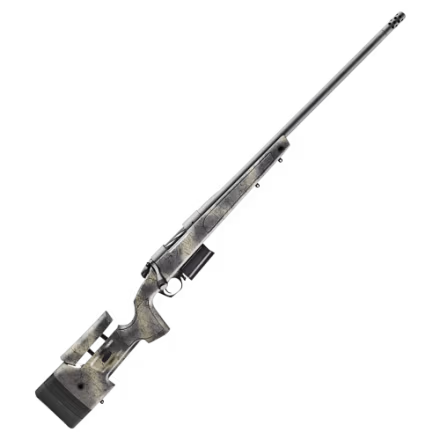
The Bergara B-14 HMR occupies a genuinely interesting position in the precision rifle market. Built around a Remington 700 footprint action, fitted with a Bergara-manufactured #6 contour 24″ barrel in 6.5 Creedmoor, and dropped into a mini-chassis stock with adjustable comb and length-of-pull, this rifle is clearly aimed at shooters who want competition-capable precision without funding a full custom build. At a street price of $1,050–$1,150, it undercuts most serious precision rifles while delivering an AICS-compatible 5-round magazine, a factory-threaded 5/8×24 muzzle, and a 2.5–3 lb Premier trigger from the factory. It’s not the lightest, not the cheapest, but it may be the most capable rifle at this price point.
Quick Verdict
✓ Best for: PRS/NRL beginners, long-range precision shooters, and hunters shooting from fixed positions
✓ Price: $1,050–$1,150 street
✓ Key strength: Bergara-quality barrel delivering 0.3–0.5 MOA accuracy with full Remington 700 aftermarket compatibility
✗ Not ideal for: Mountain hunters, backcountry pack-in hunts, or anyone who needs a rifle under 8 lbs – at 9.5 lbs bare, this rifle demands a stationary shooter
Real-World Performance
The B-14 HMR’s 24″ barrel with a 1:8 twist rate does exactly what Bergara intends – it stabilizes 140–147gr projectiles cleanly and squeezes every available foot-per-second out of the 6.5 Creedmoor cartridge. Expect around 2,750 fps with 140gr ELD-M loads and roughly 2,650 fps with 147gr ELD-M match ammunition. That 50 fps advantage over 22″ barrels sounds marginal, but it translates to a flatter trajectory and slightly more retained energy past 800 yards – meaningful for competition and hunting at distance.
Accuracy is where this rifle separates itself from the mid-price field. The Bergara barrel is not a sourced component – Bergara manufactures their own barrels, and the quality control shows. Factory groups with Hornady 140gr ELD-M typically land between 0.3 and 0.5 MOA, and handloaders routinely push that to 0.2–0.4 MOA with developed loads. Cold-bore shots track consistently with group centers – a sign of a quality barrel with good bore geometry.
The heavy #6 contour is a genuine advantage during string shooting. Running 20-round strings at a club match, point-of-impact shift stays under 0.2 MOA as the barrel heats – something lighter-barreled rifles simply cannot match. Barrel life sits in the 2,500–3,500 round range, reasonable for the caliber. The Premier trigger ships at 2.5–3 lbs with a clean break and minimal creep – competent for hunting and adequate for precision work, though competitive shooters will want to upgrade it eventually.
Applications & Use Cases
PRS/NRL Club Competition
The B-14 HMR was practically designed for Production Division PRS shooting. At 9.5 lbs, the weight is manageable across positional stages, and the heavy barrel stays cool during multi-round strings. The adjustable comb and length-of-pull let you dial in a repeatable cheekweld quickly when transitioning between positions. AICS magazine compatibility means you can run any number of aftermarket mags without adapter hassles. The included 20 MOA Picatinny rail gets you straight into glass without additional purchases.
Verdict: This is the rifle’s strongest use case – buy it specifically for this and you won’t regret it.
Long-Range Precision Shooting (500–1,000 yards)
At 1,000 yards with 147gr ELD-M, experienced shooters are reporting 6–8 inch groups from the B-14 HMR – roughly 0.6–0.8 MOA at that distance. That’s respectable for a factory rifle at this price. The barrel’s consistency across shot strings makes reading wind corrections easier because you’re not chasing a wandering zero. For the shooter who visits a long-range range regularly and wants to push past 500 yards seriously, this rifle delivers.
Verdict: Excellent platform for dedicated long-range work, with the barrel quality to support serious load development.
Hunting from Fixed Positions
From a box blind, shooting house, or vehicle, the 9.5 lb weight becomes irrelevant. The accuracy advantage is very real – a 300-yard whitetail shot with a rifle capable of 0.4 MOA is about as close to a guaranteed hit as factory rifles get. The threaded muzzle accepts suppressors cleanly, and the adjustable stock accommodates hunters wearing heavy clothing in cold weather.
Verdict: Excellent blind or stand rifle; genuinely overkill for most hunting scenarios, but in the best way.
Mountain or Backcountry Hunting
This is where the B-14 HMR fails. Add a scope, bipod, and sling, and you’re carrying 12+ lbs up an elk mountain. After four miles at elevation, that weight difference between this and a 7 lb mountain rifle is felt in your knees and shoulders.
Verdict: Wrong tool – look at the Christensen MPR or a purpose-built lightweight platform instead.
Ergonomics & Handling
The mini-chassis stock is the most practical feature on this rifle for shooters who actually use it. The comb adjusts for height and cant, and the length-of-pull spacers let you dial the fit without gunsmithing. It’s not as rigid as a full aluminum chassis – there’s a slight flex under hard load – but it’s far more adjustable than any traditional hunting stock at this price.
The bolt runs on a two-lug push-feed design with a 90-degree throw. It’s smooth enough and reliable, but it’s noticeably slower to cycle than the Tikka T3x’s three-lug 60-degree system. Loading from the AICS-compatible detachable box is clean and positive – no fumbling, no feed issues with factory or handloaded ammunition. The oversized bolt knob gives good purchase with gloved hands.
Balance-wise, the rifle is muzzle-heavy with that #6 contour barrel, which actually helps during prone shooting – it sits on a bipod naturally and tracks targets without wandering. Off-hand or standing, the front-heaviness becomes awkward. Carrying it by the stock for any distance gets tiring. This is a rifle that belongs on a bench, a bipod, or a shooting rest – and it performs brilliantly in those conditions.
Aftermarket & Upgrade Path
The Remington 700 footprint is the B-14 HMR’s most underrated feature. The aftermarket ecosystem for the 700 action pattern is the deepest in bolt-action rifles, and virtually all of it fits the Bergara directly. Most shooters prioritize the trigger first – a TriggerTech Special drops the pull to around 1.5–2 lbs for about $250, and the improvement in precision shooting is immediately noticeable. The Timney 510 is another proven option at a similar price.
Chassis swaps are common for shooters who move deeper into competition. The MDT ACC Elite and KRG Whiskey-3 both drop in directly, adding rigidity and improved ergonomics at the cost of another pound or two of weight. Scope bases upgrade easily – the included 20 MOA rail works, but a Hawkins Precision or Badger Ordnance rail adds a measurable improvement in mounting rigidity for around $100.
When the barrel reaches end of life at 2,500–3,500 rounds, Proof Research carbon prefits and Bartlein steel blanks both fit the action. At that point, you’re building toward a semi-custom rifle for around $2,000–$2,500 total – and the Bergara action is a solid foundation for that investment. The barrel alone justifies buying this platform over a budget alternative if long-term upgradeability matters to you.
Pros & Cons
Strengths:
✓ Bergara-manufactured barrel delivers 0.3–0.5 MOA with factory 140gr ELD-M – rivals barrels costing twice as much
✓ Full Remington 700 footprint opens the deepest aftermarket ecosystem in bolt-action rifles
✓ Mini-chassis stock with adjustable comb and LOP – genuinely useful for positional shooting
✓ AICS-compatible 5-round magazine with proven feeding reliability, no adapter needed
✓ Heavy #6 contour barrel holds POI within 0.2 MOA across 20-round strings
✓ Factory-threaded 5/8×24 muzzle with thread protector included – suppressor-ready out of box
✓ 20 MOA Picatinny rail included – saves $80–$100 immediately
✓ 24″ barrel gains ~50 fps over 22″ barrels – meaningful at 1,000 yards
✓ Spanish manufacturing quality control – fit and finish exceeds the price point
✓ PRS Production Division legal and competitive out of the box
Limitations:
✗ 9.5 lbs bare – add scope, bipod, and sling, and you’re at 12+ lbs, which eliminates backcountry hunting
✗ 24″ barrel is unwieldy in brush, vehicle transport, and tight shooting positions
✗ Mini-chassis has slight flex under hard load – full aluminum chassis would be more rigid
✗ Two-lug 90-degree bolt throw is slower to cycle than Tikka’s three-lug 60-degree system
✗ Factory trigger at 2.5–3 lbs is adequate but not exceptional – expect to spend $250 on a TriggerTech upgrade for serious competition
✗ $400+ premium over Ruger American Gen II – gap narrows if you’re a casual shooter under 500 yards
✗ Barrel profile is overkill for hunters who shoot fewer than 20 rounds per session
✗ NRL Hunter weight limits may exclude this rifle depending on class rules
Competitors & Alternatives
| Feature | B-14 HMR | Ruger American Gen II | Tikka T3x CTR | Savage 110 Elite Precision | Christensen MPR |
|---|---|---|---|---|---|
| Price | $1,100–$1,150 | $649 | $1,100 | $1,400 | $1,800 |
| Weight | 9.5 lbs | 6.9 lbs | 8.4 lbs | 11.1 lbs | 8.5 lbs |
| Trigger | 2.5–3 lbs | ~3 lbs | ~2 lbs | AccuTrigger | ~3 lbs |
| Magazine | AICS 5-rd | AICS 5-rd | Proprietary | AICS 5-rd | AICS 4-rd |
| Accuracy | 0.3–0.5 MOA | 0.75–1 MOA | 0.5–0.75 MOA | 0.5–0.75 MOA | 0.3–0.5 MOA |
The Ruger American Gen II at $649 is the obvious budget comparison. It’s $400 cheaper, significantly lighter at 6.9 lbs, and shoots adequately for hunters and casual precision shooters. But the accuracy gap is real – the Bergara’s barrel quality consistently delivers groups half the size of the Ruger’s with quality ammunition. If you shoot past 500 yards regularly, the B-14 HMR earns its premium.
The Tikka T3x CTR at $1,100 is the most direct competitor. It’s lighter at 8.4 lbs, runs a smoother three-lug bolt, and has a better factory trigger. Where the Tikka loses is aftermarket depth – the proprietary magazine system and limited stock options constrain your upgrade path. The Bergara wins on out-of-box accuracy and long-term buildability. For hunters who won’t upgrade, the Tikka T3x CTR may actually be the smarter buy. For PRS shooters, Bergara wins clearly.
The Savage 110 Elite Precision at $1,400 goes heavier at 11.1 lbs with a full chassis – better for pure bench or competition use, but worse as a hybrid hunting/competition platform. The Christensen MPR at $1,800 offers carbon barrel weight savings but costs $700 more for performance that’s roughly equivalent on paper. The Bergara delivers about 80% of the Christensen’s capability at 60% of the price.
Who Should Buy This
Ideal for the PRS/NRL beginner: If you’re entering your first club matches and want a Production Division-legal rifle that won’t embarrass you at 600 yards, the B-14 HMR is the most complete package under $1,200. You don’t need to spend another dollar to compete – though you’ll want to eventually.
Also great for the dedicated long-range range shooter: The shooter who visits a 1,000-yard range monthly, handloads their own ammunition, and wants a factory rifle capable of matching their load development potential will find the Bergara barrel genuinely satisfying. It will reward careful load work with sub-0.4 MOA results.
Look elsewhere if you’re a mountain hunter or weight-conscious buyer: At 9.5 lbs, this rifle demands a stationary shooting position to make sense. The Tikka T3x CTR saves over a pound for similar money, and a Christensen MPR cuts even more weight for hunters willing to spend more.
Frequently Asked Questions
Q: Does the B-14 HMR actually shoot sub-MOA from the factory?
A: Yes, consistently. With Hornady 140gr ELD-M factory ammunition, most shooters see 0.3–0.5 MOA groups. Bergara’s sub-MOA guarantee is backed by a test target shipped with each rifle. Handloaders can push that to 0.2–0.4 MOA with developed loads.
Q: Is the mini-chassis stock as good as a full aluminum chassis?
A: No – there’s a measurable difference in rigidity under hard load. The mini-chassis is a significant improvement over traditional hunting stocks and works well for most applications, but competitive PRS shooters often migrate to an MDT or KRG chassis after a season.
Q: Can I drop this into a Remington 700 chassis directly?
A: Yes. The Bergara B-14 action uses a true Remington 700 footprint, so MDT ACC, KRG Whiskey-3, and virtually any 700-pattern chassis or stock fits without modification.
Q: What scope does this rifle need?
A: For PRS use, a 5-25×56 or similar is typical. The included 20 MOA rail gives you elevation range for 1,000-yard shooting. Budget $800–$1,500 for glass that won’t limit the rifle’s accuracy potential.
Q: How does barrel life compare to other 6.5 Creedmoor rifles?
A: The Bergara barrel lasts 2,500–3,500 rounds before accuracy degrades – standard for 6.5 Creedmoor. Quality barrels like Proof Research prefits are direct replacements when the time comes.
Q: Should I upgrade the trigger immediately?
A: Not necessarily. The factory Premier trigger at 2.5–3 lbs is usable for hunting and recreational shooting. For serious PRS competition, a TriggerTech Special at $250 is the most impactful first upgrade.
Q: Is this rifle suitable for suppressor use?
A: Yes. The 5/8×24 threaded muzzle accepts standard 6.5 Creedmoor suppressors directly. The 24″ barrel keeps velocity high even with the additional back-pressure, and the heavy contour manages the added weight balance reasonably well.
Final Verdict
The Bergara B-14 HMR is the most complete factory precision rifle under $1,200 if long-range shooting or entry-level competition is your primary purpose. The barrel quality alone justifies the price over budget alternatives. Buy it if you shoot past 500 yards regularly – look elsewhere if you need to carry it more than two miles.