 Maksym Kovaliov
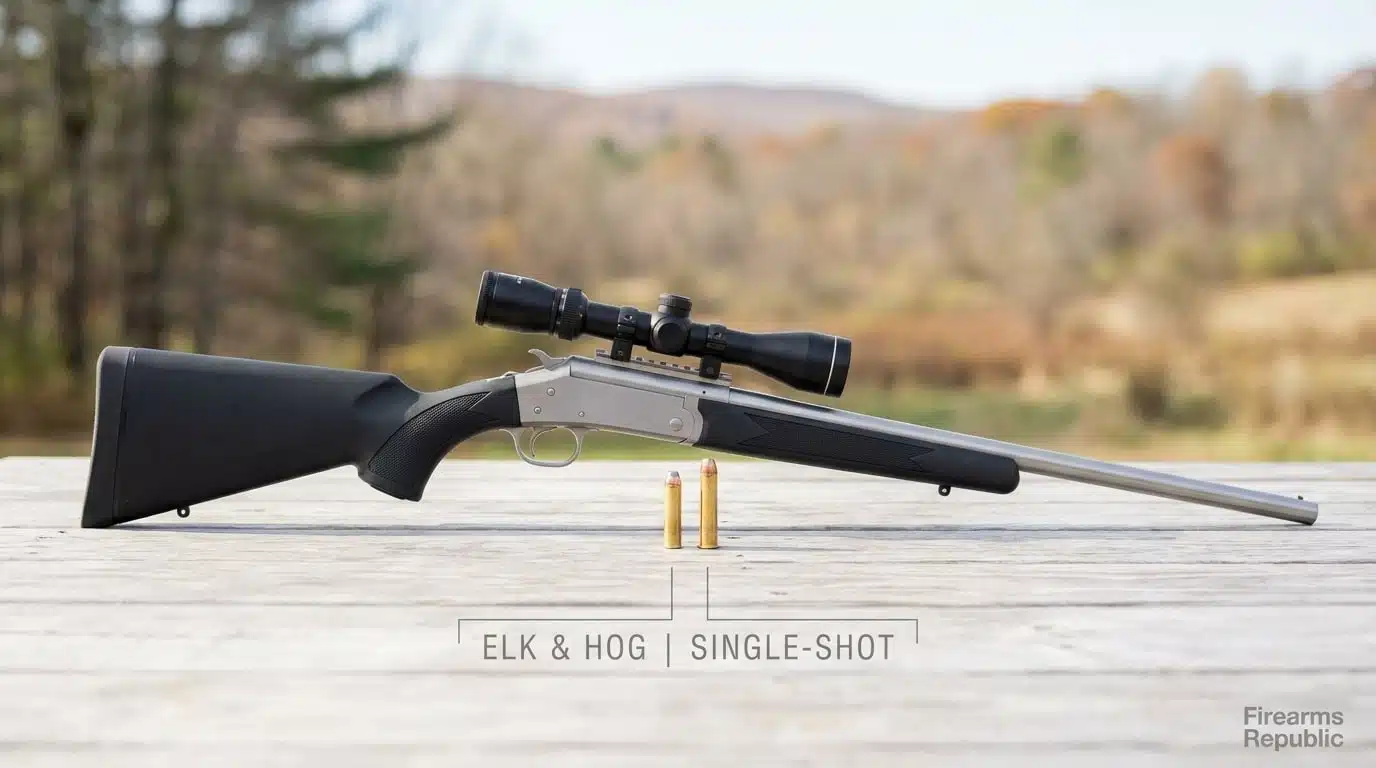
There’s a category of hunting that falls between whitetail deer and dangerous game – elk, large hogs, black bear, moose in favorable terrain – where the cartridge and rifle platform need to deliver more decisive performance than standard deer loads provide. The CVA Scout’s heavy-caliber configurations address exactly this category.
The Scout is available in four calibers that qualify as serious big-game and hog hunting tools: .45-70 Government, .444 Marlin, .35 Whelen, and .308 Winchester. This guide focuses on how these calibers perform in the Scout specifically for heavy game applications – not as deer rifles pushed past their comfort zone, but as purpose-appropriate tools for large, tough animals at practical hunting distances.
If you’re hunting elk in timber, running night hogs in the Southeast, working black bear over bait in the Northeast, or drawing a once-in-a-lifetime moose tag, this is the Scout configuration breakdown you need.
The Heavy-Game Case for a Single-Shot
Single-shot rifles have been used for elk, bear, and dangerous game for as long as centerfire cartridges have existed. The original purpose of the .45-70 Government was military and hunting use from single-shot trap-door Springfields. The tradition of one-shot hunting is embedded in the American hunting culture.
For heavy game specifically, the single-shot format has two practical advantages that matter in the field.
First, it forces deliberate shot placement. Elk and bear are large, durable animals. A marginal shot on a deer results in a short tracking job. A marginal shot on a 700-lb elk or 400-lb black bear results in a long, potentially unsuccessful recovery. Single-shot hunters – by necessity – develop the patience to wait for a clean, close broadside or quartering-away shot rather than taking marginal presentations. Over time, this discipline produces better outcomes on heavy game.
Second, the calibers that work best on heavy game at close range – .45-70, .444 Marlin, .35 Whelen – are naturally single-shot calibers. They live in break-actions, lever-guns, and falling-block designs. The Scout is one of the most affordable and accurate platforms available for these cartridges, and it handles the pressure levels that lever-actions cannot.
.45-70 Government for Elk and Heavy Game
The .45-70 is covered in depth in our CVA Scout .45-70 Review, but its role in elk and heavy game hunting deserves specific attention here.
Elk-relevant performance from a 22″ Scout barrel:
With Underwood .45-70 +P 325gr at ~2,050 fps, the Scout delivers approximately 3,030 ft-lbs at the muzzle. At 100 yards, retained energy is approximately 2,350 ft-lbs. The RMEF (Rocky Mountain Elk Foundation) recommends a minimum 1,500 ft-lbs at impact for elk – the Scout .45-70 delivers nearly 60% more than that minimum at 100 yards.
The limitation is trajectory. From a 100-yard zero with Hornady 325gr LEVERevolution, the bullet drops approximately -9″ at 150 yards and -25″ at 200 yards. This is a close-range cartridge. Elk hunters who work timber, funnel valleys, and wallows where shots stay inside 150 yards are in the Scout .45-70’s wheelhouse. Open-country elk hunters who need to reach 300+ yards should choose a different caliber.
For black bear over bait – arguably the most common North American situation where the .45-70 excels – the Scout is an exceptional setup. Most bear bait shots are under 75 yards. At that distance, the .45-70 is as decisive as any cartridge in production. A well-placed 430gr Buffalo Bore hard cast at 1,650 fps into a black bear’s shoulder produces immediate, dramatic results that lighter calibers cannot match.
.444 Marlin: The Underestimated Timber Gun
The .444 Marlin is one of the most underappreciated heavy hunting cartridges available. Introduced in 1964 for the Marlin 444 lever-action, it uses a .429″ diameter bullet – the same as .44 Remington Magnum – in a full-power rifle case. The result is a cartridge that delivers more energy than .44 Magnum rifle loads while maintaining the big-bore characteristics hunters value at close range.
From a 22″ CVA Scout barrel:
- Hornady 265gr FTX LEVERevolution: ~2,325 fps, ~3,180 ft-lbs
- Federal 240gr Fusion: ~2,150 fps, ~2,463 ft-lbs
- Cor-Bon 280gr Barnes XPB: ~2,050 fps, ~2,614 ft-lbs
The .444 Marlin’s muzzle energy from the Scout’s 22″ barrel rivals or exceeds .45-70 standard-pressure loads, and the 265gr FTX LEVERevolution’s polymer tip improves BC meaningfully over traditional flat-nose designs.
What the .444 Marlin offers over .45-70: slightly better trajectory from the higher-velocity FTX load. The 265gr FTX runs approximately 2,325 fps – 300+ fps faster than standard .45-70 loads of similar bullet weight. The result is a flatter arc that extends the cartridge’s practical range to approximately 175–200 yards with proper zeroing.
What it gives up to .45-70: the deepest selection of ultra-heavy hard-cast loads for dangerous game. The .45-70’s selection of 400gr–500gr hard cast penetrators has no real equivalent in .444 Marlin. For black bear and elk, this doesn’t matter. For brown bear or bison situations, .45-70 hard cast has the edge.
Hog hunting application: The .444 Marlin is a genuinely excellent hog cartridge. Large boars in the Southeast and Texas regularly run 250–350 lbs with heavy shield bone on the shoulder. A .444 Marlin FTX through the shoulder of a 300-lb boar drops it decisively. Many serious hog hunters who’ve moved from .308 or .30-06 to dedicated big-bore single-shots report the .444 Marlin as one of the best balance points between trajectory, energy, and practical field use.
Best use: Timber elk hunting inside 175 yards, large hog hunting, black bear at close to moderate range. The .444 Marlin is the Scout caliber for hunters who want more punch than .308 in a big-bore package without the steep trajectory of standard .45-70 loads.
.35 Whelen: The Long-Forgotten Elk Cartridge
The .35 Whelen is perhaps the most overlooked elk cartridge in the American market. Developed by James Howe and Colonel Townsend Whelen in 1922 by simply necking up the .30-06 Springfield case to .358 caliber, it was standardized by Remington in 1988. It never achieved the commercial popularity of .30-06 or .308, and most hunters today couldn’t tell you much about it.
That’s a shame, because the .35 Whelen from the CVA Scout’s 22″ barrel is genuinely one of the most capable elk cartridges available in the single-shot format.
From a 22″ CVA Scout barrel:
- Hornady 200gr SST Superformance: ~2,650 fps, ~3,118 ft-lbs
- Federal 225gr Trophy Bonded Bear Claw: ~2,500 fps, ~3,123 ft-lbs
- Remington 250gr Core-Lokt: ~2,350 fps, ~3,064 ft-lbs
Three different bullet weights, all delivering over 3,000 ft-lbs at the muzzle. The .35 Whelen pushes large .358 caliber bullets fast enough to produce meaningful trajectory out to 250 yards while maintaining the large wound channels associated with heavier bore diameters.
Compared to .45-70 for elk:
The .35 Whelen’s advantage is range. From a 100-yard zero, the 200gr SST at 2,650 fps drops approximately -3.5″ at 200 yards and -12″ at 300 yards. This is a legitimate 250-yard elk cartridge in a way that standard .45-70 loads simply are not. For elk hunters who work both timber (where .45-70 excels) and the occasional meadow shot at 200+ yards, the .35 Whelen covers more ground.
Compared to .308 for elk:
The .35 Whelen delivers more energy with a larger diameter bullet. A 225gr .35 caliber bullet at 2,500 fps produces wider wound channels and more reliable performance on large bull elk than a .30 caliber 180gr bullet at similar velocity. For hunters who want the best single-shot elk caliber in the Scout lineup that works from 50 yards to 250 yards, the .35 Whelen is arguably the most versatile option.
The limitation is ammunition availability. .35 Whelen loads are stocked by most large retailers but not universally available at small-town rural stores. If you’re hunting in remote areas where emergency ammo purchases might be necessary, .308 or .45-70 are more reliably available. See our .30-06 Springfield Caliber Guide for a comparable large-bore option with better availability.
Best use: Dedicated elk hunters who work varied terrain from dense timber to open parks, hunters who want 200+ yard capability with heavy-bore energy, and anyone willing to trade some ammo availability for genuine all-terrain elk performance.
.308 Winchester as a Heavy Game Caliber
The .308 Winchester was covered as a deer cartridge in our previous guide, but its role in heavy game deserves specific treatment here.
With proper loads, the Scout .308 is a legitimate elk cartridge inside 250 yards. The critical factor is bullet selection.
Elk-appropriate .308 loads from a 20″ Scout barrel:
- Federal 180gr Trophy Bonded Bear Claw: ~2,450 fps, ~2,399 ft-lbs
- Hornady 178gr ELD-X: ~2,520 fps, ~2,508 ft-lbs
- Nosler 168gr AccuBond: ~2,560 fps, ~2,445 ft-lbs
- Swift 180gr A-Frame: ~2,450 fps, ~2,399 ft-lbs
The Trophy Bonded Bear Claw and Swift A-Frame are the best choices for elk specifically. Both use partition or bonded construction that ensures the bullet retains weight and drives deep through heavy muscle and bone on large game. A standard soft-point designed for deer may expand too rapidly on the shoulder of a bull elk and fail to reach vitals.
Hog hunting with the Scout .308:
The Scout .308 is a capable hog gun for shots inside 200 yards. Large boars present a specific challenge: heavy shield bone over the shoulder that can deflect or stop underpowered or poorly constructed bullets. The same bonded and controlled-expansion bullets recommended for elk – Trophy Bonded, A-Frame, ELD-X – penetrate boar shields reliably. The .308’s advantage over the big-bore calibers in hog hunting is trajectory: a Scout .308 with a 200-yard zero handles shots from 30 to 250 yards without holdover, which matters during night hunting when range estimation is harder.
Best use: Hunters who want one rifle for both deer and elk, hunters who need maximum ammo availability anywhere in the country, and hog hunters who work longer shots than the big-bore calibers handle well.
See our .308 Winchester Caliber Guide for the full cartridge breakdown.
Caliber Comparison for Heavy Game
| Caliber | Muzzle Energy | Practical Range (elk/bear) | Recoil | Ammo Availability |
|---|---|---|---|---|
| .45-70 325gr +P | ~3,030 ft-lbs | 0–150 yards | High (with brake) | Good |
| .444 Marlin 265gr | ~3,180 ft-lbs | 0–175 yards | Moderate-high | Limited |
| .35 Whelen 225gr | ~3,123 ft-lbs | 0–250 yards | Moderate | Fair |
| .308 Win 180gr | ~2,399 ft-lbs | 0–250 yards | Moderate | Excellent |
The pattern is clear. .45-70 and .444 Marlin deliver maximum energy at close range with steep trajectory limits. .35 Whelen and .308 extend range while maintaining adequate energy for elk and bear. The choice depends almost entirely on the terrain and distances you hunt.
Hog Hunting Specifics
Wild hogs present different challenges than elk or bear. They’re abundant, often hunted at night with thermal or night-vision equipment, and can be encountered in large groups where a second shot might be needed – a single-shot limitation worth acknowledging honestly.
Where the Scout excels in hog hunting:
Stand or blind setups over feeders are where the Scout makes the most sense for hogs. You control the shot distance, the angle is predictable, and a single clean shot through the vitals drops a hog as effectively as any rifle. The .45-70, .444 Marlin, or .308 from a stable rest produces clean kills on hogs of any size inside 150 yards.
Where the Scout’s limitation matters:
Running shots on moving hogs, shooting into a sounder where follow-up shots at multiple animals are intended, or any hunting style that depends on quick multiple shots. A semi-automatic rifle in .308 or an AR-10 platform addresses these scenarios better than any single-shot. See our AR-10 Platform Guide for that application, or our Hog Hunting Rifle Guide for a full hog rifle breakdown.
Night hunting with the Scout:
The Scout’s threaded barrel accepts suppressors, and suppressed hog hunting with a single-shot is a legitimate and effective approach. A Scout .308 or .444 Marlin with a suppressor on a feeder setup produces minimal noise and muzzle flash that doesn’t spook surrounding hogs – a genuine tactical advantage over loud, unsuppressed alternatives. Load the Scout, make a precise shot, and the rest of the sounder may not scatter immediately.
Elk Hunting Specifics
Elk hunting with a single-shot requires specific preparation beyond deer hunting.
Distance management: Know your terrain. If you’re hunting Colorado wilderness where meadow shots at 300+ yards are realistic, the Scout is not your ideal elk rifle – a 6.5 PRC or .308 bolt-action with a 24″ barrel handles extended shots better. If you’re hunting Pacific Northwest rainforest, Idaho timber, or any terrain where 150 yards is a genuinely long shot, the Scout’s big-bore calibers are perfectly appropriate.
Shot selection: Elk are large enough that quartering-to shots are marginal with most calibers, and quartering-away shots require the bullet to traverse significant body mass to reach vitals. From a single-shot, the only appropriate elk shot is broadside or quartering-away with a clear angle to the lungs. Wait for it. A missed opportunity at a poor angle is better than a poorly hit bull that requires days of tracking.
Backup plan: With a single-shot, your backup plan is your sidearm. Many experienced elk hunters who carry single-shot rifles also carry a .44 Magnum revolver or similar powerful handgun for close follow-up if a wounded animal requires a finisher at short range.
For full elk rifle and caliber context, see our Elk Hunting Rifles Guide.
Setup Recommendations by Application
For elk hunting in timber:
- Caliber: .35 Whelen or .45-70 +P
- Optic: Leupold VX-Freedom 1.5–4×20 or Vortex Strike Eagle 1–6×24
- Zero: 150 yards
- Ammo: Federal 225gr Trophy Bonded (.35 Whelen) or Hornady 325gr LEVERevolution (.45-70)
For large hog over feeders:
- Caliber: .444 Marlin or .308 Winchester
- Optic: Red dot (Holosun 510C) for speed, or 1–4× LPVO for flexibility
- Zero: 100 yards
- Ammo: Hornady 265gr FTX (.444 Marlin) or Federal 180gr Trophy Bonded (.308)
For black bear over bait:
- Caliber: .45-70 or .444 Marlin
- Optic: 1–4× or fixed 2.5×
- Zero: 75 yards (most bait shots are inside this distance)
- Ammo: Buffalo Bore 430gr HC (.45-70) or Cor-Bon 280gr Barnes XPB (.444 Marlin)
For all-terrain elk (timber and parks):
- Caliber: .35 Whelen
- Optic: Vortex Crossfire II 2–7×32 or Leupold VX-3HD 2.5–8×36
- Zero: 200 yards
- Ammo: Federal 225gr Trophy Bonded or Hornady 200gr SST Superformance
FAQ
Q: Is the CVA Scout a legal elk rifle in all western states?
A: Yes. The Scout is a standard centerfire rifle and is legal for elk hunting wherever centerfire rifles are permitted. Some wilderness areas require horse packing or restrict certain access, but the rifle itself is universally legal. Always check state and unit-specific regulations for any additional restrictions.
Q: How does the Scout .444 Marlin handle recoil compared to .45-70?
A: The .444 Marlin produces less felt recoil than .45-70 +P loads in the Scout. Without a muzzle brake, standard .444 Marlin loads generate approximately 28–30 ft-lbs of recoil. With a muzzle brake (which some Scout configurations include), felt recoil drops to approximately 18–20 ft-lbs – similar to a .30-06 in a standard stock. The .45-70 with the KDF brake also runs in this range. If you’re comparing the two cartridges for recoil, the muzzle brake configuration matters more than the caliber choice.
Q: Can I use the Scout .308 for elk at 300 yards?
A: With proper bullet selection, the Scout .308 from a 20″ barrel delivers approximately 1,650 ft-lbs at 300 yards – above the RMEF’s recommended 1,500 ft-lbs minimum. Technically capable. Practically, however, the 20″ .308 Scout’s trajectory at 300 yards requires significant holdover from a typical hunting zero, and the 20″ barrel’s velocity disadvantage vs a 24″ bolt-gun becomes more meaningful at distance. For dedicated 300-yard elk hunting, a full-length bolt-action in 6.5 PRC or .30-06 is a more appropriate tool.
Q: Is .35 Whelen ammo available in rural areas during hunting season?
A: Less reliably than .308 or .45-70. Walmart and rural hardware stores that stock hunting ammo typically carry .308, .30-06, and .45-70. They may not carry .35 Whelen. If hunting in an area where emergency ammo purchase might be needed, bring extra or choose .308 or .45-70 for better availability.
Q: What’s the best single caliber in the Scout lineup for hunting both deer and elk?
A: .35 Whelen. It handles deer cleanly at all practical distances and delivers decisive elk performance to 250 yards. The .308 is the backup answer if ammo availability matters – it covers both applications with proper bullet selection and is stocked everywhere.
Related Guides
- CVA Scout Complete Guide
- CVA Scout .45-70 Government Review
- CVA Scout for Deer Hunting
- Elk Hunting Rifles Guide
- Hog Hunting Rifle Guide
- Bear Hunting Rifles Guide
- AR-10 Platform Guide
- .308 Winchester Caliber Guide
- Suppressor Buyer’s Guide
Word count: ~2,600 | Tables: 2 | Sections: 10 | FAQ: 5 URL: https://firearmsrepublic.com/cva-scout-elk-hog-hunting