 Maksym Kovaliov
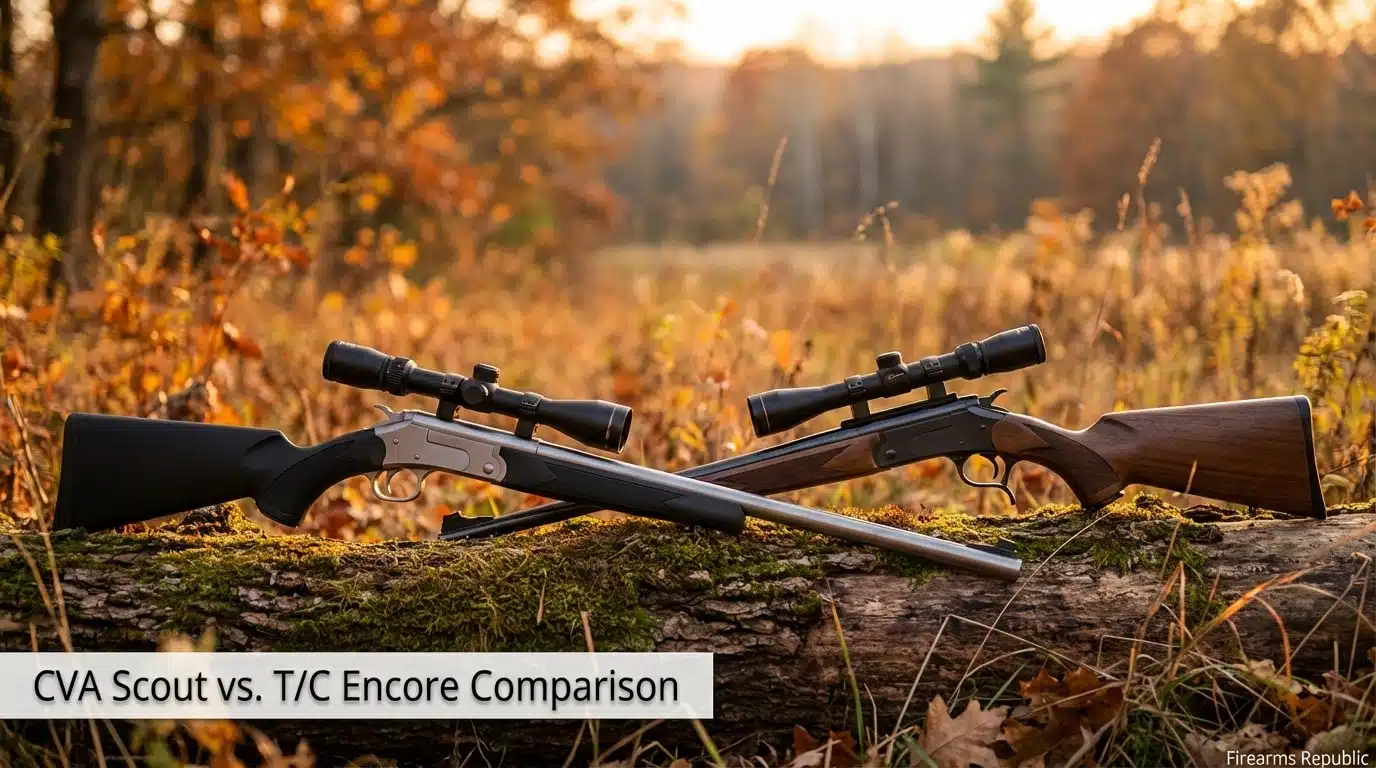
The two most serious modern single-shot hunting rifles on the American market are the CVA Scout and the Thompson/Center Encore Pro Hunter. Every serious single-shot hunting discussion eventually comes back to these two platforms. They look similar on paper – break-action, single-shot, stainless and synthetic, wide caliber availability – but they represent fundamentally different philosophies about what a single-shot rifle should be.
The T/C Encore is a platform: a receiver and stock system designed from the beginning to accept interchangeable barrels across dozens of calibers. Buy one Encore and you can run .223 Remington for varmints, .308 Winchester for deer, .45-70 for bear, and .300 Win Mag for elk – all on the same frame, with barrel swaps that take under five minutes. The Encore has been in continuous production since 1996 and has one of the deepest aftermarket ecosystems of any production hunting rifle.
The CVA Scout is a rifle: a purpose-built single-shot in a specific caliber with a Bergara-made barrel that delivers genuine accuracy at a price point the Encore cannot match. It doesn’t swap barrels with the same ease, it doesn’t have the Encore’s aftermarket depth, and it costs roughly half as much.
This comparison covers every meaningful difference between the two platforms so you can make an informed decision based on your actual hunting needs.
The Core Difference: Fixed vs Interchangeable Barrels
Everything else in this comparison flows from one fundamental design choice.
The T/C Encore Pro Hunter was designed around barrel interchangeability. The hinge pin, frame dimensions, and breech face are standardized across the entire Encore ecosystem. Remove two screws and a cross-pin, and the barrel slides free. Install a different barrel, replace the pin and screws, and you’ve changed calibers. The process takes roughly three minutes with a screwdriver and the correct pin punch. T/C and numerous aftermarket manufacturers have produced Encore barrels in over 40 calibers spanning from .17 HMR to .416 Rigby.
The CVA Scout is a fixed-barrel rifle. The barrel is installed at the factory with the correct headspace and alignment for that specific chambering. CVA does not market or support user barrel swapping the way T/C does with the Encore. Some experienced gunsmiths have swapped Scout barrels between compatible calibers, but this requires headspace verification with go/no-go gauges – it’s a gunsmithing operation, not a field swap. For practical purposes, you’re buying a Scout in one caliber and keeping it.
If you hunt with multiple calibers across different seasons and applications – varmints in spring, deer in fall, elk in September, bear in the same trip – the Encore’s barrel system delivers real value. If you hunt with one cartridge in one application, the Scout’s fixed barrel and lower price are the more logical choice.
Price Comparison
This is where the Scout wins decisively.
CVA Scout (standard, V2 or 2025): $375–$495 depending on caliber and configuration.
T/C Encore Pro Hunter (base rifle, one barrel): $699–$899 depending on barrel length and finish.
T/C Encore with additional barrels: Each barrel runs $300–$500 new. A three-barrel Encore setup (base rifle plus two additional barrels) costs $1,300–$1,900.
CVA Scout in three calibers (three separate rifles): $1,125–$1,485.
The Encore’s barrel-swapping advantage is real but requires commitment. A two-barrel Encore setup costs roughly the same as two separate Scouts. A three-barrel setup is comparable to three Scouts. The economic argument for the Encore only holds if you want more than three calibers on a single action, or if the shared receiver and stock feel matters more than the cost.
For most hunters who use two calibers – say, .308 for deer and .45-70 for hog – buying two Scouts is cheaper than one Encore with an additional barrel and gives you two complete, independent firearms ready to use simultaneously.
Trigger Quality
The trigger comparison is where the Scout wins most clearly.
CVA Scout trigger: Factory break weight typically 2.5–3.5 lbs with minimal creep. Independent reviews and owner reports consistently describe the Scout’s trigger as one of the better factory triggers available in a production hunting rifle at any price. The single-stage design with clean break is well-regarded.
T/C Encore Pro Hunter trigger: Factory break weight typically 5.5–6.5 lbs. This is the most commonly cited criticism of the Encore across forums, reviews, and independent testing. A 6-lb trigger on a hunting rifle is functional but not ideal – it’s heavy enough that some shooters push or anticipate the trigger break, which degrades accuracy. T/C’s design prioritizes safety and legal compliance over trigger feel, resulting in a pull weight that experienced precision shooters find frustrating.
Aftermarket trigger work for the Encore is available – Wolff springs reduce pull weight and improve feel – but this is an additional cost and modification. The Scout’s trigger is genuinely good out of the box.
In a hard-recoiling caliber like .45-70, .450 Bushmaster, or .35 Whelen, trigger quality matters significantly. A heavy trigger on a hard-recoiling rifle exacerbates flinching and makes accurate shooting harder. The Scout’s lighter, cleaner trigger produces better practical accuracy at hunting distances, especially for less experienced shooters.
Accuracy
Both rifles are capable of sub-MOA accuracy. The distinction lies in what drives that accuracy.
CVA Scout accuracy: The Bergara-manufactured 416 stainless barrel is the primary accuracy advantage. Bergara’s barrel manufacturing reputation is well-established – their B-14 bolt-action rifles regularly outperform $1,500+ competitors in independent accuracy testing. The same barrel quality translates to the Scout. Typical Scout accuracy with quality factory ammunition runs 0.75–1.0 MOA. With hand loads, 0.5–0.75 MOA is consistently achievable.
T/C Encore Pro Hunter accuracy: The Encore is also an accurate rifle. The interchangeable barrel system introduces one variable that fixed-barrel rifles avoid: barrel-to-receiver fit consistency. When an Encore barrel is installed correctly with proper torque and hinge pin seating, accuracy is very good – typically 0.8–1.2 MOA with quality ammunition. However, barrels that develop slight looseness at the hinge over time (a reported issue with extended use of heavy caliber loads) can open groups. This is not a universal problem, but it’s a known failure mode in the Encore ecosystem that fixed-barrel designs like the Scout simply don’t have.
For hunting accuracy – clean kills on deer and elk at practical distances – both rifles are more than adequate. For precision shooting applications where the last 0.2 MOA matters, the Scout’s consistent barrel lockup has a theoretical edge.
Caliber Availability
This is the Encore’s strongest argument.
T/C Encore Pro Hunter available calibers (partial list): .17 HMR, .22 LR, .22 Hornet, .223 Remington, .204 Ruger, .243 Winchester, .260 Remington, 7mm-08, .308 Winchester, .30-06 Springfield, .300 Win Mag, .300 WSM, 7mm Rem Mag, .338 Win Mag, .35 Whelen, .45-70, .450 Marlin, .416 Rigby, and numerous others. T/C and aftermarket manufacturers (Bullberry, MGM, others) together cover over 40 calibers.
CVA Scout available calibers: .223 Remington, .243 Winchester, 7mm-08, .308 Winchester, 6.5 Creedmoor, .35 Whelen, .444 Marlin, .45-70 Government, .450 Bushmaster, .350 Legend, .360 Buckhammer, .400 Legend, .44 Remington Magnum.
The Scout covers the most commonly hunted calibers thoroughly. Where it falls short is in the premium magnum territory – no .300 Win Mag, no 7mm Rem Mag, no .338 Win Mag. For hunters who specifically want a single-shot in a premium magnum, the Encore’s barrel library covers these; the Scout does not.
For deer, elk, hog, bear, and moderate varmint hunting – the applications that cover 95% of American hunters – the Scout’s caliber selection is fully adequate. The Encore’s broader range becomes meaningful only for hunters with very specific caliber needs outside the Scout’s lineup.
Weight and Handling
CVA Scout: 5.8–6.8 lbs depending on caliber and barrel length. Compact overall length, especially in 20″ configurations. Light, maneuverable, easy to carry in the field.
T/C Encore Pro Hunter: 6.5–8.5 lbs depending on barrel length and configuration. The 28″ bull barrel configurations in particular get heavy. The Encore’s heavier frame – designed to handle everything from .22 LR to .416 Rigby – adds weight that lighter-caliber hunters are carrying unnecessarily.
For hunters who cover distance on foot – still-hunting timber, spot-and-stalk mule deer, mountain elk hunting – the Scout’s weight advantage is real over long days. A 1.5-lb difference carried over 8 hours of mountain hiking is meaningful.
Aftermarket and Accessories
T/C Encore: Exceptional aftermarket depth built over nearly 30 years of production. Forearm options, stocks, pistol grips, barrel sets from T/C and numerous third parties. Buhmiller, Bellm, Bullberry – aftermarket Encore gunsmiths have built a cottage industry around the platform. Encore-specific accessories, replacement parts, and custom work are readily available.
CVA Scout: Limited aftermarket by comparison. The Scout’s design doesn’t lend itself to the same modular customization as the Encore. What you buy is largely what you get. DNZ mounts for the V2’s proprietary rail, slip-on recoil pads, slings, and standard optics are the practical accessory additions. There’s no chassis system, no adjustable stock aftermarket, no barrel swap ecosystem.
For hunters who enjoy customizing and building rifles, the Encore’s aftermarket is a significant advantage. For hunters who want a reliable, accurate rifle that ships ready to hunt, the Scout’s simpler ecosystem is not a limitation.
The Encore’s Shotgun and Muzzleloader Compatibility
One Encore advantage that’s worth noting specifically: T/C makes Encore frames in shotgun configuration (12 and 20 gauge) and muzzleloader configuration (.50 caliber). A hunter who wants one platform that handles deer season (rifle barrel), turkey season (shotgun barrel), and muzzleloader season (muzzleloader barrel) can accomplish all three with one Encore frame.
The CVA Scout has no such equivalents. It’s a centerfire rifle platform only. For hunters who specifically want cross-season platform flexibility, the Encore’s multi-format capability is a genuine advantage the Scout cannot match.
Henry Single Shot: Honorable Mention
Any comparison of the CVA Scout and T/C Encore should acknowledge the Henry Single Shot as a third option worth considering.
The Henry Single Shot runs $450–$550, uses American walnut stock and blued or brass receiver, and is manufactured in the United States. It’s available in a selection of calibers including .243, .308, .30-06, .45-70, and a few others. Accuracy is excellent – Henry’s quality control is consistently good.
Where Henry falls short vs both Scout and Encore: no scope rail standard (rings must be added), fixed stock with no adjustability, fewer caliber options than Scout, and no barrel-swapping capability. The Henry is a traditional-aesthetic hunting rifle that excels at being a beautiful, reliable single-shot. It doesn’t try to be a modular platform.
For hunters who value traditional aesthetics and American manufacture and don’t need the Scout’s caliber breadth or the Encore’s versatility, the Henry is worth considering alongside both.
Side-by-Side Comparison
| Feature | CVA Scout | T/C Encore Pro Hunter | Henry Single Shot |
|---|---|---|---|
| Price (base) | $375–$495 | $699–$899 | $450–$550 |
| Trigger pull | 2.5–3.5 lbs | 5.5–6.5 lbs | 3.5–4.5 lbs |
| Barrel swap | Not supported | Yes, user-swappable | No |
| Caliber count | 13 standard | 40+ | ~8 |
| Barrel maker | Bergara (Spain) | T/C (USA) | Henry (USA) |
| Weight | 5.8–6.8 lbs | 6.5–8.5 lbs | 6.5–7.0 lbs |
| Optic mount | Picatinny (2025) / proprietary (V2) | Weaver-style | Requires rings/bases |
| Shotgun/ML option | No | Yes | No |
| Aftermarket depth | Limited | Extensive | Moderate |
| Sub-MOA accuracy | Consistent | Consistent | Consistent |
Who Should Buy the CVA Scout
Buy the Scout if you want a reliable, accurate single-shot rifle in one caliber at the lowest possible price. The Bergara barrel quality, factory trigger, and Picatinny rail setup on the 2025 Scout deliver a hunting-ready rifle that outperforms its price point in accuracy and trigger feel.
Buy the Scout if you’re purchasing a dedicated hog gun, deer gun, or bear gun and you don’t intend to swap calibers. The fixed-barrel design’s simplicity and the cost savings over the Encore are the compelling advantages when you’re committed to one cartridge.
Buy the Scout if recoil-sensitive shooting is a concern. The lighter trigger weight makes accurate shooting easier in heavy calibers compared to the Encore’s heavier pull.
Who Should Buy the T/C Encore Pro Hunter
Buy the Encore if you genuinely intend to use multiple barrels. A two-barrel or three-barrel Encore setup hunting different calibers across different seasons is where the platform earns its premium. The economic case for the Encore requires actually using the barrel-swapping capability.
Buy the Encore if you want shotgun or muzzleloader compatibility on the same frame. The cross-season platform versatility is unique to the Encore among production single-shots.
Buy the Encore if you’re an enthusiast who enjoys the customization and modification ecosystem. The Encore’s aftermarket depth supports rifle builders and customizers in ways the Scout’s simpler platform cannot.
FAQ
Q: Is the T/C Encore more accurate than the CVA Scout?
A: Not consistently. Both deliver sub-MOA accuracy with quality loads. The Scout’s advantage is barrel consistency – Bergara-made barrels hold tight tolerances across production, and the fixed barrel lockup eliminates the variable of barrel-to-receiver fit that swappable systems introduce. In independent accuracy testing, the Scout and Encore perform comparably. Trigger quality gives the Scout an edge in practical shooting accuracy for most hunters.
Q: Can I use T/C Encore barrels on a CVA Scout, or vice versa?
A: No. The Scout and Encore use different receiver designs, hinge mechanisms, and frame dimensions. Barrels are not interchangeable between the two platforms.
Q: Is the T/C Encore still in production?
A: As of 2025, the Encore Pro Hunter remains available through T/C and distributors, though production has been more limited in recent years than during its peak. New Encores are available but may require ordering through a dealer rather than immediate shelf availability. The used market for Encore barrels and frames is active and represents good value.
Q: Which single-shot is better for a new hunter – Scout or Encore?
A: The Scout is the better choice for a new hunter. The lighter trigger makes accurate shooting easier to develop, the lower price reduces the financial commitment for someone still determining how much they’ll use a single-shot, and the simpler one-caliber-one-rifle design eliminates the complexity of barrel management. The Encore’s versatility is most valuable for experienced hunters with established caliber preferences and multi-season hunting plans.
Q: Does the CVA Scout hold its value better than the Encore?
A: The Encore has historically held value well in the used market, particularly because individual barrels retain value independently. A complete Encore setup (frame plus three barrels) sells well used. The Scout holds value reasonably for a production hunting rifle but doesn’t have the same barrel ecosystem that makes Encore components valuable individually. Neither is a collector’s item; both are practical hunting tools.
Related Guides
- CVA Scout Complete Guide
- CVA Scout .45-70 Government Review
- CVA Scout for Deer Hunting
- CVA Scout for Elk, Hog & Heavy Game
- Best Rifles for New Shooters
- Elk Hunting Rifles Guide
- Whitetail Deer Hunting Rifles