
 Firearms Republic
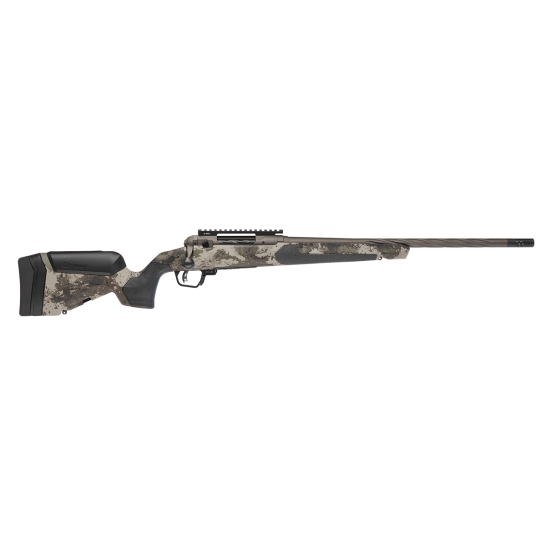
The Savage 110 Core Hunter in 6.5 PRC is one of the more interesting value propositions in the bolt-action hunting market right now. Getting 6.5 PRC chambering – a cartridge known for pushing 143gr ELD-X bullets to nearly 2,960 fps from a 24" barrel – in a rifle that streets for $699-$749 is genuinely rare. Savage bundles in their AccuTrigger (adjustable from 1.5 to 6 lbs), an AccuFit adjustable stock, a factory-threaded 5/8×24 muzzle, and an AICS-compatible 4-round detachable magazine – features that typically add up fast on competing platforms. The question isn’t whether the spec sheet looks good at this price. It does. The question is whether the execution holds up in the field.
Quick Verdict
✓ Best for: Western elk and mule deer hunters shooting 400-600 yards on a budget
✓ Price: $699-$749 street
✓ Key strength: AccuTrigger and AccuFit system deliver genuine adjustability that competitors charge $200+ extra for
✗ Not ideal for: Backcountry mountain hunters – 7.5 lbs bare is mid-weight at best, and with glass and a full pack it becomes a real conversation
The 110 Core Hunter in 6.5 PRC sits in a genuine sweet spot for hunters who want the cartridge’s ballistic advantages without crossing into four-figure rifle territory. It’s not perfect, but the trade-offs are honest ones.
Real-World Performance
The 24" barrel with a 1:8 twist is the right call for 6.5 PRC. It stabilizes everything from 130gr to 156gr bullets without issue, and the longer tube squeezes out velocity that a 22" barrel simply can’t match. Hornady’s factory 143gr ELD-X runs right around 2,960 fps, and the 147gr ELD-M comes in close to 2,910 fps – both within 20-30 fps of published specs, which is better than average for factory ammunition consistency.
Accuracy out of the box runs 0.7 to 1.0 MOA with quality factory loads. That’s not Bergara-level precision, but it’s honest sub-MOA performance adequate for any hunting application inside 600 yards. The AccuTrigger, factory-set around 3 lbs with a clean, predictable break, is the single biggest performance advantage over similarly priced competitors. It makes shooting fundamentals easier to execute, and that matters more at distance than most shooters realize.
One limitation worth noting: the sporter-profile barrel heats up faster than a medium or heavy contour. String-shooting 10 rounds sees groups open noticeably – not a hunting problem since you’re rarely shooting more than two or three rounds in the field, but worth knowing if you plan extended range sessions. Cold-bore shots are consistent, which is what counts when that first shot at an elk is the only one that matters. Energy at 500 yards with the 143gr load sits around 1,650 ft-lbs – adequate for elk with proper shot placement, and comfortably above minimums for mule deer at any practical hunting range.
Applications & Use Cases
Western Hunting – Antelope and Mule Deer
In open country where shots at 350-500 yards are the norm rather than the exception, the 6.5 PRC earns its keep. The cartridge’s wind drift advantage – roughly 15% better than 6.5 Creedmoor at 600 yards – is meaningful when you’re holding into a 15 mph Wyoming crosswind. The flat trajectory and manageable recoil (around 16 ft-lbs, noticeably less than a 7mm Rem Mag) let hunters call their shots accurately and recover quickly for follow-up if needed.
Verdict: This is where the Core Hunter genuinely shines – a capable, budget-friendly platform for exactly the kind of shooting western hunters face.
Elk Hunting at Distance
At 400+ yards on elk, the 6.5 PRC’s energy advantage over 6.5 Creedmoor becomes real and practical. The extra 200 ft-lbs at distance and flatter trajectory give a meaningful margin. Inside 300 yards, the difference is academic and 6.5 Creedmoor does the same job for cheaper. The 7.5 lb rifle weight isn’t a problem for hunters working out of camps or glassing from a vehicle – it becomes a problem on day 4 of a backcountry horseback hunt where every pound matters.
Verdict: Solid elk rifle for hunters with vehicle or base-camp access, less ideal for true pack-in scenarios.
Suppressed Hunting
The factory 5/8×24 threading and 24" barrel make this a practical suppressor host. The extra barrel length keeps velocity high even with the added backpressure, and the moderate recoil of 6.5 PRC stays comfortable even suppressed. Running a can from a whitetail blind or coyote stand works well.
Verdict: A legitimate suppressor-ready hunting platform at a price point where threaded barrels are still uncommon.
Ergonomics & Handling
The AccuFit stock is the ergonomic story here. Five comb height positions and five length-of-pull positions (12.5" to 13.5") adjusted via removable inserts – no tools, no gunsmith – means most shooters can dial in proper eye alignment with their scope without shimming or custom work. That’s genuinely useful, especially for hunters sharing a rifle or running different scope heights.
The synthetic stock itself feels hollow when tapped – it’s not a confidence-inspiring material, and the matte finish scratches easily in brush. Functionally it’s adequate, but Weatherby’s and Bergara’s stocks feel noticeably more substantial. Balance with a mid-size scope sits slightly muzzle-heavy, which some hunters prefer for steadier off-hand holds.
Bolt operation is smooth enough but not Tikka-smooth. It’s a working rifle bolt – functional, reliable, decades-proven – but it won’t impress anyone coming from a T3x. The AICS-compatible 4-round magazine drops free cleanly and seats positively. Four rounds feels limiting compared to five-round alternatives, though most hunters never fire more than two in the field. Loading is straightforward with no feed issues noted across multiple ammunition types.
Aftermarket & Upgrade Path
The Savage 110 platform has a legitimate aftermarket ecosystem, and the Core Hunter drops into it without modification. Boyd’s At-One stocks run around $200 and dramatically improve the feel and rigidity over the factory synthetic. MDT’s LSS-XL Gen2 chassis at roughly $500 transforms it into a precision-capable platform, though that pushes total cost past $1,200 – at which point the Bergara B-14 Ridge starts looking rational.
The barrel nut system is Savage’s most underappreciated feature. A $50 barrel nut wrench and a vise let you swap prefit barrels at home – no gunsmith, no headspace gauges. Criterion and McGowen both offer 6.5 PRC prefits in the $300-400 range. Shoot the factory barrel to its 1,500-2,000 round limit, install a heavier Criterion, and you’ve got a meaningfully improved rifle for a fraction of what a custom build costs. Scope bases from EGW in 20 MOA Picatinny run $50 and are essential for serious long-range work. The AccuTrigger is already the best factory trigger in this price range – skip that upgrade category entirely and put the money toward glass or a better stock.
Pros & Cons
Strengths:
✓ AccuTrigger adjustable from 1.5-6 lbs, factory-set at ~3 lbs – best factory trigger under $800
✓ 6.5 PRC chambering under $750 – genuinely rare; nearest competitor is $300+ more
✓ AccuFit system adds 5-position comb and LOP adjustability without tools or gunsmith
✓ Factory-threaded 5/8×24 muzzle ready for suppressor or brake without additional cost
✓ AICS-compatible magazine allows Magpul and Accurate Mag upgrades immediately
✓ Barrel nut system enables home barrel swaps – saves $150-300 in gunsmith fees
✓ AccuStock aluminum bedding block provides genuine rigidity in an otherwise modest stock
✓ Sub-MOA accuracy guarantee from factory – 0.7-1.0 MOA typical with quality ammo
✓ Proven 110 action reliability across decades of hard field use
✓ 143gr ELD-X at 2,960 fps delivers 1,650 ft-lbs at 500 yards – adequate for elk
Limitations:
✗ Synthetic stock sounds hollow when tapped – cheaper feel than Bergara or Weatherby at similar price points
✗ 4-round AICS magazine limits capacity vs. competitors offering 5-round standard
✗ 7.5 lbs bare – add scope and rings and you’re at 9+ lbs, tiring on backcountry elevation
✗ Bolt operation lacks the smoothness of Tikka T3x or Bergara B-14 – noticeable difference
✗ 6.5 PRC ammunition runs $2.50-3.25/round factory – $500 more over 5 years vs. 6.5 CM
✗ Barrel life estimated 1,500-2,000 rounds due to higher pressure – shorter than 6.5 CM
✗ Matte synthetic finish scratches easily in brush and timber
✗ Factory accuracy averages 0.7-1.0 MOA – honest but not the 0.5 MOA some competitors deliver
✗ Sporter barrel heats quickly – groups open after 8-10 rounds in range sessions
Competitors & Alternatives
| Feature | Savage 110 Core Hunter | Ruger American 6.5 PRC | Weatherby 307 Range | Bergara B-14 Ridge |
|---|---|---|---|---|
| Price | $699-749 | $649 | $999 | $1,050 |
| Weight | 7.5 lbs | 6.2 lbs | 7.8 lbs | 8.1 lbs |
| Trigger | ~3 lbs adj. | ~3.5 lbs adj. | ~3 lbs | ~3 lbs adj. |
| Magazine | 4-rd AICS | 4-rd rotary | 4-rd AICS | 5-rd AICS |
| Accuracy | 0.7-1.0 MOA | 0.8-1.2 MOA | Sub-MOA guarantee | 0.5 MOA typical |
The Ruger American 6.5 PRC at $649 is the obvious starting comparison. It’s $100 cheaper and meaningfully lighter at 6.2 lbs – a real advantage for backcountry hunters. But the Ruger’s trigger is less refined, the stock offers no adjustability, and there’s no threaded barrel from factory. The Savage’s AccuTrigger alone is worth more than that $100 price gap, and the AccuFit system adds another $100-200 of practical value. The Savage is the better buy for most hunters.
The Weatherby 307 Range at $999 closes the gap on fit, finish, and the confidence that comes with a more premium package – but $250 more for incremental improvement is a hard sell when the Savage already delivers sub-MOA performance in the field. The Bergara B-14 Ridge at $1,050 is genuinely in a different accuracy tier, averaging around 0.5 MOA, with a noticeably better barrel and smoother action. If precision matters more than budget, the Bergara is worth every penny of the $300 premium.
The Browning X-Bolt Hell’s Canyon at $1,200 is premium territory that the Core Hunter simply doesn’t compete with directly – better everything, but nearly double the price.
Who Should Buy This
Ideal for the budget-conscious western hunter: If you’re hunting elk and mule deer in open country at 400+ yards regularly, need the ballistic advantage of 6.5 PRC over 6.5 Creedmoor, but can’t justify spending $1,000+ on a hunting rifle, the Core Hunter delivers the performance where it counts. The cartridge’s wind performance and energy retention at distance are real advantages in that application.
Also great for the DIY builder: Hunters who want a starting platform they can grow into will appreciate the barrel nut system for home barrel swaps, the AICS magazine compatibility for immediate upgrades, and the AccuTrigger that needs no replacement. Start at $749, add a Boyd’s stock and 20 MOA base, and you’ve got a $1,000 semi-custom without gunsmith bills.
Look elsewhere if weight is your priority: Backcountry elk hunters packing 10+ miles at elevation should look at the Ruger American for a lighter starting point, or save up for a purpose-built mountain rifle. The Core Hunter’s 7.5 lbs is simply the wrong tool for that job.
Frequently Asked Questions
Q: Does the Savage 110 Core Hunter actually shoot sub-MOA consistently?
A: With quality factory ammunition like Hornady 143gr ELD-X or Federal 140gr Trophy Bonded, expect 0.7-1.0 MOA in typical 3-shot groups. It’s not a benchrest rifle, but it’s honest sub-MOA performance for hunting purposes. Handloads can push that to 0.5-0.7 MOA with development.
Q: Is 6.5 PRC worth the ammo cost over 6.5 Creedmoor for deer hunting?
A: Honestly, no – not for deer inside 300 yards. The extra $1/round is hard to justify when 6.5 Creedmoor does the same work. For elk at 400+ yards or in consistently windy conditions, the PRC’s advantages become real and practical.
Q: Can I really swap barrels myself with the Savage barrel nut system?
A: Yes. A $50 barrel nut wrench, a vise, and a prefit barrel from Criterion or McGowen are all you need. It’s a legitimate DIY process – no headspace gauges required. Savage prefits ship ready to install, and accuracy results are comparable to traditionally threaded barrels.
Q: How does the AccuFit system work in practice?
A: Removable inserts adjust comb height across 5 positions in 0.25" increments, and LOP from 12.5" to 13.5" in five steps. No tools needed – swap inserts by hand. It’s not infinite adjustment like a competition chassis, but it covers the range most hunters need.
Q: What scope mounting setup do you recommend for long-range use?
A: An EGW 20 MOA Picatinny base ($50) gives you the elevation travel needed for 600+ yard shooting. Standard rings in a reputable brand – Talley, Leupold, Warne – finish the setup without overcomplicating it.
Q: Is the 24" barrel practical for hunting in timber?
A: It’s manageable but not ideal for dense brush. In open western terrain it’s the right call for velocity. If most of your hunting is in eastern timber, the extra barrel length is more nuisance than asset.
Final Verdict
- Hunting: 4/5
- Long-Range: 3.5/5
- Competition: 2/5
- Value: 4.5/5
The Savage 110 Core Hunter in 6.5 PRC is a genuinely smart buy for western hunters who want the cartridge’s ballistic advantages without the premium price tag. The AccuTrigger, AccuFit adjustability, factory threading, and barrel nut system deliver real-world value that competitors charge significantly more for. It’s not the smoothest, lightest, or most refined rifle in its class – but for a hunter running 20-50 rounds a year at elk and mule deer in open country, it’s hard to argue against what you’re getting at $749.