
 Firearms Republic
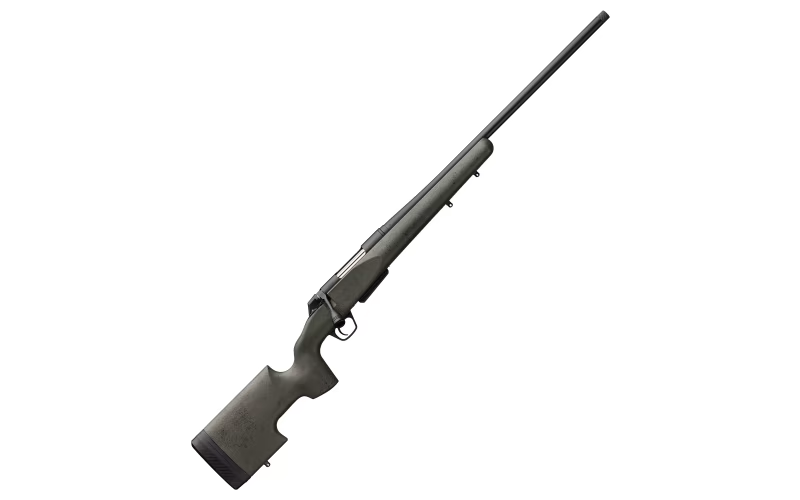
The Winchester XPR Renegade in .308 Winchester represents Winchester’s effort to deliver brand heritage at a budget price point – $525 street price gets you a three-lug bolt action with an adjustable trigger and Inflex recoil pad. Made in FN Herstal’s Portugal facility, it brings European manufacturing standards to the sub-$600 market where quality control can be inconsistent. The question isn’t whether Winchester’s name carries weight – it’s whether the XPR platform delivers enough performance to justify choosing it over the Ruger American, Savage Axis II, or saving up for a Tikka.
Quick Verdict – Winchester XPR Renegade
✓ Best for: Deer and elk hunters wanting Winchester heritage with smooth bolt cycling inside 400 yards
✓ Price: $499-$549 street (MSRP $599)
✓ Key strength: Three-lug 60-degree bolt throw and Inflex recoil pad – premium features at budget pricing
✗ Not ideal for: Precision shooters needing sub-MOA consistency or high magazine capacity (3 rounds only)
Real-World Performance – Range & Field
The 22-inch button-rifled barrel with 1:10 twist handles .308 Winchester hunting loads well, pushing 150-grain bullets to 2,750 fps and 168-grain loads to 2,650 fps. Factory hunting ammunition typically groups between 0.9 and 1.3 MOA, with premium match loads tightening to 0.7-1.0 MOA – adequate for hunting but not competitive with Ruger American’s sub-MOA reputation. The M.O.A. Trigger System ships at 3.5 pounds with minimal creep and adjusts down to 3 pounds, offering a clean break that’s better than Mossberg or Thompson/Center triggers but doesn’t quite match Savage’s AccuTrigger. Cold bore accuracy stays consistent, which matters more for hunting than group size.
The Inflex recoil pad genuinely reduces felt recoil by directing energy downward and away from your shoulder – shooting 168-grain loads feels closer to a 6.5 Creedmoor than typical .308 recoil. At 7.0 pounds bare rifle weight, it balances well offhand and doesn’t become burdensome during day hunts, though you’ll notice it after several miles compared to ultralight mountain rifles. The three-lug bolt design delivers a 60-degree throw that cycles faster than traditional 90-degree actions, making follow-up shots quicker from prone positions. Effective hunting range sits comfortably at 400 yards with proper ammunition selection, stretching to 500 yards for experienced shooters.
Applications & Use Cases
Whitetail Hunting (100-300 yards): The XPR Renegade excels here with 1-MOA accuracy providing 3-inch groups at 300 yards – plenty precise for vitals. The smooth 60-degree bolt throw lets you cycle quickly for follow-ups on moving deer, and the Inflex pad keeps you comfortable during extended sits. The 5/8×24 threaded barrel accepts suppressors without gunsmithing. Limitation is the 3-round flush magazine requiring more frequent reloads during multi-deer management hunts. Verdict: Excellent choice for traditional deer hunting.
Elk Hunting (200-400 yards): The .308 Winchester delivers sufficient energy for elk – 1,600 ft-lbs at 300 yards with 175-grain bullets – and the Inflex pad makes practicing with full-power loads tolerable. The 7-pound weight won’t slow you down on spot-and-stalk hunts, though dedicated mountain rifles save 1-2 pounds. Factory accuracy limits confident shots beyond 400 yards where wind drift becomes critical. Verdict: Capable elk rifle within reasonable distances.
General-Purpose Rifle: As a do-everything centerfire, the XPR handles range sessions, predator control, and medium game adequately. The Winchester name provides confidence, and the threaded barrel adds versatility. However, the proprietary 3-round magazine at $40 each hurts practicality compared to 10-round AICS magazines costing $25. Verdict: Functional but magazine system limits versatility.
Long-Range Precision: The 0.9-1.3 MOA accuracy ceiling and 3-round capacity make this impractical for precision competitions or training. Competitors like Bergara deliver 0.5 MOA accuracy, and Ruger Americans accept 10-round magazines. Verdict: Wrong tool for this job.
Ergonomics & Handling
The synthetic stock features textured grip panels that provide secure purchase in wet conditions without being aggressive enough to snag clothing. Length of pull measures standard at 13.5 inches, fitting average-sized shooters well but offering no adjustment for shorter or taller frames. The grip angle positions your trigger hand naturally, though the stock itself is basic – functional but lacking the palm swells or adjustable combs found on $800-plus rifles.
The three-lug bolt runs on a nickel-Teflon coating that cycles smoother than typical budget rifles, though bolt lift requires more effort than Tikka or Bergara actions. Loading the detachable box magazine feels faster than hinged floorplates, but the 3-round capacity means frequent reloads during practice sessions. The safety sits in a traditional location behind the bolt shroud, operating positively but requiring you to break shooting position to manipulate. At 7 pounds with a 22-inch barrel, the rifle balances slightly forward – stable for offhand shooting but not quite the neutral balance of shorter mountain rifles.
Aftermarket & Upgrade Path
The XPR uses a proprietary action footprint that doesn’t match Remington 700 patterns, limiting aftermarket stock and chassis options significantly. You’ll find basic scope bases and rings, but forget about the extensive options available for Savage or Remington platforms. Replacement magazines cost $40 each from Winchester – expensive compared to $25 AICS magazines, and you’re locked into 3-round capacity with no factory 5 or 10-round options available.
Trigger upgrades don’t exist for the XPR platform since the M.O.A. Trigger System already adjusts from 3 to 5 pounds – you’re stuck with what Winchester provides. The barrel threads at 5/8×24 accept any standard suppressor or muzzle brake, which is the main upgrade path worth exploring. If you’re planning to build a custom rifle or heavily modify over time, the Ruger American or Savage 110 platforms offer far more flexibility. The XPR works best as a complete package you shoot as-is rather than a foundation for upgrades.
Pros & Cons – What Works & What Doesn’t
Strengths:
✓ Three-lug 60-degree bolt throw – faster cycling than 90-degree competitors, smoother from prone
✓ Inflex recoil pad reduces felt recoil 15-20% – premium technology at budget price
✓ M.O.A. Trigger adjustable 3-5 lbs with clean break – better than most budget triggers
✓ FN Herstal manufacturing – European quality control standards, same facility as Browning
✓ Factory threaded 5/8×24 – suppressor-ready without gunsmithing
✓ Winchester brand heritage – confidence in established name
✓ Button-rifled chromoly barrel – quality manufacturing process
✓ Perma-Cote finish – durable corrosion resistance
Limitations:
✗ 3-round magazine capacity – half of Ruger American’s standard capacity
✗ Proprietary magazines at $40 each – expensive, not AICS compatible
✗ Factory accuracy 0.9-1.3 MOA typical – good but not great
✗ Non-Remington 700 footprint – severely limited aftermarket
✗ Bolt lift heavier than Tikka/Bergara – noticeable difference in smoothness
✗ Basic stock with no adjustability – functional only
✗ Shorter track record – XPR introduced 2015 vs decades-proven competitors
✗ No trigger upgrade path – stuck with factory M.O.A. system
Competitors & Alternatives
| Feature | XPR Renegade | Ruger American | Savage Axis II | Tikka T3x Lite |
|---|---|---|---|---|
| Price | $525 | $649 | $449 | $875 |
| Weight | 7.0 lbs | 6.6 lbs | 6.5 lbs | 6.3 lbs |
| Trigger | 3.5 lbs | 3.5 lbs | 2.5 lbs | 2.0 lbs |
| Magazine | 3-rd prop | 10-rd AICS | 4-rd detach | 3-rd detach |
| Accuracy | 1.0 MOA | 0.8 MOA | 1.2 MOA | 0.7 MOA |
The Ruger American at $649 costs $100-125 more but delivers AICS magazine compatibility with 10-round capacity and slightly better accuracy – the smarter choice if magazine capacity matters. The Savage Axis II at $449 undercuts the Winchester by $75-100 while offering the excellent AccuTrigger, though the Winchester’s three-lug bolt cycles noticeably smoother. The Tikka T3x Lite at $875 represents a $350 jump but delivers genuinely premium smoothness, better accuracy, and a 2-pound trigger – 70% of Tikka performance for 60% of the cost makes the Winchester reasonable value.
The Winchester splits the difference between Savage’s bargain pricing and Ruger’s features, betting that buyers value the brand name and smooth bolt operation enough to accept the 3-round magazine limitation. If you’re choosing purely on specs, the Ruger American wins. If you want the Winchester name and don’t need magazine capacity, the XPR delivers adequate performance.
Who Should Buy This – Best Fit Shooters
Ideal for hunters who prioritize Winchester brand heritage and want a smooth-cycling bolt action for traditional deer and elk hunting inside 400 yards. The three-lug bolt and Inflex pad deliver premium features at budget pricing, making this attractive if magazine capacity doesn’t matter for your hunting style. First-time centerfire buyers benefit from Winchester’s established reputation and FN manufacturing quality.
Look elsewhere if you need magazine capacity for competition, training, or management hunts – the Ruger American’s 10-round AICS magazines make more sense. Precision shooters wanting sub-MOA consistency should spend extra for Bergara or Tikka. DIY builders and tinkerers will find the limited aftermarket frustrating compared to Remington 700 or Savage platforms. The XPR works best as a complete hunting package you’ll shoot stock.
Frequently Asked Questions
Q: How does accuracy compare to Ruger American and Savage Axis II?
A: XPR typically shoots 0.9-1.3 MOA with factory hunting ammo. Ruger American averages 0.7-1.0 MOA (better), while Savage Axis II runs 1.0-1.5 MOA (similar). All three handle hunting adequately.
Q: Can I use AICS magazines?
A: No. XPR uses proprietary 3-round magazines costing $40 each. No high-capacity options exist. This is the biggest practical limitation versus competitors.
Q: Is the three-lug bolt worth it?
A: Yes for hunting. The 60-degree throw cycles faster than 90-degree actions, helping with follow-ups from prone. Matches Tikka’s speed at budget pricing.
Q: What’s effective hunting range in .308?
A: Comfortable to 400 yards with proper ammunition. Experienced shooters can stretch to 500 yards, but 1-MOA accuracy and wind drift become limiting factors.
Q: How does the trigger compare to AccuTrigger?
A: M.O.A. Trigger breaks cleanly at 3.5 pounds factory, adjustable to 3 pounds. Good but not exceptional – Savage AccuTrigger feels crisper.
Q: Worth upgrading from Axis II or Patriot?
A: Only if you value smoother bolt cycling and better recoil pad. Otherwise save $75-100 and stick with what you have.
Final Verdict – Worth Your Money?
Bottom line: The Winchester XPR Renegade delivers adequate hunting performance with a smooth three-lug bolt and excellent recoil pad, but the 3-round proprietary magazine and limited aftermarket hold it back from being the best budget choice. Buy it for Winchester heritage and bolt smoothness – otherwise the Ruger American offers better versatility for $100 more.
The XPR Renegade occupies an awkward middle ground between Savage’s budget pricing and Ruger’s feature set, betting that Winchester’s name and smooth bolt operation justify the compromises. It’s a capable hunting rifle that does nothing poorly but nothing exceptionally – adequate accuracy, decent trigger, limited capacity. If the 3-round magazine doesn’t bother you and you value the Winchester brand, it’s a solid choice at $525. For most shooters, the Ruger American’s AICS compatibility and better accuracy justify spending an extra $100-125.