 Maksym Kovaliov
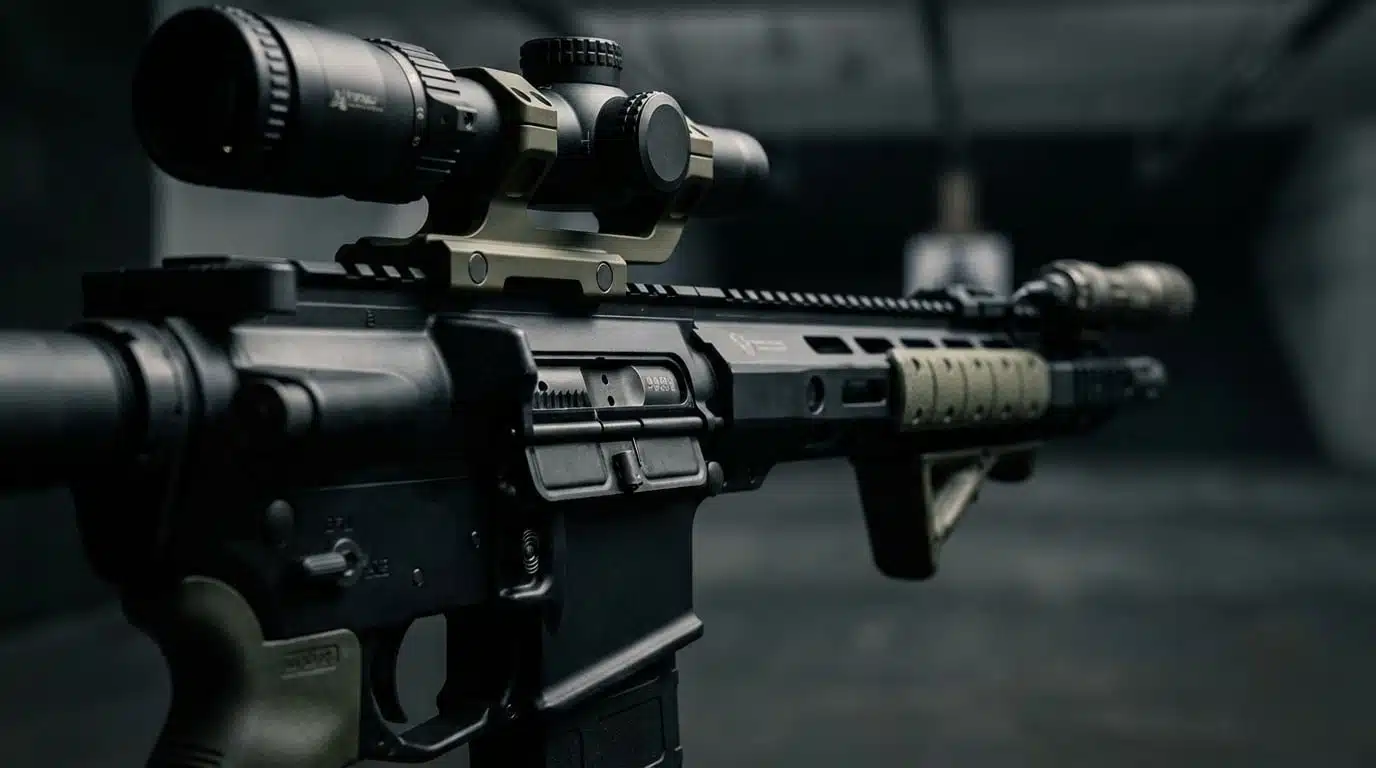
The AR-10 is the full-power big brother most AR-15 owners eventually come around to – a battle rifle platform chambered in .308 Winchester and a growing family of precision cartridges that share the same action-length case. Where the AR-15 gives you fast follow-up shots in an intermediate cartridge, the AR-10 adds genuine reach: reliable terminal performance past 600 yards, enough energy for elk-sized game, and the foundation for one of the best competition platforms in PRS Gas Gun division. It’s heavier, more expensive, and more demanding to maintain than the AR-15 – but for hunters, competitors, and precision shooters who need what the platform delivers, there’s nothing else quite like it.
This guide covers everything about the AR-10 platform: how it came to exist, the critical DPMS vs. Armalite compatibility question that trips up first-time builders, which calibers actually make sense, the best production rifles available right now, and when a bolt-action is the smarter choice. If you’re deciding between the AR-10 and AR-15 platforms, see our AR-15 vs AR-10 guide for a full use-case comparison.
A Brief History of the AR-10
Eugene Stoner and ArmaLite: 1956
The AR-10 predates the AR-15. Engineer Eugene Stoner developed the original design for ArmaLite – a small division of Fairchild Aircraft – in 1956. The rifle was chambered in 7.62×51 NATO and introduced several ideas that were radical at the time: a straight inline stock that redirected recoil directly into the shooter’s shoulder rather than rotating the muzzle upward, a direct impingement gas system that used propellant gas to cycle the action directly rather than driving a separate piston, and a lightweight aluminum receiver that replaced the heavy steel receivers standard on contemporary military rifles.
ArmaLite submitted the AR-10 for U.S. Army trials in 1957–1959. It lost to the Springfield Armory M14 – a decision that military historians still debate. Small numbers of AR-10s were produced for the Portuguese, Sudanese, and Nicaraguan militaries, then the platform went dormant for decades.
The Scale-Down That Changed Everything
In 1957, Stoner scaled the AR-10 design down to accept the .223 Remington cartridge, producing the AR-15. ArmaLite sold the rights to Colt in 1959. The military adopted the rifle as the M16 in 1964. The AR-10 itself was largely forgotten as attention shifted to the smaller caliber platform.
The 1990s Revival: SR-25 and the DPMS Era
The AR-10 returned in the 1990s through two parallel efforts that created the compatibility problem builders still navigate today.
Knights Armament Corporation (KAC) developed the SR-25 (Stoner Rifle-25) in 1990 – a refined, accurized version of the AR-10 built for USSOCOM snipers. It was adopted by U.S. Special Operations Forces in 1995 and remains in service. KAC built around a slightly modified Armalite geometry that became one of the two dominant standards.
DPMS (Defense Procurement Manufacturing Services) entered the civilian market with the LR-308, building around a slightly different geometry they called the “DPMS pattern.” DPMS priced the platform accessibly and built dealer relationships that made LR-308 components ubiquitous. By the 2000s, the DPMS pattern had more aftermarket support than the Armalite-derived standard.
The result: two physically similar but mechanically incompatible platforms sharing the same name. This matters enormously when building – see the compatibility section below.
The 6.5 Creedmoor Effect: 2007–Present
Hornady introduced the 6.5 Creedmoor in 2007. By 2015, it had become the dominant long-range precision cartridge, and builders figured out that the AR-10’s action length accommodated 6.5 CM with no other changes. The combination unlocked everything the AR-10 had been promising: a 1,000-yard capable semi-automatic platform with moderate recoil and excellent factory ammunition availability.
The PRS Gas Gun Division formalized competitive shooting on the platform, and the AR-10 in 6.5 Creedmoor became the de facto competition semi-auto. Today the AR-10 is arguably more relevant than it’s ever been. For the full story on 6.5 CM’s ballistic advantages, see our 6.5 Creedmoor Caliber Guide.
Platform Architecture: How the AR-10 Works
Direct Impingement vs. Piston
Most AR-10s use direct impingement (DI): propellant gas bleeds off the barrel through a gas port, travels down a gas tube, and impacts the bolt carrier group directly, cycling the action rearward. It’s mechanically simple, accuracy-friendly (no piston mass to disturb barrel harmonics), and lightweight – but it deposits carbon and fouling inside the receiver with every shot, requiring regular cleaning.
A minority of AR-10s use a piston-driven system: gas drives a separate piston, which drives a pushrod, which drives the bolt carrier group. Piston guns run cleaner, run more reliably suppressed without an adjustable gas block, and stay cooler under sustained fire. They’re also heavier and more expensive. LWRC, Adams Arms, and a few others offer piston AR-10s worth considering for dedicated suppressor hosts or rifles that need to run hard with minimal maintenance.
Upper and Lower Receivers
The AR-10 splits into two receivers joined by two takedown pins – same architecture as an AR-15, just larger. The upper receiver contains the barrel and chamber, handguard and free-float rail, bolt carrier group, charging handle, and forward assist and dust cover. The lower receiver contains the trigger group, buffer tube and buffer and recoil spring, pistol grip, stock, magazine well and release, and bolt catch and safety selector.
Key Differences from AR-15
| Spec | AR-10 | AR-15 |
|---|---|---|
| Typical calibers | .308 Win, 6.5 CM, .243 Win | 5.56 NATO, .300 BLK, 6mm ARC |
| Platform weight | 7.5–10 lbs | 5.5–8 lbs |
| Action length | Long (.308 family) | Short/Intermediate |
| Magazine standard | SR-25 / DPMS LR | STANAG / AR-15 |
| Muzzle energy | 2,300–2,700 ft-lbs | 1,200–1,500 ft-lbs |
| Effective range | 800–1,000+ yards | 400–600 yards |
| Felt recoil | Moderate (14–18 ft-lbs) | Mild (4–6 ft-lbs) |
The DPMS vs. Armalite Compatibility Problem
This is the most important thing to understand before building or buying components for an AR-10. The two major patterns are not cross-compatible. An upper from a DPMS-pattern rifle will not fit a lower from an Armalite-pattern rifle, and vice versa.
DPMS Pattern (LR-308)
The dominant standard in today’s market. Characterized by a wider upper receiver profile and the SR-25/LR-308 magazine well.
Who uses DPMS pattern: Aero Precision (M5/M5E1), DPMS, Palmetto State Armory, Ruger (SR-762, SFAR), LaRue Tactical, and most aftermarket lower and upper receivers.
Aftermarket depth: extensive. Hundreds of barrel makers, stock makers, and accessory producers build to DPMS spec. If you’re building an AR-10, build DPMS pattern.
Armalite Pattern (AR-10)
The original. Slightly different upper receiver geometry and magazine well dimensions.
Who uses Armalite pattern: Armalite, Knights Armament (SR-25), some Daniel Defense configurations.
Aftermarket depth: limited compared to DPMS. Fewer options, higher prices on compatible components.
Pattern Reference by Manufacturer
| Manufacturer | Pattern |
|---|---|
| Aero Precision M5/M5E1 | DPMS |
| DPMS LR-308 / G2 | DPMS |
| Palmetto State Armory PA-10 | DPMS |
| Ruger SR-762 / SFAR | DPMS |
| LaRue Tactical OBR | DPMS |
| Knights Armament SR-25 | Armalite |
| Armalite AR-10 | Armalite |
Builder’s rule: Unless you’re specifically building around KAC SR-25 or Armalite components, build DPMS pattern. You’ll have more choices, better pricing, and easier future upgrades. Always confirm the pattern with the manufacturer before ordering – don’t assume.
Component Compatibility: What Transfers from AR-15
One of the AR-10’s practical advantages is how many AR-15 components transfer directly. This reduces the upgrade cost for existing AR-15 owners building their first AR-10.
Direct transfers (same parts work): Trigger groups – standard AR fire control groups fit identically. Geissele, TriggerTech, CMC, and LaRue MBT triggers all drop into an AR-10 lower without modification. Pistol grips – any AR-15/M16 pistol grip fits. Stocks – mil-spec carbine stocks (Magpul CTR, MOE, UBR) fit the same buffer tube; fixed stocks like the Magpul PRS and Luth-AR MBA-3 are AR-15/AR-10 compatible. Charging handles – most AR-15 charging handles fit including the Radian Raptor-LT, BCM Gunfighter, and Geissele ACH. Rail accessories – standard Picatinny and M-LOK accessories are universal. Safety selectors – standard AR-15 selectors fit.
AR-10 specific components (do NOT transfer): Bolt carrier groups – the AR-10 BCG is larger and not interchangeable with an AR-15 BCG. Barrels – completely different diameter and length. Magazines – AR-10 uses SR-25/LR-308 pattern magazines; AR-15 STANAG magazines do not fit. Upper and lower receivers – physically larger, different geometry. Buffer and buffer spring – AR-10 requires heavier buffers. Handguards – different barrel nut dimensions.
Buffer Weight Guide
| Application | Buffer | Weight |
|---|---|---|
| Standard .308 loads | H2 | 4.6 oz |
| Hot loads / overpressure | H3 | 5.4 oz |
| Suppressed shooting | Adjustable (JP, SureFire) | Variable |
| Mid-length gas system | H2 | 4.6 oz |
| Pistol-length gas (short barrels) | Carbine | 3.0 oz |
Calibers for the AR-10 Platform
The AR-10 action handles any cartridge based on the .308 Winchester case family – a large and useful group. Understanding which calibers actually make sense for your use case is more valuable than knowing the full list.
Primary Calibers
| Caliber | Velocity (24″ bbl) | Muzzle Energy | Best Use |
|---|---|---|---|
| .308 Winchester | 2,700 fps (168gr) | 2,720 ft-lbs | Hunting, general purpose |
| 6.5 Creedmoor | 2,710 fps (140gr) | 2,283 ft-lbs | PRS, long range, elk hunting |
| 6mm Creedmoor | 2,960 fps (108gr) | 2,099 ft-lbs | PRS competition (lower recoil than 6.5 CM) |
| .243 Winchester | 3,000 fps (95gr) | 1,899 ft-lbs | Varmints, youth hunters |
| 7mm-08 Remington | 2,850 fps (140gr) | 2,524 ft-lbs | Deer, elk, excellent BC |
| .260 Remington | 2,750 fps (140gr) | 2,352 ft-lbs | Long range (largely superseded by 6.5 CM) |
| .338 Federal | 2,500 fps (185gr) | 2,568 ft-lbs | Large bear, heavy game |
.308 Winchester vs. 6.5 Creedmoor: The Real Answer
This is the most common question new AR-10 buyers ask. The honest breakdown:
Choose .308 Winchester if you hunt deer and need ammunition available at any rural sporting goods store, your shots are inside 400 yards, you want subsonic loads for suppressed shooting, you’re building a hog hunting rig where volume of fire matters more than precision at distance, or budget-conscious practice is a priority (.308 factory ammo runs $0.50–$1.50/round versus $1.00–$2.50 for 6.5 CM match loads).
Choose 6.5 Creedmoor if you shoot or plan to compete in PRS or NRL Gas Gun, you’re hunting elk or pronghorn at distances past 400 yards, wind drift at 800–1,000 yards matters to you (6.5 CM’s high-BC bullets drift significantly less), or you want the platform the precision shooting community has standardized on.
For the full head-to-head ballistic comparison, see our 6.5 Creedmoor vs .308 Winchester guide. For elk-specific caliber guidance including 7mm PRC, see our Elk Hunting Caliber Comparison.
Magazines
DPMS / SR-25 Compatible (Recommended)
| Magazine | Rounds | Price | Notes |
|---|---|---|---|
| Magpul PMAG LR/SR 20 | 20 | $22 | Best overall – most reliable |
| Magpul PMAG LR/SR 25 | 25 | $28 | Good for competition |
| Magpul PMAG LR/SR 10 | 10 | $18 | States with magazine restrictions |
| Lancer L7 AWM | 10/20/25 | $32 | Translucent body for round count visibility |
| DPMS Steel | 10/20 | $14 | Budget option, reliable |
Capacity by Use Case
| Application | Recommended Capacity |
|---|---|
| Deer hunting | 5–10 rounds (check state regs) |
| Hog hunting | 20–25 rounds |
| PRS Gas Gun stages | 10 rounds (most stage maximum) |
| Range training | 20 rounds |
| Home defense | 20 rounds |
Note on hunting regulations: many states limit semi-automatic magazine capacity for big game hunting. Colorado, Wisconsin, and others restrict to 5 rounds for deer. Always check your state regulations before hunting with an AR-10.
Best AR-10 Rifles: Production Models
Budget Tier ($700–$1,200)
Palmetto State Armory PA-10 ($800) is the entry point. It’s a functional DPMS-pattern rifle with no pretensions – trigger is rough, fit and finish is workmanlike, accuracy runs 2–2.5 MOA with factory ammunition. But it’s a complete, upgradeable DPMS platform. Drop in a Geissele trigger, add a free-float handguard, and you have a $1,200 rifle that performs significantly better. The right starting point for budget-conscious builders who want room to upgrade.
DPMS Oracle .308 ($850) is the rifle that democratized the AR-10. Basic 16″ or 20″ barrel, DPMS pattern, no frills. Accuracy is 1.5–2 MOA with factory ammo. At $850, it does exactly what it promises – function – and leaves the performance improvements for your upgrade budget.
Savage MSR-10 Hunter ($1,100) is notable for one reason: the AccuTrigger. The factory adjustable trigger (3.5 lbs out of box, adjustable to 2.5 lbs) is genuinely competition-quality in a rifle at this price. DPMS pattern, 18″ or 20″ barrel options, decent barrel quality. If trigger pull is your priority and budget is tight, this is the strongest value in the tier.
Ruger SR-762 ($1,100–$1,200) is Ruger’s proven AR-10 entry before the SFAR. Heavier at 8.6 lbs, but a reliable DPMS-pattern rifle with Ruger’s consistent quality. Good choice if you want Ruger reliability without the SFAR’s weight-savings premium.
Mid-Range ($1,200–$2,500)
Ruger SFAR ($1,200) is Ruger’s 2022 answer to the “AR-10 is too heavy” problem. The SFAR fits .308 Winchester into a receiver barely larger than an AR-15 – the result is a 6.8-lb rifle that handles like an intermediate platform. The 16″ barrel in standard carbine configuration makes it genuinely light enough for terrain where weight matters. For deer hunters who want semi-auto capability without traditional AR-10 bulk, the SFAR is the standout value in the mid-range. See our Best AR-10 Rifles for Elk Hunting guide for platform comparisons in a hunting context.
Aero Precision M5E1 Enhanced ($1,100–$1,300) is the best choice for a serious DPMS-pattern build. Aero’s fit and finish between upper and lower is noticeably tighter than budget manufacturers, reducing barrel harmonics variation. Available as a complete rifle or as separate upper and lower for custom builds. If you’re assembling a custom AR-10, the M5E1 is the starting point most experienced builders recommend.
Springfield Armory SAINT Edge ATC ($1,900) uses Springfield’s Accu-Tite Torque System – a proprietary torque interface that eliminates the play common in budget DPMS builds. A $1,900 rifle that shoots tighter than its price suggests. The 16″ barrel keeps it compact; the aluminum chassis look is polarizing but distinctive.
LWRC REPR MKII ($2,400) is the best piston-driven AR-10 in the mid-range. Six-position adjustable gas system makes it the easiest AR-10 to run suppressed without chasing springs and buffers. Extremely reliable across wide temperature and condition variation. The right choice if you’re running a suppressor regularly or need maximum mechanical reliability. See our Best Suppressed Hunting Setups guide for suppressor selection in this context.
Premium Tier ($2,500+)
Daniel Defense DD5V4 ($2,800) entered the AR-10 market with an immediately competitive product. The 18″ barrel in .308 or 6.5 Creedmoor delivers consistent 1 MOA accuracy with a factory guarantee. The integrated upper/lower fit is tight enough to eliminate the wobble common in budget builds. Competes directly with the LaRue OBR and wins on ergonomics and out-of-box usability.
LaRue Tactical OBR 7.62 ($2,800) remains the benchmark for production AR-10 accuracy. Built on DPMS pattern with tight-tolerance machining, the OBR delivers consistent 0.5 MOA groups with quality match ammunition. The 18″ or 20″ bull barrel and free-float rail make it PRS-ready out of the box. At $2,800, you’re paying for proven precision, not marketing.
Knights Armament SR-25 Enhanced Combat Carbine ($4,500+) is the original. Still in production, still adopted by USSOCOM, still the gold standard for reliability and mechanical precision. Piston-driven with a quick-change barrel system. Well beyond practical for most shooters – but it’s the rifle that proved the platform could work at the highest military standards.
Model Comparison
| Model | Price | Weight | Barrel | Pattern | Accuracy | Best For |
|---|---|---|---|---|---|---|
| LaRue OBR 7.62 | $2,800 | 9.5 lbs | 18″/20″ | DPMS | 0.5 MOA | PRS, precision |
| Daniel Defense DD5V4 | $2,800 | 8.9 lbs | 18″ | DDV2 | 1 MOA | All-around |
| LWRC REPR MKII | $2,400 | 9.2 lbs | 16″/20″ | DPMS | <1 MOA | Suppressed, rugged |
| Springfield SAINT ATC | $1,900 | 8.8 lbs | 16″ | DPMS | 1 MOA | General purpose |
| Aero M5E1 | $1,250 | 8.5 lbs | 16″/18″/20″ | DPMS | 1 MOA | Custom builds |
| Ruger SFAR | $1,200 | 6.8 lbs | 16″/20″ | DPMS | 1.5 MOA | Hunting, lightweight |
| Savage MSR-10 Hunter | $1,100 | 8.0 lbs | 18″/20″ | DPMS | 1.5 MOA | Budget hunting |
| PSA PA-10 | $800 | 8.0 lbs | 16″/20″ | DPMS | 2 MOA | Entry / upgrade base |
AR-10 for PRS Gas Gun Competition
The PRS Gas Gun Division and NRL have become the fastest-growing segment of practical precision shooting, and the AR-10 in 6.5 Creedmoor is the dominant platform.
The semi-automatic operating system allows rapid engagement of multiple targets on time-limited stages where a bolt gun simply can’t keep up. 6.5 Creedmoor’s high-BC bullets remain supersonic past 1,200 yards – a real advantage at 1,000-yard stage targets. The platform can be tuned to minimize recoil impulse, improving performance on multi-target strings. And a competitive Gas Gun build costs $2,000–$4,000 versus $5,000–$12,000 for a competitive bolt-action PRS rig – a meaningful barrier-to-entry difference.
A typical competitive Gas Gun configuration: Aero Precision M5E1 lower with Geissele Super Tricon or TriggerTech Diamond trigger, 22″ stainless match barrel in 6.5 Creedmoor with 1:8 twist and mid-length gas, Magpul PRS Gen3 or Luth-AR MBA-3 stock, Vortex Razor HD Gen3 4-24×50 or Nightforce ATACR 5-25×56 optic, Atlas BT47 or ARCA-compatible bipod. Total build cost: $2,800–$4,500.
See our PRS Gas Gun Competition Guide and Long-Range Shooting Guide for the full competition and precision shooting context.
Upgrades: Priority Order
If you’re building on a budget platform and want to improve performance systematically, do it in this order:
1. Trigger – The single highest-impact upgrade. A LaRue MBT-2S at $95 transforms a PSA PA-10; a Geissele SSA-E at $260 makes any AR-10 competition-capable. Do this first without exception. See our Best Triggers for AR-15 / AR-10 guide for the full comparison.
2. Free-float handguard – Eliminates barrel interference from the factory handguard, improves accuracy, and allows proper bipod mounting. Budget M-LOK options run $80–$150.
3. Match-grade barrel – A Criterion or Proof Research barrel in 20″ or 22″ stainless tightens groups from 2 MOA to sub-MOA with quality ammunition. Cost: $350–$800.
4. Adjustable stock – Magpul PRS Gen3 ($230) or Luth-AR MBA-3 ($200) allows proper cheek weld with high-mounted scopes. Non-negotiable for serious long-range use.
5. Optic – Nothing else on this list matters as much as quality glass at long range. Budget $500 minimum for a hunting application; $1,500–$3,000 for serious precision shooting. See our Best Scopes for Long-Range Shooting guide for optic recommendations.
6. Adjustable gas block – Required if you’re running a suppressor. Superlative Arms ($90) or JP Enterprises ($130) are the standard recommendations.
Maintenance
DI System Cleaning Schedule
AR-10s with direct impingement gas systems push carbon into the bolt carrier group with every shot. This is normal – but it requires regular cleaning to maintain reliability.
| Shooting Volume | Cleaning Interval |
|---|---|
| Casual (50–100 rds/session) | Every 500–1,000 rounds |
| Heavy training (200+ rds/day) | Every 300–500 rounds |
| Suppressed shooting | Every 200 rounds (significantly more fouling) |
| Piston-driven systems | Every 1,000–1,500 rounds |
Key cleaning points: BCG (especially the tail and gas key), gas tube (blow out with compressed air), chamber (solvent to remove carbon ring), and receiver extension and buffer.
Running a Suppressor on an AR-10
Direct impingement AR-10s with suppressors require an adjustable gas block. Without it, the suppressor’s back pressure over-gases the system – cycling rate increases, bolt velocity spikes, and extractor wear accelerates. With an adjustable gas block, you reduce gas flow to match suppressed conditions. Budget $90–$130 for a quality adjustable block from Superlative Arms or JP Enterprises. For full suppressor setup guidance, see our Suppressor Buyer’s Guide and Best Suppressed Hunting Setups.
Pros and Cons
Strengths: ✓ Inline stock design directs recoil straight back – significantly less muzzle rise than bolt-actions in the same caliber ✓ Semi-automatic rate of fire – practical for hog hunting, multiple target engagements, and Gas Gun competition where a bolt gun can’t keep up ✓ Modularity – swap uppers to change calibers; one lower, multiple configurations ✓ Massive DPMS aftermarket – more triggers, stocks, barrels, and chassis options than any other large-caliber semi-auto platform ✓ Competitive accuracy ceiling – best builds achieve 0.3–0.5 MOA with match ammunition ✓ Flat-top Picatinny rail accepts any scope, red dot, or LPVO
Limitations: ✗ Weight – most AR-10s run 8–10 lbs empty; add glass and a loaded magazine and you’re carrying 11–13 lbs; not the right tool for backcountry elk hunts where every pound matters ✗ Pattern incompatibility – DPMS vs. Armalite remains a real headache for component buyers who don’t verify before ordering ✗ Cost-to-accuracy ratio – a Tikka T3x or Bergara B-14 will outshoot most AR-10s below $2,000; see our Tikka T3x vs Bergara B-14 guide for the bolt-gun comparison ✗ Maintenance demands – DI systems require regular cleaning, especially suppressed ✗ Legal restrictions – AWB-compliant versions required in CA, NY, MA, NJ, CT, MD, and other states ✗ Hunting regulations – semi-automatic rifles are prohibited for big game in some states; magazine capacity limits apply in others
Who Should Buy an AR-10
This platform makes sense if:
- You hunt hogs, feral animals, or any situation where rapid follow-up shots have practical value
- You compete or plan to compete in PRS Gas Gun or NRL
- You want a single platform that handles 600-yard precision work and deer hunting with an upper swap
- You’re a builder who wants to invest in a platform with significant room to grow
Consider alternatives if:
- You need a lightweight mountain rifle – a 6.5 Creedmoor bolt gun at 5.5–6.5 lbs serves better; see our Mountain / Backcountry Hunting Rifles guide
- Your total budget is under $800 – you’ll get better accuracy per dollar from a Ruger American or Savage 110; see our Best Budget Hunting Rifles Under $600
- You live in a state with AWB legislation – the restricted-feature requirements add cost and complexity
- You’re primarily a deer hunter who takes one shot per season – a bolt-action is simpler, cheaper, and more accurate per dollar for this use case
Frequently Asked Questions
Q: What is the difference between an AR-10 and an AR-15?
A: The AR-10 is a larger, heavier platform chambered for full-power cartridges like .308 Winchester and 6.5 Creedmoor. The AR-15 uses intermediate cartridges like 5.56 NATO and .300 Blackout. The two platforms share the same manual of arms and many small parts (triggers, pistol grips, stocks, charging handles) but do not share receivers, barrels, bolt carrier groups, or magazines. An AR-10 typically weighs 1.5–2.5 lbs more than a comparable AR-15 and generates significantly more muzzle energy – roughly 2,500 ft-lbs versus 1,300 ft-lbs. For a full use-case comparison, see our AR-15 vs AR-10 guide.
Q: Are DPMS and Armalite AR-10 parts interchangeable?
A: No – and this is the most important thing to understand before buying components. DPMS pattern (LR-308) and Armalite pattern uppers and lowers are not cross-compatible due to different receiver geometry and magazine well dimensions. Small parts like triggers, pistol grips, and charging handles transfer between the two patterns, but receivers, handguards, and barrels do not. For new builds, stick with DPMS pattern – it has vastly more aftermarket support. Always confirm the pattern with the manufacturer before ordering a stripped upper or lower.
Q: Can I use AR-15 magazines in an AR-10?
A: No. AR-10 rifles use SR-25/DPMS LR-308 pattern magazines, which are physically larger than AR-15 STANAG magazines. The magazine wells are different sizes and the two formats are not interchangeable. For DPMS-pattern AR-10s, Magpul PMAG LR/SR magazines are the standard recommendation – reliable, widely available, and priced at $18–$28. Armalite-pattern rifles require their own proprietary magazines with a smaller selection.
Q: Is the AR-10 legal in my state?
A: In most U.S. states, yes. However, California, New York, New Jersey, Massachusetts, Connecticut, Maryland, Hawaii, and Washington state all have varying Assault Weapons Ban restrictions on features like pistol grips, adjustable stocks, and flash hiders. In these states, AR-10s must be configured in a “featureless” or fixed-magazine configuration to be legal. Some states additionally restrict magazine capacity. Always verify current laws in your specific state before purchasing – regulations change frequently.
Q: What’s the best AR-10 caliber for elk hunting?
A: 6.5 Creedmoor is the top choice for elk hunting on the AR-10 platform. High-BC 140gr bullets retain energy effectively past 500 yards and drift less in wind than .308. For ethical elk hunting, use premium bonded bullets – Federal Terminal Ascent, Nosler AccuBond, or Barnes LRX – to ensure adequate penetration through shoulder bone. The .308 Winchester is fully capable on elk inside 400 yards and offers cheaper practice ammunition. Check your state’s semi-automatic regulations before hunting. See our Elk Hunting Caliber Comparison and Best AR-10 Rifles for Elk Hunting for the full picture.
Q: How accurate is an AR-10 compared to a bolt-action rifle?
A: At the budget end of the market (under $1,200), a quality bolt-action like the Bergara B-14 or Tikka T3x outshoot most AR-10s. Bolt-actions have inherently tighter lockup and no gas system variables affecting barrel harmonics. However, premium AR-10s – LaRue OBR, Daniel Defense DD5V4, purpose-built PRS Gas Gun builds – are fully capable of sub-0.5 MOA accuracy with match ammunition. The gap narrows significantly above $2,000. For hunting where 1–1.5 MOA is entirely adequate, the accuracy difference is irrelevant. For precision competition, a well-built AR-10 in 6.5 Creedmoor is competitive at 1,000 yards against any bolt-action in the same price range.