 Maksym Kovaliov
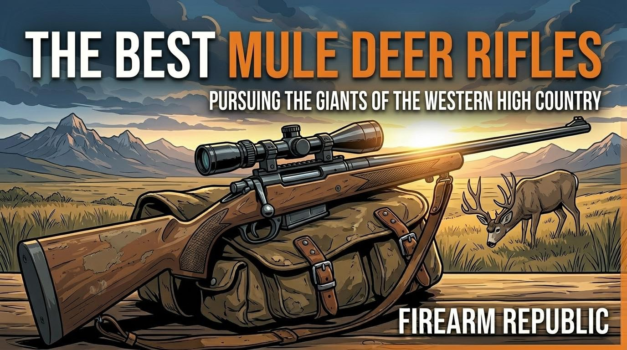
Mule deer hunting is a different problem than whitetail hunting, and the rifle that solves it well is not necessarily the same gun. Where whitetail hunting in the East and Midwest produces shots inside 200 yards from tree stands and field edges in relatively calm conditions, mule deer hunting in the West regularly puts hunters on open sage flats, canyon rims, and alpine basins where a buck spotted at 400 yards may be the only opportunity of the day – and the wind is almost never calm. A mule deer rifle needs to shoot flat enough to manage a 350-yard shot without excessive mental arithmetic, resist the 15 mph afternoon thermals that define canyon country and open high desert, and carry energy sufficient for a clean kill on a 200–250 lb animal that may not present a perfect broadside shot. That is a more demanding brief than most whitetail hunting requires and shapes every recommendation in this guide. This guide covers which cartridges, which rifles, and which setups genuinely solve the mule deer problem across the terrain types where these animals live.
What Mule Deer Hunting Actually Requires
Mule deer hunting across the West – from the sage deserts of Nevada and Wyoming to the canyon country of Utah and Colorado to the high basins of Montana and Idaho – creates a consistent set of demands that shapes the right rifle choice.
Shot distances: The most common shot distance in western mule deer hunting across survey data and guide experience is 200–400 yards. Shots under 150 yards happen in canyon bottoms and heavy brush. Shots to 500 yards are realistic in open basin and flat desert country and should be within a prepared shooter’s capability. Shots past 500 yards happen but require specific preparation – range cards, practiced field positions, and deliberate setup time that not every hunting situation allows.
Wind: Canyon country and open desert produce wind that tests both shooter and bullet. A 15 mph crosswind at 350 yards moves a standard .308 Win 150gr load approximately 12 inches – more than a mule deer’s heart-lung zone. The same wind moves a 140gr 6.5 CM load approximately 8 inches at the same distance. Cartridge selection for mule deer hunting is, in significant part, a wind management decision.
Terrain and carry weight: A mule deer rifle carried across five miles of steep sidehill terrain needs to be different from a benchrest rifle. Under 8 lbs scoped is the practical target for most western hunters. Under 7 lbs is better for serious backcountry mule deer hunting in the high country.
Terminal performance: Mule deer weigh 150–280 lbs depending on region, sex, and season. They are soft-bodied animals relative to elk but significantly heavier than most whitetail. A quality 140gr 6.5mm or 160gr 7mm bullet placed through the heart-lung zone kills them cleanly at any practical hunting distance. The cartridge energy floor for mule deer is lower than for elk – 1,000 ft-lbs at impact is commonly cited as minimum, and most deer cartridges exceed this at 400 yards or more.
Best Cartridges for Mule Deer Hunting
The First-Choice Tier
6.5 Creedmoor – The most complete all-around mule deer cartridge for most hunters. Low recoil (9–11 ft-lbs) enables comfortable practice, which builds the accuracy that open-country shooting demands. The 140gr ELD-X at 2,710 fps carries 1,500+ ft-lbs at 400 yards and drifts only 8.5 inches in a 10 mph crosswind at that distance. Sub-MOA accuracy from production rifles like the Tikka T3x Lite and Bergara B-14 is achievable without custom work. For mule deer hunters whose shots stay inside 400 yards, the 6.5 CM is the strongest single recommendation. See our 6.5 Creedmoor Caliber Guide.
7mm-08 Remington – The recoil-friendly mule deer cartridge that hits harder at moderate ranges than the 6.5 CM. At 300 yards, the 140gr ELD-X from a 7mm-08 carries 1,614 ft-lbs – above the 6.5 CM at the same distance – with a wider 7mm wound channel. For mule deer hunters whose shots peak at 350 yards and who want more terminal authority on heavy-framed bucks at close to moderate range, the 7mm-08 is a legitimate choice over the 6.5 CM. Wind performance past 400 yards is slightly inferior to the 6.5 CM. See our 7mm-08 Remington Caliber Guide.
6.5 PRC – The step up for hunters whose mule deer hunting extends to 500 yards in significant wind. At 500 yards the 143gr ELD-X carries approximately 1,700 ft-lbs and drifts 7 inches in a 10 mph crosswind – better than the 6.5 CM at that distance by a meaningful margin. The recoil increase to 15–17 ft-lbs is real but manageable in a standard hunting rifle. For hunters who regularly glass open basins and expect 400–500 yard shots to be part of their season, the 6.5 PRC provides genuine additional capability over the 6.5 CM. See our 6.5 PRC Caliber Guide.
7mm PRC – Maximum mule deer capability with manageable recoil. The 175gr ELD-X at 2,975 fps carries 2,100+ ft-lbs at 500 yards with wind drift that makes 500-yard shots in reasonable conditions feel like 300-yard shots feel in less capable cartridges. For hunters in open country who want the most confidence-inspiring setup for any distance opportunity that presents itself, the 7mm PRC delivers. At 22–24 ft-lbs of recoil in a standard rifle, it is more demanding than the PRC family below it, but shooters who practice regularly manage it without a brake. See our 7mm PRC Caliber Guide.
Strong Alternatives
.30-06 Springfield – The classic western mule deer cartridge remains fully capable in 2025. The 165gr ELD-X at 2,870 fps carries 1,886 ft-lbs at 400 yards and the wider .30-caliber bullet provides more terminal authority on quartering shots than 6.5mm alternatives. For hunters who own a quality .30-06 and want to use it for mule deer rather than buy a new rifle, it handles every realistic mule deer scenario confidently. Wind performance at 400+ yards is inferior to the 6.5 CM and 7mm PRC, requiring more attention to reading and timing shots in canyon wind. See our .30-06 Springfield Caliber Guide.
7mm Remington Magnum – The traditional western hunting cartridge that defined open-country big game hunting for 60 years. The 162gr ELD-X at 2,980 fps carries 2,200 ft-lbs at 400 yards – more than mule deer require at any distance, with the wind performance that makes 400-yard shots manageable for practiced hunters. For hunters who want the universal availability of an established cartridge in combination with genuine long-range performance, the 7mm Rem Mag remains a strong choice. See our 7mm Rem Mag Caliber Guide.
.243 Winchester – The right choice specifically for youth hunters and recoil-sensitive adults who hunt mule deer. The 100gr ELD-X carries 1,100 ft-lbs at 400 yards – approaching the lower bound of comfortable ethical margin on a large mule deer buck but adequate for well-placed shots. For mule deer inside 350 yards with quality bullets and good angles, the .243 Win works and its negligible recoil makes accurate shooting at distance achievable for hunters who would flinch with larger cartridges. See our .243 Winchester Caliber Guide.
Cartridge Performance at Mule Deer Hunting Distances
| Cartridge | Load | 400 yd Energy | 400 yd Wind (10 mph) | Recoil (8 lb rifle) |
|---|---|---|---|---|
| .243 Win | 100gr ELD-X | ~1,100 ft-lbs | 6.8″ | 9–11 ft-lbs |
| 7mm-08 | 140gr ELD-X | ~1,350 ft-lbs | 8.2″ | 11–13 ft-lbs |
| 6.5 CM | 140gr ELD-X | ~1,500 ft-lbs | 8.5″ | 9–11 ft-lbs |
| 6.5 PRC | 143gr ELD-X | ~2,100 ft-lbs | 7.2″ | 15–17 ft-lbs |
| 7mm-08 | 140gr AccuBond | ~1,350 ft-lbs | 8.4″ | 11–13 ft-lbs |
| 7mm Rem Mag | 162gr ELD-X | ~2,200 ft-lbs | 7.5″ | 20–22 ft-lbs |
| 7mm PRC | 175gr ELD-X | ~2,474 ft-lbs | 6.4″ | 22–24 ft-lbs |
| .30-06 | 165gr ELD-X | ~1,886 ft-lbs | 9.2″ | 18–20 ft-lbs |
Best Rifles for Mule Deer Hunting by Scenario
The Canyon Country Hunter – Moderate Range, Steep Terrain
Canyon country mule deer hunting in Utah, Colorado, and the Snake River drainages of Idaho produces shots at 200–350 yards with variable wind in the afternoon thermals and the need to carry a rifle on steep sidehill terrain for hours at a time. Weight matters, accuracy matters, and reliability in dust and occasional rain matters.
Top recommendation: Tikka T3x Lite in 6.5 CM ($800–$875)
At 6.1 lbs bare, the Tikka T3x Lite is among the lightest production bolt-action rifles available that does not compromise accuracy. The factory trigger – adjustable to approximately 2 lbs – is the best available at any price under $1,000. In 6.5 CM with 140gr ELD-X, it handles every canyon country mule deer shot to 400 yards with margin to spare. The detachable magazine is a practical convenience for glassing-and-stalking hunting where the rifle is constantly handled. See our Tikka T3x Complete Guide.
Alternative: Ruger American Gen II in 6.5 CM ($599–$649)
The best value mule deer rifle available. AICS magazine compatibility, threaded barrel, adjustable trigger, and 0.7–0.9 MOA accuracy. At the right price for hunters who want to invest more in glass than in the rifle itself – a legitimate priority for the 300–400 yard shooting that canyon mule deer hunting demands. See our Ruger American Complete Guide.
The Basin and Flat Hunter – Long Range, Calm Mornings
Open basin mule deer hunting in Wyoming, Nevada, and eastern Montana produces the longest-range mule deer shots in North America. Mornings can be calm enough for 500-yard shots; afternoons in the Great Basin regularly produce 20+ mph winds that compress ethical shooting range significantly. The right rifle for this scenario shoots sub-MOA, carries high-BC bullets that manage the afternoon wind, and can be shot from prone or off a pack at distances where precise trigger technique matters.
Top recommendation: Bergara B-14 HMR in 6.5 PRC or 7mm PRC ($950–$1,050)
The B-14 HMR’s combination of a chassis-compatible design, heavy contour barrel for consistent accuracy across temperature swings, and Bergara’s sub-MOA guarantee makes it the go-to precision hunting choice at mid-range pricing. In 6.5 PRC with 143gr ELD-X, it handles 500-yard mule deer shots in moderate wind with genuine confidence. In 7mm PRC with 175gr ELD-X, it extends that confidence further. The HMR is heavier than the T3x Lite (7.9 lbs bare) but more accurate in extended strings and more stable from improvised field rests. See our Bergara B-14 Series Guide.
Alternative: Christensen Arms Mesa in 6.5 PRC ($1,300–$1,450)
Carbon fiber barrel and stock in a 6.5 lb package that matches the B-14 HMR’s accuracy while saving 1.5 lbs – relevant when this rifle is carried across miles of basin country. The weight savings are real and appreciated on day 4 of a mule deer hunt that involves long daily approaches. Sub-MOA guarantee with factory ammo.
The Backcountry High Country Hunter – Alpine Basins and Ridgelines
High country mule deer hunting in the Wind River Range, the Beartooths, or the Eagles Cap Wilderness involves multi-day pack-ins, significant elevation gain, and the kind of weather that alternates between clear and brutal within a single afternoon. The rifle needs to be light enough to carry without degrading the rest of the physical effort the hunt requires, tough enough to survive weather exposure, and accurate enough to shoot well when the moment comes after days of carrying.
Top recommendation: Christensen Arms Ridgeline FFT in 6.5 PRC ($1,800–$2,000)
At 5.3 lbs bare, the Ridgeline FFT is the lightest production rifle that delivers sub-MOA accuracy and the cartridge performance that high-country mule deer hunting demands. In 6.5 PRC, it carries elk-capable energy past 500 yards in a package that weighs less than many scope-and-mount combinations on heavier rifles. A quality muzzle brake is effectively required at this weight with the 6.5 PRC – recoil in a 5.3 lb rifle is sharp. The brake adds approximately 3 inches to the rifle length and decibels to the report, both of which are manageable trade-offs for hunters who prioritize weight above all else.
Alternative: Tikka T3x Lite in 6.5 PRC ($950–$1,000)
For hunters who want the Tikka’s proven trigger and lighter weight without the full premium of the carbon-construction rifles, the T3x Lite in 6.5 PRC at 6.1 lbs represents an excellent compromise. Not as light as the Christensen options, but meaningfully less expensive and with Tikka’s well-established accuracy and reliability track record.
The Youth and First-Time Mule Deer Hunter
Mule deer hunting is a legitimate first western hunting experience for youth hunters, and the right setup for that context prioritizes a rifle the hunter can shoot accurately over one that maximizes ballistic performance. A 14-year-old who shoots a .243 Win accurately at 200 yards is better prepared for a mule deer hunt than one who cannot manage the recoil of a 7mm Rem Mag but is carrying one because their father thinks bigger is better.
Top recommendation: Savage Axis II or Ruger American Compact in .243 Win ($380–$550)
The .243 Win handles mule deer to 300 yards cleanly with 100gr ELD-X or Federal Fusion loads. These rifles in youth configurations with 12.5″ length of pull fit smaller-framed shooters correctly, which matters more than most adults realize for developing accurate shooting habits. At this price range, investing the savings into quality glass (a $300–$400 Vortex Crossfire or Nikon Prostaff scope) and range practice time produces better outcomes than spending more on the rifle itself.
Best Mule Deer Rifle Setups by Budget
Under $1,000 Complete (Rifle + Scope)
Rifle: Ruger American Gen II 6.5 CM ($599–$649) Scope: Vortex Crossfire II 3–9×40 ($150–$180) or Nikon ProStaff 3–9×40 ($150–$170) Ammo: Hornady 140gr ELD-X ($32–$38/20) or Federal 140gr Terminal Ascent ($48–$55/20) Total: $750–$850
This is the setup that outperforms its price point for mule deer hunting inside 350 yards. The Ruger American’s accuracy, AICS magazine system, and threaded barrel give it features that cost $200–$300 more in competing brands. The Crossfire II provides adequate clarity for 350-yard shots in the morning and evening light that mule deer hunting favors. Spend what remains on range time.
$1,000–$2,000 Complete
Rifle: Tikka T3x Lite 6.5 CM ($800–$875) or Bergara B-14 Hunter 6.5 PRC ($750–$850) Scope: Vortex Viper HD 4–16×44 ($450–$500) or Leupold VX-5HD 3–15×44 ($600–$700) Ammo: Hornady 143gr ELD-X (6.5 PRC) or Federal 140gr Terminal Ascent (6.5 CM) Total: $1,250–$1,550
At this budget, the scope investment becomes as important as the rifle. A quality 4–16x with first focal plane reticle and exposed turrets allows precise holdover at 400–500 yards without guessing, and the Viper HD and VX-5HD both deliver genuine low-light performance at first and last light when mule deer move. The Tikka or Bergara at this price tier provides sub-MOA accuracy that maximizes what the glass can deliver.
$2,000–$3,500 Complete
Rifle: Christensen Arms Mesa 6.5 PRC ($1,300–$1,450) or Bergara HMR Pro 7mm PRC ($1,400–$1,600) Scope: Nightforce SHV 4–14×56 ($650–$750) or Leupold Mark 5HD 5–25×56 ($2,200–$2,500) Ammo: Hornady 175gr ELD-X (7mm PRC) or Federal 143gr Terminal Ascent (6.5 PRC) Total: $2,000–$3,500 depending on scope investment
At this tier, glass quality becomes the differentiating factor. Nightforce and Leupold Mark 5HD represent the benchmark for hunting-weight precision optics that perform in every light condition western mule deer hunting produces. Paired with a carbon-construction rifle, this is the complete western hunting setup that serious mule deer hunters build toward.
Optics for Mule Deer Hunting
Mule deer hunting is an optics-intensive pursuit – most hunters spend more time behind binoculars and spotting scopes than behind rifle scopes. The rifle scope needs to perform at the distances the hunt demands and in the specific light conditions of early morning and late evening when mule deer are most active.
Variable magnification matters: A fixed 4x or 6x scope handles close-range shots but limits precision at 400 yards where the target subtends roughly 2 MOA in a 10-inch vital zone. A 3–12x or 4–16x variable provides the flexibility from quick 80-yard canyon shots to deliberate 400-yard basin shots.
First focal plane for holdover: Mule deer hunting produces shots at genuinely variable distances without time to dial elevation. A first focal plane reticle – where subtensions are accurate at any magnification – allows accurate holdover at whatever magnification the situation demands. Second focal plane reticles require full magnification for accurate use of the reticle markings, which is a real limitation at low light or when a shot must be taken quickly at moderate magnification.
Low-light glass quality: The best mule deer shooting opportunities happen in the first and last 30 minutes of legal shooting light. A scope that loses contrast and clarity in low light costs shots that better glass would not. This is where the $450–$550 investment in quality mid-tier glass (Vortex Viper HD, Leupold VX-5HD) over budget alternatives pays for itself. See our Best Hunting Scopes guide for full optic comparisons.
Rangefinder: Non-negotiable in open mule deer country. Distance estimation by eye across open basins is notoriously inaccurate – what looks like a 300-yard shot is often 450 yards, and what looks like 200 yards is sometimes 280. A quality laser rangefinder – Sig Sauer Kilo3000BDX ($400–$500), Leica Rangemaster CRF 2700-B ($500–$600), or Vortex Fury HD 5000 ($500–$550) – confirms distance before every shot past 200 yards.
Field Shooting for Mule Deer
Mule deer hunting regularly produces shots that require field shooting skills the range does not fully prepare hunters for. Building these skills before the hunt matters as much as rifle selection.
Shooting sticks: The standard field position for mule deer hunting at 200–400 yards. A quality shooting sticks system – Trigger Sticks, Primos Gen 3 Trigger Stick, or similar – provides a stable bipod-like platform from a standing or kneeling position that is faster to deploy than prone and more stable than unsupported standing. Most experienced western hunters carry a shooting sticks system as standard equipment.
Pack rest: When a full prone setup is available, using a loaded pack as a front rest produces stability comparable to a bipod. Many hunters in open country shoot their best field groups off a pack due to the wider, more conformable rest surface compared to a rigid bipod.
Wind reading: No skill is more important for open-country mule deer hunting. Wind at 15 mph at the shooter may be 8 mph at 300 yards and 20 mph at 400 yards as terrain channels and releases the flow. Vegetation (grass bent at 30 degrees = ~10 mph, horizontal = 20+ mph), mirage movement, and dust provide wind reads at distance. Carrying a small wind meter (Kestrel 2000 or equivalent) and taking a reading before deliberate shots is standard practice for serious long-range hunters.
Know your maximum field accuracy: The most important mule deer hunting skill is honest self-assessment of the distance at which you can place a shot in a 6-inch circle from a field position with shooting sticks 90% of the time. Build this number through field-position practice at known distances before season. Most hunters who practice seasonally are at 250–300 yards. Hunters who train methodically in field positions extend this to 400+ yards. Shoot at this distance or closer in the field.
Ammunition Recommendations for Mule Deer
For 6.5 CM: Hornady 140gr ELD-X ($32–$38/20) for general hunting. Federal 140gr Terminal Ascent ($48–$55/20) for hunters who want bonded construction for any shot angle. Both expand reliably at 6.5 CM impact velocities and carry sufficient BC for 400-yard performance.
For 6.5 PRC: Hornady 143gr ELD-X ($50–$58/20) is the clear first choice – the load the cartridge was designed around and what produces the best combination of long-range BC and controlled expansion on mule deer. Federal 140gr Terminal Ascent works equally well.
For 7mm PRC: Hornady 175gr ELD-X ($58–$65/20) is the defining mule deer load for this cartridge – the BC and energy combination at 400–500 yards is genuinely best-in-class for non-dangerous game hunting at manageable recoil.
For 7mm-08: Federal 140gr Fusion ($28–$35/20) is the value pick; Hornady 140gr ELD-X ($38–$46/20) for hunters who want premium performance. Both are reliable mule deer loads inside 350 yards.
For .30-06: Hornady 165gr ELD-X ($50–$58/20) or Nosler 165gr AccuBond ($55–$65/20). The 165gr class in .30-06 provides the best balance of trajectory and terminal performance for mule deer at western hunting distances.
Frequently Asked Questions
Q: What is the best cartridge for mule deer in open country?
A: The 6.5 Creedmoor for hunters whose shots stay inside 400 yards, and the 6.5 PRC for those who regularly face 400–500 yard opportunities. Both cartridges provide flat trajectories, wind-resistant high-BC bullets, and enough energy for clean mule deer kills at those distances. The 7mm PRC is the choice for hunters who want maximum confidence at every distance the terrain can produce without committing to a full-power magnum like the .300 Win Mag.
Q: How far is too far to shoot a mule deer?
A: The ethical ceiling is the distance at which you can place a shot in a 6-inch circle from a field position – kneeling or standing with shooting sticks – 90% of the time. For most hunters who practice seasonally, this is 250–300 yards. For hunters who train extensively in field positions, 400–450 yards is achievable with the right cartridge and glass. No cartridge extends ethical range beyond what the shooter can deliver accurately – a 7mm PRC in the hands of a hunter who cannot execute a 400-yard field shot is not more ethical than a 6.5 CM in the hands of one who can.
Q: Do I need a magnum cartridge for mule deer?
A: Not for most mule deer hunting situations. The 6.5 CM, 6.5 PRC, and 7mm-08 handle 400-yard mule deer shots cleanly without magnum recoil. Where magnums earn their keep is in the specific context of consistent 500+ yard shots in significant wind – the Great Basin flats and open Wyoming prairie where range and wind combine to make the 7mm PRC’s additional performance genuinely relevant. For canyon country, mountain, and most western terrain where shots peak at 350–400 yards, the 6.5 PRC or 6.5 CM is more than adequate.
Q: How light should a mule deer rifle be for backcountry hunting?
A: Under 8 lbs scoped for moderate terrain day hunts. Under 7 lbs scoped for serious backcountry pack-ins where the rifle is carried 6–10 miles per day. Below 7 lbs requires either lightweight construction (carbon barrel and stock) or accepting a smaller cartridge – there is no free lunch between weight, cartridge capability, and cost. The Christensen Arms Ridgeline FFT in 6.5 PRC at approximately 7 lbs scoped represents the current best-practice balance for serious backcountry mule deer hunters who want genuine long-range capability in a light package.
Q: What scope magnification do I need for mule deer hunting?
A: A 3–12x or 4–16x variable with a quality reticle handles every realistic mule deer hunting scenario. At 400 yards on a mule deer, 12–16x provides enough magnification to precisely place a crosshair on the heart-lung zone. More magnification than 16x introduces mirage distortion in the afternoon heat common in western hunting terrain and is not practically useful at field shooting distances. A first focal plane reticle for accurate holdover at any magnification setting is worth the modest premium over second focal plane alternatives at this magnification range.
Q: Is the .243 Winchester adequate for large mule deer bucks?
A: Yes, under specific conditions. Large-framed western mule deer bucks weigh 200–250 lbs and are tougher animals than the eastern whitetail most .243 hunters train on. Use quality bonded or controlled-expansion 100gr loads – Federal Trophy Bonded or Nosler AccuBond – not cheap cup-and-core soft points. Prioritize broadside or slight quartering-to shots. Stay inside 300 yards where impact velocity keeps the bullet in its expansion range. A disciplined .243 Win hunter takes mule deer cleanly; a hunter who uses it as an excuse for marginal shot selection will have tracking problems.