 Maksym Kovaliov
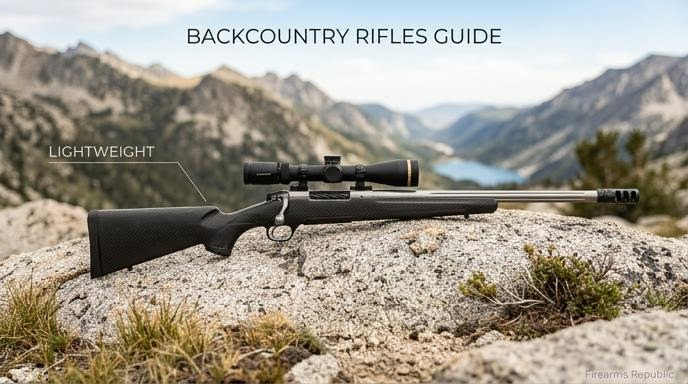
Backcountry hunting strips away everything that is convenient about hunting and replaces it with what is real. There are no ATVs on a 12-mile pack-in to a Wyoming basin. There is no truck to drop the rifle in when your pack gets heavy at mile 8. There is no second chance at the shot if the one opportunity a four-day hunt produces comes at 420 yards across a drainage with a 12 mph left-to-right wind while you are breathing hard from a 400-foot climb. The backcountry hunting rifle is the piece of equipment that must be right because everything else on the hunt has already been optimized down to the last ounce, and the rifle’s weight, reliability, and accuracy on one specific day determines whether years of planning, thousands of dollars in tags and logistics, and days of physical effort produce a filled tag or an empty pack frame. This guide covers what backcountry hunting actually demands from a rifle, how to build the right system across every budget, and which cartridges and platforms genuinely serve the application.
The Backcountry Hunting Rifle Equation
Backcountry hunting creates a specific and unforgiving equipment equation: every pound saved on the rifle is a pound available for food, emergency gear, or meat pack-out capacity. But every performance capability sacrificed in the name of weight – caliber, accuracy, reliability – is a capability that is gone when the shot presents itself. Understanding where this trade-off sits for your specific hunt is the first and most important decision.
The weight equation in practice:
A standard mid-tier hunting rifle setup – Bergara B-14 Hunter with a Leupold VX-5HD 3–15×44 and rings – runs approximately 9.5 lbs. A lightweight backcountry-optimized setup – Christensen Arms Ridgeline FFT with a Leupold VX-5HD 3–15×44 – runs approximately 7.5 lbs. The 2 lb difference is the weight of one day’s food supply. Over a 7-day hunt covering 10 miles per day, that 2 lbs saved is 14 mile-days of reduced carry weight. For hunters who are at the edge of their physical capability, it matters. For hunters who are in strong physical condition, it matters less than precision and cartridge selection.
The performance floor:
Weight savings become counterproductive when they require accepting a cartridge that is inadequate for the intended game or a rifle that cannot consistently place shots at the distances the terrain produces. A 5 lb .243 Win rifle that is inadequate for elk, or a 5.5 lb mountain rifle in 6.5 CM with a scope that loses clarity at last light when the elk finally steps out, is the wrong optimization. Start with the minimum acceptable performance floor and then optimize weight from there.
The practical weight targets:
- Day hunts in accessible backcountry (under 5 miles one way): Under 9 lbs scoped is adequate. Standard production rifles qualify.
- Multi-day pack-in with base camp (5–10 miles): Under 8 lbs scoped is the practical target. Mid-weight production and lightweight production rifles qualify.
- Serious backcountry pack-ins (10+ miles, multi-day, no resupply): Under 7 lbs scoped is the goal. Lightweight carbon construction rifles and purpose-built mountain setups.
- Ultra-lightweight minimalist hunts: Under 6 lbs scoped is achievable with carbon-wrapped barrels and carbon stocks. Recoil management with any cartridge above 6.5 CM requires a muzzle brake.
What the Terrain Demands: Backcountry Shot Profile
The shot profile in backcountry hunting differs from accessible hunting in predictable ways. Understanding this shapes cartridge selection.
Ranges are less predictable: In accessible country, hunters often know the distances in their hunting area from scouting. In backcountry, a bull elk seen at dawn across a basin may be at an unknown distance with no time to carefully range and set up. Quality rangefinder capability and the ability to shoot confidently at 250–400 yards from a field position without a perfect rest are baseline requirements.
Wind increases with elevation: At 10,000 feet in exposed alpine basins, wind that is 10 mph at the valley floor is often 20+ mph on the ridge. This compounds wind drift beyond what cartridge tables built at sea level suggest. A cartridge that drifts 6 inches at 400 yards in 10 mph wind may drift 14 inches at the same distance in the exposed conditions that alpine elk and mule deer hunting produces. Cartridge selection for backcountry hunting should prioritize BC more than for low-elevation hunting.
Shots are often off-hand or from improvised rests: The classic “shooting sticks in a prairie” setup rarely applies in backcountry terrain. More commonly, a hunter shoots from a sitting position behind a rock, kneeling against a tree, or prone with the pack as a front rest and a rolled jacket as a rear bag. Practicing from these positions at hunting distances before the trip is not optional.
Animals may not be recovered before dark: A wounded elk in backcountry at last light creates a survival situation, not just a hunting inconvenience. Cartridge selection should lean toward more capability rather than less, and shot discipline (no shot beyond confirmed effective range from a confirmed field position) must be stricter than in accessible hunting.
Cartridge Selection for Backcountry Hunting
For Deer and Mountain Mule Deer
6.5 Creedmoor remains the best all-around backcountry deer cartridge. The combination of 9–11 ft-lbs recoil – manageable even in a 6 lb rifle without a brake – and 400-yard effective range on deer with 140gr ELD-X makes it the most versatile choice for mule deer and whitetail backcountry hunting. In alpine terrain where wind compounds, the 140gr ELD-X’s BC handles it better than any .30-caliber deer load at comparable recoil. See our 6.5 Creedmoor Caliber Guide.
7mm-08 Remington is the alternative for hunters who want more terminal authority at moderate ranges. At 300 yards the 140gr ELD-X carries 1,614 ft-lbs – above the 6.5 CM at the same distance – with comparable recoil. For mountain deer hunting where shots rarely exceed 350 yards in terrain that limits long-range setups, the 7mm-08’s energy advantage at moderate range over the 6.5 CM is real. See our 7mm-08 Remington Caliber Guide.
For Elk and Large Mountain Game
6.5 PRC is the recommended minimum for elk in backcountry terrain. At 500 yards the 143gr ELD-X carries approximately 1,700 ft-lbs with wind drift that is manageable in alpine conditions. In a Christensen Ridgeline configuration at 6 lbs bare, it is among the lightest elk-capable cartridge platforms available. The honest limitation: at 15–17 ft-lbs of recoil in a genuinely lightweight 6 lb rifle, a quality muzzle brake is effectively mandatory. Without a brake, most hunters develop flinch habits that degrade precision in the field. See our 6.5 PRC Caliber Guide.
7mm PRC is the performance standard for backcountry elk and large mule deer hunters who can accept 22–24 ft-lbs of recoil with a quality brake. The 175gr ELD-X at 2,975 fps carries 2,474 ft-lbs at 500 yards – well above the elk hunting minimum at that distance. In alpine terrain where shots across drainages at 400–500 yards are realistic, the 7mm PRC’s combination of energy and BC provides genuine confidence that the 6.5 PRC cannot fully match. In a Christensen Mesa or Ridgeline at 6.5–7 lbs bare with a brake, it is the most capable backcountry elk cartridge that does not require a full-size magnum action. See our 7mm PRC Caliber Guide.
7mm Remington Magnum with 160–162gr loads remains a fully capable backcountry elk cartridge for hunters who value universal ammo availability on remote hunts. In a Browning X-Bolt Speed or Weatherby Backcountry configuration at 6.5–7 lbs scoped, it handles the full range of backcountry elk hunting distances. For hunters whose tags or hunts involve remote lodges or pack-out outfitters where a 7mm Rem Mag spare box can be sourced if ammo is damaged in the field, the availability advantage matters. See our 7mm Rem Mag Caliber Guide.
.300 Win Mag is the maximum practical backcountry elk and bear cartridge. At 25–28 ft-lbs recoil, a quality brake is mandatory in any rifle under 9 lbs. The weight penalty – quality lightweight .300 Win Mag rifles rarely go below 7 lbs bare – and the recoil management requirement mean this is the choice for hunters who specifically need the .300 Win Mag’s energy margin on large bears or elk at maximum distance, and who are experienced enough to manage the recoil accurately. See our .300 Win Mag Caliber Guide.
Cartridge Weight Trade-Off Summary
| Cartridge | Min Rifle Wt (bare) | Brake Needed? | 500 yd Energy | Best For |
|---|---|---|---|---|
| 6.5 CM | 5.5 lbs | No | ~1,300 ft-lbs | Backcountry deer |
| 7mm-08 | 5.5 lbs | No | ~1,050 ft-lbs | Mountain deer |
| 6.5 PRC | 5.8 lbs | Yes (<7 lbs) | ~1,700 ft-lbs | Elk + mule deer |
| 7mm PRC | 6.0 lbs | Yes | ~2,200 ft-lbs | Elk + large game |
| 7mm Rem Mag | 6.2 lbs | Recommended | ~2,100 ft-lbs | Elk + availability |
| .300 Win Mag | 7.0 lbs | Yes | ~2,100 ft-lbs | Elk + bear |
Best Backcountry Hunting Rifles
The Benchmark: Christensen Arms Ridgeline FFT ($1,800–$2,000)
The Ridgeline FFT defines the current state of the art in lightweight production bolt-action rifles. At 5.3 lbs bare, a carbon fiber-wrapped barrel, and a carbon fiber stock, it is 2–3 lbs lighter than comparably capable production rifles. Sub-MOA guarantee. Available in 6.5 CM, 6.5 PRC, 7mm PRC, .308 Win, and .300 Win Mag.
The recoil consideration is not optional: 5.3 lbs with 6.5 PRC or larger requires a quality muzzle brake for comfortable shooting. The APA Little Bastard, Precision Armament M11 Severe Duty, and Christensen Arms factory brake are all effective. The brake adds approximately 3 oz, 2.5 inches, and significant noise – none of which are prohibitive for backcountry hunting where the rifle is slung most of the day and fired once or twice.
Who it’s for: Hunters whose physical performance is the limiting factor on miles covered per day, who hunt in high-elevation terrain with significant climbs, and who are willing to invest in the most capable lightweight platform available.
Best Value Lightweight: Tikka T3x Lite ($850–$950)
At 6.1 lbs bare with the best factory trigger available under $1,000, the Tikka T3x Lite occupies the optimal balance of weight, accuracy, trigger quality, and price for most backcountry hunters. Not as light as the carbon-construction premium rifles, but 1.5–2.5 lbs lighter than standard production hunting rifles at a fraction of the cost.
In 6.5 PRC or 7mm Rem Mag, it handles every realistic backcountry elk hunting scenario to 500 yards from a stable field position. In 6.5 CM, it is the most competent mountain deer rifle available under $1,000. The detachable magazine is a practical hunting feature for a rifle handled constantly on a backcountry trip. See our Tikka T3x Complete Guide.
Who it’s for: Hunters who want a genuine weight reduction over standard hunting rifles without the full premium of carbon construction, and who want the best factory trigger available at the price point.
Best Mid-Range Carbon: Christensen Arms Mesa ($1,300–$1,500)
The Mesa splits the difference between the Ridgeline FFT’s extreme lightweight focus and the T3x Lite’s value positioning. At 6.5 lbs bare with a carbon-wrapped barrel and a more conventional synthetic stock (not full carbon fiber), it is noticeably lighter than steel-barreled alternatives while providing the barrel cooling benefits of carbon construction. Sub-MOA guarantee. Available in the full PRC and standard magnum cartridge range.
For hunters who want carbon barrel benefits without the Ridgeline FFT’s full premium price, the Mesa represents a well-balanced step up. See our platform coverage in the Bergara B-14 Series Guide for comparable mid-range options.
Who it’s for: Hunters who want carbon barrel performance at a mid-tier price point, with a more traditional stock feel than the Ridgeline’s tactical aesthetic.
Premium Lightweight: Proof Research Elevation ($3,500–$4,500)
For hunters who want the absolute pinnacle of purpose-built backcountry rifle engineering, Proof Research’s Elevation brings a PROOF carbon fiber-wrapped barrel (not a steel core with carbon wrap, but a PROOF-specific construction), carbon fiber stock, and precision-class action to a complete rifle that runs approximately 5.5–6 lbs bare in most configurations. Sub-0.5 MOA accuracy guarantee. Available in the full range of western hunting cartridges.
The price is premium and honest – this is a purpose-built rifle that reflects the cost of carbon fiber construction at precision tolerances. For hunters who make one or two serious backcountry elk hunts per year and want the best equipment available for that investment, the Proof Research Elevation is the benchmark.
Budget-Accessible Lightweight: Ruger American in 6.5 CM ($500–$650)
The Ruger American’s standard configuration runs approximately 6.3 lbs bare – already lighter than many premium production hunting rifles – and delivers 0.75–0.9 MOA accuracy at a price that leaves significant budget for a quality scope. For hunters who want to reduce carried weight without spending on carbon construction, the Ruger American in 6.5 CM represents the most budget-friendly path to a sub-7 lb backcountry deer rifle.
The limitation for serious backcountry elk use is cartridge ceiling – in 6.5 CM the Ruger American is a deer rifle, not an elk rifle, at the distances backcountry terrain produces. For hunters whose trips are mule deer or whitetail focused, it is a genuine value option. See our Ruger American Complete Guide.
Complete Backcountry Rifle System Builds
Weight must be accounted for across the complete system: rifle, scope, rings, ammo, and sling. The rifle weight figures above are bare (without scope). A complete system add-on typically runs:
- Scope: 12–18 oz (Leupold VX-5HD 3–15×44 = 13.5 oz; Nightforce SHV 4–14×56 = 22 oz)
- Rings: 2–4 oz (lightweight titanium rings vs. standard steel)
- 5 rounds of ammo in the magazine: 3–4 oz
Complete system targets:
A Christensen Ridgeline FFT (5.3 lbs) + Leupold VX-5HD 3–15×44 (13.5 oz) + lightweight rings (2.5 oz) = 6.8 lbs complete. Add a lightweight sling (4 oz) for 7 lbs total. This is the current practical floor for a complete, capable backcountry elk rifle system.
A Tikka T3x Lite (6.1 lbs) + Leupold VX-3HD 3–12×40 (11.5 oz) + Tikka rings (3 oz) = 7.2 lbs complete. A standard mid-tier production rifle can reach the sub-7.5 lb target with scope selection attention.
Scope Recommendations for Backcountry
Primary recommendation: Leupold VX-5HD 3–15×44 ($600–$700)
At 13.5 oz, the VX-5HD is among the lightest quality hunting scopes with genuine low-light performance. The 44mm objective balances light gathering with kept weight. Twilight Max HD optics deliver clarity at dusk when mountain game is most active. A zero-stop turret allows quick return to hunting zero after dialing for a specific shot. First focal plane reticle available in FireDot and Duplex configurations.
Budget alternative: Vortex Viper HD 4–16×44 ($450–$500)
At 15.6 oz, slightly heavier than the VX-5HD but with comparable glass quality at a lower price. For hunters who want quality optics without the Leupold premium, the Viper HD is the strongest alternative.
Weight-no-object: Kahles K525i 5–25×56 ($2,800–$3,200)
For hunters who want competition-grade glass in a hunting-weight package, the Kahles K525i at 26 oz delivers the best optical performance available in a rifle scope with a meaningful weight advantage over the ATACR and Razor HD LT. The SKMR3 reticle is among the most practical hunting reticles available at any price point.
Critical Backcountry Rifle Practices
Zero Verification Before the Trip
A zero verified at the range two months before a backcountry hunt is not a verified zero for the trip. Rifles that travel in hard cases in cargo holds, strap to the outside of pack frames, or ride in vehicle gun racks experience vibration and minor stock compression changes that shift point of impact by 0.5–1.5 inches. The only acceptable pre-hunt practice is shooting the rifle from a stable rest at 100 yards within 48 hours of departure. This catches shifted zeros and confirms the load you packed is the load the rifle is zeroed for.
Load Consistency for the Trip
Pack all ammo for a backcountry hunt from the same lot. Velocity variations between lots can shift point of impact by 1–2 inches at 300 yards – enough to matter on an elk’s lung zone. Never mix hunting ammo lots on a serious hunt. Carry the same load you practiced with at the range.
Muzzle Brake and Hearing Protection
A muzzle brake on a lightweight backcountry rifle creates a noise level that causes immediate hearing damage without protection. In the field, a single shot without ear protection is acceptable – the adrenaline of the shot and the ambient wind reduce the perceived impact. For a follow-up shot or a close-range encounter where multiple shots are likely, ear protection is appropriate. Many backcountry hunters carry small foam or silicone earplugs in a shirt pocket as a lightweight hearing protection option. At 2–4 grams, this is weight that earns its place.
Barrel Break-In for Carbon Barrels
Carbon fiber-wrapped barrels from Christensen Arms and Proof Research benefit from a specific break-in protocol that differs from steel barrels. Follow the manufacturer’s specific instructions exactly – typically a clean-after-every-shot sequence for the first 10–20 rounds to seat the rifling before transitioning to normal shooting intervals. A carbon barrel that skips break-in shows inconsistent accuracy that stabilizes only after 50–100 rounds of normal shooting – better to do it correctly before the hunt.
Pack Weight Integration
The rifle is one item in a complete backcountry hunting load. Understanding how it integrates with the full system is necessary for honest weight assessment.
Typical backcountry hunting base weight (excluding food, water, rifle): 18–25 lbs for a well-optimized 5-day setup
Complete carried weight breakdown for a 5-day elk hunt:
- Base pack weight (shelter, sleep, clothing, safety gear): 22 lbs
- Food (5 days @ 1.75 lbs/day): 8.75 lbs
- Water (starting load, 2 liters): 4.4 lbs
- Rifle system: 7 lbs
- Binoculars and rangefinder: 2 lbs
- Total carried weight: ~44 lbs
Each pound saved on the rifle reduces total load by 1 lb, which directly affects miles-per-day capacity, daily climbing performance, and end-of-trip physical reserves. On a hunt where the difference between making a 4-mile approach and not making it is 2 lbs of carried weight, the $1,500 premium for a carbon-construction rifle is a direct performance investment.
Frequently Asked Questions
Q: What is the lightest elk-capable backcountry rifle setup available?
A: The Christensen Arms Ridgeline FFT in 6.5 PRC with a Leupold VX-5HD 3–15×44 and titanium rings runs approximately 6.8 lbs complete with a quality muzzle brake – the current practical floor for a complete elk-capable setup. The 6.5 PRC at this weight provides genuine 500-yard elk capability with manageable recoil using a brake. Lighter configurations exist (sub-5 lb custom builds) but require compromises in cartridge capability or scope quality that most elk hunters are not willing to accept.
Q: Is a carbon fiber barrel worth the premium for backcountry hunting?
A: For hunters who regularly carry rifles 8+ miles per day on multi-day backcountry hunts, yes. Carbon fiber-wrapped barrels save 8–16 oz over comparable steel profiles – a meaningful weight reduction when every pound matters. They also run cooler between shots, which preserves consistent zero across strings of fire – relevant on days when a successful stalk results in multiple shots quickly. For hunters whose backcountry hunts involve less than 5 miles per day carry, the premium is less clearly justified and the money may be better spent on optics quality.
Q: Do I need a muzzle brake on my backcountry rifle?
A: In any rifle under approximately 7 lbs bare with a cartridge larger than 6.5 CM, yes. Recoil in a 5.5–6 lb rifle with 6.5 PRC or larger is sharp enough that consistent accurate follow-up shots require a brake or suppressor to manage. The noise trade-off is real – a brake without hearing protection at close range is damaging. The practical solution is foam earplugs in a shirt pocket for any situation where a follow-up shot is anticipated. For hunting scenarios where only one shot is expected, the first shot without ear protection is acceptable.
Q: How do I protect my rifle scope during a backcountry pack-in?
A: Scope covers – Leupold Alumina flip-back covers, Butler Creek caps, or Vortex aluminum caps – protect the objective and ocular lenses from rain, dust, and impact. On extended pack-ins where the rifle is strapped to the outside of a frame pack, a neoprene scope cover over the entire scope body protects against rain and brush contact. Hard-sided cases protect the rifle during vehicle and aircraft travel. Within the backcountry itself, carrying the rifle either slung or in a padded rifle scabbard (for horse-assisted hunts) minimizes scope impact risk.
Q: What is the best cartridge for a hunter who hunts both deer and elk in backcountry terrain?
A: The 6.5 PRC is the strongest single answer: capable for elk to 500 yards with quality bullets and shot placement, flat enough for mule deer to 450 yards, and available in lightweight rifle configurations at 6 lbs or less. The recoil at 15–17 ft-lbs is manageable in a 6 lb rifle with a quality brake. A single rifle in 6.5 PRC eliminates the need for a separate deer rifle and a separate elk rifle, and the cartridge’s selection of premium factory loads covers both applications without compromise. Hunters who primarily focus on deer with only occasional elk opportunity may find the 6.5 CM a more comfortable single-cartridge choice.
Q: How much should I spend on optics for a backcountry rifle?
A: As much as the rifle itself, or more. A $1,500 lightweight rifle with a $200 scope underperforms a $600 rifle with a $700 scope in the conditions that determine backcountry hunting success – low light at first and last shooting hours, variable distances requiring accurate holdover, and the physical and mental demands of a hard hunt where mistakes are compounded. For backcountry elk hunting, the minimum optic investment is a quality mid-tier scope like the Leupold VX-5HD or Vortex Viper HD. For hunters who can justify the investment, Nightforce SHV or Kahles quality glass provides meaningfully better low-light performance and reticle precision.