 Maksym Kovaliov
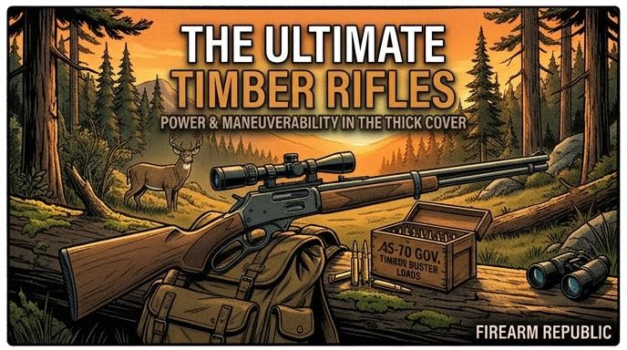
Dense timber hunting is the application that most modern rifle marketing ignores – the world of sub-100-yard shots in lodgepole pines, dark spruce timber, alder brush, and eastern hardwoods where a 6-inch scope and a 26-inch barrel that would serve beautifully at 500 yards on a Wyoming sage flat becomes awkward, slow, and counterproductive. The rifle that wins in timber is not the most powerful, the longest-reaching, or the most ballistically sophisticated. It is the rifle that handles quickly when a buck steps across a shooting lane at 60 yards in fading light, that shoulders smoothly when the angle is steep and the footing is uncertain, and that delivers adequate terminal energy at ranges where even a 30-30 Winchester is fully capable. This guide covers the specific demands of timber hunting, which platforms and cartridges are genuinely suited to the application, and how to build a setup that is optimized for the shots that dense cover actually produces.
What Dense Timber Hunting Actually Demands
Understanding the timber environment shapes every equipment choice.
Shot distances: In true dense timber – mature lodgepole or spruce forest in the West, eastern hardwoods and second-growth, northern cedar swamps, Pacific rainforest, southern bottomland hardwoods – most shots break inside 100 yards. Many are inside 50 yards. Visibility is limited by trees, brush, and terrain. A hunter who builds a setup for 500-yard shots because their cartridge guide suggested it is carrying unnecessary weight and complexity.
Speed of shot opportunity: Timber game – deer, elk, black bear – often appears suddenly and moves quickly through narrow windows. A buck crossing a logging road, a bull moving through a spruce thicket, a bear working a game trail at 40 yards through the brush: these situations reward a rifle that shoulders naturally, has a short overall length, and has a sight picture that acquires quickly. A rifle with a 24-inch barrel and a 5–25x scope with a first focal plane reticle takes longer to mount, shoulder, and acquire a target than a 20-inch-barreled lever gun with a 3x fixed scope.
Thick brush and angles: Timber hunting produces shots at angles and through cover that open-country hunting does not. An elk at 65 yards in a spruce thicket may be quartering hard, partially obscured, and moving. The bullet must drive through whatever meat and bone stands between the entry point and the vitals with enough energy to cause rapid incapacitation. This context favors heavier, larger-diameter bullets over light, high-velocity designs that fragment on surface tissue before reaching vitals.
Rain, mud, and cold: Dense timber environments are often wet, cold, and muddy. The rifle must function reliably without pristine cleaning conditions. Walnut stocks that shift point of impact when wet, scopes that fog in cold-to-warm transitions, and complicated mechanical systems that collect debris are liabilities in timber country.
What does not matter in timber:
- Ballistic coefficient – BC advantages evaporate at 75 yards
- Trajectory flatness past 200 yards – irrelevant
- Wind performance at distance – there is no wind in the trees
- Extreme accuracy at long range – 2 MOA is adequate inside 100 yards
Platform Options for Dense Timber
Lever-Action Rifles
The lever-action is the original timber hunting platform and remains genuinely excellent for the application. Its advantages are real and specific to this context.
Short overall length: A lever-action with a 20-inch barrel runs 37–38 inches overall – shorter than most bolt-action rifles with comparable barrel length. In heavy brush, the shorter OAL reduces snagging and allows faster maneuvering.
Fast follow-up shots: The lever-action cycles with a wrist motion that does not break cheek weld or disrupt the sight picture the way a bolt-action’s 90-degree lift and rearward stroke does. In timber hunting where a second shot at a running deer or a follow-up on a black bear at 30 yards is a realistic scenario, this matters.
Low-mounted optics: Most lever-action rifles accept low-profile mounts that position the scope or red dot close to the receiver, which contributes to faster target acquisition and more natural cheek weld than the higher-mounted scopes that bolt-action hunters use.
Classic platforms:
The Henry Side Gate .30-30 ($900–$1,000) and Marlin 336 ($750–$850) in .30-30 Winchester are the canonical timber rifles. The .30-30 with 150–170gr flat-nose or FTX loads is fully adequate for deer and black bear inside 150 yards. The .30-30’s energy at 100 yards – approximately 1,300–1,500 ft-lbs – is more than deer and black bear require at that distance, and the cartridge’s moderate recoil makes rapid follow-up shots manageable.
The Henry Big Bore .45-70 ($950–$1,050) brings significantly more close-range energy – 2,200+ ft-lbs at the muzzle with Hornady LEVERevolution 325gr FTX – in the same lever-action platform. For timber hunting where black bear are a realistic encounter alongside deer, or for elk in the timber where close-range stopping power matters, the .45-70 is the most capable lever-action option. The trade-off is that recoil in a lightweight lever gun is sharp and the trajectory arc past 150 yards is significant.
The Browning BLR Lightweight in 6.5 CM, .308 Win, or .30-06 ($1,100–$1,300) bridges the lever-action platform with modern spitzer bullets that are not safe in traditional tube magazines. The rotary magazine and rear-locking bolt allow pointed bullets that improve the cartridge’s performance across the full hunting range. For hunters who want lever-action handling with a modern cartridge’s versatility, the BLR is the solution.
Bolt-Action Rifles – Compact Configurations
The bolt-action is not the natural timber rifle, but short-barreled bolt guns in appropriate cartridges are entirely functional in timber and often preferred by hunters who want a single rifle for both timber and open-country use.
Barrel length: A 20-inch barrel in a standard bolt-action rifle reduces overall length by 4–6 inches compared to the 24–26-inch barrels appropriate for open-country hunting. The velocity penalty – approximately 50–100 fps depending on the cartridge – is irrelevant at timber hunting distances. A 20-inch .30-06 at 200 fps below its rated velocity is still more than adequate for 75-yard elk in the timber.
Scout rifle configuration: The scout rifle concept – popularized by Jeff Cooper – specifies a bolt-action rifle with a barrel not exceeding 19 inches, a forward-mounted low-power scope, and a weight under 6.6 lbs. The Ruger Gunsite Scout Rifle ($1,000–$1,100) in .308 Win embodies this configuration and is among the most practical timber bolt-action rifles produced. The forward-mounted 2.5x or 3x IER (intermediate eye relief) scope allows shooting with both eyes open, provides fast target acquisition, and places weight closer to the shooter’s body for better balance. For hunters who want a bolt-action designed specifically for close-range timber work, the scout configuration is worth serious consideration.
Compact production bolt-actions:
The Ruger American Compact ($450–$550) in .308 Win or .30-06 with a 18″ barrel runs 38 inches overall – competitive with lever-action OAL. The detachable magazine, good trigger, and 0.75–1.0 MOA accuracy make it a capable timber rifle at a price that does not require justification.
The Tikka T3x Compact Tactical Rifle ($1,050–$1,150) in .308 Win provides Tikka’s excellent trigger in a 20″ barrel configuration that handles dense timber with more agility than full-length alternatives. See our Tikka T3x Complete Guide.
Semi-Automatic Options
AR-15 and AR-10 pattern in appropriate calibers: For hunters in states where semi-automatic rifles are legal for big game, an AR-15 in .350 Legend, 6.5 Grendel, or .300 Blackout – or an AR-10 in .308 Win – provides fast follow-up shots in a compact configuration. A 16-inch AR-15 with a collapsible stock runs approximately 32 inches collapsed – shorter than most lever-actions.
The .300 Blackout in a 16″ suppressed AR-15 is the specialist timber hunting setup: the short carbine length handles brush well, the suppressed report does not spook other deer in the area after a shot, and the 220gr subsonic loads produce adequate energy for deer inside 100 yards with excellent meat preservation. This is a niche configuration that serves specifically the hunter who prioritizes silence, short overall length, and follow-up shot capability in southern deer or hog country. See our .300 Blackout Caliber Guide and AR-15 Platform Guide.
Best Cartridges for Dense Timber
.30-30 Winchester
The cartridge that defined American timber deer hunting for 130 years. Loaded with Hornady LEVERevolution 160gr FTX ($28–$34/20) or Winchester 150gr Power Point ($22–$28/20), the .30-30 carries 1,500+ ft-lbs at 100 yards and approximately 1,200 ft-lbs at 150 yards – adequate for deer and black bear at all reasonable timber hunting distances. The flat-nose and rubber-tip designs required for tube-magazine lever-actions do not have the BC of spitzer bullets, but BC is irrelevant at 75 yards.
The honest assessment: the .30-30 is a 150-yard deer cartridge. Not more. For elk in timber, it requires the most careful shot placement and inside-75-yard conditions to be ethical. For deer and black bear at timber distances, it has an irreproachable track record across more than a century.
.308 Winchester
The .308 Win brings the full capabilities of a modern hunting cartridge to the timber context. At 100 yards the 165gr Trophy Bonded carries approximately 2,500 ft-lbs – significantly more than timber hunting requires but with no downside. The compact bolt-action .308 in a 20″ configuration is the most versatile single-cartridge timber-to-field rifle available: capable at 400 yards if the terrain opens up, fully capable inside 100 yards in the timber. For hunters who want one rifle that handles eastern hardwoods and the occasional food plot shot at 300 yards, the .308 Win in a short-barreled bolt-action is the answer. See our .308 Winchester Caliber Guide.
.45-70 Government
The .45-70 is the serious timber cartridge for hunters who prioritize close-range stopping power. At 1,800 fps with 325gr FTX, it generates 2,346 ft-lbs at the muzzle that drives a wide, heavy bullet through whatever tissue and bone stands between entry and the vitals. For elk in dark timber, black bear at bait stations, or hogs in thick cover where shot angles are steep and distances are short, the .45-70 with modern loads is among the most effective close-range hunting cartridges available. The Henry Big Bore and Marlin 1895 are the primary platforms.
.300 Blackout (Suppressed)
For deer hunters who want the quietest, most compact timber setup available, the .300 BLK with 220gr subsonic loads in a suppressed AR-15 is a specialist choice that serves the application well. At 1,050 fps, the 220gr bullet produces approximately 540 ft-lbs at the muzzle – at the lower bound for deer inside 75 yards – but the combination of quiet report and reliable cycling makes this the choice for hunters who prioritize noise reduction. Supersonic .300 BLK loads (110–125gr at 2,200–2,350 fps) carry 1,400+ ft-lbs at the muzzle and are more confident at 100 yards. See our .300 Blackout Caliber Guide.
.35 Remington and .350 Legend
The .35 Remington in a Marlin 336 is the traditional alternative to the .30-30 for hunters who want more close-range authority. The 200gr flat-nose load at 2,080 fps carries approximately 1,920 ft-lbs at the muzzle and approximately 1,500 ft-lbs at 100 yards – a meaningful step up from .30-30. For hunters who encounter large-framed deer and the occasional black bear in timber country, the .35 Remington in a Marlin 336 is the traditional maximum for tube-magazine lever-action capability.
The .350 Legend in a bolt-action (Ruger American Ranch) or AR-15 (PSA, CMMG) serves the same close-range role in states with straight-wall requirements, and has the advantage of modern AR-15 platform compatibility. See our Straight-Wall AR Calibers Guide.
Optics for Dense Timber Hunting
Nothing defines the right optics for timber hunting more clearly than target acquisition speed. The hunter who gets a 6x scope on a buck at 55 yards in 4 seconds beats the hunter with a 20x scope who takes 8 seconds every time.
Red Dot Sights
A quality red dot sight – Trijicon MRO ($430–$500), Aimpoint Micro H-2 ($800–$900), Holosun 510C ($200–$250) – is the fastest-acquiring optic available for close-range timber hunting. At 1x with a 2 MOA dot, it provides a precise aiming point for 100-yard shots while enabling both-eyes-open shooting that maintains situational awareness in cover. For lever-action rifles at bait station ranges and close-range deer stands in heavy brush, a red dot is genuinely more practical than a low-power variable.
Low-Power Fixed Scopes
A 2.5x or 4x fixed scope is the traditional timber hunting optic – field of view wide enough for close-range target acquisition, magnification sufficient for precise shot placement at 100 yards. Leupold’s FX-3 4x33mm ($350–$400) and Burris Fullfield II 4x32mm ($200–$250) are the classical options. For lever-action rifles especially, a forward-mounted 2.5x IER scope in scout configuration enables both-eyes-open shooting at close range.
Low-Power Variable Optics (LPVO)
A 1–4x or 1–6x LPVO is the most versatile timber optic – true 1x for close encounters, up to 6x for 150-yard field-edge shots if the timber gives way to open ground. The Vortex Strike Eagle 1–6×24 ($300–$350) and Leupold VX-3HD 1.5–5×20 ($450–$500) cover the practical range. For hunters whose timber hunting occasionally transitions to clearcut or food plot shots at 150–200 yards, the LPVO provides versatility that fixed scopes cannot match. See our Best LPVO Scopes for AR-15 guide for full LPVO comparisons.
What to avoid in timber: High-magnification scopes (10x and above) that reduce field of view to a narrow tunnel at target acquisition range. Large objective lenses (50mm+) that require high mounts and break cheek weld. First focal plane reticles that shrink to near-invisibility at 1x – unnecessary for timber hunting where most shots are not at maximum range.
Complete Timber Hunting Setups
The Classic Eastern Deer Hunter: Rifle: Marlin 336 or Henry Side Gate in .30-30 Win ($750–$1,000) Optics: Leupold FX-3 4x33mm ($350–$400) or Burris 2.75x Scout scope ($200–$250) Ammo: Hornady LEVERevolution 160gr FTX Why: Purpose-built for the job, 130 years of proven track record, handles a whitetail at 40 yards in the hardwoods as well as anything made
The Versatile Timber-to-Field Bolt: Rifle: Ruger American Compact in .308 Win with 18″ barrel ($450–$550) Optics: Vortex Strike Eagle 1–6×24 ($300–$350) Ammo: Federal 165gr Trophy Bonded Why: Handles timber shots inside 100 yards and field-edge shots to 300 yards without changing anything
The Close-Range Heavy Hitter: Rifle: Henry Big Bore .45-70 Govt ($950–$1,050) Optics: Holosun 510C red dot ($200–$250) or Leupold FX-3 4x33mm Ammo: Hornady LEVERevolution 325gr FTX Why: Maximum close-range energy for elk in timber, black bear, large-framed northern deer
The Suppressed Timber Deer Hunter: Rifle: PSA 16″ AR-15 in .300 BLK with Geissele SSA-E trigger Suppressor: SilencerCo Omega 300 or Dead Air Sandman-S Optics: Trijicon MRO or Holosun 510C Ammo: Hornady 220gr SUB-X (subsonic) or Hornady 110gr V-MAX (supersonic) Why: Quietest deer hunting setup available, handles 100-yard brush shots from a 32″ collapsed OAL platform
Frequently Asked Questions
Q: Is a lever-action rifle still competitive for modern timber hunting?
A: Yes, absolutely. The lever-action’s short overall length, fast cycling, and tube-fed capacity are genuinely well-suited to dense timber hunting in ways that modern bolt-action and semi-auto rifles partially replicate but do not fully match. A Marlin 336 or Henry Side Gate in .30-30 Win is a more practical deer rifle in eastern hardwood timber than a bolt-action 6.5 CM in almost every way that matters in that specific environment. The caveat is that lever-action tube magazines require flat-nose or rubber-tip bullets that limit trajectory performance past 150 yards – not a meaningful limitation for timber hunting.
Q: What is the best barrel length for a timber hunting rifle?
A: 16–20 inches is the optimal range for timber hunting. A 16-inch barrel on an AR-15 produces a 32-inch collapsed OAL – exceptionally compact for brush work. A 20-inch bolt-action barrel gives up approximately 50–100 fps vs. a 24-inch tube with minimal practical impact at timber distances. Below 16 inches, velocity loss becomes significant for some cartridges, muzzle blast increases substantially, and the short OAL advantage plateaus. Above 20 inches in a timber rifle, the extra length creates handling disadvantages in brush without meaningful performance gain inside 150 yards.
Q: Does bullet construction matter more in timber hunting?
A: Yes, for two specific reasons. First, brush and twigs can deflect light, high-velocity bullets before they reach the animal – heavier, wider flat-nose and semi-spitzer bullets are more resistant to deflection than slender spitzer designs. Second, quartering shots through heavy muscle and bone are more common in timber than in open country where broadside presentations can be waited for. Bonded or heavy controlled-expansion bullets in the .30 caliber and larger category are more reliable through thick shoulder structure than standard cup-and-core designs that fragment early.
Q: Can I use the same rifle for timber hunting and western elk or mule deer hunting?
A: Yes, with the right configuration. A bolt-action in .30-06 or .308 Win with a 20-inch barrel and a 1–6x LPVO is capable from 50-yard timber to 350-yard field edge. The short barrel loses 50–100 fps vs. a 24-inch tube, which is inconsequential at timber ranges and a modest disadvantage at 350 yards. The LPVO at 1x handles timber and at 6x extends to modest open-country ranges. For hunters who face both environments on the same property or hunt elk in Rocky Mountain timber followed by mule deer on open ridges, the 20-inch .30-06 with LPVO is the most versatile single-rifle solution available.
Q: Is the .30-30 adequate for elk in timber?
A: For carefully selected shots inside 75 yards – broadside, through the ribs, with quality 170gr flat-nose or Hornady FTX loads – yes. The .30-30 carries approximately 1,200 ft-lbs at 75 yards which is the lower bound for elk. The limitation is penetration depth on quartering shots and marginal hits: a .30-30 hit through the shoulder on an elk at 60 yards may not reach the vitals. For dedicated elk hunting in timber where close shots are expected but quartering-away scenarios are possible, the .308 Win, .30-06, or .45-70 provides more confident margin. The .30-30 is the deer and black bear cartridge.
Q: What is the best scope for a timber lever-action rifle?
A: A 2.5x or 4x fixed scope or a 1–4x LPVO is ideal. The Leupold FX-3 4x33mm provides enough magnification for 150-yard field shots while maintaining a wide field of view for close-range target acquisition. For hunters who want a red dot option, any quality 1x red dot (Trijicon MRO, Holosun 510C) provides maximum speed at the cost of the modest magnification that helps shot placement at 100+ yards. The key constraint for lever-action scopes is mount height and eye relief – some lever-action receivers require specific mounting systems, and straight-grip lever guns can have different cheek weld requirements than bolt-action rifles.