 Maksym Kovaliov
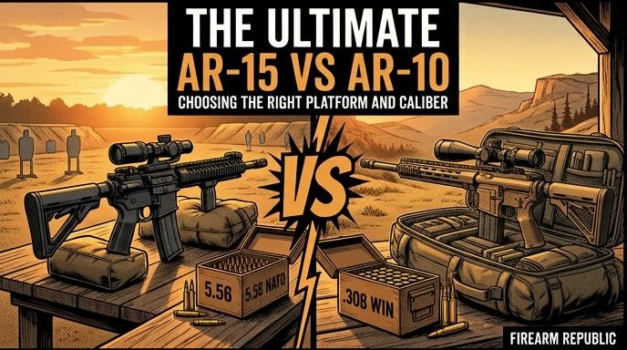
The question comes up constantly: AR-15 or AR-10? It seems like a simple platform comparison, but it’s actually a caliber question, a use-case question, and a weight question bundled into one. The AR-15 fires cartridges based on the .223/5.56 case – small, light, fast, with minimal recoil and high magazine capacity. The AR-10 fires cartridges based on the .308/7.62 case – larger, heavier, hitting harder at distance, with more recoil and a heavier rifle. Neither platform is universally better. The right answer depends entirely on what you’re doing: hunting deer in eastern hardwoods versus elk in Wyoming basin country, competing in 3-Gun versus PRS, home defense versus long-range target shooting. This guide walks through every meaningful use case and tells you which platform wins it – and why.
Understanding the Platforms
The AR-15
The AR-15 is the most popular rifle platform in the United States, and for good reason. The direct-impingement or short-stroke piston operating system in a mil-spec configuration is reliable, accurate, and backed by more aftermarket support than any other firearm platform in history. In its standard 5.56 NATO/.223 Remington chambering, it fires a 55–77gr projectile at 2,750–3,300 fps from a 16″ barrel, generating 1,200–1,800 ft-lbs of muzzle energy. Recoil is approximately 4–6 ft-lbs – essentially negligible for most shooters.
The AR-15’s weight advantage is significant: a complete mil-spec AR-15 with 16″ barrel runs 6.5–7.0 lbs. Add a red dot or LPVO and quality magazines and the loaded system is 7.5–8.5 lbs – light enough to carry and maneuver comfortably all day.
Beyond standard 5.56, the AR-15 platform supports a wide range of caliber conversions with just an upper receiver swap: .300 Blackout, .350 Legend, 6.5 Grendel, 6mm ARC, .224 Valkyrie, and others. This caliber flexibility – the ability to run a dedicated upper for each use case on the same lower receiver – is one of the platform’s defining practical advantages. See our AR-15 Platform Guide for a complete platform overview and our AR-15 Caliber Selection Guide for the full caliber breakdown.
The AR-10
The AR-10 is the larger-frame sibling of the AR-15, designed to fire .308 Winchester and other cartridges based on the larger .308 case. The operating system is functionally similar to the AR-15, but the larger receiver, longer magazine well, and heavier barrel required for .308-class cartridges add meaningful weight: a complete AR-10 with 18–20″ barrel typically runs 8.5–9.5 lbs, rising to 10–11 lbs with a quality optic and loaded magazine.
In .308 Winchester, the AR-10 fires a 150–180gr projectile at 2,550–2,750 fps from a 20″ barrel, generating 2,300–2,900 ft-lbs of muzzle energy – roughly double the AR-15 in 5.56. Recoil is 14–18 ft-lbs in a 9-lb rifle, similar to a bolt-action .308. The platform is also available in 6.5 Creedmoor, .260 Remington, .243 Winchester, 7mm-08, and other .308-based cartridges that offer better ballistic performance than standard .308 at comparable recoil levels.
The AR-10 is not a single unified standard – unlike the AR-15’s mil-spec compatibility, the AR-10 market is fragmented between DPMS-pattern and Armalite-pattern receivers with limited cross-compatibility. Magazines, handguards, and some components do not interchange between patterns. Verify pattern compatibility before mixing components. See our AR-10 Platform Guide for full platform details and pattern compatibility explanation.
Use Case Comparisons: Which Platform Wins?
Home Defense: AR-15 Wins
For home defense, the AR-15 in 5.56 NATO wins on nearly every relevant criterion. The 5.56’s lower recoil allows faster, more accurate follow-up shots under stress than .308. Standard 30-round magazines provide adequate capacity for any realistic defensive scenario. The rifle’s lighter weight makes it easier to maneuver through doorways and hallways. And 5.56 M193 or M855A1 ammunition at indoor distances is effective on human targets while modern defensive loads (Hornady TAP, Federal LE Tactical) are engineered to minimize over-penetration through common building materials.
The AR-10’s recoil, weight, and muzzle blast are all disadvantages in a home defense context where the stakes are high, the distances are short, and accurate shot placement under stress is the primary variable. No realistic home defense scenario benefits from .308 energy at 20 yards.
The one exception: rural properties or farms where defensive engagements might occur at 100+ yards against multiple threats – a rare but real scenario in some agricultural contexts. Even there, the .300 Blackout AR-15 configuration covers most needs without stepping to an AR-10.
See our Home Defense Rifle Guide for a full defensive rifle breakdown.
Winner: AR-15
Deer Hunting (Inside 250 Yards): AR-15 Viable, AR-10 Better
For deer hunting inside 250 yards, the platform choice depends largely on state regulations and specific caliber selection.
In states that allow centerfire rifle hunting without cartridge restrictions, an AR-15 in 6.5 Grendel (1,800 ft-lbs at the muzzle from a 20″ barrel), .350 Legend (1,800 ft-lbs), or 6mm ARC (1,600 ft-lbs) is fully adequate for deer at typical hunting distances. These calibers provide deer-ethical energy inside 200 yards with standard AR-15 platform weight and recoil. The .350 Legend specifically is the right choice for hunters in straight-wall cartridge states (Ohio, Indiana, Michigan) where bottlenecked centerfire cartridges are prohibited. See our Best Deer Hunting AR-15 Calibers guide for the full caliber breakdown.
An AR-10 in .308, 6.5 Creedmoor, or 7mm-08 provides more energy margin, better performance at 200–300 yards, and more reliable terminal performance on larger deer with tougher shoulders. The AR-10 in .308 with 150gr Federal Fusion or Hornady SST handles any deer inside 300 yards cleanly. For hunters who want the same platform for deer and occasional hog hunting where volume shooting matters, the AR-10 in .308 is a strong choice.
For hunters in heavily wooded country where shots average under 100 yards and weight matters for still hunting, the AR-15 in an adequate deer caliber is the better platform. For hunters in mixed terrain where shots occasionally extend to 250 yards, the AR-10 provides more comfortable margin.
Winner: Slight edge to AR-10, AR-15 viable with right caliber
Elk and Large Game: AR-10 Wins Clearly
For elk, large black bear, and other game requiring 1,500+ ft-lbs at impact, the AR-10 is the right platform. An AR-10 in 6.5 Creedmoor with Federal Terminal Ascent 130gr generates 2,315 ft-lbs at the muzzle and retains approximately 1,820 ft-lbs at 200 yards – well within elk-ethical territory with the right bullet construction. In .308 with 180gr Nosler Partition, it generates 2,743 ft-lbs at the muzzle and retains 2,143 ft-lbs at 200 yards.
The AR-15’s best deer calibers (6.5 Grendel, .350 Legend) are marginal for elk and not recommended. The cartridge energy simply isn’t there for large, heavy-boned game at hunting distances. The AR-10’s semi-auto operating system also provides a practical advantage on elk specifically: a wounded bull that doesn’t go down on the first shot may require a fast follow-up, and a semi-auto’s cycling speed is faster than any bolt gun under field pressure.
See our Best AR-10 Rifles for Elk Hunting and Elk Hunting Caliber Comparison for the full elk context.
Winner: AR-10
Hog Hunting: AR-15 Wins for Most Scenarios
Feral hog hunting is arguably the AR-15’s best hunting use case. Hogs require fast follow-up shots, often present in groups, frequently hunted at night with thermal optics, and are fully within the energy capabilities of 5.56 with appropriate bullet selection or .300 Blackout for suppressed setups.
The AR-15’s 30-round magazines, lighter weight for mobile hunting, lower recoil for fast multiple-target transitions, and suppressor-friendly .300 Blackout chambering all make it better suited to hog hunting than the AR-10 in most field scenarios. A 200-lb feral hog hit with a 62gr Barnes TSX from a .223 at 150 yards – approximately 1,400 ft-lbs – goes down cleanly with a properly placed shot. A suppressed AR-15 in .300 Blackout subsonic is the quietest practical hog hunting combination available.
The AR-10 makes sense for open-country hog hunting where shots regularly extend past 300 yards, or for the largest mature boars (300+ lbs) where the .308’s heavier bullet provides better penetration through the thick shoulder plate. For the majority of hog hunters operating inside 200 yards in typical field conditions, the AR-15 platform’s advantages outweigh the AR-10’s additional energy.
See our Hog Hunting Rifle Guide and Night Hunting Rifles & Optics Guide for complete hog hunting setup recommendations.
Winner: AR-15 (most scenarios)
Varmint Hunting: AR-15 Wins Clearly
Prairie dog, ground squirrel, and coyote hunting at 100–400 yards is the AR-15’s home territory. In .223 Remington or .22-250 (via a dedicated upper), the AR-15 delivers flat-shooting, accurate, low-recoil performance ideal for high-volume varmint shooting. The 55gr Hornady V-Max at 3,240 fps is devastatingly effective on prairie dogs at 300 yards. The AR-15’s light recoil allows keeping the scope on target through the shot and quickly acquiring the next animal.
The AR-10 has no meaningful advantage in varmint hunting. The .308’s heavier bullet isn’t more effective on small animals; it costs more per round, generates more recoil, and adds unnecessary weight to a rifle that will be carried and shot extensively. For coyote-specific hunting where shots occasionally extend to 400+ yards in open country, a .224 Valkyrie AR-15 upper with a 75gr ELD-M bullet maintains accuracy and BC advantage over .308 at long range.
See our Varmint Hunting Rifles Guide for the full varmint context.
Winner: AR-15
Long-Range Target Shooting (500–1,000 Yards): AR-10 Wins
For precision long-range target shooting at 500–1,000 yards, the AR-10 in 6.5 Creedmoor is the dominant platform. The 6.5 CM’s 140gr match bullets (BC .617–.697) stay supersonic past 1,200 yards, drift approximately 20 inches in a 10 mph crosswind at 1,000 yards, and shoot sub-MOA accuracy in quality AR-10 barrels. The AR-10 platform’s heavier weight provides a more stable shooting platform for prone long-range work than the lighter AR-15.
The AR-15 in 6.5 Grendel or 6mm ARC can reach 600–800 yards with adequate accuracy, but energy and BC fall short of the AR-10 in 6.5 CM for serious 800–1,000-yard work. The .224 Valkyrie is the AR-15’s most capable long-range cartridge, reaching 1,000 yards in capable hands, but it has narrower ammunition selection and is less dominant in competition than 6.5 CM in the AR-10.
See our Long-Range Shooting Guide for the full 500–1,000-yard framework, and our AR-10 Platform Guide for AR-10 precision builds.
Winner: AR-10
PRS Gas Gun Competition: AR-10 Wins
Precision Rifle Series (PRS) Gas Gun division, NRL22X, and similar precision semi-auto competitions are dominated by AR-10 platforms in 6.5 Creedmoor. The combination of 6.5 CM’s long-range ballistic performance, the AR-10’s semi-auto speed advantage on multi-target strings, and the platform’s compatibility with precision rifle accessories (AICS magazines, chassis systems, suppressor-ready threaded barrels) makes it the purpose-built competition choice.
An AR-10 in 6.5 Creedmoor with a quality 22–24″ barrel, adjustable gas system, and a first focal plane 4.5–27x scope is competitive at national-level PRS Gas Gun matches. The AR-15 has no realistic role in this competition division.
See our PRS Gas Gun Competition Guide for complete setup recommendations.
Winner: AR-10
3-Gun / Multi-Gun Competition: AR-15 Wins
3-Gun competition – combining rifle, pistol, and shotgun stages – is built around the AR-15. The sport’s rifle stages are designed for 5.56 carbines at distances from 7 to 200 yards with fast target transitions between multiple steel and paper targets. The AR-15’s lighter weight, lower recoil for faster split times, 30-round magazine capacity, and lower-cost ammunition (5.56 versus .308) all favor the platform.
No major 3-Gun competition division requires .308 performance. Competitors who bring AR-10s to 3-Gun matches are fighting the platform – heavier rifle, slower transitions, more recoil on close-range steel, and more expensive practice. The AR-15 is the correct tool for 3-Gun.
See our 3-Gun / Multigun Competition Guide for complete competition setup guidance.
Winner: AR-15
Suppressed Shooting: AR-15 Wins (.300 Blackout)
For the best suppressed shooting experience, the AR-15 in .300 Blackout is the dedicated answer. Subsonic 220gr loads through a .30-cal suppressor produce approximately 125–130 dB – the quietest practical centerfire rifle combination available. The .300 Blackout’s subsonic/supersonic flexibility (switch loads without changing the platform) is unique. The shorter, lighter AR-15 platform manages suppressor weight addition better than the heavier AR-10.
The AR-10 in .308 suppressed produces approximately 130–135 dB – quieter than unsuppressed but not as quiet as the AR-15 in .300 Blackout subsonic. The AR-10’s heavier platform and higher operating pressure also mean suppressor wear is faster on an AR-10 than a comparable AR-15 in .300 Blackout.
See our Suppressor Buyer’s Guide, .300 Blackout Caliber Guide, and Best Suppressed Hunting Setups for complete suppressed setup guidance.
Winner: AR-15 (.300 Blackout)
Platform Comparison Table
| Use Case | AR-15 | AR-10 | Winner |
|---|---|---|---|
| Home defense | Excellent | Excessive recoil/weight | AR-15 |
| Deer (inside 250 yds) | Viable (right caliber) | Better energy margin | AR-10 edge |
| Elk / large game | Inadequate | Purpose-built | AR-10 |
| Hog hunting | Excellent | Overkill most scenarios | AR-15 |
| Varmint hunting | Excellent | Wrong tool | AR-15 |
| Long-range (500–1k yds) | Limited | Dominant | AR-10 |
| PRS Gas Gun competition | No role | Dominant | AR-10 |
| 3-Gun competition | Dominant | Wrong platform | AR-15 |
| Suppressed shooting | Best (.300 BLK) | Good but heavier | AR-15 |
| Weight / portability | 6.5–7.5 lbs | 8.5–10.5 lbs | AR-15 |
| Ammunition cost | Lower | Higher | AR-15 |
| Recoil | Minimal (4–6 ft-lbs) | Moderate (14–18 ft-lbs) | AR-15 |
| Effective range | 400–600 yds (typical) | 800–1,000 yds | AR-10 |
The Weight and Recoil Reality
The weight difference between platforms deserves direct attention because it affects every use case. A complete AR-15 with 16″ barrel, red dot, and loaded 30-round magazine weighs approximately 8.5 lbs. A complete AR-10 with 20″ barrel, 3-15x scope, and loaded 20-round magazine weighs approximately 12–13 lbs.
That 3.5–4.5 lb difference is not trivial. For a hunter covering 8 miles at elevation, it’s the weight of an extra water bottle per hour of hiking. For a 3-Gun competitor running 10 stages, it’s meaningful fatigue accumulated across the match. For a home defense rifle that might be used from an awkward position in the dark, it’s the difference between a rifle that handles naturally and one that feels unwieldy under stress.
The recoil difference is similarly real. The AR-15’s 4–6 ft-lbs in 5.56 is effectively unnoticeable for most adult shooters; the AR-10’s 14–18 ft-lbs in .308 is comparable to a bolt-action hunting rifle. Both are manageable, but the AR-10 requires more deliberate recoil management for accurate rapid fire and produces meaningful fatigue over extended range sessions.
These differences don’t determine which platform is “better” – they determine which platform is right for a specific use case. Where energy and long-range accuracy are the primary criteria, the AR-10’s trade-offs are worth accepting. Where weight, recoil management, and ammunition economy matter, the AR-15’s advantages are decisive.
Ammunition Cost and Practice Economics
The cost difference between 5.56 and .308 ammunition is significant for shooters who practice regularly.
Quality 5.56 NATO training ammunition runs $0.40–$0.60 per round in bulk. Quality .308 training ammunition runs $0.80–$1.20 per round. For a shooter who fires 100 rounds per month:
- AR-15 in 5.56: $480–$720 per year in ammunition
- AR-10 in .308: $960–$1,440 per year in ammunition
That $500–$700 annual difference either funds more range time on the AR-15 platform or represents a real cost the AR-10 shooter pays for the platform’s capability advantage. Shooters who practice seriously – and more practice means better shooting – often find that the AR-15’s lower ammunition cost enables them to shoot more frequently and ultimately become better shooters than they would be on an AR-10 with the same budget.
6.5 Creedmoor match ammunition in an AR-10 runs $1.40–$2.50 per round – significantly more than .308 and dramatically more than 5.56. For precision AR-10 shooters who shoot quality match ammunition, annual ammunition costs can exceed $2,000 at moderate volume.
Buying the Right Platform
Buy an AR-15 if:
You primarily use the rifle for home defense, varmint hunting, hog hunting, 3-Gun competition, or suppressed shooting. The AR-15 is also the right choice if budget constrains both the rifle and its ammunition supply – lower ammunition cost means more practice and ultimately better shooting. If you want a lighter, more portable rifle for any purpose where .308-class power is unnecessary, the AR-15 serves you better.
Recommended AR-15 configurations by use case: standard 5.56 16″ for home defense and general use; .300 Blackout 10.5″–16″ for suppressed hog hunting; 6.5 Grendel or 6mm ARC 18″–20″ for deer hunting; .223 Rem 18″–20″ for varmint hunting.
Buy an AR-10 if:
You hunt elk or large game, compete in PRS Gas Gun or precision semi-auto matches, regularly shoot targets at 600+ yards, or want a semi-auto platform that handles large game across the American West. The AR-10 is also the right platform if you’re building a single rifle that must cover deer hunting today and might see an elk tag in the future – the energy margin in 6.5 Creedmoor or .308 covers both use cases where the AR-15 cannot.
Recommended AR-10 configurations by use case: 6.5 Creedmoor 20–22″ for precision/competition; .308 Winchester 18–20″ for hunting; 6.5 Creedmoor 18″ for a hunting/competition hybrid.
Consider both if:
You hunt a variety of game across multiple contexts or compete in multiple shooting sports. Many serious shooters own both platforms – an AR-15 for 3-Gun, varminting, and suppressed hog work, and an AR-10 for elk season and long-range target shooting. The platforms are complementary rather than redundant when the use cases are genuinely distinct.
Pros and Cons Summary
AR-15: ✓ Lighter (6.5–7.0 lbs bare rifle) ✓ Lower recoil – faster follow-up shots and better fatigue management ✓ Cheaper ammunition – more practice per dollar ✓ Wide caliber variety via upper swaps ✓ Dominant platform for home defense, 3-Gun, varminting, hog hunting ✓ Best suppressed platform (.300 Blackout subsonic) ✗ Inadequate for elk and large game in standard calibers ✗ Limited effective range versus AR-10 in .308/6.5 CM ✗ Not competitive for precision long-range work past 600 yards
AR-10: ✓ Adequate energy for elk and all North American large game ✓ Long-range capability to 1,000 yards in 6.5 Creedmoor ✓ Dominant in PRS Gas Gun competition ✓ Semi-auto speed advantage on large game follow-up shots ✓ Genuine versatility from 100 to 1,000 yards ✗ Heavier (8.5–9.5 lbs bare rifle) – meaningful for field carry ✗ More recoil – affects practice quality and rapid-fire splits ✗ More expensive ammunition – constrains practice volume ✗ Platform fragmentation (DPMS vs. Armalite) limits parts interchangeability
Frequently Asked Questions
Q: Which is better for a first AR – the AR-15 or AR-10?
A: The AR-15 for most first-time buyers. It’s less expensive ($600–$1,000 versus $1,200–$2,000 for quality AR-10s), lighter to handle and carry while developing technique, and its 5.56 ammunition is cheap enough to practice frequently. Unless you have a specific large game hunting need that requires the AR-10, start with an AR-15 and add an AR-10 when a specific use case demands it. See our Best Rifles for New Shooters guide for broader entry-level context.
Q: Can an AR-15 kill deer humanely?
A: Yes, in appropriate calibers with proper bullet selection and shot placement. Standard 5.56 FMJ ammunition is not an ethical deer hunting choice – but 5.56 with quality expanding bullets (62gr Barnes TSX, 75gr Hornady ELD-M) and caliber-specific uppers like 6.5 Grendel, .350 Legend, or 6mm ARC are all legal and ethical for deer inside 200 yards. Know your state’s regulations – some states have minimum caliber or bullet diameter requirements for deer. See our Best Deer Hunting AR-15 Calibers guide for the full breakdown.
Q: Is the AR-10 or AR-15 better for long-range shooting?
A: The AR-10 in 6.5 Creedmoor is better for serious 600–1,000-yard work. The 140gr match bullets’ high BC and adequate velocity from a 20–22″ barrel maintain supersonic flight past 1,200 yards and produce manageable wind drift at 1,000. The AR-15 in .224 Valkyrie or 6.5 Grendel reaches 800 yards in capable hands but doesn’t match the AR-10’s energy retention or competition dominance at extreme range. For recreational shooting inside 600 yards, either platform works; for serious long-range or competition past 600 yards, the AR-10 is the right platform.
Q: What’s the effective range of each platform?
A: The AR-15 in 5.56 is effective on human-sized targets to approximately 500 yards in trained hands; on deer-sized game, 300 yards is the practical ethical maximum with appropriate calibers. The AR-10 in 6.5 Creedmoor is effective on steel targets to 1,000+ yards and on elk-sized game to 400 yards with adequate energy. On deer specifically, both platforms can cover 300 yards in appropriate calibers – the difference becomes meaningful at 400 yards and beyond.
Q: Which platform is more reliable?
A: Both are reliable when quality components are used and the rifle is properly maintained. The AR-15’s mil-spec standardization means a quality parts kit from any reputable manufacturer produces a reliable rifle. The AR-10’s lack of a unified standard (DPMS vs. Armalite pattern) means parts compatibility must be verified, and the larger operating pressures of .308-class cartridges require more attention to gas system tuning for reliable cycling. A quality factory AR-10 from Aero Precision, JP Enterprises, or CMMG is thoroughly reliable; a budget AR-10 from an unknown manufacturer with mismatched components may not be.
Q: Can I hunt elk with a .308 AR-10?
A: Yes – a .308 AR-10 with 180gr bonded bullets (Nosler Partition, Federal Trophy Bonded Bear Claw) is adequate for elk inside 300 yards. The semi-auto operating system provides a practical advantage for fast follow-up shots if needed. Most western states allow semi-automatic rifles for big game hunting; verify your specific state and unit regulations before hunting. The AR-10 in 6.5 Creedmoor is the better elk choice ballistically, retaining more energy at distance and offering better BC projectiles. See our Elk Hunting Caliber Comparison and Best AR-10 Rifles for Elk Hunting for the full picture.