 Maksym Kovaliov
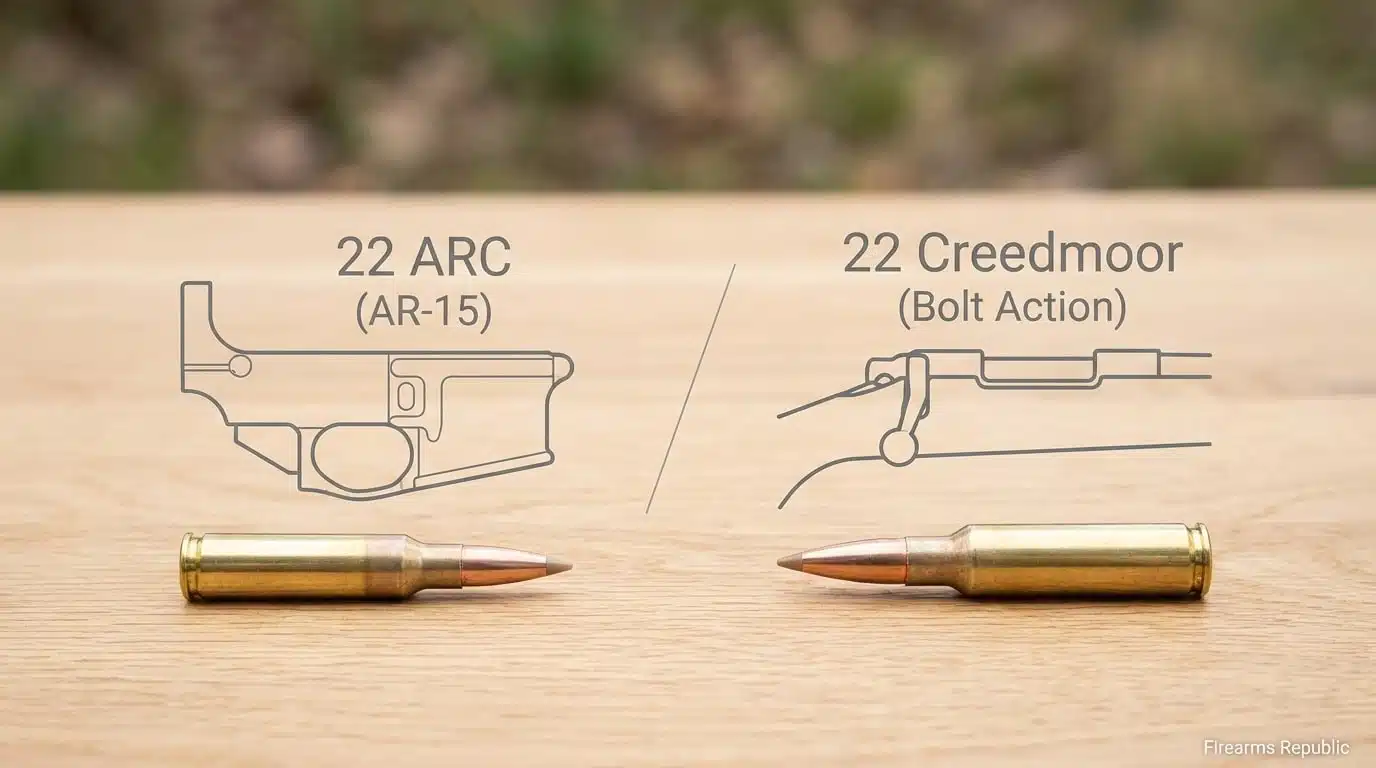
The ballistics debate between .22 ARC and .22 Creedmoor gets plenty of attention online. Velocity numbers, BC comparisons, 1,000-yard drop charts – shooters love that conversation. But most people asking “which one should I build?” aren’t really asking about ballistics. They’re asking about iron: what receiver, what platform, what ecosystem, what does the whole system cost, and what happens two years from now when you need a replacement barrel.
That’s the question this article answers. The ballistic performance gap between these two cartridges is real but narrow – the .22 Creedmoor holds a 25–50 yard edge in effective hunting range over a bolt-action .22 ARC handload, and both leave factory .22 ARC AR-15 performance well behind. What separates them in a meaningful, practical way is platform architecture. The .22 ARC is two rifles – an AR-15 and a bolt-action – with different pressure ceilings, different use cases, and different ecosystems. The .22 Creedmoor is one rifle: a short-action bolt gun, full stop. Understanding that distinction is the foundation of making the right choice.
Two Cartridges, Three Platforms
Before comparing them side by side, it helps to map out what each cartridge actually runs in.
The .22 ARC was engineered by Hornady and Barrett specifically for the AR-15 platform. Its case is derived from the 6.5 Grendel – compact enough to fit inside an AR-15 magazine at standard COAL while seating long, high-BC .224 bullets without intruding into powder space. In an AR-15 running factory ammunition, the SAAMI pressure limit is 52,000 PSI, which produces approximately 2,700–2,850 fps with an 80gr bullet from a 16″ barrel. That same cartridge in a bolt-action rifle – either a purpose-built mini-action or a short-action with a Grendel-type bolt face – can be handloaded to 60,000–62,000 PSI, pushing the same bullet to 3,050–3,100 fps from an 18″ barrel. Same cartridge, meaningfully different performance depending on platform. If you’re building a bolt-action .22 ARC, the mini-action is the optimized choice for this cartridge’s geometry.
The .22 Creedmoor is a wildcat formed by necking down 6.5 Creedmoor brass to .224. It runs exclusively in bolt-action rifles on a standard .473″ short-action bolt face – the same as .308 Winchester and 6.5 Creedmoor. There is no AR-15 version, no semi-auto application, no factory ammunition. It’s a handloader’s bolt-action cartridge with a large case capacity, maximum velocity ceiling, and shorter barrel life as the price of admission. The build process is covered in detail in the .22 Creedmoor rifle build guide.
So the real comparison isn’t .22 ARC vs .22 Creedmoor in a head-to-head ballistic duel. It’s three distinct use-case scenarios against each other:
- .22 ARC in an AR-15 – semi-automatic, factory ammo capable, 52,000 PSI ceiling
- .22 ARC in a bolt-action – handload capable, 62,000 PSI ceiling, mini-action optimized
- .22 Creedmoor in a bolt-action – handload only, maximum .224 performance, short-action standard
Platform Architecture: What the Bolt Face Tells You
The bolt face diameter is the most important single number in a bolt-action rifle build. It determines receiver compatibility, the entire aftermarket ecosystem you have access to, and what brass you’re working with.
.22 ARC uses a .440″ bolt face – the 6.5 Grendel Type II specification. This is a niche diameter. A handful of custom action makers offer it, the Q Mini Fix is built around it, and it’s available in short-action receivers from select makers – but the selection is a fraction of what you find at the .473″ standard. Magazines are Grendel-format: Geissele, DuraMag, and MDT’s AICS-format Grendel magazines for bolt guns. These are purpose-specific and more expensive per unit than standard AICS magazines.
.22 Creedmoor uses a .473″ bolt face – the universal short-action standard. Defiance, Bighorn, Curtis, Zermatt, Surgeon, and dozens of other custom action makers produce short-action receivers with this bolt face as their default. Stocks, chassis, triggers, and aftermarket components designed for short-action Remington 700-pattern rifles all fit directly. AICS magazines for .308-length cartridges work out of the box. The ecosystem is the largest in precision bolt-action rifle building.
For the AR-15 side of the .22 ARC equation, compatibility is different again. The .22 ARC AR-15 build uses a standard AR-15 lower without modification, but requires a Grendel Type II BCG, a purpose-chambered barrel with 1:7 twist, and Grendel-compatible magazines. The upper receiver is standard AR-15 format.
| Feature | .22 ARC (AR-15) | .22 ARC (Bolt) | .22 Creedmoor (Bolt) |
|---|---|---|---|
| Bolt/BCG face | .440″ Grendel Type II | .440″ Grendel Type II | .473″ standard short-action |
| Platform | AR-15 | Mini-action preferred | Short-action standard |
| Magazine format | Grendel-compatible | MDT Grendel AICS | Standard AICS .308 |
| Factory ammo | Yes | Yes (under-pressure) | No |
| Handload required | No | For full performance | Yes, always |
| Aftermarket ecosystem | AR-15 standard | Limited, growing | Largest available |
| Pressure ceiling | 52,000 PSI | 62,000 PSI | ~62,000 PSI (wildcat) |
Scenario 1: Maximum Speed of Deployment
If you need a fast follow-up shot, a manual-reset trigger, or the ability to engage multiple targets in sequence, the .22 ARC AR-15 is the only option on this list. The .22 Creedmoor has no semi-auto platform. The bolt-action .22 ARC requires manually cycling between shots.
The AR-15 configuration also offers the most flexibility in barrel length for suppressed use. A 16″ barrel with a 7–8″ suppressor keeps total system length manageable, and the .22 ARC’s compatibility with standard AR-15 suppressors makes this a straightforward setup. Gas system tuning matters here – mid-length gas is mandatory for a 16″ barrel, and an adjustable gas block is worth the investment for suppressor use.
The trade-off is the 52,000 PSI ceiling. Factory .22 ARC from a 16″ AR-15 barrel produces approximately 2,700–2,800 fps with an 80gr bullet. That’s a capable cartridge – better wind resistance than .223, higher BC bullets, accurate past 600 yards – but it falls short of what either bolt-action configuration delivers. For hunting, the 2,000 fps impact velocity threshold for reliable bullet expansion is reached at approximately 450 yards from an AR-15 versus 580–600 yards from a bolt-action handload.
Choose this scenario if: You want a multi-purpose AR-15 that can reach past .223’s practical limits, you’re varmint hunting where fast follow-up shots matter, or you want factory ammunition capability with meaningful long-range improvement over .223.
Scenario 2: Maximum Accuracy and Long-Range Performance
Both bolt-action configurations compete here, and the differences are narrower than most expect.
A bolt-action .22 ARC with handloads at 62,000 PSI produces approximately 3,050–3,100 fps with an 80gr ELD-X from an 18″ barrel. The .22 Creedmoor with optimized handloads produces approximately 3,100–3,180 fps with the same bullet from an 18″ barrel. That’s a 50–130 fps difference – real, but not transformative. At 1,000 yards, the trajectory difference between those velocity figures amounts to roughly 2–4 inches of additional drop for the ARC. Wind drift difference is similarly modest.
Where the gap shows more clearly is at the absolute performance ceiling. The .22 Creedmoor’s larger case can push heavier charges of slower powders, which extracts slightly more velocity from the heaviest bullets. With an 88gr ELD-M, the Creedmoor holds supersonic past approximately 1,200 yards in standard conditions; the bolt-action ARC holds supersonic past approximately 1,100 yards. For competition shooting at distances above 1,000 yards, that matters. For hunting inside 600 yards, it doesn’t.
The bolt-action .22 ARC has two advantages that partially offset its velocity deficit. First, barrel life: approximately 3,000 rounds versus 1,300–1,900 rounds for the Creedmoor. Over the life of a rifle used for regular long-range practice, that’s one fewer barrel replacement – a $300–$600 savings depending on your barrel choice. Second, the 1:7 twist standard for .22 ARC ensures proper stabilization of heavy bullets across all conditions. Many .22 Creedmoor barrels are offered in 1:8, which is marginal for 80–88gr projectiles in cold weather or at altitude. If you’re ordering a Creedmoor barrel, specify 1:7 explicitly – this is covered in more detail in the .22 Creedmoor build guide.
Choose this scenario if: You’re building a dedicated precision or competition rifle, handloading is already part of your workflow, and you want to maximize every performance metric from a short-action .224 build.
Scenario 3: Hunting Applications
For hunting, the relevant question is where the 2,000 fps impact velocity threshold falls – the generally accepted minimum for reliable expansion of modern hunting bullets like the 80gr ELD-X or 71gr Copper Rose.
- Factory .22 ARC from AR-15: approximately 450 yards
- Bolt-action .22 ARC handload (3,080 fps): approximately 580–600 yards
- .22 Creedmoor handload (3,150 fps): approximately 625–650 yards
The practical hunting range gap between a bolt-action ARC and a Creedmoor is 25–50 yards. In most hunting scenarios – whitetail inside 300 yards, elk inside 500 yards in open country, pronghorn at 400 yards on the plains – that margin is irrelevant. Even the factory AR-15 limit of 450 yards covers the vast majority of ethical hunting shots for most hunters in most terrain.
Where the Creedmoor’s range extension matters is in wide-open western hunting environments: long-range pronghorn shots, mule deer in open desert basins, elk hunting where you might glass a bull at 500–550 yards and need confidence in your expansion threshold. For those specific scenarios, the Creedmoor’s 625-yard expansion range versus the bolt ARC’s 600-yard range is a meaningful margin – though either cartridge still requires proper bullet placement, and neither replaces wind reading ability.
An important legal note for hunters: many states restrict deer hunting to minimum bullet diameters above .224″, which means .22 ARC and .22 Creedmoor may not be legal for deer in your state regardless of their terminal performance. Always verify current hunting regulations before building a .22-caliber hunting rifle.
Choose this scenario if: You’re building a dedicated hunting rifle for western open-country applications and want to maximize ethical range. Both bolt configurations are appropriate; the Creedmoor earns its complexity only at the margin of 600+ yard shots.
Cost to Enter Each System
The total cost of ownership matters more than component prices in isolation – especially for a cartridge like .22 Creedmoor where barrel replacement is part of the budget math.
AR-15 .22 ARC build:
- Complete build cost: $800–$1,600 depending on components
- Factory ammo: $1.50–$2.00/round
- Barrel life: 5,000+ rounds (gas-operated platforms are easier on barrels than bolt guns)
- Replacement barrel cost: $220–$450
- No reloading required
Bolt-action .22 ARC build:
- Complete build cost: $1,200–$2,800 depending on receiver and components
- Handload cost: $0.50–$0.80/round with quality components
- Barrel life: ~3,000 rounds
- Replacement barrel cost: $250–$500
- Reloading setup required if not already equipped: $400–$800
.22 Creedmoor bolt-action build:
- Complete build cost: $1,000–$2,800 depending on components
- Handload cost: $0.55–$0.85/round
- Barrel life: 1,300–1,900 rounds
- Replacement barrel cost: $280–$750 (Proof CF recommended for heat management)
- Reloading setup required: $400–$800
- Brass forming required (from 6.5 CM): additional time investment
The Creedmoor’s shorter barrel life means a high-volume shooter goes through barrels roughly twice as fast as with bolt-action ARC. Over 5,000 rounds of practice, that’s potentially two barrel replacements for the Creedmoor versus one for the ARC – a $300–$700 difference depending on which barrel you choose. For a shooter putting 500 rounds a year through a hunting rifle, barrel life is largely irrelevant. For a competition shooter putting 2,000+ rounds annually through a precision rifle, it matters significantly.
Parts Availability and Long-Term Serviceability
This is where the .22 Creedmoor’s .473″ bolt face pays the biggest dividend. The short-action .308-family ecosystem is the most robust in precision rifle building. If you’re in rural Montana and your barrel shoots out, a replacement Criterion or Benchmark barrel in .22 Creedmoor can be ordered from any major retailer and installed by any competent gunsmith. The receiver, trigger, stock, and chassis are all standard short-action components available everywhere.
The .22 ARC bolt-action ecosystem is still developing. Mini-action receivers are available from a limited number of sources, and Grendel-type bolt faces in short-action receivers require explicitly seeking out non-standard configurations. This improves as the cartridge matures, but right now the serviceability story for bolt ARC is thinner than for Creedmoor.
The AR-15 .22 ARC ecosystem is well-supported by comparison. Grendel-compatible BCGs, purpose-built uppers, and Grendel magazines are stocked by major retailers. The AR-15 lower is standard. For the AR-15 platform specifically, .22 ARC parts availability is solid and improving.
The Honest Summary
Neither cartridge is wrong. They’re designed for different things, and the right choice follows directly from what you’re trying to build.
If you want one rifle that does everything – hunting, range, varmint, semi-auto capability, factory ammo, no mandatory handloading – build a .22 ARC AR-15. It’s the most versatile configuration, the most accessible, and covers 90% of what most shooters need from a precision .224 platform.
If you want maximum bolt-action performance with the best ecosystem – widest parts availability, standard magazines, straightforward gunsmith support, and you’re already handloading – the .22 Creedmoor short-action is the performance ceiling. Accept the barrel life trade-off and budget accordingly.
If you want the middle ground – bolt-action precision, handload capability, good barrel life, and you’re comfortable sourcing mini-action or Grendel-bolt components – the bolt-action .22 ARC delivers 95% of Creedmoor performance at a more sustainable long-term cost.
FAQ
Q: Can I build one rifle that handles both .22 ARC and .22 Creedmoor?
A: No. The cartridges use different bolt face diameters (.440″ vs .473″), different case dimensions, and different chamber geometries. There is no conversion that makes a single rifle switch between them. They are separate builds.
Q: Is the velocity difference between bolt-action .22 ARC and .22 Creedmoor significant enough to matter?
A: At practical hunting and competition distances inside 800 yards, the 50–130 fps gap produces differences of 2–5 inches in drop and roughly 0.5–1 inch in wind drift at 1,000 yards. For most applications, this is not decisive – shooter skill, wind reading, and trigger technique produce larger variances. At distances beyond 1,000 yards in PRS-style competition, the Creedmoor’s velocity advantage becomes more meaningful.
Q: Which has better factory ammunition support?
A: .22 ARC, by a wide margin. Hornady produces factory .22 ARC ammunition in the 88gr ELD-M configuration, and the cartridge’s SAAMI standardization means other manufacturers are developing loads. .22 Creedmoor has zero factory ammunition – it’s a wildcat cartridge that requires handloading without exception. If factory ammo matters to you, .22 ARC is the only viable choice between these two.
Q: If I already own a 6.5 Creedmoor bolt-action, which is easier to add as a second barrel?
A: .22 Creedmoor, clearly. If your 6.5 Creedmoor rifle uses a standard .473″ short-action bolt face and AICS magazines, a barrel swap to .22 Creedmoor is a straightforward barrel replacement. Same bolt, same magazines, same stock and chassis. .22 ARC requires a different bolt face (.440″), different magazines, and is most naturally suited to a mini-action receiver – a more significant conversion or separate build.
Q: Which is better for a beginner to precision rifle shooting?
A: .22 ARC in an AR-15, without hesitation. It requires no handloading, runs on factory ammunition, fits a standard AR-15 lower the shooter may already own, and introduces precision .224 performance without commitment to wildcat cartridge development. The .22 ARC AR-15 build guide covers the full parts list and common mistakes. Once comfortable with the platform and interested in extracting maximum bolt-action performance, the upgrade path to a dedicated bolt-action build is a natural next step.
Q: Does .22 Creedmoor make sense for a hunter who only fires 50–100 rounds per year?
A: Marginally. At 50–100 rounds per year, barrel life is essentially irrelevant – even the Creedmoor’s 1,300-round minimum life represents 13–26 years at that volume. The practical barriers are the mandatory handloading requirement and the absence of factory ammo. If you’re already a handloader with a short-action .308-family platform, adding a .22 Creedmoor barrel is a reasonable upgrade. If you’re not already handloading, the setup investment isn’t justified for 50 rounds a year.