 Maksym Kovaliov
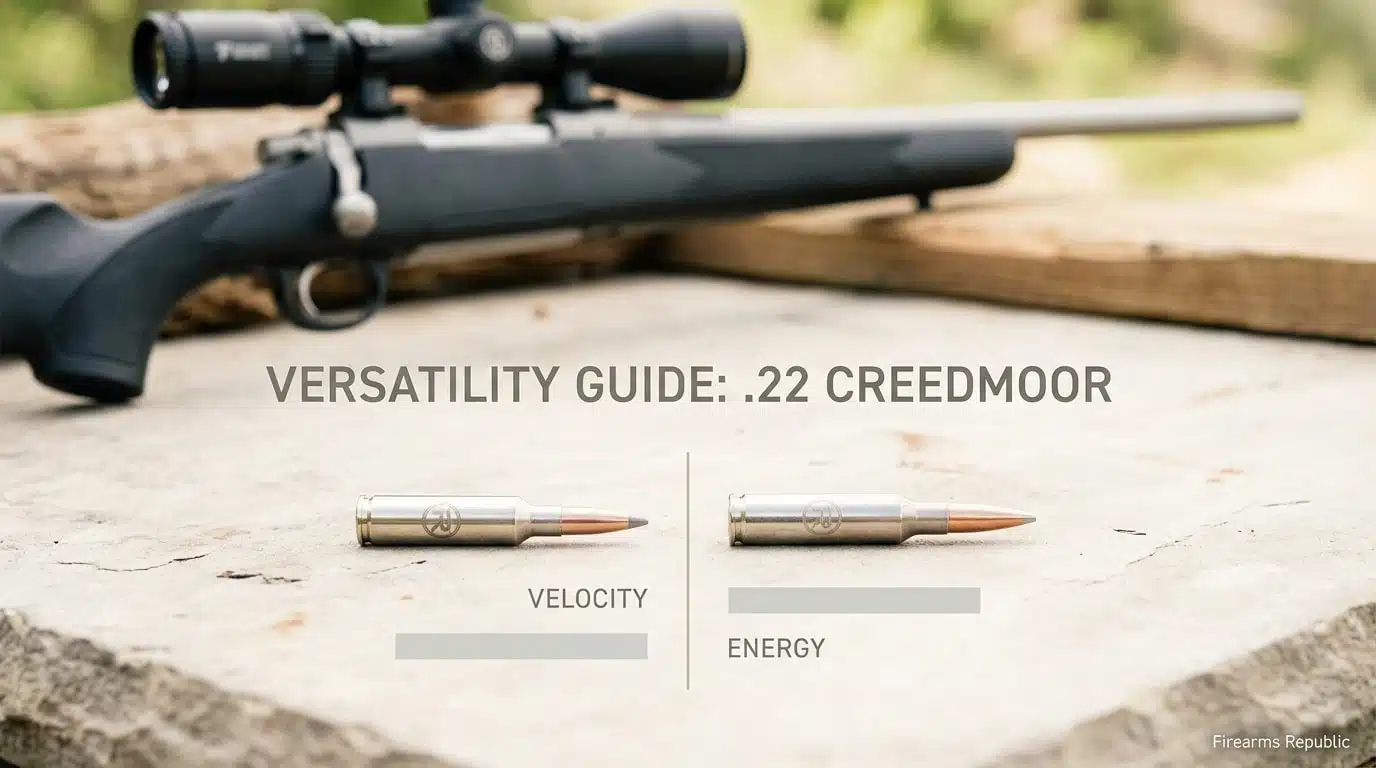
Finding a factory rifle chambered in .22 Creedmoor is harder than it sounds. The cartridge is a wildcat – no SAAMI standardization, no factory ammunition, and consequently very few production rifles built around it. Most .22 Creedmoor rifles are either custom builds assembled from components or factory rifles that have been re-barreled by a gunsmith. That’s the reality of the cartridge, and it’s worth stating upfront before you search a retailer’s website and come up empty.
What does exist is a well-defined path to a finished rifle: take a short-action bolt-action platform with a standard .473″ bolt face, replace the barrel with a quality .22 Creedmoor chamber at 1:7 twist, and you have a precision rifle capable of pushing an 88gr ELD-M past 3,100 fps with handloads. The platform options for doing this range from $500 production actions to $1,200 custom receivers – and the right choice depends on whether you’re prioritizing budget, precision, hunting utility, or competition performance.
This guide covers the best starting platforms and complete builds for .22 Creedmoor, organized by use case and price tier, with honest assessments of what each delivers and what it costs to run long-term.
What to Look For in a .22 Creedmoor Platform
Before getting into specific rifles, it’s worth establishing the criteria that separate a good .22 Creedmoor platform from a poor one – because the wrong starting point will cost you more in the long run than spending correctly upfront.
Barrel twist: 1:7 is mandatory. This is the single most important specification and the one most frequently compromised on factory-adjacent options. Many barrels offered for short-action .224 builds default to 1:8, which is marginal for 80–88gr bullets and a real liability at distance in cold weather or at altitude. If a rifle or barrel package comes with 1:8, either specify 1:7 on order or plan to replace the barrel immediately. The entire performance rationale of .22 Creedmoor is built around heavy, long .224 bullets – a 1:8 barrel leaves most of that rationale unrealized. The .22 Creedmoor build guide covers this in detail.
Bolt face: .473″ standard short-action. This is what gives the .22 Creedmoor its ecosystem advantage over .22 ARC bolt-action builds. Every receiver on this list uses the universal short-action bolt face, which means standard AICS magazines, the widest possible aftermarket selection, and straightforward gunsmith support anywhere in the country.
Barrel quality over barrel length. The .22 Creedmoor erodes throats faster than moderate-pressure cartridges – expect 1,300–1,900 rounds before accuracy falls off with a quality steel barrel, fewer with a budget option. Spending $280 on a Criterion barrel versus $150 on an unknown brand means the difference between 1,600 rounds of useful life and 900. Carbon fiber barrels from Proof Research extend life further through better heat management and are worth the premium for high-volume shooters.
Chassis vs stock. For precision and competition use, a rigid chassis is the better choice – no bedding required, consistent lockup, and typically better accuracy repeatability between sessions. For hunting, a traditional stock in a lightweight contour keeps carry weight down. Both approaches work; the choice follows from intended use.
Best Budget Platform: Howa 1500 ($550–$750)
The Howa 1500 is the most accessible entry point for a .22 Creedmoor build. It’s a production bolt-action rifle on a standard short-action, .473″ bolt face platform with a reputation for solid out-of-box accuracy and a trigger that’s actually usable without immediate replacement.
The Howa 1500 ships in various calibers – you won’t find a factory .22 Creedmoor version, but that’s expected. The build path is to purchase a Howa 1500 in 6.5 Creedmoor or .308 Winchester (same bolt face, same action), then send it to a barrel smith for a .22 Creedmoor re-barrel at 1:7 twist. The action itself is well-dimensioned for the short-action cartridge family, feeds from AICS magazines without modification, and has a solid track record as a platform for wildcat builds.
The factory trigger – Howa’s HACT two-stage – breaks at approximately 3.5 lbs with reasonable consistency. It’s functional for hunting use. For precision competition, budget $100–$150 for a Timney 517 drop-in replacement that improves pull weight and consistency significantly.
Barrel replacement cost: $250–$320 for a Criterion barrel installed and headspaced by a gunsmith, plus $80–$120 labor. Total platform cost with re-barrel: approximately $900–$1,100.
Best for: First .22 Creedmoor build, budget-conscious precision shooter, hunter wanting a re-barreled platform without custom action costs.
Limitations: Factory barrel must be replaced – budget for this upfront. Action is good but not trued from the factory; a gunsmith action truing job ($150–$200) improves consistency for serious precision work.
Best Mid-Tier Platform: Tikka T3x CTR ($1,050–$1,150)
The Tikka T3x CTR (Compact Tactical Rifle) is one of the smoothest-cycling production bolt-actions available at any price, and it builds into an excellent .22 Creedmoor platform with a single barrel swap. The T3x action uses a standard .473″ bolt face in short-action configuration, feeds from AICS-compatible magazines (Tikka uses a proprietary magazine, but AICS adapters are available), and comes with an adjustable cheekpiece and a factory trigger that breaks at approximately 2–2.5 lbs – competitive with aftermarket options on less expensive actions.
The T3x CTR ships with a threaded barrel and a Picatinny rail, both useful for a precision build. Re-barreling to .22 Creedmoor at 1:7 twist is the primary modification – the action itself requires nothing else for the cartridge to run correctly. The three-lug 60-degree bolt gives the T3x its characteristic smooth, fast cycling that makes it a pleasure to shoot in extended precision sessions.
One important note on Tikka re-barrels: Tikka uses a proprietary barrel thread pattern, which means most standard barrel pre-fits won’t fit directly. A gunsmith will cut a custom barrel to Tikka dimensions, or you can use a Tikka-specific pre-fit from makers like Proof Research or Bartlein who offer them. This adds modest complexity to the re-barrel process but doesn’t change the end result.
Platform cost: $1,050–$1,150 for the CTR Re-barrel cost: $350–$500 for a quality barrel plus $100–$150 labor Total build cost: approximately $1,500–$1,800
Best for: Precision shooter wanting the best factory trigger and bolt feel without custom action pricing. Excellent suppressor host due to factory threading. Hunters who want a refined shooting experience.
Limitations: Proprietary barrel threading adds re-barrel complexity. Tikka’s magazine system requires adapters for standard AICS magazines. Heavier than ultralight hunting builds at 7.9 lbs with optic.
Best Precision Platform: Bergara B-14 HMR ($1,100–$1,200)
The Bergara B-14 HMR (Hunting and Match Rifle) sits at an interesting price point – it’s a production rifle with a chassis-style stock, AICS magazine compatibility, and a reputation for sub-MOA accuracy out of the box in standard calibers. As a .22 Creedmoor platform it’s particularly well-suited because it ships with many of the features a precision builder would add anyway: adjustable cheekpiece, AICS magazine well, threaded barrel, and a factory trigger that breaks at approximately 3 lbs with minimal creep.
The B-14 uses Bergara’s own action, which is dimensionally similar to a Remington 700 footprint but with tighter tolerances from the factory. The bolt face is standard .473″ short-action. Re-barreling the B-14 HMR to .22 Creedmoor is straightforward because it uses a standard Remington 700-pattern barrel threading – the widest possible selection of pre-fit barrels from Criterion, Bartlein, Benchmark, and others thread directly onto the action without custom fitting work.

Bergara Rifles Hmr 22 Creedmoor Bolt 20 5+1
The HMR’s chassis-style synthetic stock with aluminum bedding block delivers consistent accuracy without the bedding work a traditional stock requires. At 9.5 lbs with a scope, it’s a range and competition rifle rather than a field carry gun – but for precision work at a bench or in PRS-style competition, that weight provides a stable shooting platform.
Platform cost: $1,100–$1,200 Re-barrel cost: $280–$450 for a standard Remington 700-pattern pre-fit plus $80–$120 labor Total build cost: approximately $1,500–$1,800
Best for: Precision and competition shooting. The Remington 700-pattern threading makes this the easiest re-barrel on the list. Excellent value for a precision-ready chassis platform.
Limitations: Heavy for hunting carry at 9.5 lbs with optic. Not ideal for backcountry or extended field use. Factory trigger acceptable but benefits from upgrade for serious competition.
Best Custom Action Platform: Defiance Machine Deviant ($900–$1,100 action only)
For shooters who want to build the most accurate possible .22 Creedmoor rifle without compromise, a Defiance Machine Deviant or Ruckus action is the starting point. These are precision-machined custom actions with tighter tolerances than any production receiver, trued faces from the factory, and a reputation built over years of PRS and F-class competition use.
The Deviant is available in short-action, .473″ bolt face as a standard configuration – no special order required. It pairs with any Remington 700-pattern barrel pre-fit, any short-action stock or chassis, and any Remington 700-compatible trigger. The action itself contributes to accuracy in ways that production rifles can’t fully replicate: lug engagement is consistent, the bolt body runs true, and the receiver face is square to the bore. Over the life of a barrel, that consistency shows in group size and shot-to-shot repeatability.
Building around a Defiance action is a full custom build – you’re sourcing every component separately and having a gunsmith assemble, headspace, and true the system. The total cost is higher than any production-based option, but the result is a rifle that will outlast multiple barrel replacements and continue to shoot accurately as long as components are maintained.
Recommended build around Defiance Deviant:
- Action: Defiance Deviant – $950
- Barrel: Bartlein 22″ 1:7 heavy Palma – $420
- Chassis: MDT ESS or KRG Bravo – $300–$325
- Trigger: TriggerTech Diamond – $270
- Magazines (3x AICS): $120
- Gunsmith assembly and headspace: $200–$300
- Total: approximately $2,260–$2,385
Best for: Serious precision competition, F-class, or a shooter building a forever rifle that will accept multiple barrel replacements over its life. The highest accuracy ceiling on this list.
Limitations: Highest upfront cost. Requires full custom build – not appropriate for shooters who want to hand a rifle to a gunsmith and pick it up complete. Long lead times from custom action makers are common.
Best Hunting Platform: Weatherby Vanguard Series 2 ($650–$800)
The Weatherby Vanguard Series 2 is an underrated platform for a hunting-oriented .22 Creedmoor build. It uses a standard .473″ short-action bolt face, feeds from AICS magazines with a minor modification (the factory magazine box accommodates standard AICS mags with a spacer), and ships with one of the better factory triggers in its price range – the adjustable Vanguard trigger breaks at approximately 2.5–3.5 lbs and is competitive with budget aftermarket options.
The Vanguard’s primary advantage for a hunting build is weight. The Series 2 with a synthetic stock runs approximately 7.25 lbs, which is manageable for field carry. Combined with a lightweight Proof Research carbon fiber barrel at 22″ in .22 Creedmoor, the completed hunting build can come in under 8 lbs with a scope – reasonable for backcountry use where you’re not going ultralight.
The Vanguard also uses a Remington 700-compatible barrel thread pattern on most configurations, which simplifies the re-barrel process and opens up the full range of standard pre-fit options.
Platform cost: $650–$800 Re-barrel cost (Proof CF 22″ 1:7): $650–$750 plus $100–$150 labor Total build cost: approximately $1,400–$1,700
Best for: Hunter who wants a .22 Creedmoor field rifle with manageable weight. The Proof CF barrel investment makes particular sense here – the carbon fiber’s heat dissipation helps maintain cold-bore consistency that matters on a one-shot hunting scenario, and it keeps the build light enough for serious field use.
Limitations: Factory magazine system requires modification for standard AICS compatibility. Not optimized for precision competition due to its field-oriented stock geometry.
Comparison Table
| Rifle | Base Cost | Re-barrel Cost | Total Build | Barrel Thread | Best For |
|---|---|---|---|---|---|
| Howa 1500 | $550–$750 | $350–$450 | ~$900–$1,100 | Standard | Budget first build |
| Tikka T3x CTR | $1,050–$1,150 | $450–$650 | ~$1,500–$1,800 | Proprietary | Precision/suppressed |
| Bergara B-14 HMR | $1,100–$1,200 | $360–$570 | ~$1,500–$1,800 | Rem 700 pattern | Precision/competition |
| Defiance Deviant | $950 (action) | $420+ | ~$2,260–$2,400 | Rem 700 pattern | Top-tier precision |
| Weatherby Vanguard S2 | $650–$800 | $750–$900 | ~$1,400–$1,700 | Rem 700 pattern | Hunting/field |

Hornady 22 Creedmoor 69 Gr ELD-VT (Box)
Optics: What the .22 Creedmoor Requires
A precision .22 Creedmoor build deserves a scope that can extract its full performance. The cartridge is capable of consistent hits at 1,000 yards – but that requires a scope with enough elevation travel to get there, sufficient magnification to see the target clearly, and a reticle calibrated for precise wind and elevation holds.
Minimum useful specification for long-range .22 Creedmoor use: 5–25x magnification, 30mm or 34mm tube for elevation travel, first focal plane (FFP) reticle with MOA or MRAD subtensions. Budget entry point: Vortex Viper PST Gen II 5–25x ($900–$1,000). Mid-tier: Nightforce NX8 4–32x ($1,600–$1,800). Premium: Nightforce ATACR 5–25x ($2,400–$2,800) or Kahles K525i ($2,600–$3,000).
For a hunting-focused build on the Weatherby platform, a 4–16x or 5–20x with a second focal plane hunting reticle is appropriate – Leupold VX-6HD or Tract Toric UHD are well-matched options in the $800–$1,200 range. Full scope selection for long-range precision work is covered in the best long-range scopes guide.
The Reloading Requirement
Every .22 Creedmoor build on this list requires handloading. There is no factory ammunition for this cartridge. Before committing to a .22 Creedmoor build, confirm you have reloading equipment or budget for it – a functional precision reloading setup costs $400–$800 for press, dies, scale, and case preparation tools.
The good news is that once set up, handloading .22 Creedmoor costs approximately $0.55–$0.85 per round with quality components, versus $1.50–$2.00 per round for factory .22 ARC. Over 2,000 rounds of practice, that’s a $1,300–$2,300 savings that partially offsets the custom build costs.

Hornady 22 Creedmoor Full Length Die Set
Brass is formed from 6.5 Creedmoor – run factory 6.5 CM brass through a .22 Creedmoor sizing die to neck it down. Lapua and Peterson brass give the best case life, typically 8–12 firings with proper annealing every 2–3 loadings. H4350 is the most common powder for 80–88gr loads; StaBALL 6.5 offers better temperature stability for hunters taking rifles between cold mornings and warm afternoons. Start at published minimums and work up carefully – chamber dimensions vary between reamers, and there is no universal .22 Creedmoor load data that applies to every barrel.
Who Should Build a .22 Creedmoor Rifle
The .22 Creedmoor is not for everyone, and stating that clearly is more useful than overselling it.
Build a .22 Creedmoor if: You’re already a committed handloader, you want the maximum performance ceiling available from a short-action .224 platform, you shoot enough to amortize the barrel replacement cost over time, and you’re building a precision or competition rifle where every fps and every inch of trajectory advantage matters.
Don’t build a .22 Creedmoor if: You want factory ammo capability, you’re new to handloading, you want a rifle that a local gunsmith can easily service without specialized knowledge, or you’re cost-sensitive to frequent barrel replacement. In those cases, a bolt-action .22 ARC delivers approximately 95% of the Creedmoor’s performance with twice the barrel life, factory ammunition support, and a simpler build process. For hunters who need legal deer caliber compliance in restricted states, the 6.5 Creedmoor or 6mm ARC are more practical choices.
The .22 Creedmoor rewards the shooter who knows exactly what they want from it and builds accordingly. Done right – quality action, 1:7 barrel, rigid chassis, refined handload – it’s one of the most capable short-action precision platforms available.

Bergara Rifles Premier 22 Creedmoor Bolt 20 5+1
FAQ
Can I buy a factory .22 Creedmoor rifle off the shelf?
Not from major production manufacturers. .22 Creedmoor is a wildcat cartridge without SAAMI standardization, so no major factory produces rifles chambered in it as a standard offering. Some custom rifle makers and boutique shops build complete .22 Creedmoor rifles to order – Surgeon Rifles and GA Precision have offered complete builds – but these are custom-order items at premium pricing. The practical path for most shooters is a production action with a re-barrel, as described in this guide.
How often will I need to replace the barrel?
Expect 1,300–1,900 rounds with a quality steel barrel before accuracy degrades past acceptable precision thresholds. A carbon fiber barrel from Proof Research typically extends this to 2,200–2,500 rounds due to better heat management. For a shooter putting 500 rounds per year through a hunting rifle, that’s 3–4 years per barrel. For a competition shooter putting 2,000+ rounds annually, plan for a barrel replacement roughly every year. Budget $280–$750 for the barrel plus $80–$150 gunsmith labor per replacement.
Is the Bergara B-14 HMR a good choice for someone who wants to compete in PRS?
Yes, with the right barrel and trigger upgrade. The B-14 HMR’s Remington 700-pattern threading makes re-barreling to .22 Creedmoor at 1:7 straightforward, and the chassis-style stock is PRS-appropriate. Replace the factory trigger with a TriggerTech Diamond or Geissele for consistent 1.5–2.0 lb pull, and the platform is genuinely competitive in PRS bolt-gun divisions. The PRS competition guide covers the full platform requirements for that specific use case.
Why is a 1:7 twist so important – won’t 1:8 work?
A 1:8 barrel stabilizes .22 Creedmoor’s 80–88gr bullets under standard conditions at sea level and moderate temperatures. The problem appears at the margins: cold weather increases air density and raises gyroscopic stability requirements; altitude decreases air density but creates other stability challenges during the transonic transition; and at 800–1,000 yards, a marginally stabilized bullet shows vertical dispersion and unpredictable fliers. The .22 Creedmoor is specifically built for long-range work where those margins matter most. Specifying 1:8 saves nothing meaningful in cost or performance at short range while compromising the exact performance envelope the cartridge is designed for.
How does the .22 Creedmoor compare to 6mm Creedmoor for a precision build?
The 6mm Creedmoor (.243 caliber) is the more practical choice for most shooters – it’s SAAMI standardized, has factory ammunition available, and meets minimum caliber requirements for deer in all 50 states. The .22 Creedmoor has a modest wind drift advantage due to the slightly higher BC of premium .224 bullets over comparable 6mm projectiles, but the difference is small at most practical ranges. If you’re comparing the two for a first precision build, 6mm Creedmoor is the more versatile, lower-maintenance option. .22 Creedmoor is the specialist’s choice for maximum .224 performance with full acceptance of the wildcat trade-offs.
What’s the minimum optic budget for a .22 Creedmoor precision build?
For a rifle capable of serious 800–1,000 yard work, budget at least $800–$1,000 for an optic – the Vortex Viper PST Gen II 5–25x is the practical floor for a precision build that should reach 1,000 yards. A scope that can’t resolve targets clearly at 25x or doesn’t have sufficient elevation travel will become the limiting factor before the rifle does. Mounting hardware matters too – a quality set of Nightforce or Spuhr rings adds $150–$350 but ensures the scope holds zero through the .22 Creedmoor’s recoil cycle consistently.