 Maksym Kovaliov
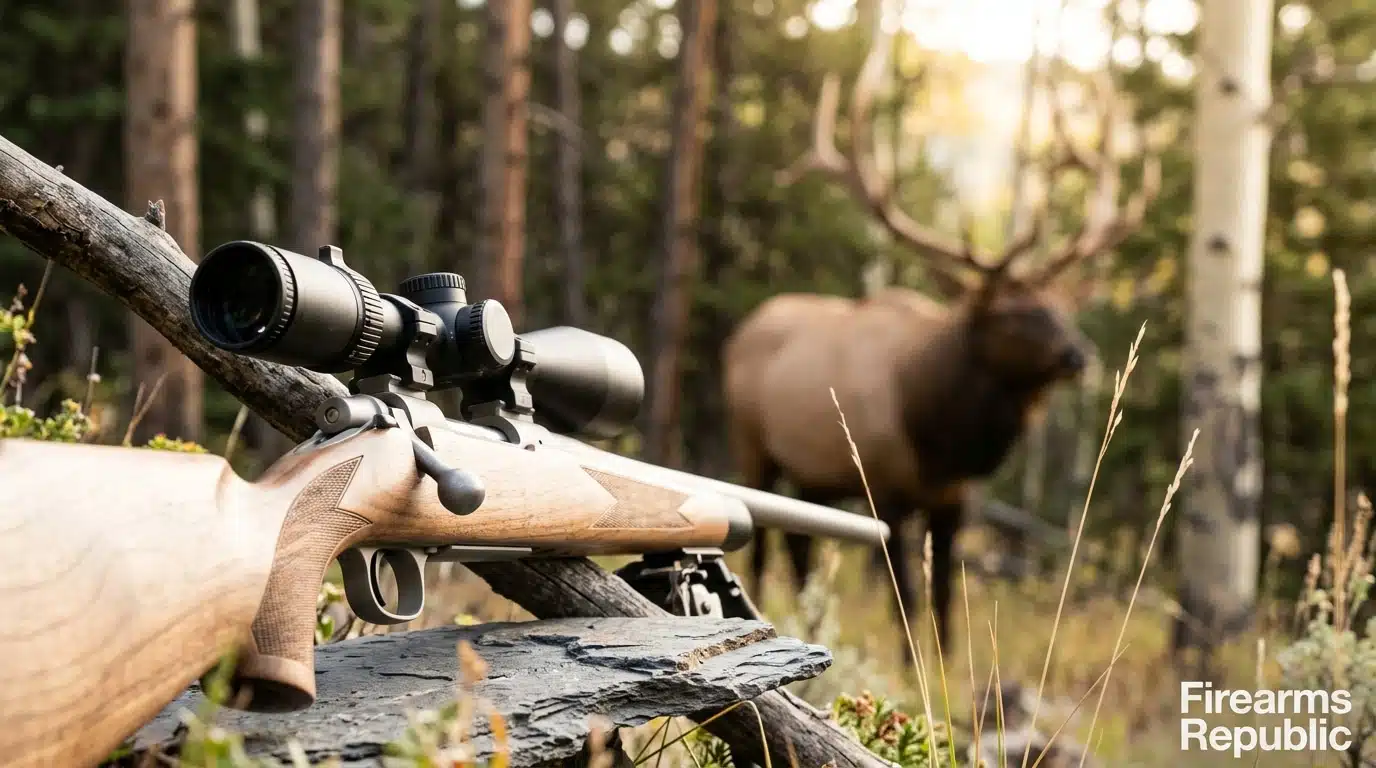
Elk hunting is where cartridge selection actually matters. Unlike whitetail deer hunting – where dozens of cartridges from .243 Win upward perform adequately – elk hunting creates genuine demands that separate capable cartridges from marginal ones. A mature bull elk weighs 700–1,100 lbs, is built with heavy bone structure, thick hide, and a will to cover ground after a shot that deer simply do not have. Shots in western elk country regularly stretch to 300–500 yards across open basins, down canyon walls, and across ridge tops where wind can run 15–25 mph. And unlike deer hunting, where a hunter might take one or two shots per season at known distances from a stand, elk hunting often means a single shot opportunity after days of physical effort at an unconfirmed distance with a body position dictated by terrain rather than a comfortable shooting bench. The margin for error is smaller, the consequences of a wounded animal are more severe, and the cartridge you carry genuinely affects the outcome in ways that deer hunting does not. This guide covers what elk hunting actually demands, which cartridges meet those demands honestly, and which rifles deliver the accuracy and reliability needed for the most challenging big game hunt in North America.
What Elk Hunting Actually Demands From a Rifle
Before breaking down cartridges and rifles, establishing what the application requires – not what marketing materials suggest, but what experienced elk hunters and guides actually observe across thousands of shots – is essential.
Energy at impact: 1,500 ft-lbs is the commonly cited minimum for elk, but most experienced hunters and guides operate with a practical floor of 1,800–2,000 ft-lbs at the expected shot distance. The difference matters: a cartridge that carries 1,600 ft-lbs at 400 yards will kill elk on broadside shots, but a 700 lb bull hit slightly off-angle through heavy shoulder bone needs more. 2,000 ft-lbs provides margin. 2,400 ft-lbs provides comfort.
Bullet construction: This is non-negotiable for elk. Cup-and-core soft points that perform adequately on deer fail on elk at the ranges and angles that elk hunting produces. Bonded bullets – Federal Trophy Bonded, Nosler AccuBond, Hornady ELD-X – maintain core-jacket integrity through heavy bone and deliver full energy transfer to the vitals. Controlled-expansion monolithics (Barnes TTSX, Hornady CX, Federal Trophy Copper) provide the deepest penetration for tough angles. Do not hunt elk with premium deer bullets like the Hornady SST or Winchester Ballistic Silvertip – they are designed for fragmentation on deer, not deep penetration on elk.
Accuracy at field ranges: A hunting rifle that shoots 1 MOA from the bench but 2 MOA from a sitting position with shooting sticks at 300 yards is a 300-yard rifle, not a 600-yard rifle. Honest assessment of maximum effective field accuracy – not bench accuracy – defines real-world range limits. For most hunters who practice seasonally but are not dedicated long-range shooters, 300 yards is the honest ceiling from field positions without a rest. For hunters who train extensively in field positions, 500 yards is achievable.
Rifle reliability: An elk rifle that fails to extract a round after a cold night in a backcountry tent, or whose action freezes up in rain and mud, ends a hunt regardless of its ballistic merits. Bolt-action reliability under adverse conditions is a genuine consideration in western hunting environments where the rifle may be carried 10+ miles from the nearest vehicle.
Weight for carries: A 9.5 lb scoped rifle that feels comfortable at the range becomes a liability after mile 8 of a steep pack-in. Most serious western hunters target a complete scoped rifle weight of 7.5–9 lbs as the practical balance between durability, accuracy, and carry comfort over miles.
Best Cartridges for Elk Hunting
The Core Tier: Capable, Proven, and Widely Available
6.5 PRC – The most technically capable elk cartridge in the standard-magnum-action class at moderate recoil. The 143gr ELD-X at 2,960 fps carries 2,100+ ft-lbs at 500 yards and 1,600+ ft-lbs at 600 yards. Recoil at 15–17 ft-lbs is manageable for high-volume practice. The honest limitation is that 143gr at .264 caliber provides less penetration depth through heavy shoulder bone than .30-caliber bullets of comparable weight – shot placement discipline matters more with the 6.5 PRC than with cartridges above it. For elk hunters whose shots stay inside 400 yards with good angles, it is fully capable. See our 6.5 PRC Caliber Guide.
7mm PRC – The strongest argument for a modern elk cartridge at manageable recoil. The 175gr ELD-X at 2,975 fps carries 2,474 ft-lbs at 500 yards and 1,800+ ft-lbs at 700 yards. The .284 caliber bullet diameter and 175gr weight provide better penetration depth than the 6.5 PRC on heavy bone, and the BC advantage over the .300 Win Mag at comparable velocities means less wind drift at distance. Recoil at 22–24 ft-lbs is real but manageable. The strongest modern argument for an elk cartridge that is not a .300 Win Mag. See our 7mm PRC Caliber Guide.
7mm Remington Magnum – The historical elk cartridge of the western United States and still fully capable with modern 160–162gr loads. The 162gr ELD-X at 2,960 fps carries 2,200 ft-lbs at 400 yards. The limitation versus the 7mm PRC is the OAL constraint that prevents optimal seating of modern 175gr high-BC bullets – with 160–162gr loads the gap is modest. The advantage over the 7mm PRC is universal ammo availability: every sporting goods store in elk country stocks 7mm Rem Mag. See our 7mm Rem Mag Caliber Guide.
7mm-08 Remington – A capable close-range elk cartridge under specific conditions: shots inside 250 yards, broadside or slight quartering-to angles, quality 140–150gr bonded bullets. Most elk guides and experienced hunters consider it minimum adequate rather than confidently capable. For hunters who draw a tag and own a 7mm-08, it is usable. For hunters buying a new elk rifle, there is no reason to stop at 7mm-08 when the 6.5 PRC, 7mm PRC, or .308 Win provide more margin with comparable or lower recoil. See our 7mm-08 Remington Caliber Guide.
6.5 Creedmoor – Technically capable at close range with quality bullets but genuinely marginal for elk at distances that western elk hunting regularly produces. At 400 yards the 140gr ELD-X carries approximately 1,500 ft-lbs – approaching the lower bound of ethical confidence on a 700 lb bull that may not be broadside. Guides in serious elk country consistently report more follow-up shots and longer tracking jobs from 6.5 CM hunters than from those running larger cartridges. If 6.5 CM is your only rifle, use it with 143gr ELD-X, stay inside 300 yards, and prioritize perfect shot placement. If you are buying a dedicated elk rifle, choose something larger. See our 6.5 Creedmoor Caliber Guide.
The Standard Tier: Proven and Broadly Trusted
.308 Winchester – Minimum adequate for elk at moderate range with the right load. The 180gr AccuBond or Federal Trophy Bonded at 300 yards carries approximately 2,000 ft-lbs and provides adequate penetration with quality bullets on broadside shots. The limitation is that the .308 is loaded relatively conservatively compared to modern alternatives and its terminal performance on large elk at extended ranges is where its guides begin specifying something larger. For hunters who own a quality .308 and are hunting in close country (timber, thick brush, inside 300 yards), it is a legitimate choice. See our .308 Winchester Caliber Guide.
.30-06 Springfield – The historical elk cartridge that built the tradition, and still fully capable in 2025. The 180gr AccuBond or 200gr Partition provides the combination of penetration and energy that elk hunting demands across a wide range of shot angles. At 400 yards the 180gr ELD-X carries approximately 1,877 ft-lbs – above the practical floor for elk at that distance. The 200–220gr heavy bullet options for thick timber and close-range bear work give the .30-06 versatility no short-action cartridge matches. Widely available everywhere elk hunters go. See our .30-06 Springfield Caliber Guide.
.300 Winchester Magnum – The benchmark elk cartridge by which others are measured. The 180gr ELD-X at 2,960 fps delivers 2,393 ft-lbs at 500 yards and 1,800+ ft-lbs at 700 yards. The .30-caliber bullet diameter provides wide wound channels through the vitals and the 200–220gr bullet options handle the worst shot angles on large bulls. Guides worldwide trust it above all others because it works across the full range of conditions and shot angles that elk hunting produces. Recoil at 25–28 ft-lbs requires practice commitment. See our .300 Win Mag Caliber Guide.
Comparison Table: Elk Cartridges at 400 Yards
| Cartridge | Load | 400 yd Energy | 400 yd Wind (10 mph) | Recoil (9 lb rifle) | Availability |
|---|---|---|---|---|---|
| 6.5 CM | 140gr ELD-X | ~1,500 ft-lbs | 8.5″ | 9–11 ft-lbs | Excellent |
| 6.5 PRC | 143gr ELD-X | ~2,100 ft-lbs | 7.2″ | 15–17 ft-lbs | Good |
| 7mm-08 | 140gr ELD-X | ~1,350 ft-lbs | 8.2″ | 11–13 ft-lbs | Good |
| 7mm Rem Mag | 162gr ELD-X | ~2,200 ft-lbs | 7.5″ | 20–22 ft-lbs | Excellent |
| 7mm PRC | 175gr ELD-X | ~2,474 ft-lbs | 6.4″ | 22–24 ft-lbs | Good |
| .308 Win | 180gr AccuBond | ~1,900 ft-lbs | 9.5″ | 14–16 ft-lbs | Excellent |
| .30-06 | 180gr ELD-X | ~1,877 ft-lbs | 9.5″ | 18–20 ft-lbs | Excellent |
| .300 Win Mag | 180gr ELD-X | ~2,393 ft-lbs | 8.0″ | 25–28 ft-lbs | Excellent |
Best Elk Hunting Rifles by Category
Best Value Elk Rifle: Ruger American in 6.5 PRC or .300 Win Mag ($500–$650)
The Ruger American is the most capable elk rifle per dollar available. AICS-compatible magazines, a threaded barrel, the Ruger Marksman Adjustable trigger, and consistent 0.7–0.9 MOA accuracy make it a legitimate elk tool at a price that leaves budget for quality glass. In 6.5 PRC it handles elk to 500 yards with confidence. In .300 Win Mag it covers every North American big game scenario. The synthetic stock handles mountain weather without swelling or shifting point of impact. Not a refined experience – the trigger is the standout – but it shoots elk confidently at a price most hunters can justify. See our Ruger American Complete Guide.
Best Mid-Range Elk Rifle: Bergara B-14 Wilderness or B-14 Ridgeback ($850–$1,300)
Bergara’s sub-MOA guarantee means every B-14 leaves the factory capable of 0.75 MOA with factory ammo – a standard most rifles at twice the price aspire to. The Wilderness adds a weather-resistant Softtouch stock and Cerakote finish suited to the conditions elk hunting produces. In 6.5 PRC, 7mm PRC, 7mm Rem Mag, or .300 Win Mag, it delivers the accuracy and terminal performance combination that western elk hunters need. The Ridgeback adds an adjustable stock for precision-oriented hunters. See our Bergara B-14 Series Guide.
Best Factory Trigger: Tikka T3x in 6.5 PRC or 7mm Rem Mag ($900–$1,000)
No production elk rifle has a better factory trigger than the Tikka T3x. The two-stage trigger breaks at approximately 2 lbs with no perceptible creep – a benchmark that competes with rifles costing $500 more. The 60-degree bolt lift cycles smoothly under field conditions, the stock fits most adult hunters well, and the detachable magazine is a genuine hunting-use practical feature. In 6.5 PRC the T3x handles elk to 500 yards; in 7mm Rem Mag it is a universal western hunting rifle. The honest limitation is aftermarket depth – Tikka’s proprietary stock dimensions mean fewer custom stock options than Remington 700-footprint rifles. See our Tikka T3x Complete Guide.
Best Mountain Elk Rifle: Christensen Arms Mesa or Ridgeline ($1,300–$2,000)
For elk hunters who cover serious miles – pack-in hunts in Colorado’s Flat Tops, Idaho’s Frank Church Wilderness, or Montana’s Bob Marshall – rifle weight is a practical consideration. The Christensen Mesa with carbon fiber barrel runs 6.5 lbs bare in 6.5 PRC or 7mm PRC. The Ridgeline FFT at 5.5 lbs bare is among the lightest full-capability elk rifles produced. Carbon barrels run cooler between shots and resist heat-induced throat erosion better in high-volume shooting scenarios. Sub-MOA accuracy guarantee. The trade-off is recoil – 22–24 ft-lbs of 7mm PRC recoil in a 5.5 lb rifle is genuinely sharp and a quality muzzle brake is effectively mandatory for comfortable range sessions. Without a brake, shooters develop flinches that undermine the precision these rifles are capable of.
Best Semi-Custom Elk Rifle: Bergara HMR Pro or Ruger Precision in .300 Win Mag ($1,400–$1,600)
For hunters who also compete in precision rifle formats or want a chassis-style platform for their elk rifle, the Bergara HMR Pro and Ruger Precision Rifle bring adjustable stocks, AICS magazines, and sub-MOA accuracy to the elk hunting application. In .300 Win Mag these are rifles that shoot well past 800 yards on steel and carry elk-killing energy to 600 yards. The weight penalty – 10–11 lbs before optics – is real for backcountry use but acceptable for hunters who drive to trailheads and hunt within reasonable pack-in distances.
Best Traditional Elk Rifle: Winchester Model 70 in .30-06 or .300 Win Mag ($900–$1,100)
The Winchester Model 70’s controlled-round-feed action has a following among elk hunters for a specific reason: it works. The controlled-feed claw extractor grips the case from the moment it leaves the magazine, preventing double feeds and extraction failures under field conditions that can defeat push-feed actions with dirty or cold chambers. The three-position safety allows carrying with a round chambered and the action on safe – the practical carry mode for active elk hunting. In .30-06 or .300 Win Mag with a Leupold VX-5HD or similar scope, this is a complete elk rifle that requires no apology to any more modern design.
Best Elk Hunting Ammunition
For most situations – 6.5 PRC: Hornady 143gr ELD-X ($55–$60/20 rounds). Controlled expansion, high BC, and velocity that ensures reliable expansion at extended ranges.
For most situations – 7mm PRC: Hornady 175gr ELD-X ($58–$65/20 rounds). The best combination of energy, BC, and terminal performance in any standard hunting load.
For most situations – 7mm Rem Mag: Nosler 160gr AccuBond ($55–$65/20 rounds) or Hornady 162gr ELD-X ($50–$58/20 rounds). Both have extensive elk hunting track records.
For most situations – .300 Win Mag: Federal Premium 180gr Trophy Bonded ($60–$70/20 rounds) or Nosler 180gr AccuBond ($58–$68/20 rounds). These are the loads elk guides specify by name.
For tough angles and heavy bone: Hornady 160gr CX (7mm) or Federal 180gr Trophy Bonded (.300 Win Mag). Monolithic and bonded construction for shots that require deep, straight penetration through shoulder bone.
Bullet construction reminder: Avoid using any bullet marketed as a deer or varmint load on elk – the SST, Ballistic Tip, and V-MAX are designed to fragment on deer and will fail to penetrate adequately on large elk through heavy structure. Use ELD-X, AccuBond, Trophy Bonded, or Barnes TTSX for elk.
Optics for Elk Hunting
The scope matters as much as the rifle for elk hunting. A $1,500 rifle with a $200 scope underperforms a $700 rifle with a $600 scope in the conditions elk hunting produces – low light at first and last shooting hours, variable distances from 80 to 500 yards, and the need to quickly range and confirm an animal before the opportunity passes.
For moderate-range hunting (inside 350 yards):
A quality 3–12x or 3–15x variable with a second focal plane reticle handles most elk hunting situations. Leupold VX-5HD 3–15×44 ($600–$700) is the benchmark – exceptional glass clarity in low light, a zero-stop turret for quick confirmation, and Leupold’s reliability track record in mountain conditions. Vortex Viper HS LR 4–16×50 ($450–$550) provides comparable performance at lower cost. Zeiss Conquest V4 4–16×44 ($700–$800) is the premium mid-range choice for hunters who prioritize glass quality.
For long-range hunting (350–600 yards):
A 4–20x or 5–25x scope with a first focal plane reticle and exposed elevation turret is the appropriate step up. First focal plane reticles maintain accurate subtension at any magnification – relevant for ranging and holdover without the mental arithmetic that second focal plane reticles require at non-maximum magnification. Nightforce SHV 4–14×56 ($600–$700) and ATACR 5–25×56 ($2,000–$2,200) represent the mid-tier to premium options. Vortex Razor HD Gen III 5–27×56 ($2,500) is the high-performance choice for hunters who want competition-grade glass in a hunting-weight package. See our Best Scopes for Long-Range Shooting guide and Best Hunting Scopes guide for full optic recommendations.
Rangefinder: Non-negotiable for elk hunting past 200 yards. Laser rangefinders – Leica Rangemaster CRF 2700-B ($500–$600), Vortex Fury HD 5000 ($500–$550), or Sig Sauer Kilo 3000BDX ($400–$500) – confirm distance before every shot past 200 yards. Estimating distance by eye is a consistent source of misses and wounding shots in open western terrain where perspective is distorted by scale.
Best Applications Within Elk Hunting
Close-Range Timber Elk Hunting (Under 200 Yards)
Elk hunting in dense timber – the lodgepole pine country of Idaho and Wyoming, the aspen groves of Colorado, the dark timber of the Bob Marshall – produces short, fast shooting opportunities where 80–150 yard shots are standard and the rifle must handle quickly in brush. In this context, cartridge selection matters less than rifle handling. A Tikka T3x Lite in .30-06 at 6.1 lbs is fast to shoulder, points naturally, and carries 180gr AccuBond that kills elk at 150 yards with any reasonable shot placement. The .300 Win Mag is more rifle than the situation requires; the 6.5 CM is adequate but offers no advantage over the .30-06 at these ranges.
Open Basin and Clear-Cut Hunting (200–400 Yards)
The most common elk hunting scenario in the West: glassing a basin or clear-cut, spotting elk at 200–400 yards, and making a deliberate shot from a field position with shooting sticks or a pack rest. This is the scenario that defines which cartridges are confidently capable vs. marginally adequate. The 6.5 PRC, 7mm PRC, 7mm Rem Mag, and .300 Win Mag all operate with genuine confidence in this range. The 6.5 CM and 7mm-08 require more careful shot selection and range management.
Over-the-Canyon Long-Range Hunting (400–600 Yards)
In canyon country and open high basins, shots across drainages at 400–600 yards are not uncommon for prepared hunters. This is the scenario where cartridge selection matters most – the 7mm PRC and .300 Win Mag provide genuine ethical confidence at 500+ yards that the 6.5 CM and .308 Win cannot match. At 500 yards the 7mm PRC carries 2,200+ ft-lbs and the .300 Win Mag carries 2,100+ ft-lbs – both above the 2,000 ft-lb threshold that provides margin for imperfect shots. At 500 yards the 6.5 CM carries approximately 1,300 ft-lbs – workable on a perfect broadside shot, marginal on a quartering angle. The extra energy of larger cartridges earns its keep at these distances. Our Elk Hunting Caliber Comparison covers this range tier in specific detail.
Backcountry Pack-In Elk Hunting
Multi-day backcountry elk hunts in the Frank Church Wilderness, Eagles Cap Wilderness, or similar remote areas require rifles that balance weight, durability, and capability in a package that can be carried 8–12 miles per day for multiple days. The Christensen Arms Mesa or Ridgeline FFT in 6.5 PRC or 7mm PRC – 6.5–7 lbs scoped – represents the practical optimum. Carbon barrels and stocks minimize weight without sacrificing accuracy. A brake is essential on the lightest configurations. The tradeoff between sufficient cartridge capability (minimum 6.5 PRC for backcountry where a second shot opportunity may not exist) and manageable carry weight is the central equipment decision for these hunts. See our Mountain / Backcountry Hunting Rifles guide for full pack-in setup analysis.
What Guides and Outfitters Actually Specify
The opinions of experienced elk guides who see the results of hundreds of hunter-elk interactions over many seasons provide calibration that no ballistic table can fully replace. Common patterns from guides in Wyoming, Montana, Colorado, and Idaho:
What they consistently trust: .300 Win Mag, 7mm Rem Mag, .30-06 with quality loads, and increasingly 7mm PRC. These cartridges produce consistent first-shot kills across the range of shot angles, distances, and conditions elk hunting produces.
What they consider minimum adequate: 6.5 PRC with quality bonded bullets inside 400 yards. .308 Win inside 300 yards with 180gr bonded loads. 7mm-08 inside 250 yards with careful shot selection.
What they are honest about: The 6.5 CM on elk requires more follow-up shots and longer tracking jobs than cartridges above it, particularly past 300 yards and on shots that are not perfectly placed. This is not condemnation – it is the honest observation of people who track wounded elk for a living.
What they recommend for new elk hunters: Start with a .30-06 or 7mm Rem Mag that the hunter can shoot accurately and practice with regularly. Recoil management and shot placement with a familiar cartridge outperforms unfamiliar precision with a theoretically superior one.
Frequently Asked Questions
Q: Is 6.5 Creedmoor enough for elk?
A: It is technically capable under specific conditions – shots inside 300 yards, broadside or slight quartering-to angles, quality bonded bullets, and precise shot placement through the heart-lung zone. Where it falls short relative to larger cartridges is energy margin at distance and penetration depth through heavy shoulder bone on quartering shots. Guides in serious elk country consistently report more follow-up shots and wounded animals from 6.5 CM users than from hunters running 7mm and .30-caliber magnums. If you own a 6.5 CM, use 143gr ELD-X, stay inside 300 yards, and be disciplined about shot angles. If you are buying a dedicated elk rifle, the 6.5 PRC provides significantly more confidence with comparable recoil increase.
Q: What is the minimum cartridge for elk?
A: Most experienced guides and elk hunters cite .30-06 Springfield or 7mm Rem Mag as practical minimums for confident elk hunting across the range of conditions western hunting produces. The .308 Win with 180gr bonded loads inside 300 yards is adequate. The 6.5 PRC inside 400 yards is capable. Anything smaller requires such specific conditions (close range, perfect angles) that calling it a minimum without caveats is misleading.
Q: What is the best elk rifle for under $1,000?
A: The Tikka T3x in 6.5 PRC or 7mm Rem Mag at $900–$950 is the strongest recommendation in this budget – best factory trigger available, consistent sub-MOA accuracy, and detachable magazine. The Bergara B-14 Hunter in 7mm Rem Mag or .300 Win Mag at $750–$850 is the alternative if Tikka availability is an issue in your area. Both outperform their price points meaningfully and are complete elk rifles without requiring any upgrades.
Q: How far can I shoot elk ethically?
A: The honest answer is the maximum distance at which you can place a shot in a 6-inch circle from a field position – kneeling or sitting with shooting sticks, simulating actual hunting conditions – 90% of the time. For most hunters who practice seasonally, this is 200–300 yards. For hunters who train extensively in field positions with their hunting rifle and load, 400–500 yards is achievable. The cartridge’s capability at distance is irrelevant if the shooter’s field accuracy does not match it. Most wounded elk are wounded because the hunter attempted a shot beyond their practical field accuracy, not because the cartridge lacked power.
Q: Do I need a muzzle brake on my elk rifle?
A: In a rifle weighing 8.5 lbs or more with a .30-06 or 7mm Rem Mag, most adult hunters manage recoil without a brake for the shot volumes hunting involves. In a lightweight 6.5–7 lb mountain rifle with a 7mm PRC or .300 Win Mag, a quality brake is strongly recommended for comfortable range sessions that build the accuracy habits that clean kills require. The noise amplification of a brake requires hearing protection for nearby hunting partners – account for this in your setup.
Q: What bullet should I use for elk with a .300 Win Mag?
A: For most elk hunting conditions, Federal Premium 180gr Trophy Bonded or Nosler 180gr AccuBond are the first recommendations – both have extensive track records on elk and provide reliable performance across the range of shot angles hunting produces. For hunters in dense timber who may face close-range shots through heavy structure, the 200gr Federal Trophy Bonded or 200gr Nosler Partition provide maximum penetration depth. Avoid lighter 150–165gr .300 Win Mag loads for elk – the high velocity of the .300 Win Mag with light bullets produces fragmentation that reduces penetration below what elk-class game requires.